Kostaive
Italy
Table of Contents
- Patient Information Leaflet: Information for the User
- Kostaive powder for dispersion for injectable preparation
- 1. What Kostaive is and what it is used for
- 2. What you need to know before you are given Kostaive
- 3. How Kostaive is administered
- 4. Possible side effects
- 5. How to store Kostaive
- 6. Package contents and other information
- The following information is intended exclusively for healthcare professionals:
Patient Information Leaflet: Information for the User
Kostaive powder for dispersion for injectable preparation
COVID-19 mRNA vaccine
zapomeran
This medicinal product is subject to additional monitoring. This will allow for the rapid identification of new safety information. You can help by reporting any side effects you experience while receiving this medicine. See the end of section 4 for information on how to report side effects.
Please read this leaflet carefully before you are given this vaccine, as it contains important information for you.
- Keep this leaflet. You may need to read it again.
- If you have any questions, consult your doctor, pharmacist, or nurse.
- If you experience any side effect, including those not listed in this leaflet, tell your doctor, pharmacist, or nurse. See section 4.
Contents of this leaflet
- What Kostaive is and what it is used for
- What you need to know before you are given Kostaive
- How Kostaive is administered
- Possible side effects
- How to store Kostaive
- Contents of the pack and other information
1. What Kostaive is and what it is used for
Kostaive is a vaccine that helps protect adults aged 18 years and older against COVID‑19 caused by SARS-CoV-2.
Kostaive works by preparing the body to defend itself against COVID-19. It contains a molecule called sa-mRNA that carries instructions for making copies of the spike protein. This is a protein found on the surface of the SARS-CoV-2 virus, which the virus needs to enter the body's cells.
When a person is given the vaccine, some of their cells will read the sa-mRNA instructions and temporarily produce the spike protein. The person's immune system will then recognize this protein as foreign and produce antibodies and activate T lymphocytes (white blood cells) to attack it.
If, in the future, the person comes into contact with SARS-CoV-2, their immune system will recognize it and be ready to defend the body against it.
Since Kostaive does not contain the virus to produce immunity, it cannot cause COVID-19.
The use of this vaccine should be in accordance with official recommendations.
2. What you need to know before you are given Kostaive
The vaccine must not be administered
- if you are allergic to the active substance or to any of the other ingredients of this vaccine (listed in section 6).
Warnings and precautions
Talk to your doctor, pharmacist, or nurse before you are given the vaccine if:
- you have ever had a severe allergic reaction or breathing problems after any other vaccine injection or after being given Kostaive in the past.
- you feel anxious about the vaccination process or have ever fainted after an injection.
- you have a high fever or a serious infection; however, you may still be able to receive the vaccine if you have a mild fever or a minor upper respiratory tract infection such as a cold.
- you have a bleeding disorder, bruise easily, or are taking a medication to prevent blood clots.
- you have a weakened immune system due to a disease such as HIV infection or due to medications such as corticosteroids that affect the immune system.
If any of the above conditions apply to you (or if you are unsure), speak with your doctor,
pharmacist, or nurse before receiving Kostaive.
Following vaccination with other anti-COVID-19 vaccines, there is an increased risk of myocarditis
(inflammation of the heart muscle) and pericarditis (inflammation of the outer lining of the heart).
These conditions may develop within a few days after vaccination and have occurred mainly within
14 days. After vaccination, you should be alert for signs of myocarditis and pericarditis, such as
shortness of breath, palpitations, and chest pain, and seek immediate medical attention if any of
these symptoms occur.
Children and adolescents
Kostaive is not recommended for children under 18 years of age. Currently, there is insufficient
information available on the use of Kostaive in children and adolescents under 18 years of age.
Other medicines and Kostaive
Tell your doctor or pharmacist if you are taking, have recently taken, or might take any other
medicines, or if you have recently been given any other vaccines.
Pregnancy and breastfeeding
If you are pregnant, suspect you may be pregnant, or are breastfeeding, ask your doctor or
pharmacist for advice before you are given this vaccine.
Data on the use of this vaccine in pregnant women are limited.
Kostaive may be administered during breastfeeding.
Driving and using machines
Some of the side effects of Kostaive listed in section 4 (Possible side effects) may temporarily
reduce your ability to drive or operate machinery. Wait until the effects of the vaccine have
subsided before driving or using machinery.
Kostaive contains potassium and sodium
This vaccine contains less than 1 mmol of potassium (39 mg) per dose, i.e., essentially “potassium-free”.
This vaccine contains less than 1 mmol of sodium (23 mg) per dose, i.e., essentially “sodium-free”.
3. How Kostaive is administered
Kostaive is administered as a single 0.5 ml injection into a muscle in the upper arm.
If you have previously been vaccinated with a COVID-19 vaccine, you should receive a dose of Kostaive at least 5 months after your most recent dose.
If you have any questions about the use of Kostaive, consult your doctor, pharmacist, or nurse.
4. Possible side effects
Like all medicines, this vaccine can cause side effects, although not everyone experiences them.
Very rare side effects: may affect up to 1 in 10,000 people
- anaphylaxis (sudden and severe allergic reaction with symptoms such as breathing difficulties, swelling, mental confusion, rapid heartbeat, sweating and loss of consciousness)
Seek urgent medical assistance if you experience any symptoms of anaphylaxis.
Contact your doctor or nurse if you develop any other side effects. These may include:
Very common side effects: may affect more than 1 in 10 people
- pain at the injection site
- tenderness at the injection site
- feeling tired (fatigue)
- chills
- fever
- joint pain (arthralgia)
- muscle pain (myalgia)
- headache
- dizziness.
Common side effects: may affect up to 1 in 10 people
- diarrhoea
- feeling unwell (nausea)
- vomiting
- hardening of the skin at the injection site
- swelling at the injection site
- redness at the injection site
- itching at the injection site.
Uncommon side effects: may affect up to 1 in 100 people
- allergic reactions (urticaria and/or skin rash).
Reporting of side effects
If you experience any side effect, including those not listed in this leaflet, talk to your doctor, pharmacist or nurse.
You can also report side effects directly through the national reporting system listed in Annex V. By reporting side effects, you can help provide more information on the safety of this vaccine.
5. How to store Kostaive
Keep this medicine out of the sight and reach of children.
The following information on storage, expiration, use, and handling is intended for healthcare
professionals.
Do not use this medicine after the expiry date stated on the carton and label after "Exp." The expiry date refers to the last day of that month.
Store unopened vials in a freezer at a temperature between -15 °C and -25 °C.
Keep in the original packaging to protect the medicine from light. Vials may be stored at room temperature (up to 25 °C) for a maximum of 4 hours prior to reconstitution.
After preparation, reconstituted vaccine vials or filled syringes must be stored in a refrigerator or at room temperature (from 2 °C to 25 °C) prior to administration (including during transport) and must be administered within 6 hours after initial piercing of the vial stopper.
Thawed or reconstituted vials may be handled under normal light conditions.
Once thawed or reconstituted, the vaccine must not be refrozen.
6. Package contents and other information
What Kostaive contains
- The active substance is a self-amplifying messenger RNA (sa-mRNA) called zapomeran.
- It is a multidose vial which, after reconstitution, contains 16 doses of 0.5 ml each.
- One dose (0.5 ml) contains 5 micrograms of zapomeran (encapsulated in lipid nanoparticles).
- The other components are: di(pentadecan-8-yl)-4,4’-((((3-(dimethylamino)propyl)thio)carbonyl)azanediyl)dibutyrate (ATX-126), cholesterol, 1,2-distearoyl-sn-glycero-3-phosphocholine (distearoyl-sn-glycero-3-phosphocholine, DSPC), 1,2-dimyristoyl-rac-glycero-3-methoxypolyethylene glycol-2000 (dimyristoyl-rac-glycero-3-methoxypolyethylene glycol-2000, PEG2000-DMG), sucrose, potassium sorbate, sodium chloride, trometamol, poloxamer 188 (containing the antioxidant butylated hydroxytoluene). See section 2 “Kostaive contains potassium and sodium”.
Description of the appearance of Kostaive and package contents
Kostaive is a lyophilized powder/paste, white to off-white in colour, supplied in a glass vial with a rubber stopper and an aluminium seal.
After reconstitution, the vaccine is a white to off-white opalescent suspension (pH: 7.5–8.5). Each vial contains 16 doses of 0.5 ml.
Pack size: 20 multidose vials.
Marketing Authorisation Holder and Manufacturer
Seqirus Netherlands B.V.
Paasheuvelweg 28
1105 BJ Amsterdam
The Netherlands
Manufacturer
MIAS Pharma Limited
Suite 1 First Floor
Stafford House
Strand Road
Portmarnock
Co. Dublin
D13 WC83
Ireland
More detailed information on this medicinal product is available on the website of the European Medicines Agency: https://www.ema.europa.eu.
The following information is intended exclusively for healthcare professionals:
A single dose of 0.5 ml.
For individuals previously vaccinated with a COVID-19 vaccine, Kostaive must be
administered at least 5 months after the most recent dose.
Traceability
In order to improve the traceability of biological medicinal products, the name and batch number of the
administered medicinal product must be clearly documented.
Instructions for handling
Kostaive must be prepared by a healthcare professional using an aseptic technique to ensure
the sterility of the prepared dispersion.
- Use ONLY 10 ml of sterile 9 mg/ml (0.9%) sodium chloride injectable solution for reconstitution.
After reconstitution, each vial contains 16 doses of 0.5 ml.
Withdraw 0.5 ml of vaccine into single-use syringes.
- Each dose must contain 0.5 ml of reconstituted Kostaive.
- If the remaining amount of vaccine in the vial cannot provide a complete 0.5 ml dose, do not administer the remainder. Instead, discard the vial and any residual volume.
- Do not pool excess vaccine from multiple vials.
- After preparation, filled syringes must be stored refrigerated or at room temperature (from 2 °C to 25 °C) prior to administration (including transport during this period) and must be administered within 6 hours of the initial puncture of the vial stopper.
- Reconstituted vaccine must be discarded after 6 hours.
| Preparation of individual doses of Kostaive powder for dispersion for injectable preparation | |
| STEP A. Visual inspection and temperature stabilization of vials 1. Allow the vial to reach room temperature for at least one hour. Vials may be stored at room temperature (up to 25 °C) for a maximum of 4 hours prior to reconstitution. 2. Visually inspect the container closure for discoloration and gross defects/damage (e.g., cracks, glass chips, loose caps, missing stoppers, etc.). • The vial should contain a white to off-white solid. DO NOT USE if container damage or other defects are present. DO NOT USE if the unopened vial has been at room temperature for more than 4 hours. | 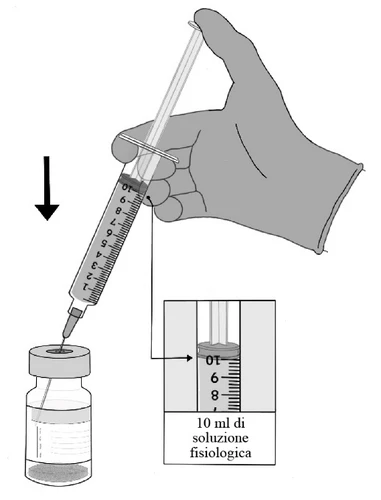 |
| STEP B. Adding saline solution to the vaccine 1. Reconstitution must be performed immediately after completion of temperature stabilization. 2. Obtain an injectable solution (saline) of sodium chloride 9 mg/ml (0.9%). Using a new sterile 10 ml syringe and a 23G needle, withdraw 10 ml of injectable sodium chloride solution 9 mg/ml (0.9%). 3. Remove the removable cap from the vial. 4. Use an alcohol swab on the vial stopper. To ensure addition of exactly 10 ml of injectable sodium chloride solution 9 mg/ml (0.9%), the syringe must not be removed from the vial during steps 5–8. 5. Pierce the stopper with the needle of the saline syringe. • Record the date and time of initial stopper puncture and the time by which the vaccine must be discarded. (Note: The vaccine must be administered within 6 hours of this initial stopper puncture.) 6. Slowly add half (5 ml) of the 10 ml of injectable sodium chloride solution 9 mg/ml (0.9%) into the vial along the side wall. 7. Equalize vial pressure by withdrawing approximately 3 ml of air from the vial into the saline syringe, keeping the needle above the liquid. 8. For the second and third additions of injectable sodium chloride solution 9 mg/ml (0.9%), add 2 to 3 ml each time, directing the flow of solution onto the inner wall of the product vial. • To equalize vial pressure, perform each addition with air withdrawal from the vial using the saline syringe. Repeat as necessary to complete addition of all 10 ml of injectable sodium chloride solution 9 mg/ml (0.9%). Do not add more than 10 ml of injectable sodium chloride solution 9 mg/ml (0.9%). | |
Preparation of individual doses of Kostaive 5 micrograms/dose (0.5 ml) powder for dispersion for injectable preparation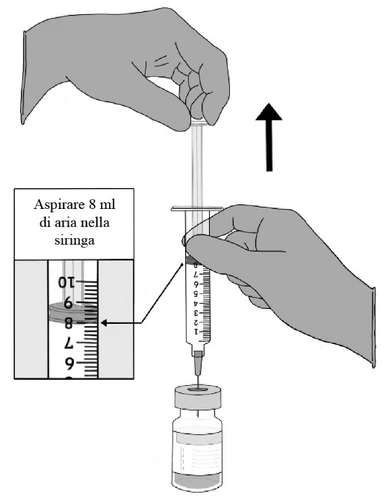 | |
| STEP C. Equalizing vial pressure 1. After completing the addition of injectable sodium chloride solution 9 mg/ml (0.9%), equalize pressure before removing the needle from the vial by withdrawing air into the 8 ml mark of the empty saline syringe. 2. Carefully adjust the needle position so that it remains above the solution (to avoid accidental withdrawal of reconstituted vaccine). 3. Remove the empty saline syringe and needle from the vial and discard them. | |
| STEP D. Mixing and visual inspection of reconstituted vaccine 1. Gently invert the vial repeatedly for at least 1 minute until the solid is completely reconstituted. • Do not shake or vortex. • Avoid foam formation. 2. Visually inspect the vaccine vial for particulate matter and discoloration. The liquid should be a white to off-white opalescent suspension. • DO NOT USE if particulate matter or discoloration is observed. 3. Reconstituted vaccine vials or filled syringes must be stored refrigerated or at room temperature (2 °C to 25 °C) prior to administration and must be used within 6 hours of initial stopper puncture. | 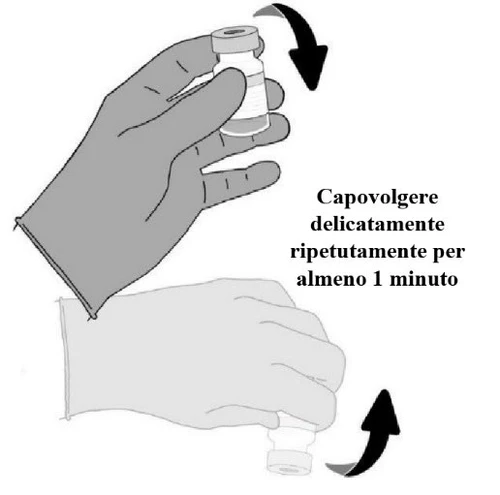 |
| STEP E. Syringe preparation 1. Ensure no air bubbles are present, then withdraw 0.5 ml of vaccine using a sterile 1 ml syringe. 2. Ensure no air bubbles are present. 3. Record the date and time of initial stopper puncture. • Each filled syringe will be used for one dose. • Store filled syringes refrigerated or at room temperature (2 °C to 25 °C) prior to administration. • Each syringe should be used as soon as possible, but must be used within 6 hours of initial stopper puncture. | 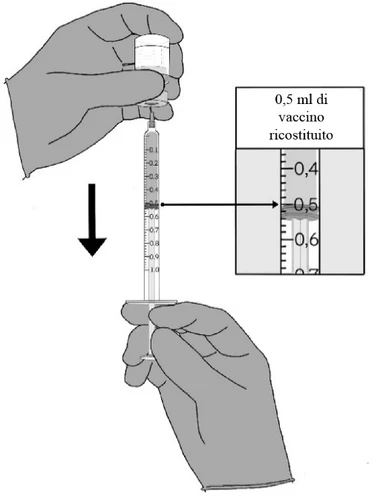 |
Disposal
Unused medicine and waste derived from this medicine must be disposed of in accordance with
local regulations.