Kigabeq
Italy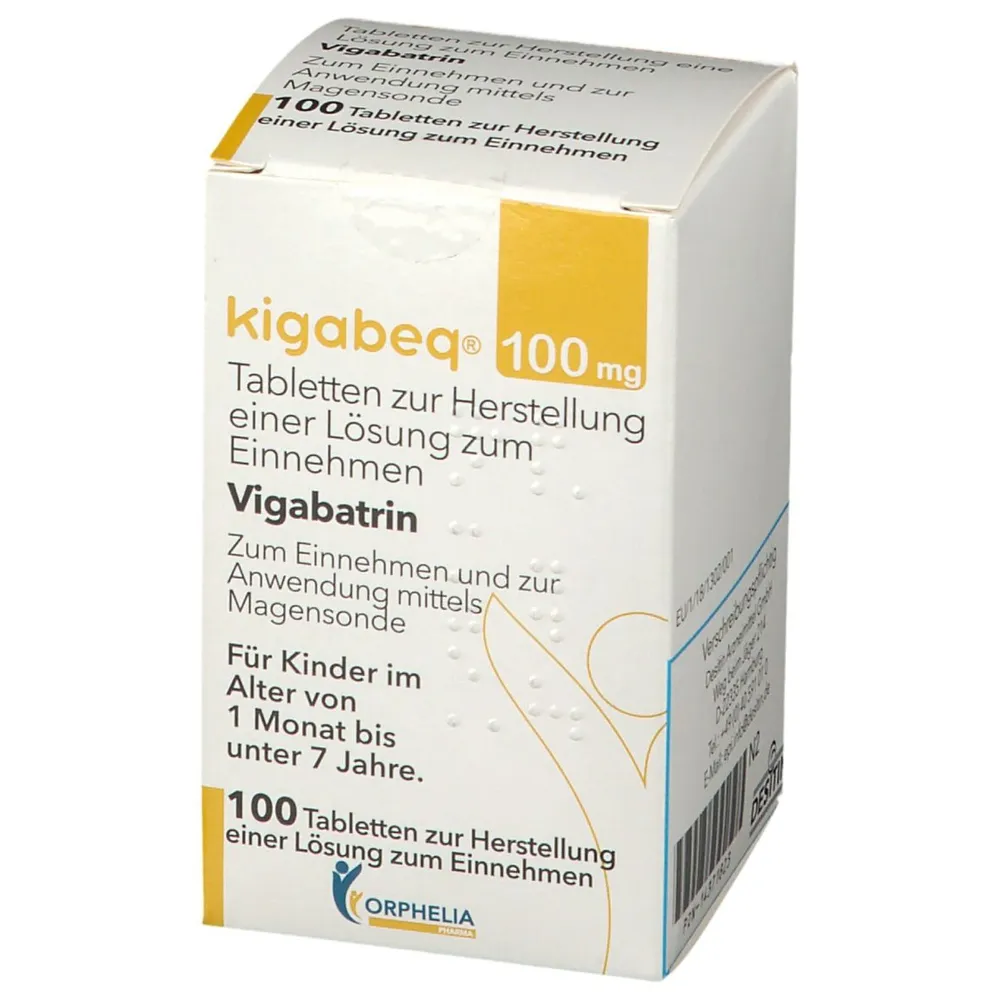
Table of Contents
- Patient Information Leaflet: Information for the User
- Kigabeq 100 mg dispersible tablets
- 1. What Kigabeq is and what it is used for
- 2. What you should know before your child takes Kigabeq
- 3. How to administer Kigabeq
- 4. Possible side effects
- 5. How to store Kigabeq
- 6. Package contents and other information
Patient Information Leaflet: Information for the User
Kigabeq 100 mg dispersible tablets
For children from 1 month of age to less than 7 years
Kigabeq 500 mg dispersible tablets
For children from 1 month of age to less than 7 years
vigabatrin
Please read this leaflet carefully before giving this medicine to your child, as it contains important information.
- Keep this leaflet. You may need to read it again.
- If you have any questions, ask your doctor or pharmacist.
- This medicine has been prescribed for your child. Do not give it to other people, even if their symptoms are the same as your child’s, as it could be harmful.
- If your child experiences any side effects, including those not listed in this leaflet, speak to your doctor or pharmacist. See section 4.
Contents of this leaflet
- What Kigabeq is and what it is used for
- What you need to know before your child takes Kigabeq
- How to give Kigabeq
- Possible side effects
- How to store Kigabeq
- Contents of the pack and other information
1. What Kigabeq is and what it is used for
Kigabeq contains vigabatrin and is used for the treatment of infants and children from 1 month of age up to less than 7 years. It is used to treat infantile spasms (West syndrome) or, in combination with other antiepileptic medicines, to treat partial seizures not adequately controlled by conventional therapy.
2. What you should know before your child takes Kigabeq
Do not administer Kigabeq:
- if your child is allergic to vigabatrin or to any of the other ingredients of this medicine (listed in section 6).
Warnings and precautions
Talk to your child’s doctor before administering Kigabeq if your child:
- has suffered or is currently suffering from depression or any other psychiatric disorder
- has had kidney problems, as they may develop symptoms such as sedation or confusion
- has had eye problems.
During treatment with vigabatrin, loss of visual field (loss of side vision in your child’s field of vision) may occur. You should discuss this possibility with the doctor before your child starts treatment, and the doctor will explain how to recognize this adverse effect.
This loss of visual field can be severe and permanent, and therefore must be diagnosed early to prevent progression. Worsening of visual field loss may continue even after stopping treatment. It is important that you immediately report to the doctor if any of these vision changes occur in your child. The doctor will examine your child’s visual field before starting treatment with vigabatrin and will continue regular monitoring throughout treatment.
If your child experiences symptoms such as drowsiness, reduced level of consciousness and movement (stupor), or confusion, inform the doctor, who may reduce the dose or discontinue treatment with Kigabeq.
A small number of people treated with antiepileptic medicines such as vigabatrin have had thoughts of self-harm or suicide. Be alert for symptoms suggesting such thoughts: sleep disturbances, loss of appetite or weight, social withdrawal, loss of interest in usual activities.
If, at any time, your child shows these symptoms, contact your child’s doctor immediately.
Movement disorders have been observed in infants treated for infantile spasms (West syndrome). If you notice unusual movements in your child, report this to the doctor, who may adjust the treatment.
Inform your child’s doctor if laboratory tests have been performed or are planned, as this medicine may lead to abnormal test results.
You should speak to your child’s doctor if their condition does not improve within one month of starting vigabatrin.
Children
Do not administer this medicine to children under 1 month of age or over 7 years of age.
Other medicines and Kigabeq
Inform the doctor if your child is taking, has recently taken, or might take any other medicines.
Kigabeq must not be used in combination with other medicines that may have adverse effects on the eyes.
Pregnancy and breastfeeding
This medicine is not intended for use in women of childbearing potential or who are breastfeeding.
Driving and using machines
Your child should not ride a bicycle, climb, or engage in potentially dangerous activities if they experience symptoms of dizziness or vertigo with Kigabeq. Visual disturbances have been observed in some patients treated with this medicine, which may affect the ability to ride a bicycle, climb, or participate in potentially dangerous activities.
Kigabeq contains sodium
This medicine contains less than 1 mmol (23 mg) of sodium per tablet, i.e. essentially ‘sodium-free’.
3. How to administer Kigabeq
Administer this medicine to the child exactly as instructed by the doctor. If you have any doubts,
consult the doctor or pharmacist.
Dosage
Do not change the dose on your own. The doctor will determine the appropriate dose individually for your child,
based on their body weight.
Kigabeq is available in 100 mg or 500 mg tablets, which can be given together to achieve the correct dose for the child.
Always check the label and tablet size to ensure the correct dose is administered.
For infantile spasms (West syndrome), the recommended initial dose is 50 milligrams per
kilogram of body weight per day. For refractory partial epilepsy (focal onset seizures), the
recommended initial dose is 40 milligrams per kilogram of body weight per day. The doctor may adjust the
dose during treatment, if necessary. If the child has kidney problems, the doctor may prescribe a lower dose.
The table below indicates the number of Kigabeq tablets to administer to the child according to the dose prescribed by the doctor.
| Dose (mg per day) | Number of tablets (strength) Morning | Number of tablets (strength) Evening |
| 150 | Half a tablet (100 mg) | One tablet (100 mg) |
| 200 | One tablet (100 mg) | One tablet (100 mg) |
| 250 | One tablet (100 mg) | One and a half tablets (100 mg) |
| 300 | One and a half tablets (100 mg) | One and a half tablets (100 mg) |
| 350 | One and a half tablets (100 mg) | Two tablets (100 mg) |
| 400 | Two tablets (100 mg) | Two tablets (100 mg) |
| 450 | Two tablets (100 mg) | Two and a half tablets (100 mg) |
| 500 | Half a tablet (500 mg) or two and a half tablets (100 mg) | Half a tablet (500 mg) or two and a half tablets (100 mg) |
| 550 | Two and a half tablets (100 mg) | Three tablets (100 mg) |
| 600 | Three tablets (100 mg) | Three tablets (100 mg) |
| 650 | Three tablets (100 mg) | Three and a half tablets (100 mg) |
| 700 | Three and a half tablets (100 mg) | Three and a half tablets (100 mg) |
| 750 | Half a tablet (500 mg) | One tablet (500 mg) |
| 800 | Four tablets (100 mg) | Four tablets (100 mg) |
| 850 | Four tablets (100 mg) | Four and a half tablets (100 mg) |
| 900 | Four and a half tablets (100 mg) | Four and a half tablets (100 mg) |
| 950 | Four and a half tablets (100 mg) | One tablet (500 mg) |
| 1 000 | One tablet (500 mg) | One tablet (500 mg) |
| 1 100 | One tablet (500 mg) | One tablet (500 mg) and one tablet (100 mg) |
| 1 200 | One tablet (500 mg) and one tablet (100 mg) | One tablet (500 mg) and one tablet (100 mg) |
| 1 300 | One tablet (500 mg) and one tablet (100 mg) | One tablet (500 mg) and two tablets (100 mg) |
| 1 400 | One tablet (500 mg) and two tablets (100 mg) | One tablet (500 mg) and two tablets (100 mg) |
| 1 500 | One and a half tablets (500 mg) | One and a half tablets (500 mg) |
How to administer the medicine
Ask your child’s doctor to show you how to administer the medicine. If you have any doubts, consult your doctor or pharmacist.
Kigabeq is for oral administration and can be taken before or after meals. The tablet may be divided into two equal parts.
Use only water to prepare the solution.
- Pour one or two teaspoons (approximately 5–10 ml) of water into a glass or cup.
- Add the correct dose of Kigabeq tablets (whole or halved) to the water.
- Wait until the tablet has completely dissolved. This takes less than one minute, but dissolution can be accelerated by gently swirling the mixture by hand.
- The mixture will appear white and cloudy. This is normal, and the cloudiness is due to excipients in the tablet that do not dissolve completely.
- Immediately give the mixture to the child directly from the glass or cup.
- If the child is unable to drink from a glass or cup, an oral syringe may be used to gently squirt the mixture into the child’s mouth, taking care to avoid choking: sit directly in front of and slightly below the child so that the child’s head is slightly forward, and administer the mixture against the cheek.
- Rinse the glass or cup with one or two teaspoons (approximately 5–10 ml) of water and have the child drink it to ensure the full dose is taken.
- If the child is unable to swallow, the mixture can be administered via a gastric tube using an appropriate syringe. The tube should be flushed with 10 ml of water.
If the child takes too much Kigabeq
If the child accidentally takes an excessive number of Kigabeq tablets, inform your doctor immediately or go to the nearest hospital or poison control center. Possible signs of overdose include drowsiness or reduced level of consciousness.
If you forget to give Kigabeq to the child
If you forget to give a dose, administer it as soon as you remember. If it is almost time for the next dose, give only one dose. Do not give a double dose to make up for the missed tablet.
If you stop giving Kigabeq to the child
Treatment must not be stopped without consulting the doctor. If the doctor decides to discontinue treatment, they will instruct you to gradually reduce the dose. Do not stop treatment suddenly, as this could cause seizures to recur in the child.
If you have any questions about the use of this medicine, consult your doctor or pharmacist.
4. Possible side effects
Like all medicines, this medicine can cause side effects, although not everyone gets them.
Some patients may experience an increased number of seizures (attacks) while taking Kigabeq. If this occurs, contact the child's doctor immediately.
Serious side effects
Contact the child's doctor immediately if the child experiences any of the following:
Very common side effects (may affect more than 1 in 10 people)
- Visual field disturbances – Approximately 33 out of 100 patients treated with vigabatrin may experience visual field disturbances (constricted visual field). Visual field defects can range from mild to severe and are usually diagnosed after several months or years of treatment with vigabatrin. Visual field disturbances may be permanent; therefore, early diagnosis is important to prevent progression. If the child experiences any visual disturbances, contact the doctor immediately or go to hospital.
Other side effects include:
Very common side effects (may affect more than 1 in 10 people)
- excitation or restlessness
- fatigue and marked drowsiness
- joint pain
Common side effects (may affect up to 1 in 10 people)
- headache
- weight gain
- tremor (trembling)
- swelling (oedema)
- dizziness
- sensations of numbness or tingling (paraesthesia)
- reduced concentration and memory
- psychological problems, including aggression, nervousness, irritability, depression, abnormal thinking, unfounded suspicion (paranoia), and insomnia. These side effects usually resolve with dose reduction or gradual discontinuation of the medicine. However, do not reduce the dose without first consulting the child's doctor. Contact the doctor if the child experiences any of these psychological effects
- nausea (feeling unwell), vomiting, and abdominal pain
- blurred vision, diplopia (double vision), and uncontrolled eye movements, which may cause dizziness
- speech disorders
- reduced number of red blood cells (anaemia)
- hair loss (alopecia)
Uncommon side effects (may affect up to 1 in 100 people)
- lack of coordination of movements or unsteady gait
- more severe psychological problems such as euphoria or overstimulation causing unusual behaviour, and feeling detached from reality
- skin rash
Rare side effects (may affect up to 1 in 1,000 people)
- severe allergic reaction causing swelling of the face or throat. If the child experiences these symptoms, seek medical help immediately.
- blisters or hives
- marked sedation (drowsiness), stupor, and confusion (encephalopathy). These side effects usually resolve with dose reduction or gradual discontinuation of the medicine. However, do not reduce the dose without first consulting the child's doctor. Contact the doctor if the child experiences any of these effects
- suicide attempt
- other eye problems, such as retinal disorders causing, for example, poor night vision and difficulty adjusting between bright and dimly lit areas, sudden or unexplained loss of vision, light sensitivity
Very rare side effects (may affect up to 1 in 10,000 people)
- other eye problems, such as eye pain (optic neuritis) and vision loss, including colour vision loss (optic atrophy)
- hallucinations (perceiving, seeing, or hearing things that are not real)
- liver problems
Not known (frequency cannot be estimated from the available data)
- movement disorders and abnormalities in brain MRI scans in infants treated for infantile spasms
- swelling of the protective layer around nerve cells in parts of the brain, as seen on MRI images, particularly in infants
- decreased vision
Reporting of side effects
If the child experiences any side effect, including those not listed in this leaflet, talk to your doctor or pharmacist. You can also report side effects directly via the national reporting system detailed in Annex V. Reporting side effects can help provide more information on the safety of this medicine.
5. How to store Kigabeq
Keep this medicine out of the sight and reach of children.
Do not use this medicine after the expiry date stated on the carton and vial. The expiry date refers to the last day of that month. This medicine should be used within 100 days of first opening.
This medicine does not require any special storage conditions.
The solution should be administered immediately after preparation.
Do not dispose of any medicine via wastewater or household waste. Ask your pharmacist how to dispose of medicines no longer in use. This will help protect the environment.
6. Package contents and other information
What Kigabeq contains
- The active substance is vigabatrin.
- One Kigabeq 100 mg soluble tablet contains 100 mg of vigabatrin.
- One Kigabeq 500 mg soluble tablet contains 500 mg of vigabatrin.
- The other components are: crospovidone type B, mannitol, sodium stearyl fumarate.
Description of the appearance of Kigabeq and package contents
Kigabeq is presented as white, oval, scored soluble tablets.
Size of the 100 mg tablet: 9.4 mm x 5.3 mm
Size of the 500 mg tablet: 16.0 mm x 9.0 mm
The solution in water is whitish and cloudy.
Pack sizes:
Kigabeq 100 mg is supplied in packs of 100 tablets.
Kigabeq 500 mg is supplied in packs of 50 tablets.
Marketing Authorisation Holder
ORPHELIA Pharma SAS
85 boulevard Saint-Michel
75005 Paris
France
Manufacturer
FARMEA
10 rue Bouché-Thomas ZAC d’Orgemont
49000 Angers
France
Centre Spécialités Pharmaceutiques
76-78 avenue du Midi
63800 Cournon d’Auvergne
France
Biocodex
1 avenue Blaise Pascal
60000 Beauvais
France
For further information about this medicinal product, please contact the local representative of the Marketing Authorisation Holder:
België/Belgique/Belgien Lietuva
Biocodex ENTAFARMA
7 avenue Gallieni Klonėnų vs. 1,
F-94250 Gentilly LT-19156 Širvintai dist. munic.
Tel: + 33 (0)1 41 24 30 00 Tel. +370 382 33001
e-mail: [email protected] e-mail: [email protected]
България Luxembourg/Luxemburg
Biocodex ORPHELIA Pharma SAS
7 avenue Gallieni Tél/Tel: + 33 1 42 77 08 18
F-94250 Gentilly
Česká republika Magyarország
ORPHELIA Pharma SAS Biocodex
Tel: + 33 1 42 77 08 18 7 avenue Gallieni
F-94250 Gentilly
Tel: + 33 (0)1 41 24 30 00
e-mail: [email protected]
Danmark Malta
Biocodex Oy ORPHELIA Pharma SAS
Metsänneidonkuja 8 Tel: + 33 1 42 77 08 18
FI-02130 Espoo
Deutschland Nederland
Desitin Arzneimittel GmbH Biocodex
Weg beim Jäger 214 7 avenue Gallieni
D-22335 Hamburg F-94250 Gentilly
Tel.: +49 (0) 40 591 01 0 Tel: + 33 (0)1 41 24 30 00
E-Mail: [email protected] e-mail: [email protected]
Eesti Norge
ENTAFARMA Biocodex AS
Klonėnų vs. 1, C/O regus Lysaker
LT-19156 Širvintai dist. munic. Lysaker Torg 5, 3 etg
Tel. +370 382 33001 NO-1366 Lysaker
e-mail: [email protected] Tel: +47 66 90 55 66
e-mail: [email protected]
Ελλάδα Österreich
Biocodex ORPHELIA Pharma SAS
7 avenue Gallieni Tel: + 33 1 42 77 08 18
F-94250 Gentilly
Tel: + 33 (0)1 41 24 30 00
e-mail: [email protected]
España Polska
Biocodex Biocodex
7 avenue Gallieni 7 avenue Gallieni
F-94250 Gentilly F-94250 Gentilly
Tel: + 33 (0)1 41 24 30 00 Tel: + 33 (0)1 41 24 30 00
e-mail: [email protected] e-mail: [email protected]
France Portugal
Biocodex Biocodex
7 avenue Gallieni 7 avenue Gallieni
F-94250 Gentilly F-94250 Gentilly
Tel: + 33 (0)1 41 24 30 00 Tel: + 33 (0)1 41 24 30 00
e-mail: [email protected] e-mail: [email protected]
Hrvatska România
ORPHELIA Pharma SAS ORPHELIA Pharma SAS
Tel: + 33 1 42 77 08 18 Tel: + 33 1 42 77 08 18
Ireland Slovenija
ORPHELIA Pharma SAS ORPHELIA Pharma SAS
Tel: + 33 1 42 77 08 18 Tel: + 33 1 42 77 08 18
Ísland Slovenská republika
ORPHELIA Pharma SAS ORPHELIA Pharma SAS
Sími: + 33 1 42 77 08 18 Tel: + 33 1 42 77 08 18
Italia Suomi/Finland
Biocodex Biocodex Oy
7 avenue Gallieni Metsänneidonkuja 8
F-94250 Gentilly FI-02130 Espoo
Tel: + 33 (0)1 41 24 30 00 Tel: +358 9 329 59100
e-mail: [email protected] e-mail: [email protected]
Κύπρος Sverige
ORPHELIA Pharma SAS Biocodex AB
Τηλ: + 33 1 42 77 08 18 Knarrnäsgatan 7
SE-164 40 Kista
Tel: +46 8 615 2760
e-mail: [email protected]
Latvija United Kingdom (Northern Ireland)
ENTAFARMA VERITON PHARMA LTD
Klonėnų vs. 1,
LT-19156 Širvintai dist. munic. Tel: + 44 (0) 1932 690 325
Tel. +370 382 33001 Fax: +44 (0) 1932 341 091
e-mail: [email protected] Web: www.veritonpharma.com
Other sources of information
More detailed information on this medicinal product is available on the website of the European Medicines Agency: http://www.ema.europa.eu