Ketoprofen lysine salt EG
Italy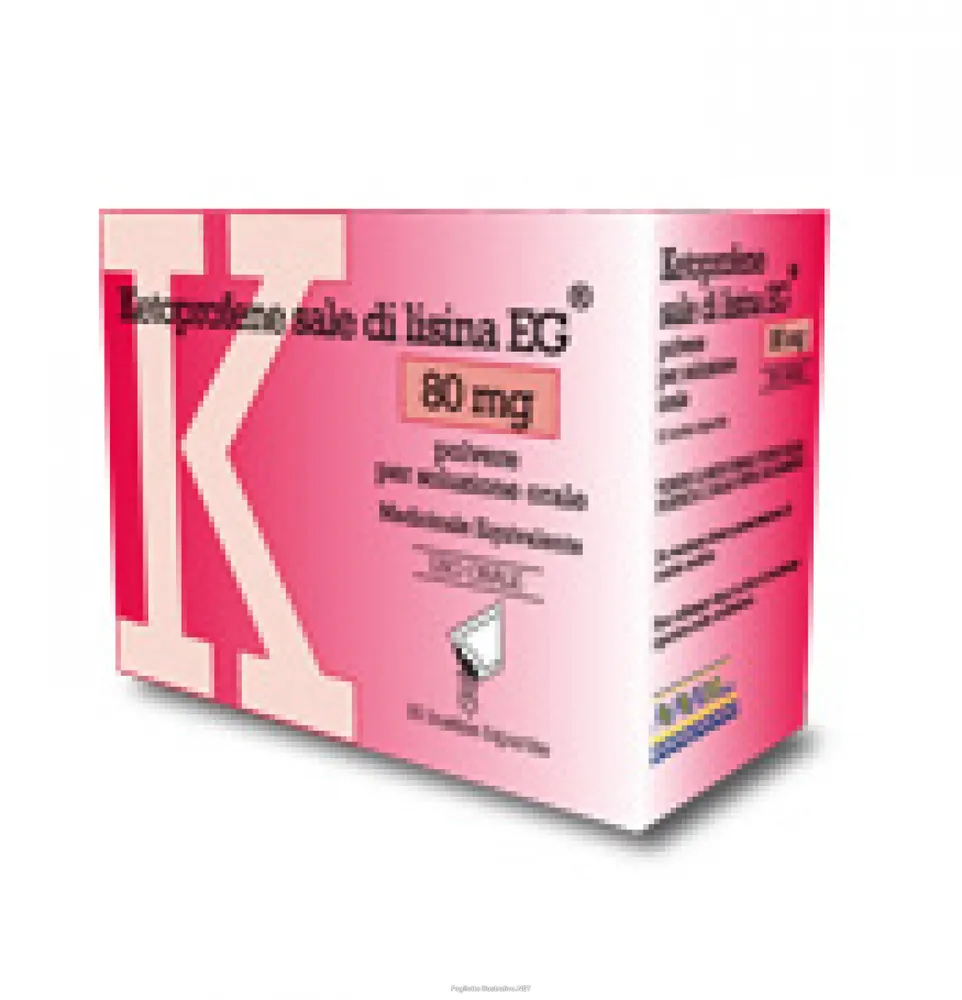
Table of Contents
- Package leaflet: Information for the patient
- KETOPROFEN LYSINE SALT EG 80 mg powder for oral solution
- 1. What KETOPROFENE LISINATE SALT EG is and what it is used for
- 2. What you should know before taking KETOPROFENE LYSINE SALT EG
- 3. How to take KETOPROFENE SALE DI LISINA EG
- 4. Possible side effects
- 5. How to store KETOPROFENE LISINE SALT EG
- 6. Package contents and other information
Package leaflet: Information for the patient
KETOPROFEN LYSINE SALT EG 80 mg powder for oral solution
Equivalent medicine
Please read this leaflet carefully before taking this medicine because it contains important information for you.
- Keep this leaflet. You may need to read it again.
- If you have any questions, ask your doctor or pharmacist.
- This medicine has been prescribed for you only. Do not give it to others, even if their symptoms are the same as yours, because it could be harmful.
- If any adverse reaction occurs, including those not listed in this leaflet, contact your doctor or pharmacist. See section 4.
Contents of this leaflet:
- What KETOPROFEN LYSINE SALT EG is and what it is used for
- What you need to know before taking KETOPROFEN LYSINE SALT EG
- How to take KETOPROFEN LYSINE SALT EG
- Possible side effects
- How to store KETOPROFEN LYSINE SALT EG
- Contents of the pack and other information
1. What KETOPROFENE LISINATE SALT EG is and what it is used for
KETOPROFENE LISINATE SALT EG contains the active substance ketoprofen, which belongs to a group of medicines called non-steroidal anti-inflammatory drugs ("NSAIDs").
KETOPROFENE LISINATE SALT EG is indicated:
- in adults , for the symptomatic treatment of pain associated with:
- inflammatory disorders affecting the joints (e.g. rheumatoid arthritis, ankylosing spondylitis, painful osteoarthritis, extra-articular rheumatism);
- inflammatory conditions due to trauma and painful inflammations affecting the mouth, teeth, ears, larynx, urinary tract, and respiratory tract;
- in children , for the short-term symptomatic treatment of pain, even when associated with fever, caused by:
- inflammatory disorders affecting the joints and bones;
- ear inflammations (otitis);
- surgical procedures.
2. What you should know before taking KETOPROFENE LYSINE SALT EG
Do not take KETOPROFENE LYSINE SALT EG
- if you are allergic to ketoprofen, to other non-steroidal anti-inflammatory drugs (NSAIDs), or to any of the other ingredients of this medicine (listed in section 6);
- if you have previously suffered from asthma, breathing difficulties (bronchospasm), nasal congestion, nasal polyps, hives (skin rash), angioedema (swelling of the face, lips, mouth, tongue, or throat that may cause difficulty in swallowing or breathing), or other allergic reactions after taking acetylsalicylic acid or other non-steroidal anti-inflammatory drugs (NSAIDs). In such cases, a sudden potentially fatal allergic reaction may occur;
- if you currently suffer or have previously suffered from stomach or intestinal ulcers (e.g., active or recurrent peptic ulcer);
- if you currently suffer or have previously suffered from gastrointestinal bleeding or perforation;
- if you have previously experienced gastrointestinal bleeding or perforation following administration of non-steroidal anti-inflammatory drugs (NSAIDs);
- if you have previously suffered from chronic digestive problems (including gastritis);
- if you currently suffer from inflammatory bowel disease, such as Crohn's disease or ulcerative colitis;
- if you have previously suffered from asthma (bronchial asthma);
- if you have severe heart problems (heart failure);
- if you have severe liver or kidney problems (hepatic insufficiency, liver cirrhosis, severe hepatitis, or renal insufficiency);
- if you are undergoing intensive diuretic therapy (medicines that promote fluid elimination through urine);
- if you are prone to bleeding, suffer from blood clotting disorders, or are taking medicines to improve blood fluidity (anticoagulants);
- if you have bleeding leading to reduced levels of certain blood cells (leucopenia, thrombocytopenia);
- if you are pregnant (see section "Pregnancy, breastfeeding, and fertility");
- if the person taking the medicine is a child under 6 years of age.
Warnings and precautions
Talk to your doctor or pharmacist before taking KETOPROFENE LYSINE SALT EG.
Consult your doctor or pharmacist before using KETOPROFENE LYSINE SALT EG if:
- you are taking other non-steroidal anti-inflammatory drugs (NSAIDs), such as aspirin, even at low doses (see section "Other medicines and KETOPROFENE LYSINE SALT EG");
- you are elderly. In this case, adverse effects, particularly gastrointestinal bleeding and perforation, are more likely and may be fatal. If this occurs, contact your doctor immediately;
- you currently suffer or have previously suffered from stomach and/or intestinal problems. In such cases, your doctor may decide to monitor you closely and prescribe additional medication to protect your stomach (e.g., misoprostol or drugs that inhibit gastric acid production);
- you are taking medicines that may increase the risk of peptic ulcer or bleeding, such as oral corticosteroids, certain antidepressants (selective serotonin reuptake inhibitors), or agents that prevent blood clot formation such as aspirin or anticoagulants like warfarin (see section "Other medicines and KETOPROFENE LYSINE SALT EG"). In these cases, consult your doctor before taking KETOPROFENE LYSINE SALT EG;
- you experience stomach burning, bleeding, or pain—stop treatment and inform your doctor;
- you have previously suffered from chronic inflammatory bowel disease (ulcerative colitis, Crohn's disease);
- you have kidney, liver, or heart problems, fluid retention, or have previously suffered from any of these conditions. In such cases, your doctor should monitor you closely;
- you suffer from a blood or blood cell formation disorder;
- you suffer from systemic lupus erythematosus or mixed connective tissue disease (immune system disorders affecting connective tissue);
- you have an infection—see section "Infections" below;
- you are taking diuretics or medicines used to reduce blood volume;
- you suffer from allergies or have previously experienced allergic reactions;
- you have heart problems, a history of stroke, or believe you may be at risk for these conditions (e.g., if you have high blood pressure, diabetes, high cholesterol levels, or are a smoker). KETOPROFENE LYSINE SALT EG may be associated with a slight increase in the risk of heart attack and stroke. This risk is higher at high doses and with prolonged use. Do not exceed the recommended dose or duration of treatment;
- you suffer from asthma associated with chronic colds, chronic sinusitis, and/or nasal polyps;
- after starting treatment, you develop signs of a skin reaction, with or without lesions (such as exfoliative dermatitis, Stevens-Johnson syndrome, or toxic epidermal necrolysis). If this occurs, stop treatment and inform your doctor;
- you experience visual disturbances (such as blurred vision). If this occurs, stop treatment and inform your doctor.
Infections
KETOPROFENE LYSINE SALT EG may mask symptoms of infections such as fever and pain. Therefore, KETOPROFENE LYSINE SALT EG may delay appropriate treatment of an infection, increasing the risk of complications. This has been observed in bacterial pneumonia and bacterial skin infections associated with chickenpox. If you take this medicine while having an infection and infection symptoms persist or worsen, contact your doctor immediately.
Like other NSAIDs, KETOPROFENE LYSINE SALT EG may increase blood urea nitrogen, creatinine, and certain liver parameters (SGOT and SGPT).
You can reduce the risk of adverse effects by taking KETOPROFENE LYSINE SALT EG at the lowest effective dose and for the shortest possible duration.
Children
KETOPROFENE LYSINE SALT EG should be administered with caution, under strict medical supervision, and only if necessary in children over 6 years of age, as it may cause gastrointestinal bleeding and ulcers, which can be severe.
Other medicines and KETOPROFENE LYSINE SALT EG
Inform your doctor or pharmacist if you are taking, have recently taken, or might take any other medicines.
Avoid taking the following medicines together with KETOPROFENE LYSINE SALT EG:
- other non-steroidal anti-inflammatory drugs (NSAIDs) and high-dose salicylates (over 3 g per day);
- medicines used to prevent blood clots (anticoagulants such as heparin and warfarin, antiplatelet agents such as ticlopidine and clopidogrel);
- lithium, used to treat depression or similar disorders;
- high-dose methotrexate (over 15 mg per week), used to treat rheumatoid arthritis and cancer;
- hydantoins, used for epilepsy;
- sulfonamides, used for bacterial infections.
Combining KETOPROFENE LYSINE SALT EG with any of the following medicines requires special precautions:
- heparins, used to prevent blood clots;
- ACE inhibitors, diuretics, angiotensin II antagonists, used for high blood pressure and heart problems;
- cyclosporine and tacrolimus, used after organ transplantation or to treat immune system disorders;
- trimethoprim, used to treat bacterial infections;
- low-dose methotrexate (less than 15 mg per week), used to treat rheumatoid arthritis and cancer;
- corticosteroids, used for inflammation;
- pentoxifylline, used to treat chronic venous ulcers;
- zidovudine and tenofovir, used to treat AIDS;
- sulfonylureas, used for diabetes;
- cardiac glycosides, used to treat heart problems.
Your doctor should monitor you and may need to reduce the dose of KETOPROFENE LYSINE SALT EG if you are taking any of the following medicines:
- ACE inhibitors, diuretics, and beta-blockers, used for high blood pressure and heart problems;
- mifepristone, used for medical termination of pregnancy;
- intrauterine contraceptive devices;
- cyclosporine and tacrolimus, used after organ transplantation or to treat immune system disorders;
- thrombolytics, used for blood clotting disorders;
- certain antidepressants, known as selective serotonin reuptake inhibitors (SSRIs);
- probenecid, used for gout;
- certain antibiotics, used for bacterial infections;
- phenytoin, a medicine used to treat epilepsy;
- sulfamides, medicines used for bacterial infections;
- gemeprost, a medicine used in obstetrics.
KETOPROFENE LYSINE SALT EG and alcohol
Avoid consuming alcohol during treatment with this medicine.
Pregnancy, breastfeeding, and fertility
If you are pregnant, suspect you may be pregnant, planning a pregnancy, or breastfeeding, consult your doctor or pharmacist before taking this medicine.
Pregnancy
Do not take KETOPROFENE LYSINE SALT EG during the last three months of pregnancy, as it may harm the fetus or cause problems during delivery. It may cause kidney and heart problems in the fetus. It may affect your and your baby's tendency to bleed and may delay or prolong labor.
You should not take KETOPROFENE LYSINE SALT EG during the first six months of pregnancy unless absolutely necessary and under medical advice. If treatment is required during this period or during attempts to conceive, the lowest possible dose for the shortest possible time should be used. If taken for more than a few days from week 20 of pregnancy onwards, KETOPROFENE LYSINE SALT EG may cause kidney problems in the fetus, leading to reduced amniotic fluid levels (oligohydramnios) or narrowing of a blood vessel (ductus arteriosus) in the baby's heart. If prolonged treatment is needed, your doctor may recommend additional monitoring.
Breastfeeding
Do not take KETOPROFENE LYSINE SALT EG while breastfeeding.
Fertility
KETOPROFENE LYSINE SALT EG may cause fertility problems in women and is therefore not recommended for women planning pregnancy. Inform your doctor if you have fertility issues and are planning a pregnancy or undergoing fertility testing.
Driving and using machines
KETOPROFENE LYSINE SALT EG may cause dizziness, drowsiness, or seizures. If this occurs, avoid driving or operating machinery.
KETOPROFENE LYSINE SALT EG contains sorbitol and sodium
This medicine contains 1690 mg of sorbitol per sachet.
Sorbitol is a source of fructose. If your doctor has informed you (or the child) that you are intolerant to certain sugars, or if you have been diagnosed with hereditary fructose intolerance, a rare genetic disorder in which patients cannot metabolize fructose, consult your doctor before taking this medicine.
This medicine contains less than 1 mmol (23 mg) of sodium per sachet, i.e., essentially "sodium-free."
3. How to take KETOPROFENE SALE DI LISINA EG
Take this medicine exactly as directed by your doctor or pharmacist. If you have any doubts, consult your doctor or pharmacist.
The recommended dose is 1 sachet of 80 mg (full dose) 3 times daily, during meals.
The maximum daily dose must not exceed 320 mg.
The lowest effective dose for the shortest duration necessary to relieve symptoms should be used. If you have an infection, contact your doctor immediately if symptoms (such as fever and pain) persist or worsen (see section 2).
Take this medicine using the lowest effective dose and for the shortest possible duration.
Use in children aged 6 to 14 years
The recommended dose is half a sachet of 40 mg (half dose) 3 times daily, during meals.
Use in elderly patients
If you are elderly, your doctor will determine the appropriate dose.
Use in patients with liver problems
If you suffer from liver problems such as hepatic insufficiency, your doctor will determine the appropriate dose.
If you have severe liver problems, you must not use this medicine (see section "Do not take KETOPROFENE SALE DI LISINA EG").
Use in patients with kidney problems
If you have mild or moderate kidney problems, your doctor will determine the appropriate dose and must monitor you during treatment with this medicine.
If you have severe kidney problems, you must not use this medicine (see section "Do not take KETOPROFENE SALE DI LISINA EG").
Method of administration
Open the sachet along the line marked "half dose" to obtain a 40 mg dose. To obtain the 80 mg dose, open the sachet along the line marked "full dose".
Pour the contents of one sachet or half a sachet into half a glass of water and mix.
If you take more KETOPROFENE SALE DI LISINA EG than you should
Symptoms of overdose include: lethargy, headache, dizziness, drowsiness, nausea, vomiting, diarrhoea, stomach and abdominal pain.
Symptoms of severe overdose include low blood pressure (hypotension), respiratory depression, and gastrointestinal bleeding.
In case of accidental ingestion of an excessive dose of this medicine, contact your doctor immediately or go to the nearest hospital emergency department.
Take this leaflet, any remaining medicine, and its container with you to the hospital or doctor so that they know which medicine has been taken.
If you forget to take KETOPROFENE SALE DI LISINA EG
If you forget to take a dose, take it as soon as you remember, unless it is almost time for your next dose. Do not take a double dose to make up for the forgotten dose.
If you have any doubts about how to use this medicine, consult your doctor or pharmacist.
4. Possible side effects
Like all medicines, this medicine can cause side effects, although not everyone will experience them.
The side effects that may occur with KETOPROFENE SALE DI LISINA EG are:
Common (may affect up to 1 in 10 people)
Nausea, digestive problems (dyspepsia), abdominal pain, vomiting.
Uncommon (may affect up to 1 in 100 people)
Headache, dizziness, vertigo, chills, somnolence, swelling due to fluid retention (oedema), swelling of the extremities (peripheral oedema), fatigue, rash, itching, constipation, diarrhoea, excessive gas production in the gastrointestinal tract, inflammation of the stomach (gastritis).
Rare (may affect up to 1 in 1,000 people)
Reduction in red blood cell count due to bleeding (haemorrhagic anaemia), tingling and numbness in hands and feet (paraesthesia), blurred vision, ringing in the ears (tinnitus), inflammation of the mouth (stomatitis), inflammation of a portion of the intestine (colitis), stomach or intestinal ulcer (peptic ulcer), liver problems (hepatitis, increased transaminases, elevated blood bilirubin levels), yellowing of the skin and whites of the eyes (jaundice), asthma, weight gain.
Very rare (may affect up to 1 in 10,000 people)
Movement disorders (dyskinesia), loss of consciousness (syncope), low blood pressure, presence of blood in urine, tiredness, facial swelling, laryngeal swelling.
Frequency not known (frequency cannot be estimated from the available data)
reduction in platelet count (thrombocytopenia), reduction in granulocyte count, a type of white blood cells (agranulocytosis), increase in white blood cell count (leukocytosis), reduction in white blood cell count (leukopenia), reduction in neutrophil count, a type of white blood cells (neutropenia), skin spots due to reduced platelet count (thrombocytopenic purpura), reduced bone marrow activity (bone marrow failure), destruction of red blood cells (haemolytic anaemia), reduced production of red blood cells (aplastic anaemia), inflammation of lymphatic vessels (lymphangitis), sudden potentially life-threatening allergic reaction (including anaphylactic shock), seizures, taste disturbances, tremor, involuntary and uncoordinated movements (hyperkinesia), mood changes, depression, confusion, excitability, insomnia, inflammation of the membranes covering the brain and spinal cord (aseptic meningitis), allergic reaction (hypersensitivity), excessive sensitivity to light (photosensitivity), hair loss (alopecia), urticaria, skin rash (exanthema, maculopapular exanthema, acute generalized exanthematous pustulosis), skin inflammations (erythema, dermatitis), bruise-like lesions (purpura), swelling of the face, lips, mouth, tongue or throat that may cause difficulty in breathing and swallowing (angioedema), rare skin condition with blisters and bleeding of lips, eyes, mouth, nose and genitals (Stevens-Johnson syndrome), severe skin reaction (Lyell’s syndrome and toxic epidermal necrolysis), ulceration, worsening of colitis and Crohn’s disease (chronic inflammatory bowel diseases), bleeding and perforation of the stomach and intestine, heartburn, stomach ache, excessive stomach acidity (hyperchlorhydria), damage to the stomach mucosa without perforation leading to bleeding (erosive gastritis), swelling of the mouth or tongue, inflammation of the pancreas, presence of blood in vomit or stools, high blood pressure, vasodilation, inflammation of blood vessels (vasculitis, including leukocytoclastic vasculitis), breathing difficulties (bronchospasm), allergic rhinitis (rhinitis), shortness of breath (dyspnoea), narrowing of the larynx (laryngospasm), acute respiratory failure, kidney problems (acute renal failure, tubulo-interstitial nephritis, nephritis or nephritic syndrome, nephrotic syndrome, glomerular nephritis, acute tubular necrosis, renal papillary necrosis), fluid retention, decreased urine production, heart failure, changes in heart rhythm (atrial fibrillation), awareness of your heartbeat (palpitations), rapid heartbeat (tachycardia), anxiety, seeing or hearing things that are not real (hallucinations), changes in behaviour, changes in blood potassium and sodium levels (hyperkalemia, hyponatremia), swollen eyes (periorbital oedema).
Inform your doctor immediately if you notice any gastrointestinal side effects (stomach pain, burning sensation, bleeding), especially if you are elderly.
Stop taking KETOPROFENE SALE DI LISINA EG immediately and contact your doctor as soon as you notice a skin rash, any lesions inside the mouth or on the genitals, or any signs of an allergic reaction.
Medicines such as KETOPROFENE SALE DI LISINA EG may be associated with a slight increase in the risk of heart attack (myocardial infarction) and stroke.
Reporting of side effects
If you experience any side effects, including those not listed in this leaflet, talk to your doctor or pharmacist. You can also report side effects directly via the national reporting system at www.aifa.gov.it/content/segnalazioni-reazioni-avverse. By reporting side effects, you can help provide more information on the safety of this medicine.
5. How to store KETOPROFENE LISINE SALT EG
Keep this medicine out of the sight and reach of children.
Do not use this medicine after the expiry date stated on the packaging after "Exp.". The expiry date refers to the last day of that month.
Do not dispose of any medicine via wastewater or household waste. Ask your pharmacist how to dispose of medicines you no longer use. This will help protect the environment.
6. Package contents and other information
What KETOPROFENE LISINE SALT EG contains
The active substance is ketoprofene lysine salt.
Each sachet contains 80 mg of ketoprofene lysine salt (equivalent to 50 mg of ketoprofene).
The other components are: sorbitol (Neosorb P60), sorbitol (Neosorb P30/P60), povidone, anhydrous colloidal silica, sodium chloride, sodium saccharin, ammonium glycyrrhizinate, peppermint flavour.
Description of the appearance of KETOPROFENE LISINE SALT EG and contents of the pack
Pack containing 30 double-compartment sachets.
Marketing Authorisation Holder
EG S.p.A. - Via Pavia, 6 - 20136 Milan
Manufacturers
Doppel Farmaceutici S.r.l., Via Volturno 48, 20089 Quinto De’ Stampi, Rozzano (MI)
Special Product’s Line S.p.A., Via Fratta Rotonda Vado Largo, 1, 03012 Anagni (FR)