Keplat
Italy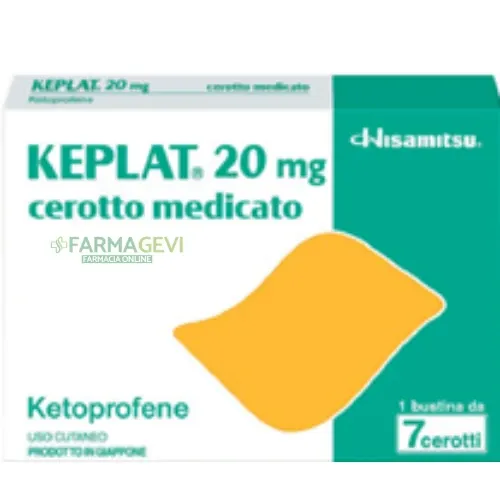
Table of Contents
Patient Information Leaflet: Information for the User
KEPLAT 20 mg medicated patch
Ketoprofen
Please read this leaflet carefully before using this medicine because it contains important information for you.
- Keep this leaflet. You may need to read it again.
- If you have any questions, ask your doctor or pharmacist.
- This medicine has been prescribed for you only. Do not give it to other people, even if their symptoms are the same as yours, as it may be harmful.
- If you experience any side effect, including those not listed in this leaflet, talk to your doctor or pharmacist. See section 4.
Contents of this leaflet
- What KEPLAT is and what it is used for
- What you need to know before using KEPLAT
- How to use KEPLAT
- Possible side effects
- How to store KEPLAT
- Contents of the pack and other information
1. What KEPLAT is and what it is used for
KEPLAT is a beige-colored medicated patch, 70 cm in size, with a flexible support matrix. The adhesive side is covered by a plastic film. KEPLAT is a non-steroidal anti-inflammatory drug for topical use. This medicine contains the active substance ketoprofen. KEPLAT is used for the treatment of pain and inflammation following injuries, sprains, and bruises, such as muscle pain, soreness, joint pain, and back pain.
2. What you need to know before using KEPLAT
Do not use KEPLAT:
- If you are allergic to ketoprofen or to any of the other ingredients of this medicine (listed in section 6)
- If you have a history of skin allergy (hypersensitivity) to tiaprofenic acid, fenofibrate, UV sunscreens, or perfumes
- If aspirin or other NSAIDs cause you asthma attacks, breathing difficulties, acute rhinitis, nasal polyps (growths in the nasal passages), hives (rash), or swelling of the eyelids or lips
- If you have experienced photosensitivity reactions
- If you suffer from asthma
- If you have or have had gastrointestinal ulcer or bleeding, or a previous gastrointestinal (stomach) ulcer
- If you have severe heart failure
- If you have liver or kidney dysfunction
- If you are prone to bruising or bleeding, have coagulation disorders/bleeding, or are undergoing anticoagulant therapy
- If you are in the last 3 months of pregnancy
- In children under 12 years of age.
The patch must not be used on open wounds or on skin with pathological alterations such as
eczema, acne, dermatitis, inflammation or infection of any kind, or on mucous membranes of body orifices.
Discontinue use of KEPLAT immediately if skin reactions occur, including those developing following concomitant use of products containing octocrylene (octocrylene is an excipient found in various cosmetic and personal hygiene products such as shampoos, aftershaves, shower and bath gels, skin creams, lipsticks, anti-aging creams, makeup removers, hair sprays, used to prevent their photodegradation).

Do not expose treated areas to sunlight or UV lamps (solarium) during treatment and for two weeks after discontinuation of treatment.
Warnings and precautions
Consult your doctor or pharmacist before using KEPLAT:
- If you suffer from allergic reactions or have a history of allergies, especially following administration of other analgesics, antipyretic medicines, or other NSAIDs
- If you have Crohn's disease or ulcerative colitis, chronic dyspepsia, or a history of bronchial asthma
- If you suffer from liver, kidney, or heart disease
- If you suffer from fluid retention
- Use caution if you are elderly, as you are generally more susceptible to adverse effects.
Exposure of treated areas to sunlight (even when the sky is overcast) or to UVA lamps after application of
KEPLAT may cause potentially serious skin reactions (photosensitization). Therefore, it is necessary to:
- Protect treated areas from sunlight by covering them with clothing throughout the duration of treatment and for two weeks after discontinuation, in order to avoid any risk of photosensitization
- Wash your hands thoroughly after each application of KEPLAT.
Treatment must be stopped immediately if any skin reaction occurs after application of KEPLAT.
Prolonged or repeated use of the product may lead to sensitization phenomena (hypersensitivity).
Paediatric population
In some paediatric patients treated with ketoprofen, gastrointestinal bleeding, occasionally severe, and gastric ulcers have been reported; therefore, the medicine should be administered under strict medical supervision, with the physician evaluating the required dosage regimen each time.
The safety and efficacy of cutaneous formulations of ketoprofen in children have not been established.
Other medicines and KEPLAT
Inform your doctor or pharmacist if you are taking, have recently taken, or might take any other medicines.
It is important to inform your doctor if you are taking methotrexate, anticoagulants, certain medicines for blood pressure or heart conditions, antidiabetics, or lithium.
Pregnancy, breast-feeding and fertility
If you are pregnant, think you may be pregnant, planning to become pregnant, or are breast-feeding, consult your doctor or pharmacist before taking this medicine.
Pregnancy
Do not use KEPLAT during the last 3 months of pregnancy. You should not use KEPLAT during the first 6 months of pregnancy unless strictly necessary and under medical advice. If treatment is required during this period, the lowest effective dose for the shortest possible duration should be used.
Oral formulations (e.g. tablets) of ketoprofen may cause adverse effects on the fetus. It is not known whether KEPLAT poses the same risk when applied to the skin.
Breast-feeding
KEPLAT is not recommended during breast-feeding.
Driving and use of machines
KEPLAT may affect your ability to drive or operate machinery due to the possible occurrence of dizziness or drowsiness.
3. How to use KEPLAT
Use this medicine exactly as instructed by your doctor. If you have any doubts, consult your doctor or pharmacist.
The recommended dose is:
Adults: Apply one patch daily, unless otherwise prescribed by your doctor.
Use in children and adolescents: From 12 to 18 years of age, according to medical prescription. Do not use in children under 12 years of age.
The patch must be applied to the painful area and replaced daily.
Before applying the patch, clean and dry the affected area. Remove the protective film and apply the adhesive side directly to the skin.
If the patch is to be applied to highly mobile joints such as the elbow or knee, it may be secured with a bandage while the joint is in a bent position, to help keep the patch in place.
Instructions for application
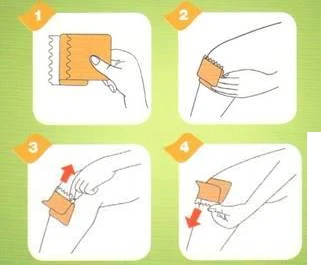
- Fold the patch in half along the perforated line of the plastic backing
- Position the patch on the clean, dry area of the body where pain is most intense
- Remove one half of the plastic backing from the perforated edge and smooth the adhesive surface onto the treatment area
- Remove the other half of the plastic backing in the same way and smooth the entire patch onto the treatment area
DO NOT chew or swallow the patch.
Duration of treatment
As prescribed by the doctor, but in any case not longer than 14 days.
If you use more KEPLAT than you should
If you have used more KEPLAT than you should, inform your doctor or pharmacist immediately.
Cases of overdose have not been reported.
If you forget to use KEPLAT
Simply apply KEPLAT as soon as you remember, and then continue with your regular dosing schedule.
DO NOT apply a double dose to make up for missed doses.
4. Possible adverse effects
Like all medicines, KEPLAT can cause adverse effects, although not everyone experiences them.
Stop using KEPLAT and seek immediate urgent medical attention if you experience:
- Rash, hives, blisters, redness, burning, itching, skin peeling, or bruising at the application site.
- Swelling of the face, runny nose, chest tightness, wheezing (severe allergic reactions).
Mild localized skin reactions have been reported at the site of KEPLAT application:
Uncommon (may affect up to 1 in 100 people): redness, burning sensation, itching, allergic skin reactions, skin reactions during exposure to sunlight.
The following additional adverse effects have been reported:
Dermatological reactions
- Rare (may affect up to 1 in 1,000 people): photosensitization and urticaria. Rare cases of more severe reactions such as bullous or vesicular eczema have occurred, which may extend beyond the application site or become generalized.
- Not known (frequency cannot be estimated from the available data): skin peeling and bruising at the application site.
Renal and urinary disorders
- Very rare (may affect up to 1 in 10,000 people): cases of worsening of pre-existing renal insufficiency.
Gastrointestinal disorders
- Not known (frequency cannot be estimated from the available data): stomach ulcer. If active or suspected stomach ulcer occurs, treatment must be immediately discontinued.
Reporting of adverse effects
If you experience any adverse effect, including those not listed in this leaflet, talk to your doctor or pharmacist.
You can also report adverse effects directly via the national reporting system: https://www.aifa.gov.it/content/segnalazioni-reazioni-avverse. By reporting adverse effects, you can help provide more information on the safety of this medicine.
- How to store KEPLAT
Keep this medicine out of the sight and reach of children. Store KEPLAT in the original packaging to protect it from light. The product is valid for 3 months after opening (please record the date of first opening in the designated space). Each time a patch is removed from the sachet, carefully reseal the open end of the pouch to protect the remaining patches from light.
Do not use KEPLAT after the expiry date stated on the carton or beyond 3 months after first opening.
The expiry date refers to the product stored unopened and under the recommended storage conditions.
Do not dispose of any medicine via wastewater or household waste. Ask your pharmacist how to dispose of medicines no longer required. This will help protect the environment.
6. Package contents and other information
Contents of KEPLAT
The active substance is ketoprofen. Each patch contains 20 mg of ketoprofen.
The other components are: styrene-isoprene-styrene copolymer, polyisobutylene 1200000, polyisobutylene, glycerol rosin ester hydrogenated, zinc stearate, liquid paraffin, polyester backing layer, plastic film.
Description of the appearance of KEPLAT and package contents
KEPLAT is a skin-colored medicated patch of 70 cm², with a flexible support matrix. The adhesive side is covered by a plastic film.
A package contains a sachet with 7 patches or 2 patches.
It is possible that not all pack sizes are marketed.
Marketing Authorization Holder and Manufacturer
Marketing Authorization Holder
Hisamitsu Italia S.r.l.
Via Paolo da Cannobio 9, 20122 Milano, Italy
Manufacturer
Hisamitsu Pharmaceutical Co., Inc., 408 Tashirodaikan-machi, Tosu, Saga, 841-0017, Japan
Batch release responsible
Millmount Healthcare Ltd
Block-7, City North Business Campus, Stamullen, Co. Meath, K32 YD60, Ireland
Distribution Licensee
Abiogen Pharma S.p.A.
Via Meucci, 36 - Ospedaletto - Pisa, Italy
This medicinal product is authorized in the European Economic Area countries under the following
names:
Czech Republic, Hungary, Italy, Portugal: KEPLAT