Kauliv
ItalyTable of Contents
- Package leaflet: Information for the user
- Kauliv 20 micrograms/80 microliters injectable solution
- 1. What Kauliv is and what it is used for
- 2. What you need to know before using Kauliv
- 3. How to use Kauliv
- 4. Possible side effects
- 5. How to store Kauliv
- 6. Package contents and other information
- Kauliv in the Kauliv Pen
Package leaflet: Information for the user
Kauliv 20 micrograms/80 microliters injectable solution
teriparatide
This medicinal product is subject to additional monitoring. This will allow for rapid identification of new safety information. You can help by reporting any side effects you experience while taking this medicine. See the end of section 4 for information on how to report side effects.
Please read this leaflet carefully before using this medicine because it contains important information for you.
- Keep this leaflet. You may need to read it again.
- If you have any questions, consult your doctor or pharmacist.
- This medicine has been prescribed for you only. Do not give it to others, even if they have the same symptoms as you, because it could be harmful.
- If you experience any side effect, including those not listed in this leaflet, consult your doctor or pharmacist. See section 4.
Contents of this leaflet
- What Kauliv is and what it is used for
- What you need to know before using Kauliv
- How to use Kauliv
- Possible side effects
- How to store Kauliv
- Contents of the pack and other information
1. What Kauliv is and what it is used for
Kauliv contains the active substance teriparatide, which is used to strengthen bones and reduce the risk of fractures by stimulating bone formation.
Kauliv is used to treat osteoporosis in adults. Osteoporosis is a disease that causes bones to become thin and fragile. This condition is particularly common in women after menopause, but it can also occur in men. Osteoporosis is also common in patients being treated with medicines called corticosteroids.
2. What you need to know before using Kauliv
Do not use Kauliv
- If you are allergic to teriparatide or to any of the other ingredients of this medicine (listed in section 6).
- If you have high levels of calcium in your blood (pre-existing hypercalcemia).
- If you have severe kidney problems.
- If you have had bone tumors or if other tumors have spread (metastasized) to your bones.
- If you have other bone diseases. If you have a bone disease, inform your doctor.
- If you have high levels of alkaline phosphatase in your blood of unknown origin, which may indicate Paget’s disease of the bone (a disease causing abnormal bone changes). If you are unsure, consult your doctor.
- If you have undergone radiation therapy involving the bones.
- If you are pregnant or breastfeeding.
Warnings and precautions
Kauliv may cause an increase in the amount of calcium in your blood or urine.
Contact your doctor before or during treatment with Kauliv:
- If you continuously experience nausea, vomiting, constipation, low energy, or muscle weakness. These may be signs of high calcium levels in your blood.
- If you have or have had kidney stones.
- If you have kidney problems (moderate renal impairment).
Some patients may experience dizziness or a rapid heartbeat after taking the first doses of Kauliv. During the initial doses, if you feel dizzy, administer Kauliv in a place where you can sit or lie down.
The recommended treatment period of 24 months must not be exceeded.
Before inserting a cartridge into the Kauliv pen, record the batch number and the date of the first injection on a calendar, and provide this information if reporting adverse effects.
The date of the first injection must also be written on the outer box of the Kauliv cartridge (see the space provided on the box: “First use”) (see section 3).
Kauliv must not be used in adults who are still growing.
Children and adolescents
Kauliv must not be used in children and adolescents (under 18 years of age).
Other medicines and Kauliv
Inform your doctor or pharmacist if you are taking, have recently taken, or might take any other medicines.
This is important because some medicines (e.g., digoxin/digitalis, a medicine used to treat heart conditions) may interact with teriparatide.
Pregnancy and breastfeeding
Do not take Kauliv if you are pregnant or breastfeeding. If you are a woman of childbearing potential, you must use effective contraceptive methods during treatment with Kauliv. If you become pregnant while using Kauliv, treatment must be discontinued. Consult your doctor or pharmacist before taking any medicine.
Driving and using machines
Some patients may experience dizziness after injection of Kauliv. If you feel dizzy, do not drive or operate machinery until you feel better.
Kauliv contains sodium
This medicine contains less than 1 mmol (23 mg) of sodium per dose, i.e., essentially “sodium-free”.
3. How to use Kauliv
Use this medicine exactly as prescribed by your doctor. If you have any doubts, consult your doctor or pharmacist.
The recommended dose is 20 micrograms (equivalent to 80 microliters) administered once daily by subcutaneous injection (injection under the skin) into the thigh or abdomen.
To help you remember to take the medicine, inject it at the same time each day. Kauliv may be injected with meals. Inject Kauliv every day for the entire duration prescribed by your doctor. The total duration of treatment with Kauliv must not exceed 24 months. You must not receive more than one 24-month treatment course during your lifetime.
Your doctor may advise you to take Kauliv together with calcium and vitamin D. Your doctor will tell you how much calcium and vitamin D you should take each day.
Kauliv may be administered with or without food.
Kauliv cartridges are designed for exclusive use with the Kauliv multidose pen and compatible needles. The pen and injection needles are not supplied with the Kauliv cartridge.
Before first use, insert the cartridge into the pen (which is supplied separately). For correct use of this medicine, it is very important to carefully follow the detailed Instructions for Use (IFU) provided with the pen.
Always use a new needle for each injection to prevent contamination, and dispose of the needle safely after use.
Never store the pen with the needle attached. Never share your pen with others.
Do not use the Kauliv pen to inject other medicines (e.g., insulin). The pen is customized for exclusive use with Kauliv.
Do not refill the cartridge.
Do not transfer the medicine into a syringe.
You should inject Kauliv shortly after removing the pen with the inserted cartridge from the refrigerator. After use, immediately return the pen with the inserted cartridge to the refrigerator. Do not remove the cartridge from the pen after use. The cartridge in the pen may be further protected by placing it into the case supplied with the pen, to shield the medicine from light throughout the 28-day treatment period.
Preparing the pen for use
- To ensure correct administration of Kauliv, always read the IFU of the Kauliv pen, included in the pen case.
- Wash your hands before handling the cartridge or pen.
- Check the expiry date on the cartridge label before inserting the cartridge into the pen. Ensure that at least 28 days remain before expiry. Insert the cartridge into the pen before first use as indicated in the pen instructions. Record the batch number of each cartridge and the date of the first injection on a calendar. You should also record the date of the first injection on the outer carton of the Kauliv cartridge (see the designated space on the box: “First use”). After inserting a new cartridge and before the first injection from this cartridge, prime the pen according to the instructions provided in the pen’s IFU. Ensure you prime the pen before each dose, as instructed in the pen’s IFU.
Injecting Kauliv
- Before injecting Kauliv, clean the skin at the injection site (thigh or abdomen) as instructed by your doctor.
- Gently pinch a portion of clean skin and insert the needle perpendicularly into the skin. Press and hold the button until the dose indicator returns to its starting position.
- After the injection, leave the needle in the skin for ten seconds to ensure the full dose is delivered.
- Immediately after the injection, place the protective cap onto the pen needle and screw it counterclockwise to remove the needle from the pen.
- Replace the cap on the pen. Leave the cartridge in the pen.
If you use more Kauliv than you should
If you accidentally take more Kauliv than prescribed, contact your doctor or pharmacist. Expected effects of an overdose include nausea, vomiting, dizziness, and headache.
If you forget to use Kauliv
If you forget an injection or cannot administer it at your usual time, inject it as soon as possible during the same day. Do not use a double dose to make up for the missed dose. Do not administer more than one injection in the same day.
If you stop using Kauliv
If you are considering stopping treatment with Kauliv, please discuss this with your doctor. Your doctor will advise you and decide how long you should continue treatment with Kauliv.
If you have any doubts about how to use this medicine, consult your doctor or pharmacist.
Use of Kauliv is not recommended for blind or visually impaired individuals without the assistance of a person trained in the correct use of the pen.
4. Possible side effects
Like all medicines, this medicine can cause side effects, although not everybody gets them.
The most common side effect is limb pain (affecting more than 1 in 10 people).
Other common side effects (may affect up to 1 in 10 people) include nausea, headache, and dizziness. If you feel dizzy (lightheadedness) after the injection, you should sit or lie down until you feel better. If you do not feel better, you must contact a doctor before continuing treatment. Cases of fainting have occurred following the use of teriparatide.
If you experience discomfort around the injection site, such as redness of the skin, pain, swelling, itching, bruising, or minor bleeding (which may occur commonly), this should resolve within a few days or weeks. Otherwise, inform your doctor.
Rarely (may affect up to 1 in 1,000 people), patients have experienced allergic reactions including shortness of breath, facial swelling, skin rash, and chest pain. Such reactions generally occur shortly after the injection. In rare cases, serious and potentially life-threatening allergic reactions including anaphylaxis may occur.
Other side effects include:
Common (may affect up to 1 in 10 people)
- increased cholesterol levels in the blood
- depression
- neuropathic leg pain
- feeling faint
- dizziness
- irregular heartbeat
- shortness of breath
- increased sweating
- muscle cramps
- loss of energy
- fatigue
- chest pain
- decrease in blood pressure
- heartburn (a sensation of pain or burning felt just below the breastbone)
- vomiting
- presence of a hernia in the tube carrying food to the stomach (hiatal hernia)
- decrease in haemoglobin or number of red blood cells in the blood (anaemia)
Uncommon (may affect up to 1 in 100 people)
- increased heart rate
- abnormal heart sounds
- shortness of breath
- haemorrhoids
- urinary incontinence
- increased need to pass fluids
- weight gain
- kidney stones
- muscle pain and joint pain. Some patients have experienced severe cramps or back pain leading to hospitalisation.
- increased calcium levels in the blood
- increased uric acid levels in the blood
- increase in an enzyme called alkaline phosphatase
Rare (may affect up to 1 in 1,000 people)
- reduced kidney function, including kidney failure
- development of swelling, particularly in the hands, feet, and legs
Reporting of side effects
If you experience any side effects, including those not listed in this leaflet, talk to your doctor or pharmacist. You can also report side effects directly via the national reporting system listed in Annex V. By reporting side effects, you can help provide more information on the safety of this medicine.
5. How to store Kauliv
Keep this medicine out of the sight and reach of children.
Do not use this medicine after the expiry date stated on the carton and cartridge after
EXP/SCAD. The expiry date refers to the last day of that month.
Store in a refrigerator (from 2°C to 8°C). Do not freeze.
Keep the cartridge in the outer carton to protect it from light.
Kauliv can be used up to 28 days after the first injection. During this period, the cartridge/pens with
the cartridge inserted should be stored in the refrigerator (2°C–8°C). The cartridge/pens may be
placed back into the pen case provided to protect the medicine from light.
Avoid placing the pens near the freezer compartment of the refrigerator to prevent freezing. Do not use Kauliv if it has been frozen.
After 28 days from first use, each cartridge must be properly discarded, even if it is not completely empty.
Kauliv contains a clear, colourless solution. Do not use Kauliv if you notice the presence of solid particles or if the solution appears cloudy or coloured.
Do not dispose of medicines via wastewater or household waste. Ask your pharmacist how to dispose of medicines you no longer use. This will help protect the environment.
6. Package contents and other information
What Kauliv contains
- The active substance is teriparatide. Each 80 microlitre dose contains 20 micrograms of teriparatide. Each 3 mL cartridge contains 750 micrograms of teriparatide (equivalent to 250 micrograms per mL).
- The other components are: anhydrous sodium acetate, glacial acetic acid, mannitol, metacresol, diluted hydrochloric acid (for pH adjustment), sodium hydroxide (for pH adjustment), water for injectable preparations. (See section 2 “Kauliv contains sodium”.)
Description of the appearance of Kauliv and contents of the pack
Kauliv is a colourless and clear injectable solution. Kauliv is supplied in a cartridge. Each cartridge contains 3 mL of solution, sufficient for 28 doses.
Pack contents:
1 cartridge or 3 cartridges packed in a sealed plastic tray with a foil lid, contained in a carton.
Kauliv pack with cartridge and pen:
1 inner box with Kauliv cartridge (containing 1 cartridge) and 1 inner box with Kauliv pen (containing 1 pen).
Marketing Authorisation Holder
Strides Pharma (Cyprus) Limited
Themistokli Dervi, 3
Julia House, 1st Floor,
1066, Nicosia, Cyprus
Manufacturer
Fairmed Healthcare GmbH
Maria-Goeppert-Strasse 3
23562 Luebeck
Germany
For further information about this medicinal product, please contact the local representative of the Marketing Authorisation Holder:
België/Belgique/Belgien Lietuva
Strides Pharma (Cyprus) Limited Strides Pharma (Cyprus) Limited
Tel: +357-2255000 Tel: +357-2255000
[email protected] [email protected]
България Luxembourg/Luxemburg
Strides Pharma (Cyprus) Limited Strides Pharma (Cyprus) Limited
Tel: +357-2255000 Tel: +357-2255000
[email protected] [email protected]
Česká republika Magyarország
Strides Pharma (Cyprus) Limited Strides Pharma (Cyprus) Limited
Tel: +357-2255000 Tel: +357-2255000
[email protected] [email protected]
Danmark Malta
Zentiva Denmark ApS Strides Pharma (Cyprus) Limited
Tel: +45 787 68 400 Tel: +357-2255000
[email protected] [email protected]
Deutschland Nederland
Strides Pharma (Cyprus) Limited Zentiva, k.s.
Tel: +357-2255000 Tel: +31 202 253 638
[email protected] [email protected]
Eesti Norge
Strides Pharma (Cyprus) Limited Zentiva Denmark ApS
Tel: +357-2255000 Tel: +45 787 68 400
[email protected] [email protected]
Ελλάδα Österreich
Strides Pharma (Cyprus) Limited Strides Pharma (Cyprus) Limited
Tel: +357-2255000 Tel: +357-2255000
[email protected] [email protected]
España Polska
Zentiva Spain S.L.U. Strides Pharma (Cyprus) Limited
Tel: +34 91 111 58 93 Tel: +357-2255000
[email protected] [email protected]
France Portugal
Strides Pharma (Cyprus) Limited Strides Pharma (Cyprus) Limited
Tel: +357-2255000 Tel: +357-2255000
[email protected] [email protected]
Hrvatska România
Zentiva d.o.o. ZENTIVA S.A.
Tel: +385 1 6641 830 Tel: +4 021.304.7597
[email protected] [email protected]
Ireland Slovenija
Strides Pharma (Cyprus) Limited Strides Pharma (Cyprus) Limited
Tel: +357-2255000 Tel: +357-2255000
[email protected] [email protected]
Ísland Slovenská republika
Strides Pharma (Cyprus) Limited Strides Pharma (Cyprus) Limited
Tel: +357-2255000 Tel: +357-2255000
[email protected] [email protected]
Italia Suomi/Finland
Zentiva Italia S.r.l. Zentiva Denmark ApS
Tel: +39 800081631 Puh/Tel: +358 942 598 648
[email protected] [email protected]
Κύπρος Sverige
Strides Pharma (Cyprus) Limited Zentiva Denmark ApS
Tel: +357-2255000 Tel: +46 840 838 822
[email protected] [email protected]
Latvija
Strides Pharma (Cyprus) Limited
Tel: +357-2255000
[email protected]
Further sources of information
More detailed information on this medicinal product is available on the website of the European Medicines Agency, http://www.ema.europa.eu/ .
Instructions for Use
Kauliv Pen
Carefully follow these instructions step by step before using the Kauliv pen.
The Kauliv pen must not be used for purposes other than those recommended by the healthcare professional.
Parts of the Kauliv pen
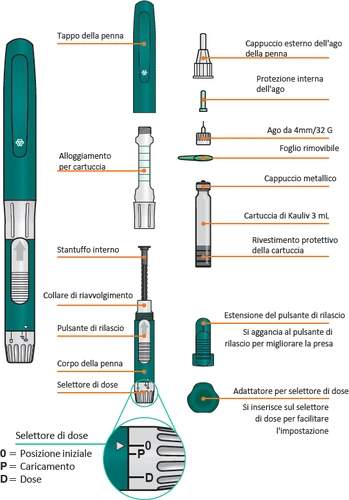
Intended use
The Kauliv pen is a reusable injection pen for the self-administration of subcutaneous injections of teriparatide. For further information, refer to "What Kauliv is and what it is used for" in the Kauliv package leaflet. The Kauliv pen must only be used with the Kauliv cartridge and 32 G 4 mm single-use pen needles.
Each cartridge contains 28 doses of teriparatide. Inject one single dose (D) of 20 micrograms (corresponding to 80 microlitres) daily.
A new cartridge must be loaded at the beginning of each new 28-day period.
Patients and caregivers administering Kauliv must receive appropriate training and instructions on the use of the Kauliv pen from a qualified healthcare professional and must read the package leaflet for the Kauliv cartridge before first use. It is important to read, understand, and follow the instructions for use provided in the Instructions for Use of the Kauliv pen.
PREPARING THE PEN: FIRST USE AND CARTRIDGE CHANGE
Write the date of the first injection of each new cartridge in the space provided on the cardboard box. This will help you keep track of when the 28 daily doses contained in each cartridge have been used (see section 2 "Warnings and precautions" and section 3 "How to use Kauliv" in the Kauliv package leaflet). Follow the instructions each time a new Kauliv cartridge is inserted.
Kauliv in the Kauliv Pen
INSERTING THE CARTRIDGE
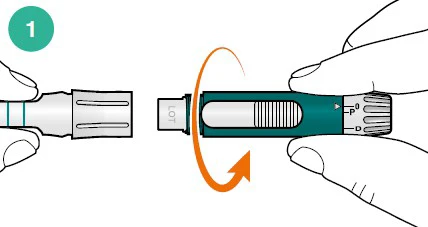
Remove the pen cap.
Unscrew by turning the body of the pen from the cartridge holder (Fig. 1).
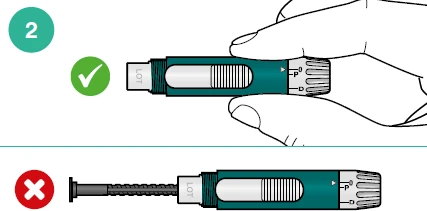
Check that the inner plunger is fully retracted (Fig. 2). If the inner plunger is extended,
refer to Fig. 12 to see how to retract it.
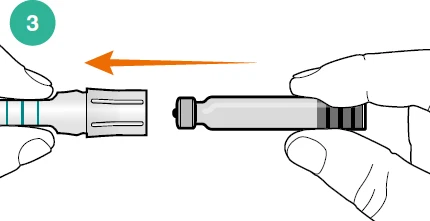
Inspect the teriparatide cartridge. If the solution is cloudy, use a new cartridge. Insert the
Kauliv cartridge into the cartridge holder, placing the metal cap first (Fig. 3).
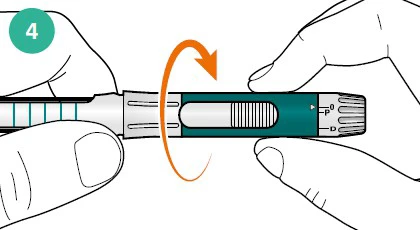
Screw the cartridge holder and the body of the pen together firmly (Fig. 4).
ATTACHING A NEW NEEDLE
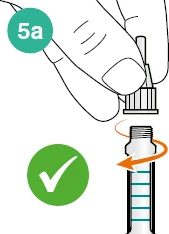
Remove the protective sheet from a new pen needle (Size: 32G 4mm).
Screw the pen needle vertically onto the cartridge holder (Fig. 5a). The pen needle must be changed for each injection.
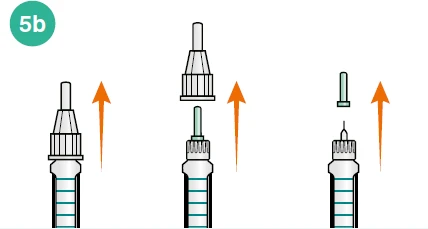
Remove the outer cap. Remove and discard the inner needle shield (Fig. 5b).
Keep the outer cap for later use.
PRIMING THE PEN
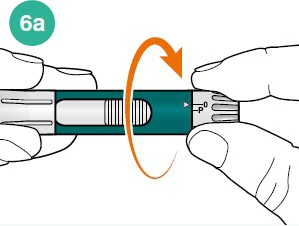
It is important to prime the Kauliv pen before each daily use to remove any air that may be present in the needle and cartridge (Fig. 6a).
Set the dose selector to P to prime the Kauliv pen (Fig. 6b). If you pass this position, proceed to Fig. 7.
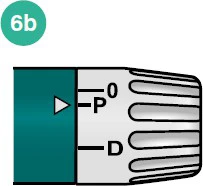
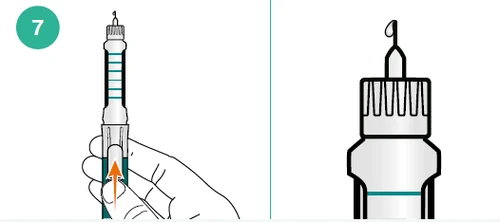
Hold the Kauliv pen with the needle pointing upward. Press and hold the release button toward the needle until the arrow on the dose selector indicates 0. Continue turning to P and release until a drop of teriparatide appears at the tip of the needle (Fig. 7). The Kauliv pen is now ready for use. (If the arrow does not return to 0 after pressing the release button, refer to the priming instructions above.)
ADMINISTERING THE DOSE
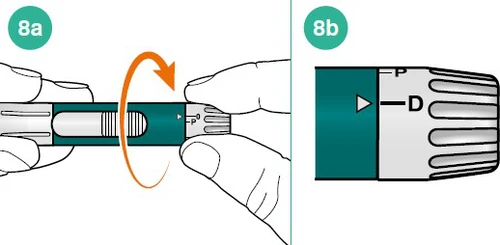
Ensure the arrow indicates 0 on the dose selector (Fig. 8a). Then rotate to D (Fig. 8b).
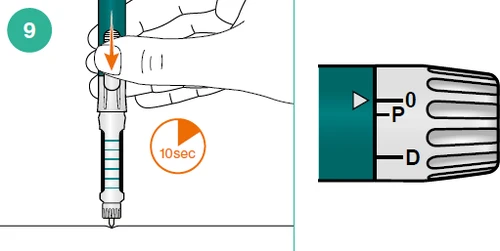
Using the technique recommended by your healthcare provider, gently insert the Kauliv pen needle into the injection site. Press the release button toward the needle and hold it down until the arrow on the dose selector indicates 0, then continue holding the release button for 10 seconds before removing the needle from the skin (Fig. 9).
REMOVING THE NEEDLE
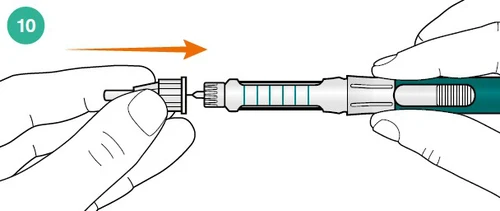
Replace the outer needle cap and unscrew the pen needle (Fig. 10). Always check that the pen needle has been removed. Dispose of used pen needles carefully in an approved sharps container, in accordance with instructions provided by your healthcare provider or local regulations. Replace the pen cap on the Kauliv pen and return it to the refrigerator for storage.
REPLACING THE CARTRIDGE (EVERY 28 DAYS)
Each cartridge contains enough teriparatide for 28 doses. After 28 days, discard the used cartridge and insert a new cartridge (Fig. 1–4). Dispose of the used cartridge in accordance with instructions provided by your healthcare provider or local regulations.
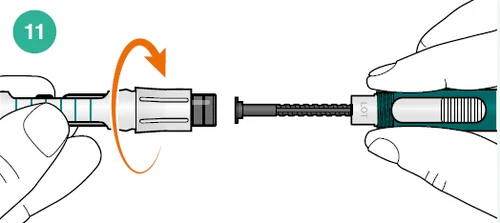
To replace the cartridge, ensure the pen needle has been removed. Unscrew the cartridge holder from the body of the pen and remove the cartridge (Fig. 11).
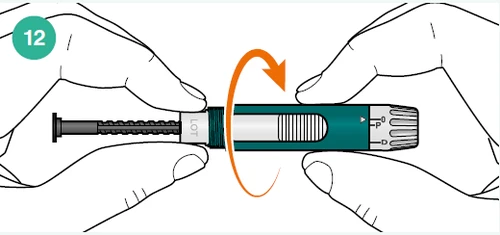
Retract the inner plunger by holding the green retraction collar on the body of the pen between your thumb and index finger (Fig. 12). Turn the body of the pen until the inner plunger is fully retracted (Fig. 2). Then return to Step 3 to insert the next cartridge.
TROUBLESHOOTING TIPS FOR PRIMING
If during the process described in Fig. 7 the arrow does not indicate 0 (after pressing the release button) and no teriparatide appears, this may indicate one of the following two possibilities:
A. The pen needle being used may be blocked. In this case, remove the pen needle from the pen and replace it with a new one. Then return to Fig. 5, Fig. 6, and Fig. 7.
B. The cartridge protective coating may need to be removed. In this case, follow these steps:
a. Replace the outer needle cap on the needle.
b. Unscrew the cartridge holder.
c. Press and hold the release button toward the inner plunger until the arrow indicates 0 on the dose selector.
d. Rotate to D without screwing the pen back together. Press and hold the release button toward the inner plunger until the arrow indicates 0.
e. Without rewinding the inner plunger, screw the cartridge holder and body together firmly. This will remove the cartridge protective coating and cause some teriparatide to be expelled; however, the pen will not be primed.
f. Repeat Fig. 6 and Fig. 7 to fully prime the pen.
SAFETY PRECAUTIONS
-
Wash hands thoroughly before use.
-
When the Kauliv cartridge is loaded, the Kauliv pen must be stored in the refrigerator (2°C–8°C) between injections for up to 28 days from the date of first use. The cartridge/pen may be placed in the provided pen case to protect the medicine from light. The Kauliv pen must be stored with the arrow on the body of the pen indicating 0 to avoid damaging the pen. Check the Kauliv cartridge. If the solution is cloudy, use a new cartridge. Always ensure the Kauliv pen has been primed before each use, following the detailed instructions in Steps 6 and 7. Failure to follow the correct priming procedures may result in inaccurate dosing.
-
Never attempt to turn the dose selector backwards, as this may damage the Kauliv pen. Expel any incorrect dose into the air.
-
Do not inject more than one dose (D) per day.
-
If leakage of teriparatide is observed when removing the pen needle, it is possible that the full dose was not administered. Do not attempt to compensate for the reduced dose by administering a second injection. The needle must be removed and disposed of immediately after each injection. Leaving the needle attached to the pen may cause it to become blocked and affect the next dose. Choking hazard – small parts. Keep out of reach of children under 3 years of age.
-
STORAGE AND CLEANING
-
To clean the Kauliv pen, wipe with a damp cloth. Do not immerse in water. Do not use other cleaning solutions, e.g., chemicals or alcohol wipes.
-
The Kauliv pen must always be stored or transported with the pen needle removed and the cap in place.
-
Discard the cartridge 28 days after the date of first use.
-
Before discarding the pen injector, ensure the pen needle has been removed.
-
Dispose of used pen needles carefully in a sharps container, in accordance with instructions provided by your healthcare provider or local regulations.
-
Do not dispose of needles directly into household waste.
-
Do not recycle a full sharps container.