Katarfluid
Italy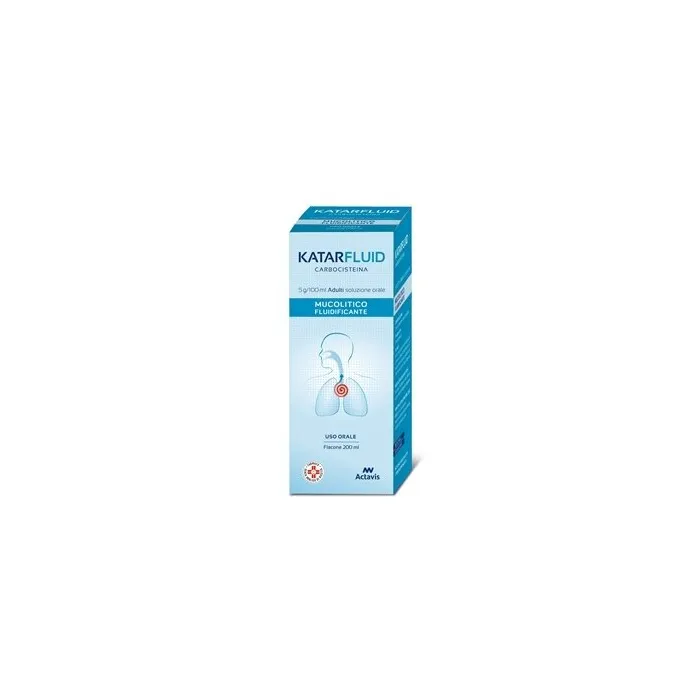
Table of Contents
- Package leaflet: Information for the patient
- KATARFLUID 5 g/100 ml adults oral solution
- 1. What KATARFLUID is and what it is used for
- 2. What you need to know before taking KATARFLUID
- 3. How to take KATARFLUID
- 4. Possible side effects
- 5. How to store KATARFLUID
- 6. Package contents and other information
Package leaflet: Information for the patient
KATARFLUID 5 g/100 ml adults oral solution
Carbocysteine
Generic medicine
Please read all of this leaflet carefully before taking this medicine because it contains important information for you.
Always take this medicine exactly as described in this leaflet or as your doctor or pharmacist has told you to do.
- Keep this leaflet. You may need to read it again.
- If you need more information or advice, consult your pharmacist.
- If you experience any side effects, including those not listed in this leaflet, contact your doctor or pharmacist. See section 4.
- Consult your doctor if you do not notice any improvement or if your symptoms worsen after 5–10 days.
Contents of this leaflet:
- What KATARFLUID is and what it is used for
- What you need to know before taking KATARFLUID
- How to take KATARFLUID
- Possible side effects
- How to store KATARFLUID
- Contents of the pack and other information
1. What KATARFLUID is and what it is used for
This medicinal product contains the active substance carbocisteine, which belongs to a group of medicines called mucolytics, used to help eliminate mucus from the respiratory tract.
KATARFLUID is indicated for the treatment of cough in acute and chronic respiratory diseases characterized by cough and phlegm in adults.
Consult your doctor if you do not feel better or if you feel worse after 5–10 days.
2. What you need to know before taking KATARFLUID
Do not take KATARFLUID
- if you are allergic to carbocisteine or to any of the other ingredients of this medicine (listed in section 6);
- if you have a stomach or intestinal problem called active gastroduodenal ulcer;
- if you are pregnant or breastfeeding (see section “Pregnancy and breastfeeding”).
KATARFLUID is contraindicated in children and adolescents.
Warnings and precautions
Talk to your doctor or pharmacist before taking KATARFLUID.
If, in addition to cough, you develop fever and/or difficulty breathing, consult your doctor, who will determine
the appropriate treatment.
Caution is recommended in elderly patients, in asthmatic patients with a history of severe respiratory problems,
in those with a history of gastroduodenal ulcers, or in those taking medicines known to cause gastrointestinal
bleeding. You must stop treatment with carbocisteine if gastrointestinal bleeding occurs.
This medicine must not be used concomitantly with cough suppressants and/or medicines that inhibit bronchial
secretion.
Other medicines and KATARFLUID
Tell your doctor or pharmacist if you are taking, have recently taken, or might take any other medicines.
No disturbances due to interactions with medicines used to treat upper and lower respiratory tract diseases
are known.
Pregnancy and breastfeeding
If you are pregnant, think you might be pregnant, are planning a pregnancy, or are breastfeeding, ask your
doctor or pharmacist for advice before taking this medicine.
Pregnancy
You must not take KATARFLUID during pregnancy.
Breastfeeding
Use of KATARFLUID is not recommended if you are breastfeeding, as it is unknown whether this medicine is
excreted in breast milk.
Driving and using machines
This medicine does not impair the ability to drive or use machinery.
KATARFLUID contains sorbitol, parahydroxybenzoates and sodium
This medicine contains sorbitol. Sorbitol is a source of fructose. If your doctor has told you that you have an
intolerance to certain sugars, or if you have been diagnosed with hereditary fructose intolerance, a rare genetic
condition in which patients cannot metabolize fructose, talk to your doctor before taking this medicine. It may
cause gastrointestinal disturbances and has a mild laxative effect.
This medicine contains parahydroxybenzoates which may cause allergic reactions (including delayed reactions).
This medicine contains 105 mg of sodium (a component of table salt) per dose (one tablespoon). This corresponds
to 5.25% of the maximum daily dietary intake recommended for an adult.
3. How to take KATARFLUID
Take this medicine exactly as stated in this leaflet or as instructed by your doctor or pharmacist. If you have any doubts, consult your doctor or pharmacist.
Adults
The recommended dose is 2–3 tablespoons per day, spaced 8 hours apart. According to the treating physician’s judgment, the dose may be increased. Take this medicine only for short periods of time. Do not exceed the indicated doses without medical advice.
If you take more KATARFLUID than you should
In case of overdose, symptoms such as headache, nausea, diarrhea, and stomach pain (gastralgia) may occur.
In the event of accidental ingestion or overdose of this medicine, contact your doctor immediately or go to the nearest hospital.
If you forget to take KATARFLUID
Do not take a double dose to make up for the missed dose.
If you have any doubts about how to use this medicine, consult your doctor or pharmacist.
4. Possible side effects
Like all medicines, this medicine can cause side effects, although not everybody will experience them.
Contact your doctor if you experience any of the following side effects:
Very common (may affect more than 1 in 10 people):
- Diarrhoea, nausea, upper abdominal pain.
Frequency not known (frequency cannot be estimated from the available data):
- Severe allergic reactions (anaphylactic reactions, allergic skin rashes, fixed drug eruption).
- Skin irritations and skin disorders (Stevens-Johnson syndrome, bullous dermatitis, erythema multiforme, toxic skin eruption, skin rash). In such cases, discontinue treatment and consult your doctor to establish appropriate therapy.
- Epigastric discomfort.
- Vomiting.
- Gastrointestinal bleeding. In this case, discontinue treatment and consult your doctor to establish appropriate therapy.
- Bronchial obstruction (bronchial occlusion).
- Dizziness.
Reporting of side effects
If you experience any side effect, including those not listed in this leaflet, inform your doctor or pharmacist.
You can also report side effects directly via the national reporting system at www.aifa.gov.it/content/segnalazioni-reazioni-avverse. By reporting side effects, you can help provide more information on the safety of this medicine.
5. How to store KATARFLUID
Keep this medicine out of the sight and reach of children.
Do not use this medicine after the expiry date stated on the packaging after "EXP".
The expiry date refers to the last day of that month.
Store below 25°C.
Do not dispose of any medicine via wastewater or household waste. Ask your pharmacist how to dispose of
medicines you no longer use. This will help protect the environment.
6. Package contents and other information
What KATARFLUID contains
- The active substance is carbocisteine. 100 ml of oral solution contain 5 g of carbocisteine.
- The other components are: sodium citrate, methyl p-hydroxybenzoate, propyl p-hydroxybenzoate, sodium hydroxide, sorbitol 70% solution, banana flavour, purified water.
Description of the appearance of KATARFLUID and contents of the pack
Pack containing 1 bottle of 200 ml.
Marketing Authorization Holder
Aurobindo Pharma Italia S.r.l., via San Giuseppe 102 – 21047 Saronno (VA)
Manufacturer
Special Product’s Line S.p.A., via Fratta Rotonda Vado Largo, 1 – 03012 Anagni (FR)
ITC Farma S.r.l., via Pontina 5 km 29 – 00071 Pomezia (RM)