Kalinox
Italy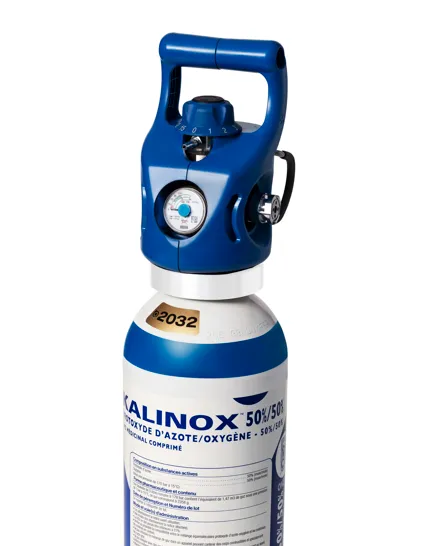
Table of Contents
- PACKAGE LEAFLET: INFORMATION FOR THE USER
- KALINOX 50%/50% medicinal gas, compressed
- 1. WHAT KALINOX 50%/50% medicinal gas, compressed, IS AND WHAT IT IS USED FOR
- 2. WHAT YOU SHOULD KNOW BEFORE USING KALINOX 50%/50% medicinal gas, compressed
- 3. HOW TO USE KALINOX 50%/50% medicinal gas, compressed.
- 4. POSSIBLE ADVERSE REACTIONS
- 5. HOW TO STORE KALINOX 50%/50% medicinal gas, compressed
- 6. PACK CONTENTS AND OTHER INFORMATION
PACKAGE LEAFLET: INFORMATION FOR THE USER
KALINOX 50%/50% medicinal gas, compressed
Nitrous oxide, oxygen
Please read this leaflet carefully before using this medicine as it contains important information for you.
- Keep this leaflet. You may need to read it again.
- If you have any questions, ask your doctor or pharmacist.
- This medicine has been prescribed for you only. Do not give it to others, even if they have the same symptoms as you, because it could be harmful.
- If you experience any adverse reactions, including those not listed in this leaflet, consult your doctor or pharmacist. See section 4.
Contents of this leaflet:
- What KALINOX 50%/50% medicinal gas, compressed is and what it is used for
- What you need to know before using KALINOX 50%/50% medicinal gas, compressed
- How to use KALINOX 50%/50% medicinal gas, compressed
- Possible side effects
- How to store KALINOX 50%/50% medicinal gas, compressed
- Contents of the pack and other information
1. WHAT KALINOX 50%/50% medicinal gas, compressed, IS AND WHAT IT IS USED FOR
KALINOX is a mixture of two medicinal gases (nitrous oxide 50% and oxygen 50%). It belongs to the class of general anaesthetics.
At this concentration, KALINOX has no anaesthetic effects.
It works by reducing pain sensitivity and promoting relaxation during certain medical procedures:
- Short-duration painful procedures in adults and children > 1 month of age, and in particular lumbar puncture ( collection of fluid from the spinal column ), myelography ( bone marrow sampling ), superficial surgery, burn dressing, reduction of simple fractures, reduction of certain peripheral joint dislocations ( procedures to reposition bones or joints ), intravenous puncture ( blood sampling ), emergency medical procedures for trauma, burns and transport.
- Dental procedures in children over 1 month of age, adolescents, and in anxious or disabled patients.
- Childbirth, exclusively in a hospital setting, prior to epidural analgesia or when such analgesia is refused or cannot be administered.
2. WHAT YOU SHOULD KNOW BEFORE USING KALINOX 50%/50% medicinal gas, compressed
DO NOT USE KALINOX:
- If you have been administered an ophthalmic gas (SF6, C2F6, C3F8) used in eye surgery, always inform your doctor so that they can ensure administration does not expose you to serious postoperative complications arising from increased intraocular pressure.
- If your condition requires administration of 100% oxygen.
- In case of intracranial hypertension ( excessive pressure in the head ).
- In case of altered state of consciousness ( not fully normal state of consciousness ).
- If you are in any of the following conditions where air is trapped inside the body:
- Head trauma,
- Maxillofacial trauma,
- Pneumothorax ( accumulation of air between the lung and the chest wall ),
- Emphysematous bullae ( lung alveoli disease causing respiratory problems ),
- Gas embolism ( formation of air bubbles in the bloodstream, e.g. after a diving accident ),
- After a recent underwater dive,
- Decompression sickness,
- Air due to encephalography,
- During ear or paranasal sinus surgery,
- Presence of air in the abdomen,
- Known and untreated deficiency of vitamin B12 or folic acid,
- Epidural anesthesia when air is injected into the epidural space,
- Unexplained recent-onset neurological abnormalities.
Warnings and precautions
- The gas must be administered by trained personnel. However, self-administration is preferred to assess the level of consciousness. NEVER manipulate the KALINOX cylinder.
- Rooms where KALINOX is frequently used must have adequate ventilation or an air extraction system to maintain nitrous oxide concentration in the air at the lowest possible level.
- Breathe normally during inhalation.
- Before administration of KALINOX, fatty substances (creams, ointments, etc.) must not have been applied to the face.
- Success rates are lower in children under 3 years of age.
- In newborns, any adverse effects, particularly respiratory depression, must be closely monitored.
- Prolonged and/or repeated administration may lead to abuse or dependence.
- In case of repeated and prolonged administration, your doctor may need to prescribe vitamin B12 due to inactivation of vitamin B12 caused by KALINOX.
- If you suffer from anemia, atrophic gastritis, intracranial disorders, follow a vegetarian diet, or are an alcoholic, inform your doctor, as these conditions are associated with risk of vitamin B12 deficiency.
- Inform your doctor if you currently have an acute ear inflammation.
Other medicines and KALINOX
- If you have been administered an ophthalmic gas (SF6, C2F6, C3F8) used in eye surgery, always inform your doctor so that they can ensure administration does not expose you to serious postoperative complications that may arise from increased intraocular pressure.
- Concomitant use with medicines acting on the central nervous system (such as morphine derivatives, benzodiazepines, and other psychotropic medicines) increases hypnotic effects. Combination with these medicines requires more careful monitoring.
The combination with medicines interfering with vitamin B12 and/or folate metabolism may increase inactivation of vitamin B12. In case of combination with such medicines, monitoring will be intensified.
Inform your doctor or pharmacist if you are taking or have recently taken any other medicines, including those not requiring a prescription.
Pregnancy and breastfeeding
If you are pregnant, suspect you may be pregnant, planning a pregnancy, or breastfeeding, consult your doctor or pharmacist before taking this medicine.
KALINOX may be used during pregnancy if clinically necessary.
After short-term administration of nitrous oxide, interruption of breastfeeding is not required.
Driving and using machines
If you need to drive or operate machinery after administration of KALINOX (especially after prolonged administration), you must be monitored until any adverse effects have disappeared and until your previous level of alertness has returned.
3. HOW TO USE KALINOX 50%/50% medicinal gas, compressed.
Dosage
Only healthcare professionals are authorized to administer KALINOX. They will explain to you how the inhalation is performed and will monitor you throughout the entire treatment. A family member or friend may also be present.
Administration of KALINOX will be immediately stopped in case of loss of verbal contact.
Maximum effectiveness is achieved after at least 3 minutes of inhalation.
Efficiency is lower in children under 3 years of age.
Method and route of administration
Administration must be carried out in clean and adequately ventilated facilities.
KALINOX is a mixture of two medicinal gases which are inhaled via a mask applied to the face and delivered through a dedicated device.
The patient must breathe normally during inhalation.
After the procedure, the mask is removed and it is necessary to remain at rest until all effects have completely disappeared.
Duration of treatment
The duration of inhalation of the gas mixture depends on the length of the procedure and must not exceed 60 consecutive minutes per day. In the case of repeated administrations, treatment should not be prolonged for more than 15 days.
If more KALINOX has been administered than intended:
The skin may develop a bluish discoloration (cyanosis); in this case, the healthcare professional will immediately stop administration. If cyanosis does not resolve very rapidly, ventilation will be provided using a manually operated bag filled with ambient air or oxygen.
If you interrupt treatment with KALINOX:
As soon as inhalation is stopped, recovery to the baseline condition is almost immediate and without residual effects.
If you have any doubts about the use of KALINOX, consult your doctor or pharmacist.
4. POSSIBLE ADVERSE REACTIONS
Like all medicines, this medicine can cause adverse reactions, although not everyone experiences them.
The following adverse reactions may occur during treatment, and most of them usually disappear within a few minutes after stopping inhalation of the mixture:
Common (≥1/100, <1/10):
- nausea,
- vomiting
Uncommon (≥1/1,000, <1/100):
- Paresthesia ( tingling sensations ),
- increased sedation ( drowsiness ),
- hallucinations,
- anxiety,
- agitation,
- euphoria,
- dreams.
Frequency not known (cannot be estimated based on available data):
- dizziness,
- headache,
- seizures,
- increased intracranial pressure (in patients at risk of intracranial hypertension - see section “Do not use KALINOX”),
- ear pain,
- disorientation,
- respiratory depression (in young children),
- respiratory depression (in newborns when KALINOX is used near delivery - see section “Warnings and precautions”),
- cases of severe visual impairment have been reported in patients who previously received intraocular gas injections for eye surgery (see section “Do not use KALINOX”).
After prolonged or repeated exposure:
Frequency not known (cannot be estimated based on available data):
- Abnormal movements, especially in the context of hyperventilation (increased breathing rate during inhalation),
- Neurological disorders such as myeloneuropathies ( spinal cord disorders ). These adverse reactions are due to vitamin B12 inactivation.
- Megaloblastic anemia with leucopenia ( reduction in red blood cell count accompanied by a reduction in white blood cell count ). These adverse reactions are due to vitamin B12 inactivation.
- Cases of abuse and dependence,
- Vitamin B12 deficiency (see sections “Do not use KALINOX”, “Warnings and precautions”, and “Other medicines and KALINOX”).
Reporting of adverse reactions
If any of the adverse reactions worsens, or if you notice any adverse reaction not listed in this leaflet, inform your doctor or pharmacist.
You can also report adverse reactions directly via the national reporting system at the following website: https://www.aifa.gov.it/content/segnalazioni-reazioni-avverse.
By reporting adverse reactions, you can help provide more information on the safety of this medicine.
5. HOW TO STORE KALINOX 50%/50% medicinal gas, compressed
Keep this medicine out of the sight and reach of children.
Do not use this medicine after the expiry date stated on the label.
The expiry date refers to the last day of the month.
Protect from shocks, falls, sources of heat or ignition, flammable materials, and weather conditions, especially from cold.
Full cylinders must be stored HORIZONTALLY at temperatures between 10 and 30 °C for at least 48 hours before use, with valves closed.
6. PACK CONTENTS AND OTHER INFORMATION
What KALINOX 50%/50% medicinal gas, compressed contains
Active substance:
Nitrous oxide ................................................................................ 50% (mole/mole)
Oxygen ....................................................................................... 50% (mole/mole)
Other components:
Not applicable
Description of the appearance of KALINOX 50%/50% medicinal gas, compressed and contents of the
packaging.
Cylinders have capacities of 2 l, 5 l, 11 l, 15 l and 20 l.
A 2-litre cylinder filled to 170 bar contains the equivalent of 0.59 m³ of gas at a pressure of 1 bar at 15°C, corresponding to 943 g.
A 5-litre cylinder filled to 170 bar contains the equivalent of 1.47 m³ of gas at a pressure of 1 bar at 15°C, corresponding to 2358 g.
An 11-litre cylinder filled to 170 bar contains the equivalent of 3.23 m³ of gas at a pressure of 1 bar at 15°C, corresponding to 5187 g.
A 15-litre cylinder filled to 170 bar contains the equivalent of 4.4 m³ of gas at a pressure of 1 bar at 15°C, corresponding to 7073 g.
A 20-litre cylinder filled to 170 bar contains the equivalent of 5.9 m³ of gas at a pressure of 1 bar at 15°C, corresponding to 9431 g.
Cylinders are made of steel or aluminium and are equipped with a residual pressure brass valve with standard outlet connector or with a brass valve with pressure reducer and standard connector.
Standardized colour: white body and white shoulder with a blue stripe.
Marketing Authorization Holder and Manufacturer
Marketing Authorization Holder
AIR LIQUIDE SANTE INTERNATIONAL
75, QUAI D’ORSAY
75007 PARIS - FRANCE
Manufacturer
AIR LIQUIDE SANTE FRANCE
6 RUE COGNACQ -JAY
75341 PARIS CEDEX 07 - FRANCE
and/or
AIR LIQUIDE MEDICAL
TOLHUISTRAAT 46-48
26-27 SCHELLE – BELGIUM
This medicinal product is authorized in the Member States of the European Economic Area under the following
names:
AUSTRIA: KALINOX
FRANCE: KALINOX
ITALY: KALINOX
POLAND: KALINOX
PORTUGAL: KALINOX
The following information is intended exclusively for healthcare professionals:
Cylinders containing equimolar nitrous oxide-oxygen mixture are intended exclusively for medical use.
The SpO₂ must never be lower than 21%.
Rooms where KALINOX is frequently used must be equipped with an adequate exhaust gas evacuation system or ventilation.
WHAT YOU NEED TO KNOW BEFORE USING KALINOX
- Personnel handling cylinders must be trained in gas handling.
- Do not use cylinders that may have been exposed to negative temperatures.
- If frost forms on the cylinder, do not use it and return it to the pharmacy.
- Do not handle a cylinder whose valve is not protected.
- Never use a cylinder that leaks.
- Never lift a cylinder by its valve.
- Never attempt to repair a damaged cylinder.
- Secure cylinders properly (using chains, hooks) to keep them IN AN UPRIGHT POSITION and prevent accidental falling.
- Never force a cylinder into a support.
PRECAUTIONS FOR THE HANDLER AND THE PATIENT
- Never stand in front of the valve outlet; always stand to the side opposite the pressure reducer, behind and slightly away from the cylinder. Never expose the patient to direct gas flow.
- Handle connection devices with clean, grease-free hands (without gloves and without using pliers).
- Do not use sprays (hair spray, deodorant) or solvents (alcohol, gasoline) on the equipment or in its vicinity.
- Do not cover the patient’s face with greasy substances (vaseline, ointments, etc.).
WARNING
- Do not apply grease.
- Do not smoke.
- Do not place near a flame.
In particular:
a) Never introduce the gas into a device that may have contained flammable materials, and especially greasy substances,
b) Never clean with flammable products, and especially greasy substances, the equipment containing this gas, taps, joints, seals, closure devices and valves.
- In case of leakage, close the valve that is leaking, ventilate the area well and evacuate it.
- In case of fire, the risk of toxicity is higher because nitrous vapours are formed.
INSTRUCTIONS FOR USE AND HANDLING OF CYLINDERS
Follow the following rules to avoid accidents:
Connection:
- For cylinders equipped with a valve:
- Briefly open the cylinder valves before connecting the pressure reducer, to expel dust or foreign particles. Always keep the interface between the cylinder and pressure reducer clean.
- Ensure that the pressure regulating device is suitable and compatible with this gas mixture and that the seal of the pressure reducer-flowmeter is in good condition.
- Use a pressure reducer-flowmeter specifically designed for equimolar medicinal nitrous oxide-oxygen mixture filled to 170 bar (pressure reducer-flowmeter with dual safety mechanism equipped with a specific L-shaped connector compliant with standard NF E 29-650).
- Use a pressure reducer with a flowmeter capable of withstanding pressures at least equal to 1.5 times the maximum working pressure of the cylinder.
- For cylinders equipped with an integrated pressure reducer:
- For safety reasons, these cylinders can only be used with a crimped tube connected to a specific connector with a blue and white fitting and connected to a demand valve, or with a flowmeter equipped with a specific blue and white fitting.
- A specific connector compliant with standard NF S 90-116 must be used for the medicinal nitrous oxide-oxygen mixture.
- Never tighten the pressure reducer-flowmeter with pliers, as this could damage the seal.
- Do not use an intermediate connector to join two devices that do not match.
- If frost appears on the pressure reducer, check that gas flows (inflated bag) because the pressure reducer may be blocked; ventilate the place of use (room, vehicle, etc.) after prolonged use and ensure that gas can be evacuated in case of accident or accidental leakage.
Opening the cylinder after connection
- Follow the instructions on the cylinder label.
- Never force the valve to open it, nor open it fully.
- Always open the valve slowly and gradually to avoid cooling, which may cause demixing.
- Never perform several successive pressurizations of the pressure reducer.
- Do not transfer pressurized gas from one cylinder to another.
After use
-
Close the cylinder valve after use, release the residual pressure in the pressure reducer by leaving the flowmeter open, then close the flowmeter and unscrew the pressure reducer adjustment screw.
-
Store empty cylinders in an UPRIGHT POSITION with valves closed (to prevent corrosion caused by moisture).