Javlor
Italy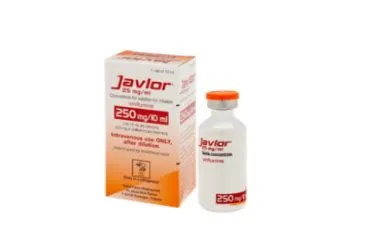
Table of Contents
Package leaflet: Information for the user
Javlor 25 mg/mL concentrate for solution for infusion
Vinflunine
Please read this leaflet carefully before you use this medicine because it contains important information for you.
- Keep this leaflet. You may need to read it again.
- If you have any questions, ask your doctor.
- If you get any side effects, including those not listed in this leaflet, tell your doctor. See section 4.
Contents of this leaflet:
- What Javlor is and what it is used for
- What you need to know before using Javlor
- How to use Javlor
- Possible side effects
- How to store Javlor
- Contents of the pack and other information
1. What Javlor is and what it is used for
Javlor contains the active substance vinflunine, which belongs to a group of anticancer medicines called vinca alkaloids. These medicines affect tumor cell growth by inhibiting cell division and causing cell death (cytotoxicity).
Javlor is used for the treatment of advanced or metastatic bladder and urinary tract cancer after failure of prior platinum-containing therapy.
2. What you need to know before using Javlor
Do not use Javlor
- If you are allergic to the active substance (vinflunine) or to other vinca alkaloids (vinblastine, vincristine, vindesine, vinorelbine)
- If you have had (within the last 2 weeks) or currently have a severe infection
- If your white blood cell and/or platelet counts are too low
- If you are breastfeeding.
Warnings and precautions
Talk to your doctor:
- if you have problems with your liver, kidneys or heart.
- if you experience any neurological symptoms that could indicate "reversible posterior encephalopathy syndrome": brain swelling with usually temporary effects such as headache, altered mental status that may lead to confusion and coma, seizures, vision disturbances, high blood pressure, nausea and vomiting, as it may be necessary to discontinue treatment with this medicine.
- if symptoms of hyponatremia (low sodium levels in the blood) or symptoms of "syndrome of inappropriate antidiuretic hormone secretion" occur, such as headache, fatigue, seizures or coma. Regular monitoring of serum sodium levels is recommended during treatment with Javlor.
- if you are taking any other medicines mentioned in the next section “Other medicines and Javlor”.
- if you have constipation, or if you are being treated with pain medications (opioids), or if you have abdominal cancer or have previously undergone abdominal surgery. Constipation is a very common side effect of Javlor. Laxatives may be administered to prevent constipation.
- if you intend to have children (see important recommendations for men and women in the section below “Pregnancy, breastfeeding and fertility”).
Your blood cell count will be monitored regularly before and during treatment, as low blood cell counts are a very common side effect of Javlor.
Intrathecal administration (into the spinal column) of Javlor can be fatal. Javlor must not be administered intrathecally.
Children and adolescents
Javlor is not suitable for use in children and adolescents.
Other medicines and Javlor
Inform your doctor if you are taking, have recently taken, or might take any other medicine.
In particular, you must inform your doctor if you have taken medicines containing any of the following active substances:
- ketoconazole and itraconazole, used to treat fungal infections
- opioids, used to treat pain
- ritonavir, used to treat HIV infection
- doxorubicin and pegylated liposomal doxorubicin, paclitaxel and docetaxel, used to treat certain types of cancer
- rifampicin, used to treat tuberculosis or meningitis
- herbal preparations containing St. John’s wort (Hypericum perforatum) used to treat mild to moderate depression.
Or if you are taking medicines known to cause changes in the electrocardiogram (ECG), particularly medicines known to cause QT interval prolongation.
Javlor with food and drink
You must inform your doctor if you drink grapefruit juice, as it may increase the effect of Javlor.
You should also drink plenty of water and eat fibre-rich foods.
Pregnancy, breastfeeding and fertility
If you are pregnant, suspect you may be pregnant, plan to become pregnant, or are breastfeeding, consult your doctor before taking this medicine.
If you are a woman or a man of reproductive age, you must use an adequate and effective method of contraception during treatment and for 4 months (if male) or 7 months (if female) after your last dose of Javlor.
Pregnancy
You must not take Javlor during pregnancy unless absolutely necessary.
If you become pregnant during treatment, you must be informed of the potential risk to the unborn child and closely monitored.
Breastfeeding
You must not breastfeed during treatment with Javlor.
Fertility
If you intend to have children, consult your doctor. Before starting therapy, you may wish to seek advice regarding sperm preservation due to the possibility of irreversible infertility caused by vinflunine therapy.
Driving and using machines
Javlor may cause side effects such as fatigue and dizziness. Do not drive or operate machinery if you experience side effects that affect your ability to concentrate or react.
3. How to use Javlor
Dosage
The recommended dose of Javlor in adult patients is 320 mg/m² of body surface area (this is calculated by the physician based on weight and height). Treatment will be repeated every 3 weeks.
Dose adjustment based on age is not required for patients under 75 years of age. The physician will adjust the dose in patients aged 75 years or older.
The physician may also modify the initial dose of Javlor based on physical condition and specific situations:
- if you have previously received pelvic irradiation
- if you have moderate or severe kidney problems
- if you have liver problems.
During treatment, the physician may reduce the dose of Javlor, delay, or interrupt treatment if certain adverse effects occur.
How Javlor is administered
Javlor MUST be administered EXCLUSIVELY by intravenous route.
Javlor must be administered by healthcare personnel (qualified in the use of oncological treatments in specialized medical units) as an intravenous infusion (infusion into the vein) lasting 20 minutes.
Javlor is a concentrate that must be diluted before administration.
If you are given more Javlor than you should receive
The medicine is administered by the physician or nurse. In case an excessive amount is administered (overdose), the physician will monitor for the presence of side effects.
If you miss a dose of Javlor
It is very important not to skip a dose of this medicine. If you miss an appointment, contact your physician immediately to reschedule.
If you stop taking Javlor
Your physician will decide when to discontinue treatment. If you wish to stop treatment prematurely, you must discuss alternative therapeutic options available to you with your physician.
If you have further questions about the use of this medicine, consult your physician.
4. Possible side effects
Like all medicines, this medicine can cause side effects, although not everybody gets them.
Contact your doctor immediately if you experience any of the following serious side effects during treatment with Javlor:
- fever and/or chills, which could be signs of infection,
- chest pain, which could be a sign of heart attack,
- constipation that does not respond to treatment with laxatives,
- neurological symptoms that could indicate "reversible posterior encephalopathy syndrome": brain swelling with usually temporary effects such as headache, altered mental status that may lead to confusion and coma, seizures, vision changes, high blood pressure, nausea and vomiting (see section 2, "Warnings and precautions").
Other side effects may include:
Very common (may affect more than 1 in 10 people)
- abdominal pain, nausea, vomiting
- constipation, diarrhoea
- inflammation of the mouth lining (stomatitis)
- fatigue (asthenia), muscle pain (myalgia)
- loss of touch sensation due to nerve damage (peripheral sensory neuropathy)
- weight loss, reduced appetite
- hair loss (alopecia)
- injection site reactions (pain, redness, swelling)
- fever
- low levels of white blood cells, red blood cells and/or platelets (detected in blood tests)
- low sodium levels in the blood (hyponatraemia) in blood tests.
Common (may affect up to 1 in 10 people)
- infections (neutropenic infection, febrile neutropenia, infections (viral, bacterial, fungal)) with symptoms such as high fever and worsening general health
- chills, excessive sweating (hyperhidrosis), pain
- allergy (hypersensitivity), dehydration, headache, skin rash (pruritus), urticaria
- loss of intestinal muscle movement (ileus), digestive disorders (dyspepsia), difficulty swallowing (dysphagia), mouth disorders (mouth pain, tongue pain, toothache), taste disturbances
- muscle weakness, jaw pain, limb pain, back pain, joint pain, muscle pain, bone pain, ear pain
- dizziness, insomnia, transient loss of consciousness (fainting)
- movement difficulties due to nerve damage (neuropathy) and nerve pain (neuralgia)
- rapid heartbeat (tachycardia), increased blood pressure, low blood pressure
- breathing difficulties (dyspnoea), cough, chest pain
- swelling of arms, hands, feet, ankles, legs or other body parts (oedema)
- inflammation of veins (phlebitis) and blood clot formation in blood vessels (venous thrombosis).
Uncommon (may affect up to 1 in 100 people)
- blood infection with low white blood cell count (neutropenic sepsis)
- vision disorders
- dry skin, skin redness (erythema)
- nerve damage causing muscle contraction problems (peripheral motor neuropathy)
- inflammation of the tube leading to the stomach (oesophagitis), painful swallowing (odynophagia), sore throat (pharyngolaryngeal pain), gum disorders
- weight gain
- urinary problems that could indicate the kidneys are unable to function properly (renal failure)
- ringing or noises in the ears (tinnitus)
- increased liver enzymes (transaminases) detected in blood tests
- "Syndrome of Inappropriate Antidiuretic Hormone Secretion", a condition causing low sodium levels in the blood
- tumour site pain
- sensation of dizziness (vertigo)
- heart attack (myocardial infarction), reduced blood supply (myocardial ischaemia)
- difficult breathing, which may be a symptom of a condition known as acute respiratory distress syndrome and may be severe and life-threatening
- extravasation (when a medicine normally injected into a vein leaks out or is accidentally injected into the surrounding tissue, where it can cause serious damage).
Reporting of side effects
If you experience any side effect, including those not listed in this patient information leaflet, talk to your doctor. You can also report side effects directly via the national reporting system referred to in Annex V.
By reporting side effects, you can help provide more information on the safety of this medicine.
5. How to store Javlor
Keep this medicine out of the sight and reach of children.
Do not use this medicine after the expiry date stated on the vial label and on the carton after EXP.
It is highly unlikely that you will be asked to store this medicine.
The storage conditions are described in detail in the section intended for doctors or healthcare professionals.
Intact vial
Store in a refrigerator (2°C - 8°C).
Keep in the original packaging to protect the medicine from light.
Diluted solution
The diluted solution should be used immediately.
Do not dispose of medicines via wastewater or household waste. Ask your pharmacist how to dispose of medicines you no longer use. This will help protect the environment.
6. Package contents and other information
What Javlor contains
- The active substance is vinflunine. Each mL of concentrate contains 25 mg of vinflunine (as bitartrate). A 2 mL vial contains 50 mg of vinflunine (as bitartrate). A 4 mL vial contains 100 mg of vinflunine (as bitartrate). A 10 mL vial contains 250 mg of vinflunine (as bitartrate).
- The other ingredient is water for injections.
Description of the appearance of Javlor and contents of the pack
Javlor is a clear, colourless to pale yellow solution. It is available in clear glass vials closed with a rubber stopper, containing 2 mL, 4 mL or 10 mL of concentrate. Each pack contains 1 or 10 vials.
Not all pack sizes may be marketed.
Marketing Authorisation Holder
PIERRE FABRE MEDICAMENT
Les Cauquillous
81500 Lavaur
France
Manufacturer
FAREVA PAU
FAREVA PAU 1
Avenue du Béarn
F-64320 Idron
France
For further information about this medicinal product, please contact the local representative of the Marketing Authorisation Holder.
This leaflet was last approved on:
Other sources of information
More detailed information on this medicinal product is available on the website of the European Medicines Agency: http://www.ema.europa.eu
<--------------------------------------------------------------------------------------------------------------------------
The following information is intended exclusively for physicians or healthcare professionals:
INSTRUCTIONS FOR USE
General precautions for preparation and administration
Vinflunine is a cytotoxic antineoplastic medicinal product, and particular care must be taken when handling Javlor, as with other potentially toxic preparations. Appropriate procedures must be followed for handling and disposal of antineoplastic medicinal products. All transfer procedures require strict adherence to aseptic techniques, preferably using a vertical laminar airflow safety cabinet. Javlor must be prepared and administered only by personnel adequately trained in handling cytotoxic agents. Pregnant personnel must not handle Javlor. Use of gloves, goggles, and protective clothing is recommended.
If the solution comes into contact with the skin, wash immediately and thoroughly with soap and water. If contact occurs with mucous membranes, they must be thoroughly rinsed with water.
Dilution of the concentrate
The volume of Javlor (concentrate) corresponding to the calculated dose of vinflunine should be mixed in a 100 mL infusion bag containing sodium chloride 9 mg/mL (0.9%) solution for infusion. Alternatively, glucose 50 mg/mL (5%) solution for infusion may be used. The diluted solution must be protected from light until administration.
Method of administration
Javlor is for intravenous use only.
Javlor is for single use only.
After dilution of the Javlor concentrate, the infusion solution must be administered as follows:
- Establish venous access with a 500 mL bag of sodium chloride 9 mg/mL (0.9%) solution for infusion or glucose 50 mg/mL (5%) solution for infusion, into a large vein preferably in the upper forearm, or via a central venous catheter. Avoid veins on the back of the hand and those near joints.
- Begin intravenous infusion with half of the 500 mL bag (i.e., 250 mL) of sodium chloride 9 mg/mL (0.9%) solution for infusion or glucose 50 mg/mL (5%) solution for infusion, at a free flow rate to flush the vein.
- The Javlor infusion solution must be connected (piggy-back technique) to the side port closest to the 500 mL bag to ensure further dilution of Javlor during administration.
- The Javlor infusion solution must be administered over 20 minutes.
- The patency of the vein must be frequently assessed, and precautions taken to prevent extravasation throughout the infusion period.
- After completion of the infusion, the remaining 250 mL of sodium chloride 9 mg/mL (0.9%) solution for infusion or glucose 50 mg/mL (5%) solution for infusion must be infused at a flow rate of 300 mL per hour. To flush the vein, administration of Javlor must always be followed by at least an equal volume of sodium chloride 9 mg/mL (0.9%) solution for infusion or glucose 50 mg/mL (5%) solution for infusion.
Disposal
Any unused medicinal product and waste materials derived from its use must be disposed of in accordance with local regulations for cytotoxic medicinal products.
Storage conditions:
Intact vial
Store in a refrigerator (2°C – 8°C).
Keep in the original packaging to protect from light.
Prepared diluted solution
The following chemical and physical stability has been demonstrated for the diluted solution:
- Protected from light in a polyethylene or polyvinyl chloride infusion bag: up to 6 days in a refrigerator (2°C – 8°C) or up to 24 hours at 25°C;
- Exposed to light in a polyethylene or polyvinyl chloride infusion set: up to 1 hour at 25°C.
From a microbiological standpoint, the product should be used immediately after dilution. If not used immediately, storage conditions and duration are the responsibility of the user and normally should not exceed 24 hours at 2°C to 8°C, unless the dilution was performed under controlled and validated aseptic conditions.