Ixchiq
Italy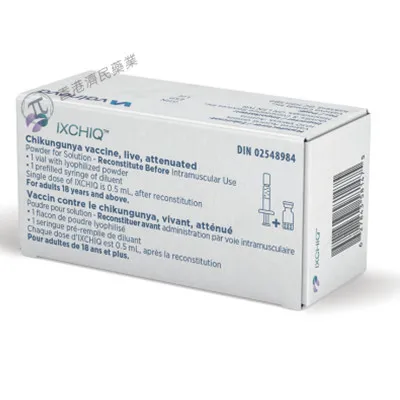
Table of Contents
- Package leaflet: Information for the user
- IXCHIQ powder and solvent for solution for injection
- 1. What IXCHIQ is and what it is used for
- 2. What you should know before receiving IXCHIQ
- 3. How IXCHIQ is administered
- 4. Possible side effects
- 5. How to store IXCHIQ
- 6. Package contents and other information
Package leaflet: Information for the user
IXCHIQ powder and solvent for solution for injection
Chikungunya vaccine (live)
This medicinal product is subject to additional monitoring. This will allow rapid identification of new safety information. You can help by reporting any side effects you experience while taking this medicine. See the end of section 4 for information on how to report side effects.
Please read this leaflet carefully before you start receiving this medicine
because it contains important information for you.
- Keep this leaflet. You may need to read it again.
- If you have any questions, ask your doctor, pharmacist, or nurse.
- If you get any side effects, including those not listed in this leaflet, contact your doctor, pharmacist, or nurse. See section 4.
What is in this leaflet
- What IXCHIQ is and what it is used for
- What you need to know before receiving IXCHIQ
- How IXCHIQ is given
- Possible side effects
- How to store IXCHIQ
- Contents of the pack and other information
1. What IXCHIQ is and what it is used for
IXCHIQ is a vaccine that helps protect adults and adolescents aged 12 years and older
against disease caused by the chikungunya virus (CHIKV).
Chikungunya is a disease caused by the chikungunya virus (CHIKV), transmitted in
subtropical regions of the Americas, Africa, Southeast Asia, India, and the Pacific region. CHIKV is
transmitted to humans through the bite of an infected mosquito. Most people infected with CHIKV
develop sudden fever and severe joint pain in multiple joints. Other symptoms may include headache,
muscle pain, joint swelling, or rash. These symptoms usually resolve within 7–10 days, but can last
for months or years.
Talk to your doctor, pharmacist, or nurse first to decide whether you should receive this
vaccine.
How the vaccine works
IXCHIQ works by teaching the immune system (the body's natural defenses) to protect against CHIKV.
The vaccine contains a form of the virus that has been weakened in the laboratory so that it cannot
replicate. When the body encounters this weakened form of the virus, the immune system recognizes it
and produces antibodies to attack it. When a vaccinated person comes into contact with the virus,
their immune system recognizes it and is ready to defend the body against it. In this way, illness is
prevented.
2. What you should know before receiving IXCHIQ
The vaccine must not be administered:
- If you are allergic to the active substance or to any of the other ingredients of this vaccine (listed in section 6).
- If your immune system has a reduced ability to fight infections and other diseases (immunodeficiency) or if your immune system is weakened (immunocompromised) due to a disease or medication (such as cancer and chemotherapy, use of drugs that weaken the immune system like corticosteroids or immunosuppressants, inherited immune disorders, or HIV infection).
Warnings and precautions
Talk to your doctor, pharmacist, or nurse before receiving IXCHIQ:
- If you have ever had a severe allergic reaction after another vaccine injection.
- If you have a fear of needles or injections or if you have ever fainted after an injection.
- If you have bleeding problems or bruise easily, or if you are taking an anticoagulant medicine (to prevent blood clots).
- If you have recently developed a fever (body temperature above 38 °C). However, you may still receive the vaccination if you have a mild fever or an upper respiratory tract infection such as a cold.
Your doctor will carefully evaluate the benefits and risks before recommending the vaccine, taking into account the risk of infection with the chikungunya virus in the regions where you live or plan to travel. Severe reactions to the vaccine have mainly been reported in individuals aged 65 years and older and in people with chronic medical conditions such as hypertension, diabetes, or heart disease. Inform your doctor or nurse immediately if you experience a worsening of your general health or of any pre-existing conditions (see section 4).
If you are unsure whether any of these conditions apply to you, discuss them with your doctor, pharmacist, or nurse before receiving the vaccine.
Do not donate blood for at least 4 weeks after being vaccinated with IXCHIQ.
Inflammation of the brain
Inflammation of the brain (encephalitis) has been observed after vaccination with IXCHIQ. Symptoms may include confusion, drowsiness, and seizures accompanied by fever and headache. If any of these symptoms occur after vaccination, seek immediate medical attention and mention that you recently received IXCHIQ (see Section 4).
Adverse reactions similar to chikungunya
IXCHIQ may cause side effects similar to those of chikungunya, which can also be severe or last longer (see Section 4).
IXCHIQ may not fully protect all individuals who receive the vaccine.
IXCHIQ does not protect against other mosquito-borne diseases.
You must continue to protect yourself from mosquito bites even after receiving the IXCHIQ vaccine. When traveling to countries with the chikungunya virus, use an insect repellent, wear long pants and long-sleeved shirts, and stay in places with air conditioning or with window and door screens.
Children and adolescents
IXCHIQ may be used in adolescents from 12 years of age. IXCHIQ has not been fully studied in individuals under 12 years of age and should not be used in this age group.
Other medicines and IXCHIQ
Inform your doctor or pharmacist if you are taking, have recently taken, or might take any other medicines.
Pregnancy, breastfeeding, and fertility
If you are pregnant, think you might be pregnant, planning to become pregnant, or breastfeeding, consult your doctor or pharmacist before receiving this vaccine.
IXCHIQ has not been studied in pregnant or breastfeeding women.
Driving and using machines
Some of the side effects of IXCHIQ (see section 4) may temporarily affect your ability to drive or operate machinery. Avoid driving or operating machinery if you do not feel well after vaccination. Wait until these effects have resolved before driving or using machines.
IXCHIQ contains sodium and potassium
This medicine contains less than 1 mmol of sodium (23 mg) per dose, i.e., essentially "sodium-free".
This medicine contains potassium, less than 1 mmol (39 mg) per dose, i.e., essentially "potassium-free".
IXCHIQ contains sorbitol
This medicine contains 25 mg of sorbitol in each 0.5 mL dose, equivalent to 0.036 mg of sorbitol/kg/0.5 mL. The additive effect of co-administered products containing sorbitol (or fructose) and dietary intake of sorbitol (or fructose) should be considered.
3. How IXCHIQ is administered
IXCHIQ is given as a single 0.5 mL injection into the muscle of the upper arm by a doctor, pharmacist, or nurse.
The dose for adolescents aged 12 to under 18 years is the same as that for adults.
If you have any questions about the use of this vaccine, consult your doctor, pharmacist, or nurse.
4. Possible side effects
Like all medicines, this vaccine may cause side effects, although not everybody experiences them.
Serious side effects
Consult a doctor urgently if you experience symptoms of a severe allergic reaction. Such reactions may include a combination of the following symptoms:
- difficulty breathing
- hoarseness or wheezing
- hives or skin rash
- swelling of the lips, face, or throat
- dizziness
- weakness
- rapid heartbeat
In the post-marketing setting, serious but rare reactions to the vaccine have been observed, especially in elderly individuals (65 years of age or older) with multiple long-term medical conditions. These adverse reactions included worsening of general health or chronic medical conditions and brain inflammation, leading to falls, hospitalization, or death (see section 2). Immediately inform your doctor or nurse if you experience worsening of your general health or of pre-existing diseases.
The following serious adverse reactions have been reported (frequency not known – cannot be estimated from available data):
- Inflammation of the brain (encephalitis)
- General dysfunction of the brain, which may be caused by various factors (encephalopathy)
- Inflammation of the membranes surrounding the brain and spinal cord (meningitis)
If you experience symptoms suggesting these adverse reactions, such as confusion, drowsiness, fever, headache, seizures, or neck stiffness, seek immediate medical attention and mention that you recently received IXCHIQ.
Chikungunya-like side effects
IXCHIQ may cause side effects resembling chikungunya (fever ≥ 38 °C together with joint pain, muscle pain, headache, fatigue, or certain neurological, heart, or eye-related symptoms). Symptoms usually begin about 3 days after vaccination and resolve within 4 days. In rare cases (approximately 4 out of 1,000 people), these side effects may last longer than 30 days. Chikungunya-like side effects are mostly mild, but some adults may develop more severe symptoms (approximately 2 out of 100 people).
Other side effects
The following side effects may also occur after receiving this vaccine.
Very common (may affect more than 1 in 10 people):
- headache
- nausea
- fatigue
- muscle pain (myalgia)
- joint pain (arthralgia)
- fever
- tenderness, pain, redness (erythema), hardening, or swelling at the injection site
- low levels of white blood cells
- elevated liver enzyme levels, detected by blood tests
Common (may affect up to 1 in 10 people):
- swollen lymph nodes (lymphadenopathy)
- skin rash
- chills
- back pain
- dizziness
- diarrhoea
- vomiting
- eye pain
Uncommon (may affect up to 1 in 100 people):
- tingling, burning, or prickling sensation usually felt in the hands, arms, legs, or feet (paraesthesia)
- dilation and redness of palpebral blood vessels
- ringing or buzzing in the ears (tinnitus)
- shortness of breath (dyspnoea)
- excessive sweating (hyperhidrosis)
- physical weakness (asthenia)
- swelling in the lower legs or hands (peripheral oedema)
- low levels of platelets in the blood, which may lead to bleeding and bruising
- fainting (syncope)
- decreased appetite
- general feeling of being unwell (not feeling well)
Rare (may affect up to 1 in 1,000 people):
- low levels of water and sodium in the blood (hypovolemic hyponatraemia)
- confusion
Reporting of side effects
If you experience any side effect, including those not listed in this leaflet, talk to your doctor, pharmacist, or nurse. You can also report side effects directly via the national reporting system listed in Appendix V.*
By reporting side effects, you can help provide more information on the safety of this medicine.
5. How to store IXCHIQ
Keep this medicine out of the sight and reach of children.
The doctor, pharmacist, or nurse is responsible for storage of the medicine and for the proper disposal of any unused product. The following information is intended for healthcare professionals.
Do not use this medicine after the expiry date stated on the carton, vial, and syringe after the words "EXP". The expiry date refers to the last day of that month.
Store in a refrigerator at a temperature between 2 °C and 8 °C. Do not freeze.
Keep in the outer packaging to protect from light.
The reconstituted vaccine has been shown to be stable for 2 hours when stored in a refrigerator (2 °C – 8 °C) or at room temperature (15 °C – 25 °C). After this period, the reconstituted vaccine must be discarded.
From a microbiological point of view, once opened, the vaccine should be used immediately. If immediate use is not possible, the storage times and conditions become the responsibility of the user.
Do not dispose of any vaccine in wastewater or household waste. The doctor or nurse will dispose of the vaccine properly. These measures will help protect the environment.
6. Package contents and other information
What IXCHIQ contains
After reconstitution, 1 dose (0.5 mL) contains chikungunya virus strain Δ5nsP3 (live,
attenuated)*, not less than 3.0 log TCID**.
* Produced in Vero cells
** 50% tissue culture infectious dose
This product contains genetically modified organisms (GMOs).
The other components are:
Powder: Sucrose, D-sorbitol, L-methionine, trisodium citrate dihydrate, magnesium chloride, dipotassium
phosphate, monopotassium phosphate, and recombinant human albumin (rHA produced in yeast
(Saccharomyces cerevisiae)).
Solvent: Water for injections, sterile
See section 2 "The vaccine contains sodium and potassium".
Appearance of IXCHIQ and contents of the pack
IXCHIQ is a powder and solvent for injectable solution. The powder is white to slightly yellowish. The
solution is a clear, colourless liquid.
Each pack of IXCHIQ contains:
- 1 vial containing the IXCHIQ powder component for 1 dose as a white to slightly yellowish powder.
- 1 pre-filled syringe containing the solvent for 1 dose of sterile water in a clear solution.
The contents of the two components (vial and syringe) must be mixed before vaccination, providing a
dose of 0.5 mL.
Marketing Authorisation Holder and Manufacturer
Valneva Austria GmbH
Campus Vienna Biocenter 3
1030 Vienna
Austria
[email protected]
Other sources of information
More detailed information on this medicine is available on the website of the European Medicines Agency
http://www.ema.europa.eu
<------------------------------------------------------------------------------------------------------------------------>
The following information is intended for healthcare professionals only:
The vaccine must be reconstituted only with the solvent provided before administration.
For reconstitution of the vaccine, a needle (22–25G) of adequate length should be used, preferably at
least 40 mm (1 1/2").
The syringe is for single use only.
The reconstituted vaccine is a clear, colourless to slightly yellowish liquid solution. The vaccine should
be inspected visually for particulate matter and discoloration prior to administration, wherever the
container and solution permit. If either condition is observed, do not administer the vaccine.
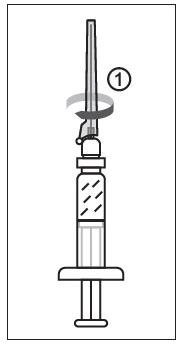
Figure 1
- After removing the syringe cap, attach a needle to the luer lock of the syringe.
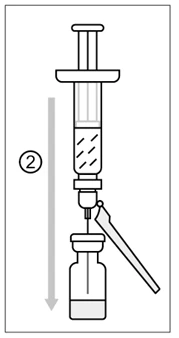
Figure 2
2) Clean the vial stopper. Slowly transfer the entire contents of the pre-filled syringe (solvent) into the vial (powder).
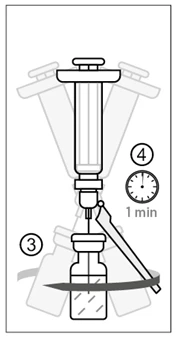
Figure 3
3) Gently rotate the vial to dissolve the powder. Do not shake or invert the vial.
4) After rotating, wait at least one minute for complete reconstitution of the vaccine.
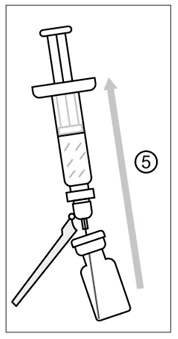
Figure 4
5) After reconstitution, tilt the vial slightly and withdraw the entire contents (0.5 mL) of the reconstituted vaccine into the same syringe. Do not invert the vial to ensure complete withdrawal of the reconstituted volume.
After reconstitution, administer IXCHIQ intramuscularly within 2 hours. If not used within 2 hours, discard the reconstituted vaccine.
Disposal
This product contains genetically modified organisms (GMOs). Any unused product or waste material must be disposed of in accordance with local guidelines for pharmaceutical waste. Any spills must be cleaned up immediately and disinfected according to local policies. Dispose of used syringes and needles in a sharps container, for example, a puncture-resistant, leak-proof, closable container.
Annex IV
Scientific conclusions
Scientific conclusions
Since January 2025, the French overseas departments of the European Union (EU) have been experiencing a large chikungunya outbreak, leading to a vaccination campaign targeting individuals aged 65 years and older with comorbidities at risk of severe disease. The campaign was subsequently extended to all individuals aged 18 years and older. By 25 April 2025, more than 44,000 confirmed cases of chikungunya had been reported in the French overseas territories of Réunion, including at least 9 fatal cases.
By 30 April 2025, the Marketing Authorisation Holder had reported 15 cases of serious adverse events following vaccination with Ixchiq, both within and outside the EU. Of the 9 serious cases reported within the EU, 4 involved individuals over 80 years of age with multiple underlying comorbidities requiring hospitalization. Two (2) of these cases involved severe neurological complications in subjects aged 84 years; one patient died following these complications, while the other was recovering in hospital. In both subjects, the vaccine strain of chikungunya virus was detected in body fluids using polymerase chain reaction (PCR) testing. Consequently, the French public health authority (Haute Autorité de Santé) recommended a temporary suspension of Ixchiq vaccination for individuals aged 65 years and older, pending completion of necessary investigations. The 6 cases reported in the United States were associated with serious neurological or cardiac adverse events following vaccination in travellers aged 67 years and older (source: Vaccine Adverse Event Reporting System, VAERS). Five (5) of these individuals were hospitalized, and all have recovered. All 6 patients had pre-existing comorbidities.
Although the Marketing Authorisation Holder did not establish a causal relationship, a plausible association between vaccination and serious adverse events was considered by at least one expert from the Clinical Immunization Safety Assessment (CISA) project. For this reason, at its meeting on 16 April, the Advisory Committee on Immunization Practices (ACIP) of the U.S. Centers for Disease Control and Prevention (CDC) recommended caution when vaccinating individuals aged 65 years and older, depending on exposure risk. Subsequently, in May, the U.S. Food and Drug Administration (FDA) and the CDC jointly issued a safety communication recommending a pause in the use of the vaccine for individuals aged 60 years and older.
On 7 May 2025, the PRAC recommended, as a temporary measure, a contraindication for Ixchiq in individuals aged 65 years and older during the ongoing review and comprehensive assessment of all available data.