Itrin
Italy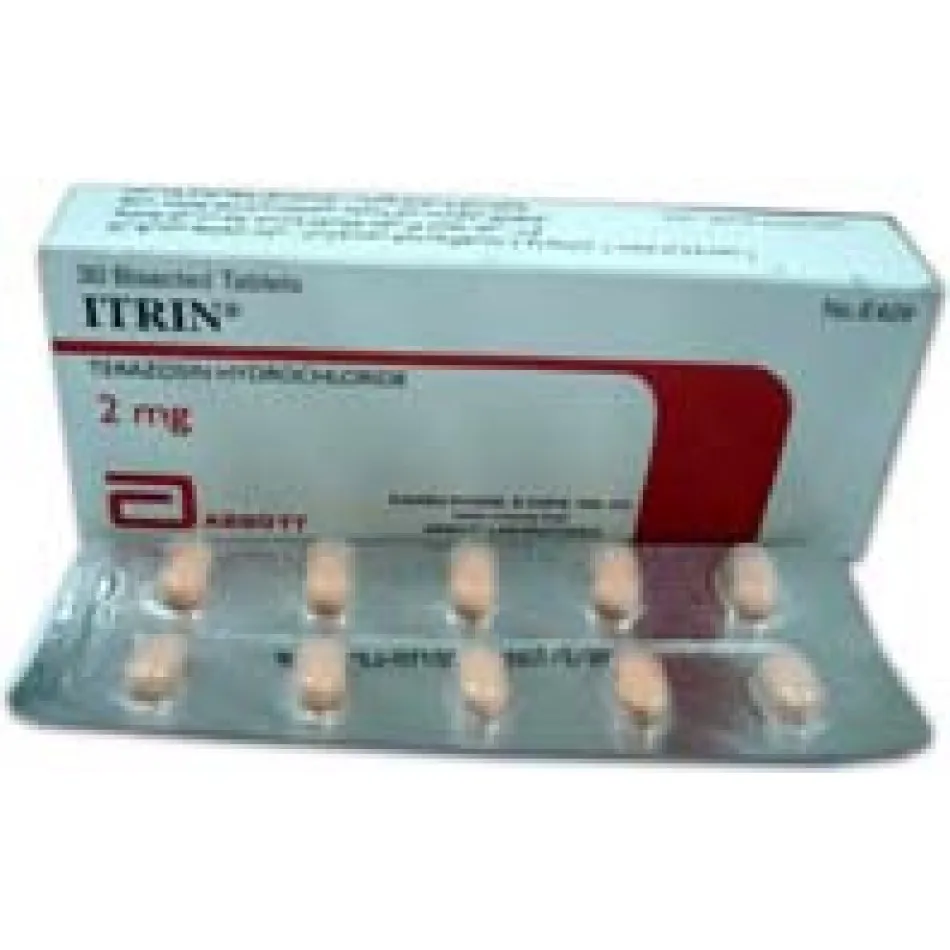
Table of Contents
Patient Information Leaflet
Itrin 2 mg tablets, 5 mg tablets
terazosin
Please read all of this leaflet carefully before you take this medicine because it contains important information for you.
- Keep this leaflet. You may need to read it again.
- If you have any questions, ask your doctor or pharmacist.
- This medicine has been prescribed for you only. Do not give it to other people, even if they have the same symptoms as yours, as it may be harmful.
- If you experience any side effects, including those not listed in this leaflet, contact your doctor or pharmacist. See section 4.
Contents of this leaflet:
- What Itrin is and what it is used for
- What you need to know before taking Itrin
- How to take Itrin
- Possible side effects
- How to store Itrin
- Contents of the pack and other information
1. What Itrin is and what it is used for
Itrin contains the active substance terazosin, which belongs to a group of medicines called alpha-blockers that work by reducing blood pressure (antihypertensives).
Itrin is indicated for the treatment of mild to moderate high blood pressure (hypertension). It may be used alone (monotherapy) or in combination with other antihypertensive medicines.
2. What you need to know before taking Itrin
Do not take Itrin
- if you are allergic to the active substance or to any of the other ingredients of this medicine (listed in section 6)
- if you are allergic to medicines similar to Itrin (quinazoline derivatives)
- if you are pregnant or breastfeeding.
Warnings and precautions
Talk to your doctor or pharmacist before taking Itrin.
After the first doses of the medicine, dizziness, lightheadedness, or weakness (asthenia) may occur.
In such cases, you should lie down for a few minutes.
In some cases, the above effects have occurred in association with rapid dose increases or following concomitant use of high doses of Itrin and another medicine that lowers blood pressure.
Your doctor can minimize this risk by prescribing an initial dose of 1 mg at bedtime, then gradually increasing the dose, and exercising caution if concomitant use with another medicine affecting blood pressure directly or indirectly is considered appropriate.
Any concomitant use with other antihypertensive medicines may require a reduction in the dosage of Itrin.
The 2 mg and 5 mg Itrin tablets are not indicated for the initial phase of therapy.
Symptoms related to reduced blood pressure values, such as dizziness and lightheadedness, may occur more frequently. Your doctor will inform you about the possibility of these effects and advise you on measures to manage them.
You are advised to inform your ophthalmologist about current or previous treatment with terazosin before undergoing surgery to remove lens opacity (cataract).
Terazosin may cause complications during surgery, which can be managed if the specialist is informed in advance.
Take Itrin with caution and consult your doctor if:
- you have heart problems (e.g., aortic or mitral stenosis) causing fluid accumulation in the lungs (pulmonary edema);
- you have severe heart problems (severe heart failure);
- you have had a heart attack (right ventricular infarction) caused by blood vessel problems supplying blood to the lungs (pulmonary embolism) or by fluid accumulation in the membrane surrounding the heart (pericardial effusion);
- you have had a heart attack in a part of the heart called the left ventricle with low blood pressure.
Other medicines and Itrin
Inform your doctor or pharmacist if you are taking, have recently taken, or might take any other medicines.
No interactions have been observed between terazosin and the following medicines:
- analgesics/anti-inflammatory agents (e.g.: paracetamol, aspirin, indomethacin, ibuprofen,
phenylbutazone, propoxyphene, tolmetin); - medicines for heart diseases (cardiac glycosides, e.g., digoxin);
- medicines to lower blood sugar (oral hypoglycemics);
- antiarrhythmic medicines (procainamide, quinidine);
- medicines for anxiety (anxiolytics/sedatives such as chlordiazepoxide, diazepam,
flurazepam); - medicines for gout (antigout agents);
- medicines against infections (antibiotics and chemotherapeutic agents such as penicillin, ampicillin,
erythromycin, tetracycline, trimethoprim, and sulfamethoxazole); - female hormones (estrogens).
Some patients taking medicines of the terazosin class (alpha-blockers) for high blood pressure or prostate enlargement may experience dizziness or a sensation of "empty head," which may be caused by a drop in blood pressure upon sitting or standing up quickly. Some patients have reported these symptoms when taking medicines for erectile dysfunction (impotence) together with medicines of the terazosin class (alpha-blockers).
To reduce the likelihood of these symptoms occurring, you should already be on a stable dose of the alpha-blocker before starting treatment with medicines for erectile dysfunction.
Pregnancy and breastfeeding
If you are pregnant, suspect you may be pregnant, planning a pregnancy, or breastfeeding, consult your doctor or pharmacist before taking this medicine.
Itrin must not be administered during pregnancy or breastfeeding.
Driving and use of machinery
Since drowsiness or dizziness may occur in some cases, exercise caution when driving vehicles and/or operating machinery requiring special attention for at least 12 hours after the initial dose or following dose increases.
Itrin contains lactose
If you have been diagnosed with an intolerance to certain sugars, consult your doctor before taking this medicine.
Itrin contains sunset yellow FCF
It may cause allergic reactions.
3. How to take Itrin
Take this medicine exactly as directed by your doctor or pharmacist. If
you have any doubts, consult your doctor or pharmacist.
The dose of Itrin should be adjusted according to the response of blood pressure values.
The recommended starting dose is:
- 1/2 tablet of 2 mg at bedtime.
Subsequent doses:
- the single daily dose may be increased to 2 mg after 1 or 2 weeks of treatment and subsequently increased to 5 or 10 mg once daily, until the desired blood pressure values are achieved.
Doses higher than 20 mg per day have rarely proven to be more effective.
If other medicines that lower blood pressure are used concomitantly (a thiazide diuretic or a beta-
blocker), it may be necessary to reduce the dose of Itrin, at the doctor's discretion.
If you take more Itrin than you should
In case of accidental ingestion/overdose of Itrin, inform your doctor immediately or go to the nearest hospital.
If you forget to take Itrin
Do not take a double dose to make up for the missed tablet.
If you stop taking Itrin
If you have any doubts about using this medicine, consult your doctor or pharmacist.
4. Possible side effects
Like all medicines, this medicine can cause side effects, although not everybody will experience them.
The following side effects have been reported:
- dizziness
- headache (cephalalgia)
- fever
- abdominal, cervical and chest pain
- nasal congestion (frequency cannot be determined from the available data).
In most cases, these symptoms disappear with continued treatment without requiring a dose reduction.
As with all medicines of the same type as terazosin (quinazoline derivatives), the above-mentioned disturbances may occur, particularly as a first-dose effect.
Other symptoms have been reported, but cannot be clearly distinguished from those that may be present inherently in hypertensive individuals not receiving treatment with terazosin, in particular:
- depression
- insomnia
- irritability, altered sensation (paraesthesia).
Use of the medicine has led to reports of some cases of:
- reduced platelet count in the blood (thrombocytopenia)
- changes in heart rhythm (atrial fibrillation)
- some cases of loss of urinary control (urinary incontinence) in postmenopausal women.
In post-authorisation clinical studies, cases have also been reported of:
- prolonged penile erection (priapism).
Reporting of side effects
If you experience any side effect, including those not listed in this leaflet, talk to your doctor or pharmacist. You can also report side effects directly via the national reporting system at https://www.aifa.gov.it/content/segnalazioni-reazioni-avverse.
By reporting side effects, you can help provide more information on the safety of this medicine.
5. How to store Itrin
This medicine does not require any special storage conditions.
Keep this medicine out of the sight and reach of children.
Do not use this medicine after the expiry date stated on the pack after "Expiry".
The expiry date refers to the last day of that month.
Do not dispose of any medicine via wastewater or household waste. Ask your pharmacist how to
dispose of medicines you no longer use. This will help protect the environment.
6. Package contents and other information
What Itrin contains
COMPOSITION
Itrin 2 mg tablets
- The active substance is terazosin hydrochloride 2.374 mg, equivalent to terazosine base 2 mg
- The other components are lactose, maize starch, talc, magnesium stearate, E-110
Itrin 5 mg tablets
- The active substance is terazosin hydrochloride 5.935 mg, equivalent to terazosine base 5 mg
- The other components are lactose, maize starch, talc, magnesium stearate, E-132, E-110
Description of the appearance of Itrin and package contents
30 tablets of 2 mg
14 tablets of 5 mg
Marketing Authorization Holder and Manufacturer
Marketing Authorization Holder:
Eberlife farmaceutici Spa – Via G. Porzio, SNC – 80143 Napoli
Manufacturer:
Special Product’s Line S.p.A., Via Fratta Rotonda Vado Largo 1, 03012 Anagni (FR)