Itovebi
Italy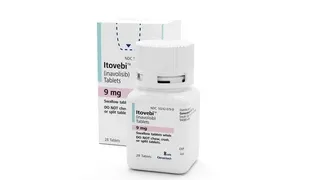
Table of Contents
- Package leaflet: Information for the patient
- Itovebi 3 mg film-coated tablets, 9 mg film-coated tablets
- 1. What Itovebi is and what it is used for
- 2. What you need to know before taking Itovebi
- 3. How to take Itovebi
- 4. Possible side effects
- 5. How to store Itovebi
- 6. Package Contents and Other Information
Package leaflet: Information for the patient
Itovebi 3 mg film-coated tablets, 9 mg film-coated tablets
inavolisib
This medicinal product is subject to additional monitoring. This will allow for the rapid identification of new safety information. You can help by reporting any adverse reactions you experience while taking this medicine. See the end of section 4 for information on how to report adverse reactions.
Please read all of this leaflet carefully before taking this medicine, because it contains important information for you.
- Keep this leaflet. You may need to read it again.
- If you have any questions, ask your doctor or pharmacist.
- This medicine has been prescribed for you only. Do not give it to others, even if their symptoms are the same as yours, as it may be harmful.
- If you experience any adverse reaction, including those not listed in this leaflet, contact your doctor or pharmacist. See section 4.
Contents of this leaflet
- What Itovebi is and what it is used for
- What you need to know before taking Itovebi
- How to take Itovebi
- Possible side effects
- How to store Itovebi
- Contents of the pack and other information
1. What Itovebi is and what it is used for
What Itovebi is
Itovebi contains the active substance inavolisib, which belongs to a group of medicines called
PI3K inhibitors.
What Itovebi is used for
Itovebi is used to treat adults with a type of breast cancer known as:
- estrogen receptor-positive (ER-positive)
- human epidermal growth factor receptor 2-negative (HER2-negative).
It is used in patients whose cancer has recurred during anti-hormonal cancer therapy or within
12 months after completing anti-hormonal cancer therapy. Itovebi is used when a patient's cancer:
- has a specific alteration (mutation) in a gene called "PIK3CA", and
- has spread to nearby tissues or lymph nodes or to other parts of the body ("metastatic").
In patients who have previously received treatment with a "CDK 4/6 inhibitor" medicine, at least
12 months must have passed since stopping the CDK 4/6 inhibitor treatment and the recurrence of
breast cancer.
Before starting treatment with Itovebi, your doctor will perform a test to detect the presence of a
PIK3CA gene mutation.
How Itovebi works
Itovebi works by blocking the effects of a protein called "p110 alpha". This protein is produced by the
PIK3CA gene. A mutation in this gene may cause tumor cells to grow and multiply more rapidly. By
blocking this protein, Itovebi can reduce the growth and spread of cancer and help destroy cancer cells.
Which other medicines Itovebi is given with
Itovebi is used in combination with "palbociclib" and "fulvestrant", medicines used to treat breast cancer.
In women who have not reached menopause and in men, treatment with Itovebi will also be combined with a medicine called a luteinizing hormone-releasing hormone (LHRH) agonist.
For further information, please consult the package leaflets of these medicines.
2. What you need to know before taking Itovebi
Do not take Itovebi
- if you are allergic to inavolisib or to any of the other ingredients of this medicine (listed in section 6).
Warnings and precautions
Talk to your doctor or pharmacist before taking Itovebi if you have previously had:
- high blood sugar levels, diabetes or signs of high blood sugar (hyperglycaemia), such as excessive thirst and dry mouth, need to urinate more often than usual, increased urine output, feeling tired, feeling unwell (nausea), increased appetite with weight loss, blurred vision and/or feeling dizzy;
- kidney problems.
Inform your doctor immediately if you develop symptoms of any of the following side effects
during treatment with Itovebi (see “Serious side effects” in section 4 for more
information):
- high blood sugar levels (hyperglycaemia) – your doctor may advise you to drink more water during treatment with Itovebi
- inflammation of the lining of the mouth (stomatitis).
Your doctor may need to treat these symptoms, suspend treatment, reduce the dose or permanently discontinue treatment with Itovebi.
Monitoring during treatment with Itovebi
Your doctor will carry out blood tests before starting treatment with Itovebi and at regular
intervals during treatment. These are to monitor your blood sugar levels.
Your doctor may also ask you to monitor your blood sugar levels at home during treatment with Itovebi.
- Your doctor will tell you exactly when to perform blood glucose testing.
- This will be required more frequently during the first 4 weeks of treatment. If you have any doubts about how to measure your blood glucose, consult your doctor, pharmacist or nurse.
Based on the results, your doctor will take all necessary actions, such as prescribing a medicine to lower blood sugar levels. If necessary, your doctor may decide to suspend treatment with Itovebi or reduce the dose of Itovebi to lower blood sugar levels. Your doctor may also decide to permanently discontinue treatment with Itovebi.
Children and adolescents
This medicine must not be given to children and adolescents under 18 years of age.
This is because Itovebi has not been studied in this age group.
Other medicines and Itovebi
Inform your doctor or pharmacist if you are taking, have recently taken or might take any other medicines. This is because Itovebi may increase or decrease the effectiveness of certain medicines. This includes over-the-counter medicines and herbal preparations.
In particular, inform your doctor or pharmacist if you are taking:
- alfentanil (a medicine used to treat pain and for anaesthesia)
- astemizole (a medicine used to treat allergies)
- cisapride (a medicine used to treat heartburn and acid reflux)
- paclitaxel (a medicine used to treat various cancers)
- quinidine (a medicine used to treat certain types of heart arrhythmias)
- warfarin (a medicine used to treat or prevent blood clots)
- medicines to prevent seizures or epileptic attacks (such as phenytoin and S-mephenytoin)
- medicines that act on the immune system (cyclosporine, sirolimus and tacrolimus)
The medicines listed above may not be the only ones that could interact with Itovebi. Ask your doctor or pharmacist if you are unsure whether your medicine is one of those listed above.
Pregnancy
- You must not take Itovebi during pregnancy because Itovebi may harm the unborn baby.
- If you are a woman of childbearing age, your doctor will check that you are not already pregnant before starting treatment with Itovebi. This may include a pregnancy test.
- If you become pregnant while being treated with this medicine, inform your doctor immediately.
- If you or your partner are planning a pregnancy, consult your doctor or pharmacist before taking this medicine.
Male and female contraception
- If you are a woman of childbearing age, you must use a non-hormonal method of birth control during treatment and for 1 week after stopping Itovebi. Ask your doctor or pharmacist which methods are most suitable.
- If you are a man and have a female partner of childbearing age or who could become pregnant, you must use a condom during treatment and for 1 week after stopping Itovebi.
Breast-feeding
- You must not breast-feed during treatment with Itovebi and for 1 week after stopping it. This is because it is not known whether this medicine passes into breast milk and could harm the newborn baby.
Driving and using machines
Itovebi may affect your ability to drive and use machines. If you feel tired during treatment with Itovebi, take particular care when driving or operating tools or machinery. You should not drive or use machines until you are certain that your ability to perform such activities is not impaired.
Itovebi contains lactose and sodium
If your doctor has diagnosed you with an intolerance to certain sugars, contact them before taking this medicine.
This medicine contains less than 1 mmol (23 mg) of sodium per film-coated tablet, i.e. essentially “sodium-free”.
3. How to take Itovebi
Take this medicine exactly as your doctor or pharmacist has told you. If you have any doubts, consult your doctor or pharmacist.
How much Itovebi to take
The usual starting dose of Itovebi is 9 mg taken once daily.
Your doctor will determine the right dose for you. You may be prescribed:
- 6 mg once daily, or
- 3 mg once daily.
Depending on your response to treatment with Itovebi, your doctor may adjust your dose. If you experience certain side effects, your doctor may ask you to switch to a lower dose, temporarily stop treatment, or stop it permanently.
How to take Itovebi
Take Itovebi once daily, with or without food. Taking Itovebi at the same time each day will help you remember when to take it.
Itovebi tablets must be swallowed whole; they must not be chewed, crushed, or split before swallowing. Do not take tablets that are broken, cracked, or otherwise damaged, as you may not receive the full dose.
How long to take Itovebi
Continue taking Itovebi every day for as long as your doctor has prescribed.
This is a long-term treatment, which may last for months or years. Your doctor will regularly monitor your condition to check that the treatment is working as expected.
If you have any questions about how long to take Itovebi, speak to your doctor or pharmacist.
If you take more Itovebi than you should
If you take more Itovebi than prescribed, contact your doctor or go to the hospital immediately. Bring the medicine pack and this leaflet with you.
If you forget to take Itovebi
If you miss a dose of Itovebi, you may still take it up to 9 hours after the time you were supposed to take it.
- If more than 9 hours have passed since the scheduled time, skip the missed dose for that day.
- The next day, take your dose at the usual time.
Do not take a double dose to make up for a forgotten dose.
If you vomit shortly after taking a dose of Itovebi
If you vomit after taking a dose of Itovebi, do not take an additional dose that day. Take your regular dose of Itovebi at the usual time the next day.
If you stop taking Itovebi
Do not stop treatment with Itovebi unless your doctor tells you to, or unless you experience serious side effects (see section 4 “Possible side effects”). Stopping treatment may worsen your condition.
If you have any questions about using this medicine, consult your doctor or pharmacist.
4. Possible side effects
Like all medicines, this medicine can cause side effects, although not everyone will experience them.
Inform your doctor if you experience any of the following side effects during treatment with Itovebi.
Your doctor may need to treat these symptoms, temporarily suspend treatment, reduce the dose, or permanently discontinue treatment with Itovebi.
Serious side effects
If you experience any of these side effects, stop taking this medicine and contact your doctor immediately:
- High blood sugar levels (hyperglycaemia) (very common; may affect more than 1 in 10 people), symptoms include:
- Difficulty breathing
- Nausea and vomiting (lasting longer than 2 hours)
- Stomach pain, extreme thirst or dry mouth
- Urinating more frequently than usual or producing larger amounts of urine than usual
- Blurred vision
- Unusual increase in appetite
- Weight loss, fruity-smelling breath
- Flushed face, dry skin and unusual drowsiness or tiredness
- Inflammation of the mucous membrane lining the mouth (stomatitis) (very common: may affect more than 1 in 10 people), symptoms include:
- Pain
- Redness
- Swelling
- Mouth ulcers
- A serious complication of hyperglycaemia leading to high levels of ketones in the blood, which may make the blood more acidic (ketoacidosis) (uncommon; may affect up to 1 in 100 people), symptoms of which may include:
- Breathing difficulties
- Headache
- Nausea
- Vomiting
Other side effects
Inform your doctor or pharmacist if you notice any of the following side effects or if they worsen:
Very common (may affect more than 1 in 10 people)
- Diarrhoea
- Low platelet levels (which help blood to clot), possibly causing unusual bruising or bleeding (thrombocytopenia)
- Tiredness
- Low red blood cell levels (anaemia), which may cause tiredness, feeling unwell and pale skin
- Feeling unwell (nausea)
- Skin rash
- Loss of appetite
- Headache
- Hair loss or thinning (alopecia)
- Weight loss
- Increased levels of alanine aminotransferase (a type of liver enzyme), detected in blood tests
- Low potassium levels, detected in blood tests
- Abdominal pain
- Vomiting
- Dry skin
- Urinary tract infection
Common (may affect up to 1 in 10 people)
- Low calcium levels, detected in blood tests
- Dry eyes
- Indigestion (dyspepsia)
- High insulin levels (a hormone that helps the body use sugar to produce energy), detected in blood tests
- Altered sense of taste (dysgeusia)
- Skin inflammation with rash (dermatitis)
- Infection or inflammation of hair follicles (folliculitis)
Inform your doctor or pharmacist if you notice the onset or worsening of any of these side effects.
Reporting of side effects
If you experience any side effect, including those not listed in this leaflet, talk to your doctor or pharmacist. You can also report side effects directly via the national reporting system detailed in Annex V. Reporting side effects can help provide more information on the safety of this medicine.
5. How to store Itovebi
Keep this medicine out of the sight and reach of children.
Do not use this medicine after the expiry date stated on the carton and blister after
Exp./EXP. The expiry date refers to the last day of that month.
This medicine does not require any special storage conditions.
Do not use this medicine if you notice any damage to the packaging or signs of tampering,
or if the tablet is broken, cracked, or otherwise not intact.
Do not dispose of any medicine via wastewater or household waste. Ask your pharmacist how
to dispose of medicines no longer used. This will help protect the environment.
6. Package Contents and Other Information
What Itovebi Contains
- The active substance is inavolisib.
- Each 3 mg film-coated tablet contains 3 mg of inavolisib.
- Each 9 mg film-coated tablet contains 9 mg of inavolisib.
The other components are:
- Tablet core (3 mg and 9 mg film-coated tablets): lactose monohydrate, magnesium stearate (E470b), microcrystalline cellulose (E460), sodium starch glycolate (see section 2 “Itovebi contains lactose and sodium”).
- Film coating (3 mg film-coated tablets): partially hydrolyzed polyvinyl alcohol; titanium dioxide (E171); macrogol; talc (E553b); iron oxide red (E172).
- Film coating material (9 mg film-coated tablets): partially hydrolyzed polyvinyl alcohol; titanium dioxide (E171); macrogol; talc (E553b); iron oxide red (E172); iron oxide yellow (E172).
Description of the Appearance of Itovebi and the Contents of the Pack
Itovebi 3 mg film-coated tablets are red, round, and convex, with “INA 3” engraved on one side. Approximate diameter: 6 mm.
Itovebi 9 mg film-coated tablets are pink, oval-shaped, with “INA 9” engraved on one side. Approximate dimensions: 13 mm (length), 6 mm (width).
Itovebi film-coated tablets are supplied in cardboard boxes containing 28 × 1 film-coated tablets in single-dose perforated blisters.
Marketing Authorization Holder
Roche Registration GmbH
Emil-Barell-Strasse 1
79639 Grenzach-Wyhlen
Germany
Manufacturer
Roche Pharma AG
Emil-Barell-Strasse 1
79639 Grenzach-Wyhlen
Germany
For further information on this medicinal product, please contact the local representative of the marketing authorization holder:
België/Belgique/Belgien, Lietuva
UAB “Roche Lietuva”
N.V. Roche S.A.
Tél/Tel: +32 (0) 2 525 82 11
България
Рош България ЕООД
Тел: +359 2 474 5444
Magyarország
Roche (Magyarország) Kft.
Tel: +36 - 1 279 4500
Česká republika
Roche s. r. o.
Tel: +420 - 2 20382111
Nederland
Roche Nederland B.V.
Tel: +31 (0) 348 438050
Danmark
Roche Pharmaceuticals A/S
Tlf: +45 - 36 39 99 99
Norge
Roche Norge AS
Tlf: +47 - 22 78 90 00
Deutschland
Roche Pharma AG
Tel: +49 (0) 7624 140
Österreich
Roche Austria GmbH
Tel: +43 (0) 1 27739
Eesti
Roche Eesti OÜ
Tel: + 372 - 6 177 380
Polska
Roche Polska Sp.z o.o.
Tel: +48 - 22 345 18 88
Ελλάδα, Κύπρος
Roche (Hellas) A.E.
Τηλ: +30 210 61 66 100
Portugal
Roche Farmacêutica Química, Lda
Tel: +351 - 21 425 70 00
España
Roche Farma S.A.
Tel: +34 - 91 324 81 00
România
Roche România S.R.L.
Tel: +40 21 206 47 01
France
Roche
Tél: +33 (0) 1 47 61 40 00
Slovenija
Roche farmacevtska družba d.o.o.
Tel: +386 - 1 360 26 00
Hrvatska
Roche d.o.o.
Tel: +385 1 4722 333
Slovenská republika
Roche Slovensko, s.r.o.
Tel: +421 - 2 52638201
Ireland, Malta
Roche Products (Ireland) Ltd.
Tel: +353 (0) 1 469 0700
Suomi/Finland
Roche Oy
Puh/Tel: +358 (0) 10 554 500
Ísland
Roche Pharmaceuticals A/S
c/o Icepharma hf
Sími: +354 540 8000
Sverige
Roche AB
Tel: +46 (0) 8 726 1200
Italia
Roche S.p.A.
Tel: +39 - 039 2471
Latvija
Roche Latvija SIA
Tel: +371 - 6 7039831
Additional Sources of Information
More detailed information on this medicinal product is available on the website of the European Medicines Agency: https://www.ema.europa.eu