Isturisa
Italy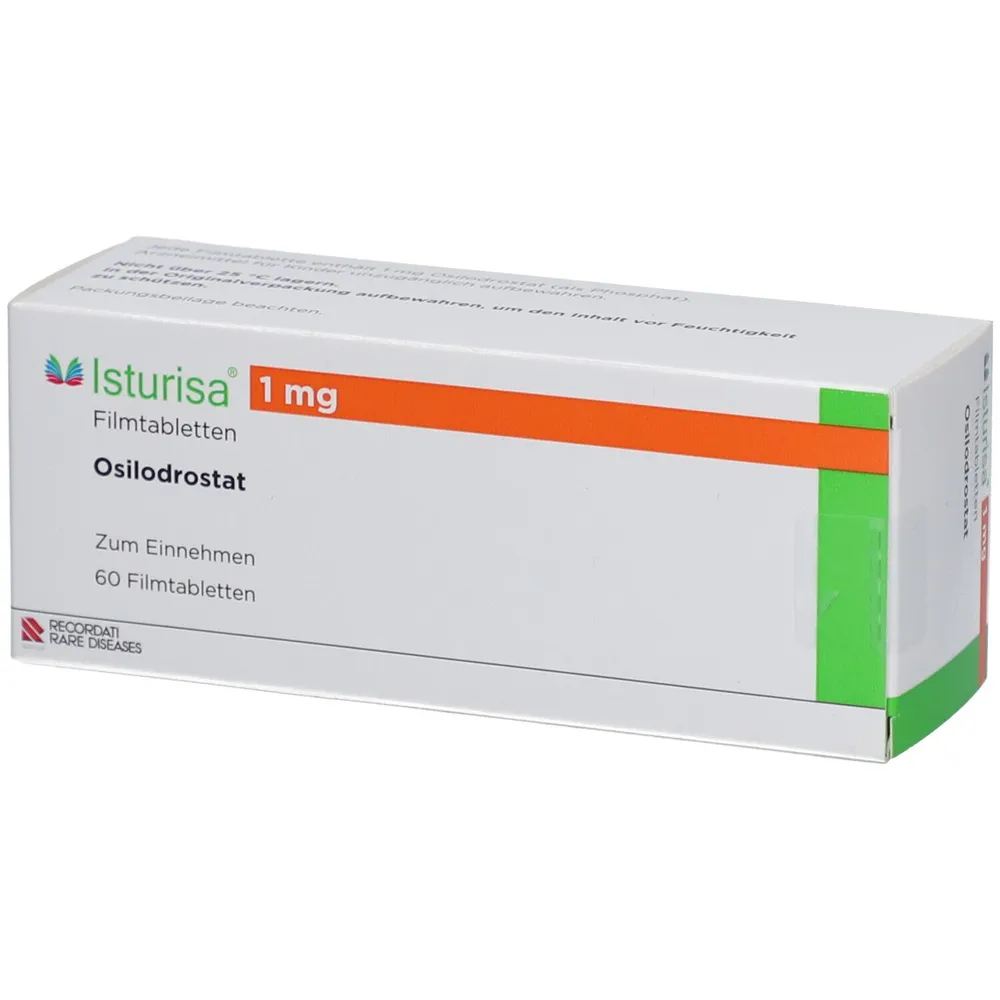
Table of Contents
- Package leaflet: Information for the patient
- Isturisa 1 mg film-coated tablets, 5 mg film-coated tablets, 10 mg film-coated tablets
- 1. What Isturisa is and what it is used for
- 2. What you need to know before taking Isturisa
- 3. How to take Isturisa
- 4. Possible side effects
- 5. How to store Isturisa
- 6. Package contents and other information
Package leaflet: Information for the patient
Isturisa 1 mg film-coated tablets, 5 mg film-coated tablets, 10 mg film-coated tablets
osilodrostat
Please read this leaflet carefully before taking this medicine because it contains
important information for you.
- Keep this leaflet. You may need to read it again.
- If you have any questions, ask your doctor or pharmacist.
- This medicine has been prescribed for you only. Do not give it to other people, even if their symptoms are the same as yours, as it may be harmful.
- If you experience any side effect, including those not listed in this leaflet, tell your doctor or pharmacist. See section 4.
What is in this leaflet
- What Isturisa is and what it is used for
- What you need to know before taking Isturisa
- How to take Isturisa
- Possible side effects
- How to store Isturisa
- Contents of the pack and other information
1. What Isturisa is and what it is used for
What Isturisa is
Isturisa is a medicine that contains the active substance osilodrostat.
What Isturisa is used for
Isturisa is used in adults for the treatment of endogenous Cushing’s syndrome, a condition in which the body produces an excessive amount of a hormone called cortisol. Excess cortisol can lead to a variety of symptoms such as increased body weight (particularly around the waist), rounded face (moon face), easy bruising, irregular menstrual cycles, excessive body and facial hair, and generally feeling weak, tired, or unwell.
How Isturisa works
Isturisa blocks the main enzyme responsible for cortisol production in the adrenal glands, thereby reducing excessive cortisol production and improving the symptoms of endogenous Cushing’s syndrome.
2. What you need to know before taking Isturisa
Do not take Isturisa
- if you are allergic to osilodrostat or to any of the other ingredients of this medicine (listed in section 6).
Warnings and precautions
Talk to your doctor or pharmacist before taking Isturisa.
If you have any of the following conditions, talk to your doctor before taking Isturisa:
- if you have heart diseases or a heart rhythm disorder such as irregular heartbeat, including a condition known as long QT syndrome (prolongation of the QT interval);
- if you have liver disease; your doctor may need to adjust your dose of Isturisa.
Contact your doctor immediately if, during treatment with Isturisa, you experience two or more of the following symptoms. These may indicate adrenal insufficiency (low cortisol levels):
- weakness
- dizziness
- fatigue
- loss of appetite
- nausea
- vomiting
After stopping Isturisa, these symptoms may persist for several months. You should contact your doctor, as you may require additional monitoring and/or treatment.
Tests before and during treatment
Your doctor will prescribe blood and/or urine tests before starting treatment and at regular intervals during treatment. These tests are used to detect possible abnormalities in your levels of magnesium, calcium, and potassium, as well as to measure cortisol levels. Depending on the results, your doctor may adjust your dosage.
This medicine may have an unwanted effect (known as QT prolongation) on heart function. Therefore, your doctor will also monitor this effect by performing an electrocardiogram (ECG) before starting treatment and during treatment.
If Cushing's syndrome is caused by a benign tumour (called an adenoma) of the pituitary gland (also known as the pituitary gland), your doctor may consider discontinuing treatment if imaging tests of the pituitary show that the adenoma has expanded into nearby areas.
Children and adolescents
The use of this medicine is not recommended in patients under 18 years of age, as there is insufficient data available for these patients.
Other medicines and Isturisa
Inform your doctor or pharmacist if you are taking, have recently taken, or might take any other medicines. It is particularly important that you inform your doctor if you are taking any of the following medicines:
- medicines that may have an unwanted effect (known as QT prolongation) on heart function. These include medicines used for heart rhythm disorders such as quinidine, sotalol, and amiodarone; medicines used for allergies (antihistamines); antidepressants such as amitriptyline and medicines for mental disorders (antipsychotics); antibiotics, including the following types: macrolides, fluoroquinolones, or imidazoles; and other medicines for Cushing's disease (pasireotide, ketoconazole)
- theophylline (used to treat breathing problems) or tizanidine (used to treat muscle pain and spasms)
Pregnancy and breastfeeding
This medicine should not be taken during pregnancy or breastfeeding, unless your doctor has advised you to take it. If you are pregnant, suspect you may be pregnant, planning to become pregnant, or breastfeeding, consult your doctor or pharmacist before taking this medicine.
Contraception
Women of childbearing potential must use an effective method of contraception during treatment and for at least one week after the last dose. Discuss with your doctor the need for contraceptive measures before starting Isturisa.
Driving and using machines
Dizziness and fatigue may occur during treatment with Isturisa. Do not drive or operate machinery if you experience these symptoms.
Isturisa contains sodium
This medicine contains less than 1 mmol (23 mg) of sodium per tablet, i.e. essentially 'sodium-free'.
3. How to take Isturisa
Take this medicine exactly as instructed by your doctor or pharmacist. If
you have any doubts, consult your doctor or pharmacist.
The usual starting dose is two 1 mg tablets twice daily (approximately every 12 hours). Patients of
Asian origin and patients with liver disease may require a lower starting dose
(one 1 mg tablet twice daily).
After starting treatment, your doctor may adjust your dose. This will depend on your response to
treatment. The maximum recommended dose is 30 mg twice daily.
Isturisa tablets are taken orally and can be taken with or without food.
If you take more Isturisa than you should
If you have taken more Isturisa than you should and you do not feel well (for example, if you feel dizzy, weak, tired, nauseous, or if you need to vomit) or if someone else accidentally takes your medicine, contact a doctor or hospital immediately for assistance. Medical treatment may be necessary.
If you forget to take Isturisa
Do not take a double dose to make up for the missed tablet. Instead, wait until it is time to take your next dose and take it at the scheduled time.
If you stop taking Isturisa
Do not stop taking Isturisa unless your doctor tells you to. If you stop treatment with Isturisa, symptoms may return.
4. Possible side effects
Like all medicines, this medicine can cause side effects, although not everyone gets them.
Some side effects can be serious. Pay particular attention to the following:
- immediately inform your doctor if you experience a heart disorder or a disturbance in your heartbeat rhythm, such as a fast and irregular heartbeat even at rest, palpitations, loss of consciousness or fainting (this could be a sign of a condition known as QT prolongation, a side effect that may affect up to 1 in 10 people);
- immediately inform your doctor if you experience two or more of the following symptoms: weakness, feeling of light-headedness, tiredness (fatigue), loss of appetite, nausea, vomiting. This may indicate adrenal insufficiency (low cortisol levels), a side effect that may affect more than 1 in 10 people. Adrenal insufficiency occurs when Isturisa excessively reduces the amount of cortisol. It is more likely to occur during periods of increased stress. Your doctor will correct this by prescribing a hormonal medicine or adjusting your Isturisa dose.
Very common side effects (may affect more than 1 in 10 people):
- low cortisol levels (adrenal insufficiency)
- vomiting
- nausea
- diarrhoea
- abdominal pain
- tiredness (fatigue)
- fluid retention causing swelling (oedema), particularly in the ankles
- abnormalities in blood tests (increased testosterone levels, increased adrenocorticotropic hormone levels, also known as ACTH, low potassium levels)
- decreased appetite
- dizziness
- fast heartbeat (tachycardia)
- myalgia (muscle pain)
- arthralgia (joint pain)
- headache
- rash
- low blood pressure (hypotension)
- excessive growth of facial or body hair (hirsutism)
- acne.
Common side effects (may affect up to 1 in 10 people):
- feeling generally unwell
- abnormalities in liver function test results
- fainting (syncope)
- abnormal electrical activity of the heart affecting its rhythm.
Reporting of side effects
If you experience any side effect, including those not listed in this leaflet, talk to your doctor. You can also report side effects directly via the national reporting system listed in Annex V. By reporting side effects, you can help provide more information on the safety of this medicine.
5. How to store Isturisa
Keep this medicine out of the sight and reach of children.
Do not use this medicine after the expiry date which is stated on the carton after Exp. and on the
blister after EXP. The expiry date refers to the last day of that month.
Do not store above 25 °C.
Store in the original packaging to protect the medicine from moisture.
Do not dispose of medicines via wastewater or household waste. Ask your pharmacist how to
dispose of medicines you no longer use. This will help protect the environment.
6. Package contents and other information
What Isturisa contains
- The active substance is osilodrostat. Each film-coated tablet contains 1 mg of osilodrostat, 5 mg of osilodrostat, or 10 mg of osilodrostat.
- The other components are:
- inside the tablet: microcrystalline cellulose, mannitol, sodium croscarmellose (see section 2 “Isturisa contains sodium”), magnesium stearate, anhydrous colloidal silicon dioxide
- in the tablet coating: hypromellose, titanium dioxide (E171), iron oxides (E172, see below), macrogol, and talc.
- Isturisa 1 mg film-coated tablets contain yellow iron oxide and red iron oxide.
- Isturisa 5 mg film-coated tablets contain yellow iron oxide.
- Isturisa 10 mg film-coated tablets contain yellow iron oxide, red iron oxide, and black iron oxide.
Description of the appearance of Isturisa and contents of the pack
Isturisa is available in packs containing 60 film-coated tablets.
The 1 mg tablets are round, light yellow in colour, non-divisible, with “1” engraved on one side,
and have a diameter of approximately 6.1 mm.
The 5 mg tablets are round, yellow in colour, non-divisible, with “5” engraved on one side,
and have a diameter of approximately 7.1 mm.
The 10 mg tablets are round, brown-orange in colour, non-divisible, with “10” engraved on one side,
and have a diameter of approximately 9.1 mm.
Marketing Authorization Holder
Recordati Rare Diseases
Tour Hekla
52 avenue du Général de Gaulle
92800 Puteaux
France
Manufacturer
Millmount Healthcare Ltd
Block 7, City North
Business Campus, Stamullen,
Co. Meath, K32 YD60,
Ireland
Recordati Rare Diseases
Tour Hekla
52 avenue du Général de Gaulle
92800 Puteaux
France
Recordati Rare Diseases
Eco River Parc
30 rue des Peupliers
92000 Nanterre
France
For further information on this medicinal product, please contact the local representative of the Marketing Authorization Holder:
België/Belgique/Belgien Lietuva
Recordati Recordati AB.
Tél/Tel: +32 2 46101 36 Tel: + 46 8 545 80 230
Švedija
България Luxembourg/Luxemburg
Recordati Rare Diseases Recordati
Teл.: +33 (0)1 47 73 64 58 Tél/Tel: +32 2 46101 36
France Belgique/Belgien
Česká republika Magyarország
Recordati Rare Diseases Recordati Rare Diseases
Tel: +33 (0)1 47 73 64 58 Tel.: +33 (0)1 47 73 64 58
France Franciaország
Danmark Malta
Recordati AB. Recordati Rare Diseases
Tlf.: + 46 8 545 80 230 Tel: +33 1 47 73 64 58
Sweden Franza
Deutschland Nederland
Recordati Rare Diseases Germany GmbH Recordati
Tel: +49 731 140 554 0 Tel: +32 2 46101 36
België
Eesti Norge
Recordati AB. Recordati AB.
Tel: + 46 8 545 80 230 Tlf: + 46 8 545 80 230
Estonia Sweden
Ελλάδα Österreich
Recordati Hellas Recordati Rare Diseases Germany GmbH
Τηλ: +30 210 6773822 Tel: +49 731 140 554 0
Greece Germany
España Polska
Recordati Rare Diseases Spain S.L.U. Recordati Rare Diseases
Tel: + 34 91 659 28 90 Tel.: +33 (0)1 47 73 64 58
Poland
France Portugal
Recordati Rare Diseases Recordati Rare Diseases SARL
Tél: +33 (0)1 47 73 64 58 Tel: +351 21 432 95 00
Hrvatska România
Recordati Rare Diseases Recordati Rare Diseases
Tel: +33 (0)1 47 73 64 58 Tel: +33 (0)1 47 73 64 58
Croatia France
Ireland Slovenija
Recordati Rare Diseases Recordati Rare Diseases
Tel: +33 (0)1 47 73 64 58 Tel: +33 (0)1 47 73 64 58
France Slovenia
Ísland Slovenská republika
Recordati AB. Recordati Rare Diseases
Sími: + 46 8 545 80 230 Tel: +33 (0)1 47 73 64 58
Iceland France
Italia Suomi/Finland
Recordati Rare Diseases Italy Srl Recordati AB.
Tel: +39 02 487 87 173 Puh/Tel: +46 8 545 80 230
Sweden
Κύπρος Sverige
Recordati Rare Diseases Recordati AB.
Τηλ: +33 1 47 73 64 58 Tel: +46 8 545 80 230
France
Latvija
Recordati AB.
Tel: + 46 8 545 80 230
Latvia
Other sources of information
More detailed information on this medicinal product is available on the website of the European Medicines Agency: https://www.ema.europa.eu