Isoprenaline hydrochloride Monico
Italy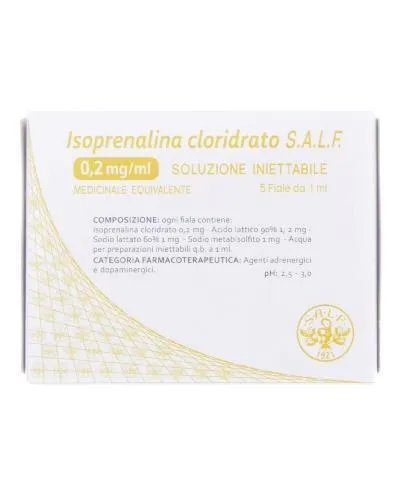
Table of Contents
- Package leaflet: Information for the user
- ISOPRENALINE HYDROCHLORIDE MONICO
- 1. What ISOPRENALINE HYDROCHLORIDE MONICO is and what it is used for
- 2. What you need to know before using ISOPRENALINA CLORIDRATO MONICO
- 3. How to use ISOPRENALINA CLORIDRATO MONICO
- 4. Possible side effects
- 5. How to store ISOPRENALINE HYDROCHLORIDE MONICO
- 6. Package contents and other information
- The following information is intended for healthcare professionals only
Package leaflet: Information for the user
ISOPRENALINE HYDROCHLORIDE MONICO
0.2 mg/ml injectable solution
Generic Medicine
Please read this leaflet carefully before using this medicine because it contains important information for you.
- Keep this leaflet. You may need to read it again.
- If you have any questions, consult your doctor, pharmacist, or nurse.
- This medicine has been prescribed for you only. Do not give it to other people, even if their symptoms are the same as yours, as it may be harmful.
- If you experience any adverse reaction, including those not listed in this leaflet, contact your doctor or pharmacist. See section 4.
Contents of this leaflet:
- What ISOPRENALINE HYDROCHLORIDE MONICO is and what it is used for
- What you need to know before using ISOPRENALINE HYDROCHLORIDE MONICO
- How to use ISOPRENALINE HYDROCHLORIDE MONICO
- Possible side effects
- How to store ISOPRENALINE HYDROCHLORIDE MONICO
- Contents of the pack and other information
1. What ISOPRENALINE HYDROCHLORIDE MONICO is and what it is used for
ISOPRENALINE HYDROCHLORIDE MONICO contains the active substance isoprenaline hydrochloride, which belongs to a group of medicines called adrenergic agents.
ISOPRENALINE HYDROCHLORIDE MONICO is indicated for the treatment of:
- severe heart problems such as complete atrioventricular block (including Adams-Stokes syndrome), cardiac arrest;
- adjunctive treatment of cardiogenic shock;
- narrowing of the airways (bronchospasm) caused by anaesthesia.
2. What you need to know before using ISOPRENALINA CLORIDRATO MONICO
Do not use ISOPRENALINA CLORIDRATO MONICO
- if you are allergic to isoprenaline hydrochloride or to any of the other ingredients of this medicine (listed in section 6);
- if you have any of the following heart conditions:
- chest pain caused by a condition called angina pectoris;
- heart problems caused by taking heart medications called digitalis (heart block and tachycardia);
- irregular heart rhythms (tachyarrhythmias);
- if the person to be treated is a child under 12 years of age;
- if you are pregnant or breastfeeding (see section “Pregnancy and breastfeeding”).
Warnings and precautions
Talk to your doctor, pharmacist, or nurse before ISOPRENALINA CLORIDRATO MONICO is administered to you.
This medicine should be administered to you with caution if you have:
- seizures;
- heart coronary problems (coronary insufficiency);
- a type of diabetes called diabetes mellitus;
- excessive sensitivity to substances called sympathomimetic amines;
- high blood pressure (hypertension);
- thyroid problems (hyperthyroidism).
For athletes: using this medicine without a therapeutic need constitutes doping and may lead to a positive result in anti-doping tests.
Other medicines and ISOPRENALINA CLORIDRATO MONICO
Inform your doctor, pharmacist, or nurse if you are taking, have recently taken, or might take any other medicines.
Isoprenaline must not be administered together with the following medicines:
- heart medications called cardioactive glycosides and anaesthetics (halothane, cyclopropane), as they may cause heart rhythm problems (arrhythmias);
- medicines called ergot alkaloids used to constrict blood vessels, because isoprenaline enhances their effect;
- antidepressant medicines such as phenelzine, selegiline, and tranilcypramine, as they may cause increased blood pressure (hypertensive effect). If you experience symptoms of high blood pressure such as headache, irregular heartbeat, fever, or vomiting, stop treatment and inform your doctor;
- entacapone, a medicine used for Parkinson’s disease, as it may cause heart problems and increased blood pressure;
- nebivolol, a medicine used to lower blood pressure, as it may cause a significant drop in blood pressure;
- theophylline, a medicine used for respiratory problems, as isoprenaline may reduce theophylline levels in the blood. In this case, your doctor may need to adjust the theophylline dose;
- tolcapone, a medicine used for Parkinson’s disease, as it may increase isoprenaline levels in the blood and therefore your doctor may need to reduce the isoprenaline dose.
Pregnancy and breastfeeding
If you are pregnant, think you may be pregnant, planning a pregnancy, or are breastfeeding, consult your doctor, pharmacist, or nurse before this medicine is administered.
This medicine must not be used during pregnancy unless absolutely necessary, for example in life-saving emergency situations involving the heart. Isoprenaline may cause complications during childbirth.
Use this medicine with caution if you are breastfeeding, as it is unknown whether isoprenaline passes into breast milk and there are no available data on its effects in newborns.
Driving and using machines
Not applicable.
ISOPRENALINA CLORIDRATO MONICO contains sodium and sodium metabisulfite
This medicine contains less than 1 mmol (23 mg) of sodium per dose, i.e. it is practically 'sodium-free'. This medicine contains sodium metabisulfite, which may rarely cause severe hypersensitivity reactions and bronchospasm.
3. How to use ISOPRENALINA CLORIDRATO MONICO
Use this medicine exactly as instructed by your doctor. If you have any doubts, consult your
doctor, pharmacist, or nurse.
Your doctor will determine the required dose according to your condition.
Treatment of serious heart problems (complete atrioventricular block, Adams-Stokes syndrome, and cardiac arrest)
- Injection into muscle (intramuscular): initially 0.2 mg, followed by doses of 0.02 mg up to 1 mg, depending on your condition.
- Intravenous injection: 2–10 micrograms per minute, depending on your condition.
- Injection under the skin (subcutaneous): initially 0.2 mg, followed by 0.15 mg up to 0.2 mg, depending on your condition.
Treatment of bronchial constriction (bronchospasm) caused by anaesthesia
- Intravenous injection: initially 0.01–0.02 mg. It may be repeated if necessary.
Treatment of cardiogenic shock
- Intravenous injection: 0.5–5 micrograms per minute, depending on your condition. Higher doses (up to 20 micrograms/minute) may be used in more severe cases.
Use in children
This medicine is not recommended for use in children.
If you use more ISOPRENALINA CLORIDRATO MONICO than you should
Symptoms of overdose may include tremors, palpitations, heart problems such as angina,
arrhythmias and tachycardia, decreased or increased blood pressure, seizures, nervousness,
headache, dry mouth, nausea, dizziness, fatigue, malaise, and insomnia.
If you have taken or received too much of this medicine, contact your doctor immediately or go to the nearest hospital.
If you have any doubts about how to use this medicine, consult your doctor, pharmacist, or nurse.
4. Possible side effects
Like all medicines, this medicine can cause side effects, although not everyone experiences them.
The following side effects may occur:
Not known (frequency cannot be estimated from the available data)
- palpitations, changes in blood pressure, heart problems (tachycardia, changes in heart rhythm, and Adams-Stokes syndrome, cardiac arrest);
- nausea, stomach and intestinal problems;
- decrease in certain blood cells (thrombocytopenia, eosinopenia);
- tremors, dizziness, nervousness, drowsiness, headache, insomnia;
- blurred vision;
- difficulty in urination;
- cough, throat irritation, bronchitis, increased mucus production, fluid accumulation in the lungs (pulmonary edema);
- swelling of the parotid gland (with prolonged use), discoloration of saliva;
- sweating, skin flushing.
Following the instructions provided in this leaflet reduces the risk of side effects.
Reporting of side effects
If you experience any side effect, including those not listed in this leaflet, inform your doctor or pharmacist.
You can also report side effects directly via the national reporting system at: www.agenziafarmaco.gov.it/it/responsabili.
By reporting side effects, you can help provide more information on the safety of this medicine.
5. How to store ISOPRENALINE HYDROCHLORIDE MONICO
Keep this medicine out of the sight and reach of children.
Do not use this medicine after the expiry date stated on the pack after “EXP.”.
The expiry date refers to the last day of that month.
Store below 15°C in the original packaging to protect the medicine from light.
If exposed to air, light, or increased temperature, the solution may develop a colour ranging from pink to brownish-pink. The solution must not be used if discoloured or if a precipitate is present.
Do not dispose of medicines via wastewater or household waste. Ask your pharmacist how to dispose of medicines no longer required. This will help protect the environment.
6. Package contents and other information
What ISOPRENALINA CLORIDRATO MONICO contains
- The active substance is isoprenaline hydrochloride. 1 ml of solution contains 0.2 mg of isoprenaline hydrochloride.
- The other components are: sodium metabisulfite, water for injections.
Description of the appearance of ISOPRENALINA CLORIDRATO MONICO and pack contents
Pack containing 5 vials of 1 ml of injectable solution.
Marketing Authorisation Holder and Manufacturer
MONICO SPA – Via Ponte di Pietra 7, 30173 – VENEZIA/MESTRE - Italy
The following information is intended for healthcare professionals only
Instructions for use
For intravenous injection
Dilute 1 ml of Isoprenaline Hydrochloride 0.2 mg/ml injectable solution with 10 ml of sodium chloride 0.9%
or 5% glucose to obtain a solution with a concentration of 0.02 mg/ml.
For intravenous infusion
Dilute 10 ml of Isoprenaline Hydrochloride 0.2 mg/ml injectable solution with 500 ml of
sodium chloride 0.9% or 5% glucose to obtain a solution with a concentration of 0.004 mg/ml.
Use a microdrip set or an infusion pump for continuous infusion to prevent sudden infusion of an
excessive amount of drug.
Incompatibilities
Isoprenaline must not be mixed with medicinal solutions having an alkaline pH (e.g. sodium
bicarbonate, aminophylline, basic buffered antibiotics), as under pH conditions above 6, the rate of oxidation increases significantly. There are conflicting data regarding incompatibility of isoprenaline when administered concomitantly with doxycycline and secobarbital. In any case, the isoprenaline solution should be administered immediately after preparation.