Isocolan
Italy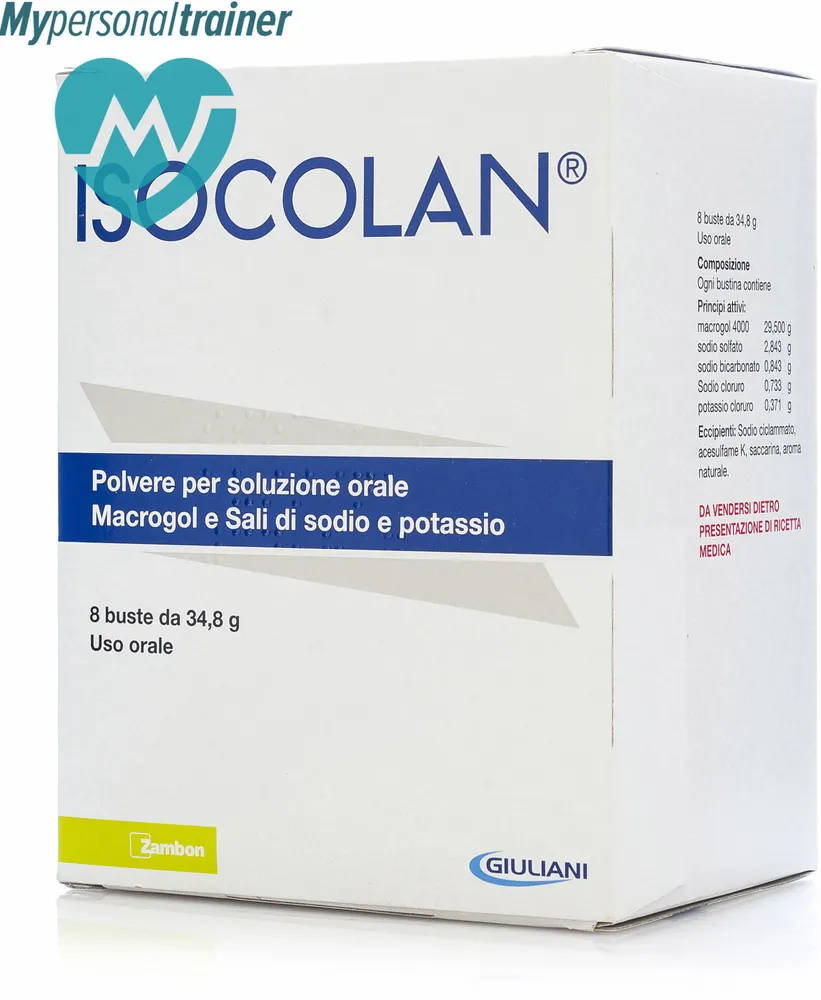
Table of Contents
- Package leaflet: Information for the user
- ISOCOLAN 29.5 g + 2.843 g + 0.843 g + 0.733 g + 0.371 g powder for oral solution, 14.75 g + 1.422 g + 0.422 g + 0.366 g + 0.186 g powder for oral solution, 7.375 g + 0.711 g + 0.211 g + 0.183 g + 0.093 g powder for oral solution
- 1. WHAT IS ISOCOLAN AND WHAT IS IT USED FOR
- 2. WHAT YOU NEED TO KNOW BEFORE TAKING ISOCOLAN
- 3. HOW TO TAKE ISOCOLAN
- 4. POSSIBLE ADVERSE REACTIONS
- 5. HOW TO STORE ISOCOLAN
- 6. CONTENTS OF THE PACKAGE AND OTHER INFORMATION
Package leaflet: Information for the user
ISOCOLAN 29.5 g + 2.843 g + 0.843 g + 0.733 g + 0.371 g powder for oral solution, 14.75 g + 1.422 g + 0.422 g + 0.366 g + 0.186 g powder for oral solution, 7.375 g + 0.711 g + 0.211 g + 0.183 g + 0.093 g powder for oral solution
macrogol 4000 + sodium sulfate + sodium bicarbonate + sodium chloride + potassium chloride
Please read this leaflet carefully before using this medicine because it contains important information for you.
- Keep this leaflet. You may need to read it again.
- If you have any questions, ask your doctor or pharmacist.
- This medicine has been prescribed for you only. Do not give it to other people, even if their symptoms are the same as yours, as it may be harmful.
- If you experience any side effects, including those not listed in this leaflet, tell your doctor or pharmacist. See section 4.
Contents of this leaflet:
- What ISOCOLAN is and what it is used for
- What you need to know before taking ISOCOLAN
- How to take ISOCOLAN
- Possible side effects
- How to store ISOCOLAN
- Contents of the pack and other information
1. WHAT IS ISOCOLAN AND WHAT IS IT USED FOR
ISOCOLAN contains as active substances macrogol (polyethylene glycol) and sodium and potassium salts, and is an osmotic laxative (it works by retaining water in the colon). This medicine is indicated in adults and children over 8 years of age and weighing more than 20 kg for the treatment of constipation and for clinical conditions requiring complete evacuation of the last part of the intestine, the large intestine (for example, preoperative preparation, diagnostic investigations). Consult your doctor if you do not feel better or if you feel worse after a short period of time.
2. WHAT YOU NEED TO KNOW BEFORE TAKING ISOCOLAN
Do not take ISOCOLAN
- If you are allergic to the active substances or to any of the other ingredients of this medicine (listed in section 6).
- If you have a perforation in the stomach or intestine, or are at risk of developing one.
- If you suspect you have an intestinal obstruction.
- If you have a severe inflammatory bowel disease (such as ulcerative colitis or Crohn's disease), or toxic megacolon (severe dilation of the colon) associated with symptomatic stenosis (narrowing).
- If you have abdominal pain syndromes of unknown origin.
- If you have acute colitis (inflammation of the colon), nausea, vomiting, marked increase or decrease in peristalsis (wave-like intestinal movements that move from top to bottom and push food and digestive products through the intestine), or rectal bleeding (from the terminal part of the intestine). The presence of one or more of these signs and symptoms requires appropriate medical evaluation to rule out pathological conditions in which laxatives must not be used (see above).
- If you are in a severe state of dehydration. The use of ISOCOLAN is not recommended during pregnancy and breastfeeding (see "Pregnancy and breastfeeding").
The use of ISOCOLAN is not recommended in children under 8 years of age and weighing less than 20 kg (see "Children and adolescents").
Warnings and precautions
Talk to your doctor or pharmacist before taking ISOCOLAN.
Do not use this medicine if you suspect intestinal blockage or if you have abdominal pain, nausea and/or vomiting.
If you develop side effects such as bloating, shortness of breath, fatigue, dehydration (symptoms include thirst, dry mouth and weakness), or heart problems, stop using ISOCOLAN and contact your doctor immediately.
Use ISOCOLAN with particular caution:
- If you suffer from heart disorders.
- If you suffer from kidney disorders.
- If you have impaired swallowing reflex or altered mental status, due to the risk of aspiration from regurgitation (reflux of stomach contents upwards, even reaching the mouth).
- If you have diarrhea and are predisposed to disturbances in fluid and electrolyte balance (e.g., if you have severe liver or kidney dysfunction, are taking diuretics, or are elderly); in such cases, frequent electrolyte monitoring is recommended. Very rare cases of allergic reactions such as rash, urticaria, and edema (fluid accumulation) have been reported with medications containing macrogol (polyethylene glycol), and exceptional cases of anaphylactic shock (a severe, rapidly developing allergic reaction that may be fatal) have also been reported (see section 4 “Possible side effects”). If you experience sudden abdominal pain or rectal bleeding while taking ISOCOLAN for bowel preparation, consult a doctor immediately. Repeated use of laxatives, especially stimulant (contact) laxatives, may lead to dependence (requiring progressively higher doses), chronic constipation, and intestinal atony (loss of normal intestinal function). Therefore, do not take a laxative for constipation over a prolonged period.
The treatment of chronic (long-lasting) or recurrent constipation always requires medical supervision for diagnosis, prescription of medications, and monitoring during therapy. A diet rich in fluids enhances the effect of the medicine.
The absorption of other medicines may be temporarily reduced due to the increased gastrointestinal transit speed caused by ISOCOLAN. Consult your doctor if you are taking other medicines or need to thicken liquids for safe swallowing (see section “Other medicines and ISOCOLAN”).
Consult your doctor if the need for a laxative arises from a sudden change in previous bowel habits (frequency and characteristics of bowel movements) lasting more than 2 weeks, or if the laxative fails to produce an effect. Treatment of constipation with any medicine is only an adjunct (a support) to a healthy lifestyle and diet including:
- Increased intake of fluids and fiber.
- Adequate physical activity and re-education of intestinal motility. You may take ISOCOLAN if you have diabetes or are on a galactose-free diet, as the medicine does not contain sugar or polyols.
Children and adolescents
Do not administer ISOCOLAN to children under 8 years of age and weighing less than 20 kg (see “Do not take ISOCOLAN”). In children over 8 years of age and weighing more than 20 kg, the medicine may be used only after consulting a doctor, and treatment should not exceed 3 months (due to lack of clinical data for treatments longer than 3 months).
Other medicines and ISOCOLAN
Inform your doctor or pharmacist if you are taking, have recently taken, or might take any other medicines.
Some medicines may not work effectively when taking ISOCOLAN, as it may delay their absorption, making them less effective or ineffective (e.g., antiepileptics, digoxin, and immunosuppressive agents).
If you need to thicken liquids for safe swallowing, ISOCOLAN may counteract the thickening agent’s effect.
In severe cases of laxative abuse, dehydration or hypokalemia (low potassium levels in the blood) may occur, potentially leading to cardiac or neuromuscular dysfunction, especially if you are also being treated with cardiac glycosides (medicines that stimulate heart function), diuretics (medicines that increase urine production), or corticosteroids (anti-inflammatory medicines).
ISOCOLAN with food
Consumption of liquorice increases the risk of hypokalemia; therefore, do not consume liquorice during treatment with ISOCOLAN.
Pregnancy and breastfeeding
If you are pregnant, suspect you may be pregnant, planning a pregnancy, or breastfeeding, consult your doctor or pharmacist before taking this medicine.
During pregnancy or breastfeeding, take this medicine only if necessary and under direct medical supervision, who will assess the expected benefit against the potential risk to the fetus or infant.
Driving and using machines
ISOCOLAN does not impair the ability to drive or operate machinery.
ISOCOLAN contains sodium
This medicine contains 15.76 mmol of sodium per 8.7 g sachet; 31.53 mmol of sodium per 17.4 g sachet; and 63.06 mmol of sodium per 34.8 g sachet—the main component of table salt.
This corresponds, respectively for each dose, to 18%, 36%, and 72% of the maximum recommended daily dietary intake for an adult.
Talk to your doctor or pharmacist if you need to take 2 or more sachets of ISOCOLAN daily for a prolonged period, especially if you have been advised to follow a low-sodium diet.
ISOCOLAN contains potassium
This medicine contains 1.34 mmol of potassium per 8.7 g sachet; 2.68 mmol of potassium per 17.4 g sachet; and 5.36 mmol of potassium per 34.8 g sachet.
This should be considered in patients with impaired kidney function or those on a low-potassium diet.
3. HOW TO TAKE ISOCOLAN
Take this medicine exactly as directed by your doctor or pharmacist. If you have any doubts, consult your doctor or pharmacist.
The effect of ISOCOLAN occurs within 24 to 48 hours after administration.
The restoration of intestinal motility induced by treatment should be maintained through a healthy lifestyle and an appropriate diet (see "Warnings and precautions"). The daily dose should be adjusted according to clinical response and may vary from one sachet every other day (alternating days, especially in children) up to two sachets per day.
Preparation instructions
For the extemporaneous preparation of the solution, pour the contents of one sachet into a container and add the amount of water indicated on the sachet itself (500 ml, 250 ml or 125 ml respectively for the 34.8 g, 17.4 g and 8.7 g sachets). Stir well to obtain a homogeneous solution and drink slowly within 15–30 minutes. If not taken immediately, the solution should be stored in the refrigerator and used within 48 hours of preparation. Do not add any other ingredients to the reconstituted solution. For the 17.4 g sachet, half a sachet may be used, diluted in half the volume (125 ml of water).
Bowel cleansing
Adults
The recommended dose is 4 litres of solution, prepared by dissolving each of the eight 34.8 g sachets in 500 ml of water. This amount should be taken either as a single dose on the afternoon before the examination, or divided into two doses: 2 litres the evening before the examination and 2 litres on the morning of the examination. Take 250 ml every 15 minutes until the full 4 litres are consumed. It is preferable to ingest each dose rapidly. The first bowel movement usually occurs approximately 90 minutes after starting administration. After taking the full recommended dose, rectal discharge will become clear. The preparation should be taken after a 3–4 hour fast. In any case, solid foods should not be consumed from 2 hours before administration until after completion of the examination. Water intake, however, is permitted. The solution may be more palatable if cooled.
Treatment of constipation
Adults
The recommended dose is one 34.8 g sachet dissolved in 500 ml of water. Depending on the individual situation and only under medical supervision and advice, a second dose may be taken 6–12 hours later (one 17.4 g sachet dissolved in 250 ml of water or one 8.7 g sachet dissolved in 125 ml of water), depending on individual response and desired effect. Take the appropriate amount of reconstituted solution within 15–30 minutes, away from meals.
Maintenance therapy
To maintain and consolidate the laxative effect and regular bowel function (the entire intestinal tract), you may begin treatment with the 8.7 g sachets (dissolved in 125 ml of water) or the 17.4 g sachets (dissolved in 250 ml of water), taken 1–2 times daily for several days, according to a regimen determined by individual response and desired effect. Optimal efficacy is achieved when the dose is taken in the evening before bedtime.
Use in children (over 8 years of age and weighing more than 20 kg) and adolescents
In children, treatment should not exceed 3 months due to lack of clinical data on longer-term use. Recommended doses should be proportionally reduced, using either the 8.7 g sachet dissolved in 125 ml of water or the 17.4 g sachet dissolved in 250 ml of water. Depending on the situation and only under medical supervision, a second dose may be administered 12 hours after the first, or according to a regimen established by the physician based on the desired effect and individual sensitivity.
If you take more ISOCOLAN than you should
Abuse of laxatives may lead to serious problems (see "Warnings and precautions"). In case of accidental overdose, contact your doctor immediately or go to the nearest hospital.
Excessive doses may cause diarrhoea, abdominal pain and vomiting, which resolve when treatment is temporarily interrupted or the dose is reduced (see section 4 “Possible side effects”).
Excessive fluid loss due to diarrhoea or vomiting may require correction of electrolyte imbalances (see "Warnings and precautions"). Conservative measures are generally sufficient; ensure adequate fluid intake, especially fruit juices.
Cases of aspiration have been reported when large volumes of macrogol (polyethylene glycol) and electrolytes are administered via nasogastric tubes (medical devices used to provide artificial nutrition to patients unable or unwilling to eat normally).
Children with neurological impairments and oromotor dysfunction (difficulty with motor control and coordination of lips, tongue, cheeks and pharynx) are particularly at risk of aspiration.
If you have any questions about the use of this medicine, consult your doctor or pharmacist.
4. POSSIBLE ADVERSE REACTIONS
Like all medicines, this medicine can cause adverse reactions, although not everyone experiences them.
Adults
Generally, the reported adverse reactions have been mild and transient, mainly affecting the gastrointestinal system.
Common adverse reactions (may affect less than 1 in 10 people)
- Abdominal pain and/or abdominal distension.
- Diarrhoea.
- Nausea.
Uncommon adverse reactions (may affect less than 1 in 100 people)
- Vomiting.
- Urgency to defecate (expulsion of faeces).
- Faecal incontinence (involuntary and uncontrolled loss of intestinal gas and faeces).
Very rare adverse reactions (may affect less than 1 in 10,000 people)
Hypersensitivity reactions (allergy) such as pruritus, rash, facial oedema, Quincke's oedema (rapid swelling,
oedema, usually affecting eyelids, lips, face, neck, hands), urticaria, anaphylactic shock.
Adverse reactions with unknown frequency (frequency cannot be determined from the available data)
Electrolyte imbalances such as hyponatraemia (reduced sodium levels in blood) and hypokalaemia (reduced potassium levels in blood) and/or dehydration, especially in elderly patients, skin redness (erythema).
Cases of hypo-hyperkinetic cardiac arrhythmias (alterations in heart rhythm) have been reported, probably secondary to altered vagal or sympathetic tone due to intestinal distension, accelerated transit, and frequent defecation.
Adverse reactions in children and adolescents
As in the adult population, adverse reactions have generally been mild and transient, mainly affecting the gastrointestinal system.
Common adverse reactions (may affect less than 1 in 10 people)
- Abdominal pain.
- Diarrhoea (may cause perianal inflammation).
Uncommon adverse reactions (may affect less than 1 in 100 people)
- Vomiting.
- Bloating.
- Nausea.
Adverse reactions with unknown frequency (frequency cannot be determined from the available data)
- Hypersensitivity reactions (anaphylactic shock, angioedema, urticaria, rash, pruritus). Reporting of adverse reactions
If you experience any adverse reaction, including those not listed in this leaflet, consult your doctor or pharmacist. You may also report adverse reactions directly via the national reporting system at the website: https://www.aifa.gov.it/content/segnalazioni-reazioni-avverse. By reporting adverse reactions, you can help provide more information on the safety of this medicine.
5. HOW TO STORE ISOCOLAN
Keep this medicine out of the sight and reach of children.
Do not use this medicine after the expiry date stated on the packaging after "Exp.".
The expiry date refers to the last day of that month.
If not taken immediately, the reconstituted solution must be stored at 2-8 °C (in the refrigerator) and used within 48 hours of preparation. Any remaining solution must be discarded.
Store the medicine in the original packaging to protect the product from moisture.
Do not use this medicine if you notice any visible signs of deterioration.
Do not dispose of any medicine via wastewater or household waste. Ask your pharmacist how to dispose of medicines no longer in use. This will help protect the environment.
6. CONTENTS OF THE PACKAGE AND OTHER INFORMATION
What ISOCOLAN contains
ISOCOLAN 29.5 + 2.843 + 0.843 + 0.733 + 0.371 powder for oral solution
Each 34.8 g sachet contains:
The active substances are: Macrogol 4000 29.5 g; Sodium sulfate 2.843 g; Sodium bicarbonate 0.843 g; Sodium chloride 0.733 g and Potassium chloride 0.371 g.
Other components are: Sodium cyclamate, Acesulfame K, Saccharin, Natural flavour.
ISOCOLAN 14.75 + 1.422 + 0.422 + 0.366 + 0.186 powder for oral solution
Each 17.4 g sachet contains:
The active substances are: Macrogol 4000 14.75 g; Sodium sulfate 1.422 g; Sodium bicarbonate 0.422 g; Sodium chloride 0.366 g and Potassium chloride 0.186 g.
Other components are: Sodium cyclamate, Acesulfame K, Saccharin, Natural flavour.
ISOCOLAN 7.375 + 0.711 + 0.211 + 0.183 + 0.093 powder for oral solution
Each 8.7 g sachet contains:
The active substances are: Macrogol 4000 7.375 g; Sodium sulfate 0.711 g; Sodium bicarbonate 0.211 g; Sodium chloride 0.183 g and Potassium chloride 0.093 g.
Other components are: Sodium cyclamate, Acesulfame K, Saccharin, Natural flavour.
Description of the appearance of ISOCOLAN and contents of the pack
Powder for oral solution.
Pack sizes:
- 2, 4 or 8 sachets of 34.8 g with a 500 ml plastic container for extemporaneous preparation of the solution
- 8 sachets of 34.8 g
- 8 sachets of 17.4 g
- 8 sachets of 8.7 g
Not all pack sizes may be marketed.
Marketing Authorization Holder
POLIFARMA S.p.A., Viale dell’Arte, 69 - 00144 Rome, Italy.
Manufacturer
SIGMAR ITALIA S.p.A., via Sombreno, n. 11 - 24011 Almè (BG), Italy.