Irbetens
Italy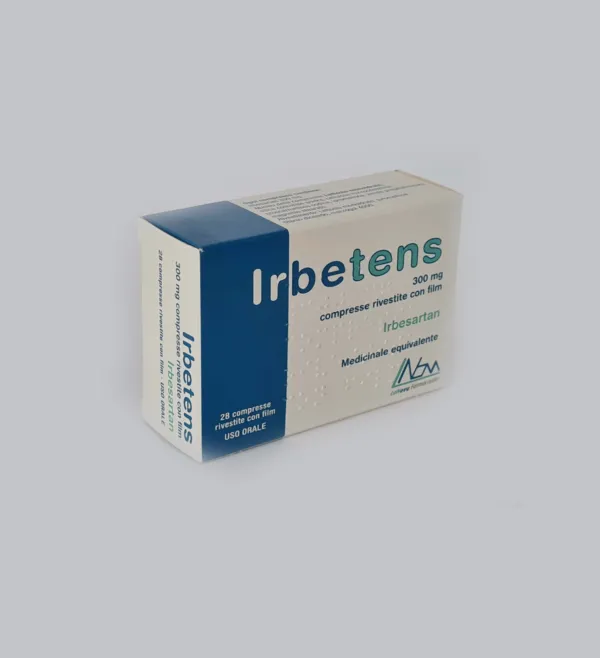
Table of Contents
- Patient Information Leaflet
- IRBETENS 150 mg film-coated tablets, 300 mg film-coated tablets
- 1. What IRBETENS is and what it is used for
- 2. What you need to know before taking IRBETENS
- 3. How to take IRBETENS
- 4. Possible side effects
- 5. How to store IRBETENS
- 6. Contents of the pack and other information
Patient Information Leaflet
IRBETENS 150 mg film-coated tablets, 300 mg film-coated tablets
Irbesartan
Please read this leaflet carefully before taking this medicine because it contains
important information for you.
- Keep this leaflet. You may need to read it again.
- If you have any questions, ask your doctor or pharmacist.
- This medicine has been prescribed for you only. Do not give it to others. It may be harmful to others, even if their symptoms are the same as yours.
- If you experience any side effects, including those not listed in this leaflet, talk to your doctor or pharmacist. See section 4.
Contents of this leaflet:
- What IRBETENS is and what it is used for
- What you need to know before taking IRBETENS
- How to take IRBETENS
- Possible side effects
- How to store IRBETENS
- Contents of the pack and other information
1. What IRBETENS is and what it is used for
IRBETENS belongs to a group of medicines known as angiotensin-II receptor antagonists. Angiotensin-II is a substance produced by the body that binds to receptors in blood vessels, causing them to narrow. This results in an increase in blood pressure. IRBETENS prevents angiotensin-II from binding to these receptors, allowing blood vessels to widen and blood pressure to decrease. IRBETENS slows the decline in kidney function in patients with high blood pressure and type 2 diabetes.
IRBETENS is used in adult patients
- to treat high blood pressure ( essential arterial hypertension );
- to protect the kidneys in hypertensive patients with high blood pressure, type 2 diabetes, and evidence of kidney dysfunction in laboratory tests.
2. What you need to know before taking IRBETENS
Do not take IRBETENS:
- if you are allergic to irbesartan or to any of the other ingredients of this medicine (listed in section 6)
- if you are more than 3 months pregnant. (It is also advisable to avoid taking IRBETENS during early pregnancy – see Pregnancy section)
- if you have diabetes or impaired kidney function and are being treated with a blood pressure-lowering medicine containing aliskiren
Warnings and precautions
Talk to your doctor or pharmacist before taking IRBETENS if you are in any of the following
conditions:
- excessive vomiting or diarrhoea;
- if you have kidney problems;
- if you have heart problems;
- if you are taking IRBETENS for diabetic kidney disorders. In this case, your doctor may prescribe regular blood tests, especially to monitor serum potassium levels in case of poor kidney function;
- if you develop low blood sugar levels (symptoms may include sweating, weakness, hunger, dizziness, tremor, headache, flushing or pallor, numbness, rapid and pounding heartbeat), particularly if you are being treated for diabetes;
- if you are scheduled for surgery or to receive anaesthetics;
- if you are taking any of the following medicines used to treat high blood pressure:
- an "ACE inhibitor" (e.g. enalapril, lisinopril, ramipril), especially if you have kidney problems related to diabetes.
- aliskiren
Contact your doctor if, after taking IRBETENS, you experience abdominal pain, nausea, vomiting, or diarrhoea. Your doctor will decide whether treatment should continue. Do not stop taking IRBETENS on your own.
Your doctor may monitor your kidney function, blood pressure, and blood levels of electrolytes (e.g. potassium) at regular intervals.
See also the section "Do not take IRBETENS"
You must inform your doctor if you think you may be pregnant (or if there is a possibility of becoming pregnant). IRBETENS is not recommended during early pregnancy and must not be taken after the first 3 months of pregnancy, as it may cause serious harm to the unborn baby if taken during this period (see section Pregnancy).
Children and adolescents
This medicine must not be used in children and adolescents, as its safety and efficacy have not yet been fully established.
Other medicines and IRBETENS
Inform your doctor or pharmacist if you are taking, have recently taken, or might take any other medicines.
Your doctor may consider it necessary to adjust your dose and/or take additional precautions:
- If you are taking an ACE inhibitor or aliskiren (see also sections "Do not take IRBETENS" and "Warnings and precautions").
You may need blood tests if you are taking:
- potassium supplements;
- potassium-containing salt substitutes;
- potassium-sparing medicines (such as certain diuretics);
- medicines containing lithium;
- repaglinide (a medicine used to lower blood sugar levels).
If you take certain painkillers called non-steroidal anti-inflammatory drugs (NSAIDs), the effectiveness of irbesartan may be reduced.
IRBETENS with food and drink
IRBETENS can be taken with or without food.
Pregnancy and breastfeeding
Pregnancy
Inform your doctor if you think you may be pregnant (or if there is a possibility of becoming pregnant). Your doctor will usually advise you to stop taking IRBETENS before becoming pregnant or as soon as pregnancy is confirmed, and will recommend an alternative medicine. IRBETENS is not recommended during early pregnancy and must not be taken after the first 3 months of pregnancy, as it may cause serious harm to the unborn baby if taken beyond the third month of pregnancy.
Breast-feeding
Inform your doctor if you are breast-feeding or planning to breast-feed. IRBETENS is not recommended for women who are breast-feeding, and your doctor may choose an alternative treatment if you wish to breast-feed, especially if the baby is a newborn or was born prematurely.
Driving and using machines
It is unlikely that IRBETENS will affect your ability to drive or operate machinery. However, occasionally, dizziness or fatigue may occur during treatment for high blood pressure. If this happens, talk to your doctor before driving or using machines.
IRBETENS contains lactose. If you have been diagnosed by your doctor with an intolerance to certain sugars, contact your doctor before taking this medicine.
IRBETENS contains sodium. This medicine contains less than 1 mmol of sodium (23 mg) per
tablet, i.e. essentially “sodium-free”.
3. How to take IRBETENS
Take this medicine exactly as directed by your doctor. If you have any doubts, consult your doctor or pharmacist.
Method of administration
IRBETENS is for oral use. Swallow the tablets with a sufficient amount of fluid (for example: a glass of water). You may take IRBETENS with or without food. Try to take the medicine at the same time each day. Treatment should be continued for as long as your doctor considers it necessary.
- Patients with high blood pressure: The usual dose is 150 mg once daily. The dose may later be increased to 300 mg (two tablets once daily), depending on the reduction in blood pressure levels.
- Patients with high blood pressure and type 2 diabetes with kidney disease: In patients with high blood pressure and type 2 diabetes, the recommended maintenance dose is 300 mg (two tablets once daily) for the treatment of associated kidney disease.
Your doctor may decide to use lower doses, especially at the beginning of treatment, in particular patients such as those on haemodialysis, or in patients over 75 years of age.
Maximum antihypertensive effect should be achieved within 4–6 weeks after starting treatment.
Use in children and adolescents
IRBETENS must not be given to children under 18 years of age. If a child ingests any tablets, contact your doctor immediately.
If you take more IRBETENS than you should
If you accidentally take too many tablets, contact your doctor immediately.
If you forget to take IRBETENS
If you accidentally miss a dose, continue your treatment as usual. Do not take a double dose to make up for the missed dose.
If you have any questions about the use of this medicine, ask your doctor or pharmacist.
4. Possible side effects
Like all medicines, IRBETENS may cause side effects, although not everybody gets them.
Some of these effects may be serious and may require medical intervention.
As with similar medicines, rare cases of skin allergic reactions (rash, urticaria) as well as localized swelling of the face, lips and/or tongue have been reported in patients treated with irbesartan. If you experience any of these symptoms or have difficulty breathing, stop taking IRBETENS and contact your doctor immediately.
The frequency of the side effects listed below is defined using the following convention:
Very common: may affect more than 1 in 10 people
Common: may affect up to 1 in 10 people
Uncommon: may affect up to 1 in 100 people
The side effects reported in clinical studies for patients treated with IRBETENS are:
- Very common (may affect more than 1 in 10 people): if you have high blood pressure and type 2 diabetes with kidney disease, blood tests may show high levels of potassium.
- Common (may affect up to 1 in 10 people): dizziness, feeling unwell/nausea, fatigue, and blood tests may show increased levels of an enzyme that measures muscle and heart function (creatine kinase). In patients with high blood pressure and type 2 diabetes with kidney disease, dizziness upon standing up from lying or sitting position, low blood pressure upon standing up from lying or sitting position, joint or muscle pain, and decreased levels of a protein in red blood cells (haemoglobin) have also been reported.
- Uncommon (may affect up to 1 in 100 people): increased heart rate, flushing, cough, diarrhoea, indigestion/heartburn, sexual dysfunction (problems related to sexual performance), chest pain.
From post-marketing experience with IRBETENS, some adverse reactions have been reported.
Adverse reactions with rare frequency (may affect up to 1 in 1,000 people):
intestinal angioedema (swelling in the intestine presenting with symptoms such as abdominal pain, nausea, vomiting and diarrhoea).
Adverse reactions with frequency not known: sensation of dizziness, headache, taste disturbances, ringing in the ears, muscle cramps, joint and muscle pain, reduced platelet count, abnormal liver function, increased blood potassium levels, decreased number of red blood cells (anaemia – symptoms may include tiredness, headache, shortness of breath during physical activity, dizziness and pale appearance), renal function disturbances, inflammation of small blood vessels mainly affecting the skin (a condition known as leukocytoclastic vasculitis), severe allergic reactions (anaphylactic shock). Uncommon cases of jaundice (yellowing of the skin and/or whites of the eyes) have also been reported.
Reporting of side effects
If you experience any side effect, including those not listed in this leaflet, talk to your doctor or pharmacist. You can also report side effects directly via the national reporting system at https://www.aifa.gov.it/content/segnalazioni-reazioni-avverse . Reporting side effects can help provide more information on the safety of this medicine.
5. How to store IRBETENS
Keep this medicine out of the sight and reach of children.
Do not use this medicine after the expiry date which is stated on the carton and blister after
Exp. The expiry date refers to the last day of that month.
Do not dispose of any medicine via wastewater or household waste. Ask your pharmacist how to
dispose of medicines you no longer use. This will help protect the environment.
6. Contents of the pack and other information
What IRBETENS contains
- The active substance is irbesartan.
- Each IRBETENS 150 mg tablet contains 150 mg of irbesartan.
- Each IRBETENS 300 mg tablet contains 300 mg of irbesartan.
The other components (excipients) are:
Tablet core: Monohydrate lactose, anhydrous colloidal silica, microcrystalline cellulose,
sodium croscarmellose, hypromellose, pregelatinized starch, magnesium stearate.
Coating: Monohydrate lactose, hypromellose, titanium dioxide, macrogol 4000. See section 2
"IRBETENS contains lactose".
Description of the appearance of IRBETENS and contents of the pack
Box of 28 tablets of 150 mg in blisters
Box of 28 tablets of 300 mg in blisters
Marketing Authorization Holder:
LANOVA Farmaceutici S.r.l. - Via Conca D’oro, 212 – 00141 Roma
Manufacturer:
Genetic S.p.A.