Iqirvo
Italy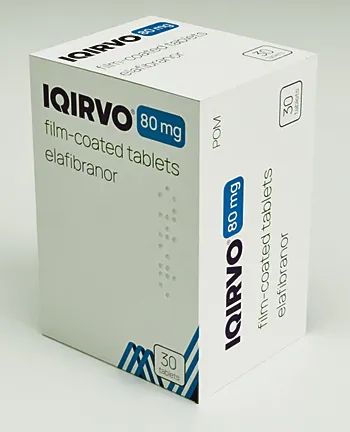
Table of Contents
Patient Information Leaflet
Iqirvo 80 mg film-coated tablets
elafibranor
This medicinal product is subject to additional monitoring. This will allow for the rapid identification of new safety information. You can help by reporting any side effects you experience while taking this medicine. See the end of section 4 for information on how to report side effects.
Please read this leaflet carefully before taking this medicine, as it contains important information for you.
- Keep this leaflet. You may need to read it again.
- If you have any questions, ask your doctor or pharmacist.
- This medicine has been prescribed for you only. Do not give it to other people, even if they have the same symptoms as you, because it could be harmful.
- If you experience any side effect, including those not listed in this leaflet, talk to your doctor or pharmacist. See section 4.
Contents of this leaflet
- What Iqirvo is and what it is used for
- What you need to know before taking Iqirvo
- How to take Iqirvo
- Possible side effects
- How to store Iqirvo
- Contents of the pack and other information
1. What Iqirvo is and what it is used for
Iqirvo contains the active substance elafibranor, which acts on two types of receptors ("PPAR alpha" and "PPAR delta").
This medicine is used in adults for the treatment of primary biliary cholangitis (PBC), a type of liver disease in which the bile ducts are slowly destroyed, making it more difficult for bile to flow. Bile is a fluid that helps digest food, especially fats. When bile cannot flow into the digestive tract, it flows back into the liver (a phenomenon known as cholestasis), where it damages liver tissue. This can reduce liver function and cause inflammation. Iqirvo can be used in combination with ursodeoxycholic acid (UDCA) or alone in patients who cannot take UDCA.
The active substance in Iqirvo, elafibranor, works by activating PPAR alpha and PPAR delta receptors. These proteins are believed to regulate bile acid levels, inflammation, and fibrosis (scar tissue formation). This reduces the production and accumulation of bile in the liver and also reduces liver inflammation.
2. What you need to know before taking Iqirvo
Do not take Iqirvo
- if you are allergic to elafibranor or to any of the other ingredients of this medicine (listed in section 6).
- if you are pregnant or think you may be pregnant, or if you are not using any contraceptive method to prevent pregnancy.
Warnings and precautions
Iqirvo may increase blood levels of liver enzymes and bilirubin (a product of red blood cell breakdown). Your doctor may perform blood tests to monitor your liver function before and during treatment. If these liver tests show abnormal results, your doctor may temporarily interrupt treatment with elafibranor until blood levels return to normal. Immediately inform your doctor if you develop symptoms of liver dysfunction, including yellowing of the skin or eyes (jaundice), abdominal pain, feeling unwell, vomiting, fatigue, loss of appetite, and dark urine.
Iqirvo may increase blood levels of creatine phosphokinase (an enzyme released into the blood when muscle tissue is damaged). Your doctor may perform blood tests to monitor creatine phosphokinase levels before and during treatment, especially if you are taking medicines known as HMG-CoA reductase inhibitors, such as atorvastatin, fluvastatin, pitavastatin, pravastatin, rosuvastatin. Seek immediate medical advice if you experience unexplained muscle pain, tenderness, or weakness while taking this medicine.
Children and adolescents
This medicine is not intended for use in children or adolescents under 18 years of age.
Other medicines and Iqirvo
Inform your doctor if you are taking, have recently taken, or might take any other medicines.
Pregnancy
Do not take Iqirvo if you are pregnant or think you may be pregnant, or if you are not using any contraceptive method to prevent pregnancy. Iqirvo may cause adverse effects in the unborn child.
Your doctor may ask you to take a pregnancy test before starting treatment with Iqirvo to rule out pregnancy prior to beginning treatment.
If you are a woman of childbearing potential, you must use effective contraceptive measures (birth control) during treatment with this medicine and for at least 3 weeks after stopping treatment to avoid potential harm to the unborn child. Your doctor will advise you on the most appropriate contraceptive methods to use in your case.
Breast-feeding
It is not known whether Iqirvo passes into breast milk. The risk to the nursing infant cannot be excluded.
You should not breast-feed during treatment and for 3 weeks after the last dose.
Iqirvo contains sodium
This medicine contains less than 1 mmol of sodium (23 mg) per tablet, i.e. essentially ‘sodium-free’.
3. How to take Iqirvo
Take this medicine exactly as your doctor has told you. If you are not sure, consult your doctor or pharmacist.
The recommended dose is one 80 mg tablet once daily. Swallow the tablets whole with water. Ask your doctor before taking Iqirvo if you have advanced cirrhosis (a type of chronic, progressive liver disease in which liver cells are replaced by scar tissue) with severe liver impairment (Child-Pugh C).
If you take more Iqirvo than you should
If you have taken more medicine than prescribed, contact your doctor immediately or go to hospital straight away. Take the tablets and this leaflet with you.
If you forget to take Iqirvo
If you forget to take Iqirvo, take your next dose as scheduled, skipping the missed dose.
Do not take a double dose to make up for a forgotten dose.
If you stop taking Iqirvo
Do not stop taking this medicine without first talking to your doctor.
If you have any doubts about how to use this medicine, consult your doctor or pharmacist.
4. Possible side effects
Like all medicines, this medicine can cause side effects, although not everybody gets them.
Possible side effects are:
Very common side effects (may affect more than 1 in 10 people):
- Stomach ache (abdominal pain)
- Diarrhoea
- Feeling unwell (nausea)
- Vomiting
Common side effects (may affect up to 1 in 10 people):
- Headache
- Constipation
- Gallstones (cholelithiasis) which may block the flow of bile causing abdominal pain, nausea or vomiting
- Increased levels of creatine phosphokinase, which may be detected by blood tests
- Muscle pain (myalgia)
Uncommon side effects (may affect 1 in 100 people):
- Itchy rash (pruritic rash)
- Increased creatinine levels, which may be detected by blood tests. Blood creatinine levels are measured to monitor kidney function
Reporting of side effects
If you get any side effects, including those not listed in this leaflet, talk to your doctor. You can also report side effects directly via the national reporting system listed in Annex V.* By reporting side effects, you can help provide more information on the safety of this medicine.
5. How to store Iqirvo
Keep this medicine out of the sight and reach of children.
Do not use this medicine after the expiry date stated on the label of the bottle and on the box after Exp. The expiry date refers to the last day of that month.
This medicine does not require any special storage conditions.
Do not dispose of medicines via wastewater or household waste. Ask your pharmacist how to dispose of medicines you no longer use. This will help protect the environment.
6. Package contents and other information
What Iqirvo contains
- The active substance is elafibranor.
- Each film-coated tablet contains 80 mg of elafibranor.
The other components are:
- Tablet core: microcrystalline cellulose, povidone, sodium croscarmellose (see section 2 “Iqirvo contains sodium”), anhydrous colloidal silica, magnesium stearate.
- Film coating: partially hydrolysed polyvinyl alcohol, titanium dioxide (E171), macrogol, talc, yellow iron oxide (E172), red iron oxide (E172).
Description of the appearance of Iqirvo and package contents
The 80 mg film-coated tablets of Iqirvo are orange-coloured, round, approximately 8 mm in diameter, with “ELA 80” engraved on one side.
Iqirvo is available in child-resistant bottles containing 30 film-coated tablets.
Marketing Authorisation Holder
Ipsen Pharma
70 rue Balard
75015 Paris
France
Manufacturer
Delpharm Milano Srl
Via Salvatore Carnevale 1
Segrate, 20054
Italy
For further information about this medicinal product, please contact the local representative of the Marketing Authorisation Holder:
België/Belgique/Belgien, Luxembourg/Luxemburg Latvija
Ipsen NV Ipsen Pharma representative office
België/Belgique/Belgien Tel: +371 67622233
Tél/Tel: +32-9-243 96 00
Česká republika Lietuva
Ipsen Pharma, s.r.o. Ipsen Pharma SAS Lietuvos filialas
Tel: +420 242 481 821 Tel: +370 700 33305
Danmark, Norge, Suomi/Finland, Sverige, Ísland Magyarország
Institut Produits Synthèse (IPSEN) AB IPSEN Pharma Hungary Kft.
Sverige/Ruotsi/Svíþjóð Tel: +36-1-555-5930
Tlf/Puh/Tel/Sími: +46 8 451 60 00
Deutschland, Österreich Nederland
Ipsen Pharma GmbH Ipsen Farmaceutica B.V.
Deutschland Tel: +31 (0) 23 554 1600
Tel.: +49 89 2620 432 89
Ελλάδα, Κύπρος, Malta Polska
Ipsen Μονοπρόσωπη EΠΕ Ipsen Poland Sp. z o.o.
Ελλάδα Tel: +48 (0) 22 653 68 00
Τηλ: +30–210–984 3324
España Portugal
Ipsen Pharma, S.A.U. Ipsen Portugal - Produtos Farmacêuticos
Tel: +34-936-858 100 S.A. Tel: +351-21-412 3550
France, България, Eesti, Hrvatska, Slovenija România
Ipsen Pharma Ipsen Pharma România SRL
France Tel: +40 21 231 27 20
Tél: +33 1 58 33 50 00
Ireland Slovenská republika
Ipsen Pharmaceuticals Ltd. Ipsen Pharma, organizačná zložka
Tel: +353-1-809-8256 Tel: +420 242 481 821
Italia
Ipsen SpA
Tel: +39-02-392241
This medicinal product has been granted a marketing authorisation “under conditional approval”. This means that additional data on this medicinal product are still required.
The European Medicines Agency will review new information on this medicinal product at least annually, and this patient information leaflet will be updated as necessary.
Further sources of information
More detailed information on this medicinal product is available on the website of the European Medicines Agency: http://www.ema.europa.eu. Links to other websites on rare diseases and related therapeutic treatments are also provided.