Iodine Almus
Italy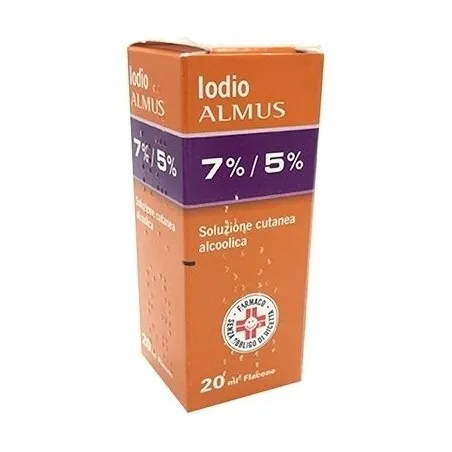
Table of Contents
PACKAGE LEAFLET
Iodio Almus 7% / 5% alcoholic cutaneous solution
PHARMACOTHERAPEUTIC CATEGORY
Antiseptics and disinfectants
THERAPEUTIC INDICATIONS
Disinfection of intact skin for occasional use.
CONTRAINDICATIONS
Hypersensitivity to the active substances or to any of the excipients. Generally contraindicated during
pregnancy (see Special warnings). Do not use in children under 6 months of age.
PRECAUTIONS FOR USE
Prolonged application may cause irritation and caustic effects on the treated surface; therefore, the
medicinal product must not be used for prolonged treatments.
The medicinal product must be applied only on intact, non-damaged skin, as it may cause irritation and delay
the healing of wounds and abrasions. Prolonged use, especially, may lead to sensitization phenomena. In
such cases, discontinue treatment and contact the physician, who may adopt appropriate therapeutic
measures. To avoid excessive iodine absorption, do not cover the treated skin area with occlusive dressings.
When used for prolonged periods over large body surfaces, on mucous membranes, or under occlusive
dressings, particularly in children and patients with thyroid disorders, thyroid function tests should be
performed.
Since iodine may affect thyroid function, caution is recommended in patients with thyroid disorders, in
patients over 45 years of age, or with goitre.
In pediatric patients, use only when strictly necessary and under medical supervision.
Discontinue treatment at least 10 days before performing a scintigraphy with radioactive iodine.
Following treatment, thyroid function test results may be altered, particularly in premature neonates.
If no improvement is observed after a short period of treatment, consult a physician.
INTERACTIONS
Inform your doctor or pharmacist if you have recently taken any other medicinal products, including
those not requiring a prescription.
If it comes into contact with acetone, elemental iodine forms an irritating, pungent compound. When
evaluating interactions with other medicinal products, possible systemic effects of iodine should be
considered, although when administered topically as recommended, it is absorbed only in small amounts.
The effects of iodine and iodides on the thyroid may be altered by other compounds, including amiodarone and lithium.
SPECIAL WARNINGS
For external use only. Do not ingest. Avoid contact with eyes.
Pregnancy and breastfeeding
Consult your doctor or pharmacist before taking any medicinal product.
Iodine is poorly absorbed when used as directed.
Iodine reaching the systemic circulation crosses the placenta, and excess iodine is harmful to the fetus: iodine use during pregnancy has been associated with goitre, hypothyroidism, respiratory problems, enlarged heart, tracheal compression, and neonatal death.
Iodine is excreted in breast milk. Excessive iodine intake by nursing mothers may increase iodine levels in breast milk and cause transient hypothyroidism in infants.
The use of iodine, even when applied topically, should generally be avoided during pregnancy and breastfeeding.
Effects on ability to drive and use machines
Not applicable
DOSAGE, METHOD AND DURATION OF ADMINISTRATION
Apply by brushing onto the affected area.
Reacts vigorously with essential oils in general, iron filings, and with white and yellow mercury precipitates. It is incompatible with silver, mercury and lead salts, alkalis, carbonates, alkaloids and their salts.
OVERDOSE
Abundant application of the medicinal product on very large skin areas, use of dressings, or prolonged use may lead to increased iodine absorption. Under these circumstances, adverse reactions are more likely to occur (see Undesirable effects).
Accidental ingestion or inhalation may have serious, sometimes fatal, consequences.
In case of exceeding the recommended doses, either intentionally or accidentally, hypothyroidism or hyperthyroidism may occur. Other symptoms may include metallic taste, increased salivation, inflammation of the salivary glands, burning or pain in the mouth and throat, eye irritation or swelling, skin eruptions, gastrointestinal disturbances with vomiting, abdominal pain and diarrhoea, metabolic acidosis, hypernatraemia, and impaired renal function. Circulatory failure and epiglottal swelling may also occur, potentially leading to asphyxiation, pneumonia, and pulmonary oedema, which may be fatal. Retinal toxicity has also been observed with overdose.
Symptomatic and supportive treatment must be initiated, with special attention to electrolyte balance and renal function impairment. Symptomatic treatment of allergic reactions may be necessary, although symptoms usually resolve rapidly once administration is discontinued. In case of accidental ingestion/overdose of Iodio Almus, contact a physician immediately or go to the nearest hospital.
If you have any doubts about the use of Iodio Almus, consult your doctor or pharmacist.
UNDESIRABLE EFFECTS
Like all medicinal products, iodine may cause undesirable effects, although not everyone experiences them.
The following are the undesirable effects associated with iodine. There are insufficient data to determine the frequency of the individual effects listed.
Skin and subcutaneous tissue disorders
Burning or irritation, acneiform eruptions, iododerma, delayed healing of injured tissues.
Inhalation of iodine vapours is highly irritating to mucous membranes.
Immune system disorders
Hypersensitivity reactions including urticaria, angioedema, skin haemorrhages or purpura, fever, arthralgia, lymphadenopathy and eosinophilia.
When administered topically as recommended, iodine is absorbed only in small amounts, resulting in minimal systemic effects. However, the following adverse reactions due to systemic effects of the medicinal product are listed, which may occur in cases of abnormal absorption (abundant, prolonged use, or occlusion of the treated skin area).
Endocrine disorders
Effects on the thyroid may cause goitre and hypothyroidism, as well as hyperthyroidism (Graves' disease). Goitre and hypothyroidism may also occur in neonates exposed to iodides during pregnancy. Iodine may interfere with thyroid function tests.
Psychiatric disorders
Depression, insomnia.
Nervous system disorders
Headache.
Gastrointestinal disorders
Nausea, vomiting, diarrhoea.
Reproductive and breast disorders
Impotence.
Injury, poisoning and procedural complications
Prolonged use may cause a series of adverse effects collectively known as "iodism", some of which may be due to hypersensitivity. These adverse effects include metallic taste, increased salivation, burning and pain in the mouth; acute rhinitis, coryza-like syndrome, throat swelling and inflammation, eye irritation and swelling, and increased lacrimation may also occur. Pulmonary oedema, dyspnoea and bronchitis may develop.
Following the instructions provided in this leaflet reduces the risk of undesirable effects.
If any of the undesirable effects worsens, or if you notice any undesirable effect not listed in this leaflet, inform your doctor or pharmacist.
EXPIRY DATE AND STORAGE
Expiry date: see the date indicated on the packaging
The expiry date refers to the product in unopened packaging, correctly stored.
WARNING: do not use the medicinal product after the expiry date stated on the packaging.
Store in the original packaging (material resistant to iodine) to protect the medicinal product from light and direct heat.
Medicinal products must not be disposed of via wastewater or household waste. Ask your pharmacist how to dispose of medicinal products no longer in use. This will help protect the environment.
Keep the medicinal product out of the reach and sight of children.
COMPOSITION
100 ml contain:
Active substances: Iodine 7 g
Potassium iodide 5 g
Excipients: Alcohol, water
PHARMACEUTICAL FORM AND CONTENT
Cutaneous solution. Also known as tincture of iodine
MARKETING AUTHORISATION HOLDER
Almus S.r.l. - Via Cesarea, 11/10 – 16121 Genoa
MANUFACTURER
Zeta Farmaceutici S.p.A. - Via Galvani, 10 - 36066 Sandrigo (VI)
February 2013