Incresync
Italy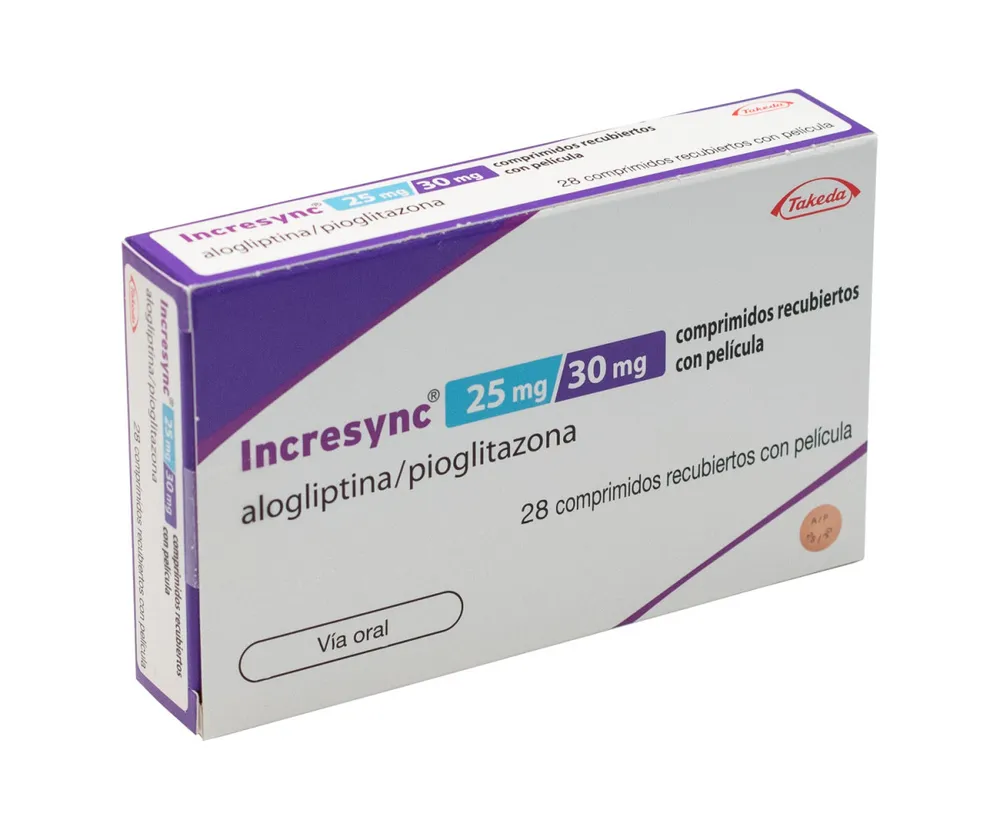
Table of Contents
- Package leaflet: Information for the patient
- Incresync 12.5 mg/30 mg film-coated tablets, 25 mg/30 mg film-coated tablets, 25 mg/45 mg film-coated tablets
- 1. What Incresync is and what it is used for
- 2. What you need to know before taking Incresync
- 3. How to take Incresync
- 4. Possible side effects
- 5. How to store Incresync
- 6. Package contents and other information
Package leaflet: Information for the patient
Incresync 12.5 mg/30 mg film-coated tablets, 25 mg/30 mg film-coated tablets, 25 mg/45 mg film-coated tablets
alogliptin/pioglitazone
Please read all of this leaflet carefully before taking this medicine because it contains important information for you.
- Keep this leaflet. You may need to read it again.
- If you have any questions, ask your doctor or pharmacist.
- This medicine has been prescribed for you only. Do not give it to other people, even if they have the same symptoms as you, because it may be harmful.
- If you experience any side effect, including those not listed in this leaflet, tell your doctor or pharmacist. See section 4.
Contents of this leaflet
- What Incresync is and what it is used for
- What you need to know before taking Incresync
- How to take Incresync
- Possible side effects
- How to store Incresync
- Contents of the pack and other information
1. What Incresync is and what it is used for
What Incresync is
Incresync contains two different medicines called alogliptin and pioglitazone in one tablet:
- alogliptin belongs to a group of medicines known as DPP-4 inhibitors (dipeptidyl peptidase-4 inhibitors). Alogliptin helps increase insulin levels in the body after a meal and reduce the amount of sugar in the body.
- pioglitazone belongs to a group of medicines known as thiazolidinediones. It helps the body make better use of the insulin it produces. Both of these groups of medicines are called "oral antidiabetics".
What Incresync is used for
Incresync is used to lower blood sugar levels in adults with type 2 diabetes. Type 2 diabetes is also known as non-insulin-dependent diabetes mellitus or NIDDM. Incresync is taken when blood sugar cannot be adequately controlled by diet, exercise, and other oral antidiabetic medicines such as pioglitazone alone, or pioglitazone and metformin taken together. Your doctor will check whether Incresync is working 3–6 months after starting treatment. If you are already taking both alogliptin and pioglitazone as separate tablets, Incresync can replace them with a single tablet. It is important that you continue to follow the diet and exercise plan recommended by your doctor or nurse.
2. What you need to know before taking Incresync
Do not take Incresync
- if you are allergic to alogliptin, pioglitazone, or any of the other ingredients of this medicine (listed in section 6);
- if you have had a severe allergic reaction to other similar medicines used to control blood sugar. Symptoms of a severe allergic reaction may include: skin rash, raised red spots on the skin (urticaria), swelling of the face, lips, tongue, and throat, which may cause difficulty breathing or swallowing. Additional symptoms may include generalized itching and a sensation of warmth, particularly on the scalp, mouth, throat, palms of the hands, and soles of the feet (Stevens-Johnson syndrome);
- if you have heart failure or have previously had heart failure;
- if you have liver disease;
- if you have diabetic ketoacidosis (a serious complication of poorly controlled diabetes). Symptoms include excessive thirst, frequent need to urinate, loss of appetite, nausea or vomiting, and rapid weight loss;
- if you have or have ever had bladder cancer (bladder tumour);
- if you have blood in your urine and your doctor has not yet investigated the cause. Do not take Incresync and consult your doctor immediately to have your urine tested as soon as possible.
Warnings and precautions
Talk to your doctor or pharmacist before taking Incresync if:
- you have type 1 diabetes (your body does not produce insulin);
- you are taking an antidiabetic medicine known as a sulfonylurea (for example, glipizide, tolbutamide, glibenclamide) or insulin;
- you have heart failure or retain fluid (fluid retention). If you are taking anti-inflammatory medicines that may also cause fluid retention and swelling, inform your doctor;
- you are elderly and taking insulin, as this may increase the risk of heart problems;
- you have liver or kidney problems. Before starting this medicine, you will have a blood test to check your liver and kidney function. This test may be repeated periodically. If you have kidney disease, your doctor may reduce your dose of Incresync;
- you have a specific type of diabetic eye disease called macular edema (swelling at the back of the eye);
- you have ovarian cysts (polycystic ovary syndrome). The likelihood of becoming pregnant may increase, as ovulation may resume when you take Incresync. If this applies to you, use an appropriate contraceptive method to avoid the risk of unintended pregnancy;
- you have or have had a disease of the pancreas. Minor changes in blood cell counts may appear in blood tests. Your doctor will discuss the results with you. A higher number of bone fractures has been observed in patients, especially in women taking pioglitazone. Your doctor will take this into account when managing your diabetes treatment. If blisters appear on your skin, consult your doctor, as this could be a sign of a condition called bullous pemphigoid. Your doctor may ask you to stop treatment with alogliptin.
Children and adolescents
Incresync is not recommended for children and adolescents under 18 years of age due to lack of data in these patient groups.
Other medicines and Incresync
Tell your doctor or pharmacist if you are taking, have recently taken, or might take any other medicines.
In particular, inform your doctor or pharmacist if you are taking any of the following medicines:
- gemfibrozil (used to lower cholesterol levels),
- rifampicin (used to treat tuberculosis and other infections).
Your blood sugar level will be monitored and your dose of Incresync may need to be adjusted.
Pregnancy and breastfeeding
If you are pregnant, think you may be pregnant, planning to become pregnant, or are breastfeeding, ask your doctor or pharmacist for advice before taking this medicine. There is no experience with the use of Incresync in pregnant or breastfeeding women. Incresync must not be used during pregnancy or breastfeeding.
Driving and using machines
You may experience vision disturbances while taking this medicine. If this occurs, do not drive or operate tools or machinery. Taking Incresync together with other antidiabetic medicines may cause low blood sugar levels (hypoglycaemia), which may affect your ability to drive and use machines.
Incresync contains lactose
If your doctor has informed you that you have an intolerance to certain sugars, consult your doctor before taking Incresync.
Incresync contains sodium
This medicine contains less than 1 mmol (23 mg) of sodium per tablet, i.e., essentially 'sodium-free'.
3. How to take Incresync
Take this medicine exactly as directed by your doctor or pharmacist. If you
have any doubts, consult your doctor or pharmacist.
Your doctor will tell you how much Incresync to take and whether you need to adjust the dose of any other
medicines you are taking.
The maximum recommended daily dose is one 25 mg/45 mg tablet.
Incresync must be taken once daily. The tablet or tablets should be swallowed whole with water. This medicine can be taken regardless of meals.
If you have kidney problems, your doctor may prescribe you a reduced dose.
If you are following a diabetic diet, you must continue it while taking Incresync.
Your weight should be monitored regularly; if you gain weight, inform your doctor.
If you take more Incresync than you should
If you take more tablets than prescribed, or if someone else or a child takes your medicine,
seek immediate medical attention at the nearest emergency department. Bring this leaflet or
some tablets with you so that the doctor can identify exactly what has been taken.
If you forget to take Incresync
If you forget to take a dose, take it as soon as you remember. Do not take a double dose to
compensate for the missed dose.
If you stop taking Incresync
Do not stop treatment with Incresync without first consulting your doctor. If you stop taking Incresync,
your blood sugar levels may increase.
If you have any doubts about how to use this medicine, consult your doctor or pharmacist.
4. Possible side effects
Like all medicines, this medicine can cause side effects, although not everyone gets them.
STOP taking Incresync and contact your doctor immediately if you notice any of the following serious side effects:
Common (affects up to 1 in 10 users):
- Sudden and severe bone pain or immobility (particularly in women). Uncommon (affects up to 1 in 100 users):
- Symptoms of bladder tumour including blood in the urine, pain when urinating, or sudden need to urinate. Not known (frequency cannot be estimated from the available data):
- An allergic reaction. Symptoms may include: rash, hives, difficulty swallowing or breathing, swelling of the lips, face, throat or tongue, and feeling faint.
- A severe allergic reaction: skin lesions or spots on the skin which may progress to sores surrounded by pale or red rings, blisters and/or skin peeling, possibly with symptoms such as itching, fever, general feeling of malaise, painful joints, vision problems, burning, pain or itching in the eyes, and mouth sores (Stevens-Johnson syndrome and erythema multiforme).
- Severe and persistent pain in the abdomen (stomach area) which may spread to the back, as well as nausea and vomiting, as these could be signs of an inflamed pancreas (pancreatitis). You should also contact your doctor if you experience any of the following side effects: Common:
- Symptoms of low blood sugar levels (hypoglycaemia) may occur when Incresync is taken in combination with insulin or sulphonylureas (e.g., glipizide, tolbutamide, glibenclamide). Symptoms may include: trembling, sweating, anxiety, blurred vision, tingling of the lips, paleness, mood changes or feeling confused. Blood sugar levels may drop below normal, but can be raised again by taking sugar. It is recommended to carry some sugar lumps, sweets, biscuits or sugared fruit juice with you.
- Symptoms similar to cold or flu such as sore throat, blocked or stuffy nose,
- inflammation of the sinuses (sinusitis),
- skin itching,
- headache,
- stomach ache,
- diarrhoea,
- indigestion, heartburn,
- feeling unwell,
- muscle pain,
- numbness in any part of the body,
- blurred or distorted vision,
- weight gain,
- swollen hands or feet,
- skin rash. Uncommon:
- sleep disorders. Not known:
- vision disorders (caused by a condition called macular oedema).
- liver problems such as nausea and vomiting, stomach pain, unusual or unexplained tiredness, loss of appetite, dark urine or yellowing of the skin or whites of the eyes.
- inflammation of the connective tissue within the kidneys (interstitial nephritis).
- blisters on the skin (bullous pemphigoid). Reporting of side effects If you get any side effects, including ones not listed in this leaflet, talk to your doctor or pharmacist. You can also report side effects directly via the national reporting system listed in Annex V. By reporting side effects, you can help provide more information on the safety of this medicine.
5. How to store Incresync
Keep this medicine out of the sight and reach of children.
Do not use this medicine after the expiry date stated on the carton and blister after Exp/EXP.
The expiry date refers to the last day of that month.
This medicine does not require any special temperature conditions for storage.
Store in the original packaging to protect the medicine from moisture.
Do not dispose of medicines via wastewater or household waste. Ask your pharmacist how to
dispose of medicines you no longer use. This will help protect the environment.
6. Package contents and other information
What Incresync contains
- The active substances are alogliptin and pioglitazone. Each 25 mg/30 mg film-coated tablet contains alogliptin benzoate and pioglitazone hydrochloride equivalent to 25 mg of alogliptin and 30 mg of pioglitazone.
- The other components are: mannitol, microcrystalline cellulose, hydroxypropylcellulose, sodium croscarmellose, magnesium stearate, lactose monohydrate, hypromellose, talc, titanium dioxide (E171), yellow iron oxide (E172), red iron oxide (E172), macrogol 8000, shellac, black iron oxide (E172). See section 2, “Incresync contains lactose”. Each 25 mg/45 mg film-coated tablet contains alogliptin benzoate and pioglitazone hydrochloride equivalent to 25 mg of alogliptin and 45 mg of pioglitazone.
- The other components are: mannitol, microcrystalline cellulose, hydroxypropylcellulose, sodium croscarmellose, magnesium stearate, lactose monohydrate, hypromellose, talc, titanium dioxide (E171), red iron oxide (E172), macrogol 8000, shellac, and black iron oxide (E172). See section 2, “Incresync contains lactose”. Each 12.5 mg/30 mg film-coated tablet contains alogliptin benzoate and pioglitazone hydrochloride equivalent to 12.5 mg of alogliptin and 30 mg of pioglitazone.
- The other components are: mannitol, microcrystalline cellulose, hydroxypropylcellulose, sodium croscarmellose, magnesium stearate, lactose monohydrate, hypromellose, talc, titanium dioxide (E171), yellow iron oxide (E172), red iron oxide (E172), macrogol 8000, shellac, carnauba wax and glycerol mono-oleate. See section 2, “Incresync contains lactose”.
Description of the appearance of Incresync and contents of the pack
- Incresync 25 mg/30 mg film-coated tablets (tablets) are peach-coloured, round (approximately 8.7 mm in diameter), biconvex, film-coated tablets with “A/P” and “25/30” printed in grey ink on one side.
- Incresync 25 mg/45 mg film-coated tablets (tablets) are red-coloured, round (approximately 8.7 mm in diameter), biconvex, film-coated tablets with “A/P” and “25/45” printed in grey ink on one side.
- Incresync 12.5 mg/30 mg film-coated tablets (tablets) are pale peach-coloured, round (approximately 8.7 mm in diameter), biconvex, film-coated tablets with “A/P” and “12.5/30” printed in red ink on one side.
Incresync is available in blister packs containing 10, 14, 28, 30, 56, 60, 90, 98 or 100 tablets. Not all pack sizes may be marketed.
Marketing Authorisation Holder
Takeda Pharma A/S
Delta Park 45
2665 Vallensbaek Strand
Denmark
Manufacturer
Takeda Ireland Limited
Bray Business Park
Kilruddery
Co. Wicklow
Ireland
For further information on this medicinal product, please contact the local representative of the Marketing Authorisation Holder:
België/Belgique/Belgien
Takeda Belgium
Tél/Tel: +32 2 464 06 11
[email protected]
България (Bulgaria)
Такеда България
Тел.: +359 2 958 27 36; +359 2 958 15 29
Luxembourg/Luxemburg
Takeda Belgium
Tél/Tel: +32 2 464 06 11
[email protected]
Česká republika (Czech Republic)
Takeda Pharmaceuticals Czech Republic s.r.o.
Tel: +420 234 722 722
Magyarország (Hungary)
Takeda Pharma Kft.
Tel: +361 2707030
Danmark (Denmark)
Takeda Pharma A/S
Tlf./Tel: +45 46 77 11 11
[email protected]
Deutschland (Germany)
Takeda GmbH
Tel: +49 (0) 800 825 3325
[email protected]
Eesti (Estonia)
Takeda Pharma AS
Tel: +372 6177 669
Ελλάδα (Greece)
TAKEDA ΕΛΛΑΣ Α.Ε.
Τηλ: +30 210 6387800
[email protected]
España (Spain)
Laboratorios Menarini, S.A.
Tel: +34 934 628 800
[email protected]
France
Takeda France SAS
Tél: +33 1 40 67 33 00
[email protected]
Hrvatska (Croatia)
Takeda Pharmaceuticals Croatia d.o.o
Tel: +385 1 377 88 96
Ireland
Takeda Products Ireland Limited
Tel: 1800 937 970
[email protected]
Ísland (Iceland)
Vistor hf.
Sími: +354 535 7000
[email protected]
Italia (Italy)
Takeda Italia S.p.A.
Tel: +39 06 502601
Κύπρος (Cyprus)
TAKEDA ΕΛΛΑΣ Α.Ε.
Τηλ: +30 210 6387800
[email protected]
Latvija (Latvia)
Takeda Latvia SIA
Tel: +371 67840082
Lietuva (Lithuania)
“Takeda” UAB
Tel: +370 521 09 070
Luxembourg/Luxemburg
Takeda Belgium
Tél/Tel: +32 2 464 06 11
[email protected]
Magyarország (Hungary)
Takeda Pharma Kft.
Tel: +361 2707030
Malta
TAKEDA HELLAS S.A.
Tel: +30 210 6387800
Nederland (Netherlands)
Takeda Nederland B.V.
Tel: +31 20 203 5492
[email protected]
Norge (Norway)
Takeda AS
Tlf: +47 6676 3030
[email protected]
Österreich (Austria)
Takeda Pharma Ges. m.b.H.
Tel: +43 (0) 800-20 80 50
[email protected]
Polska (Poland)
Takeda Pharma sp. z o.o
Tel: +48 22 608 13 00
Portugal
Takeda Farmacêuticos Portugal, Lda.
Tel: +351 21 120 1457
România (Romania)
Takeda Pharmaceuticals SRL
Tel: +40 21 335 03 91
Slovenija (Slovenia)
Takeda Pharmaceuticals farmacevtska družba d.o.o.
Tel: +386 (0) 59 082 480
Slovenská republika (Slovakia)
Takeda Pharmaceuticals Slovakia s.r.o.
Tel: +421 (2) 20 602 600
Suomi/Finland
Takeda Oy
Tel: +358 20 746 5000
Sverige (Sweden)
Takeda Pharma AB
Tel: +46 8 731 28 00
[email protected]
United Kingdom (Northern Ireland)
Takeda UK Ltd
Tel: +44 (0) 2830 640 902
[email protected]
Other sources of information
More detailed information on this medicinal product is available on the website of the European Medicines Agency: http://www.ema.europa.eu.