Increlex
Italy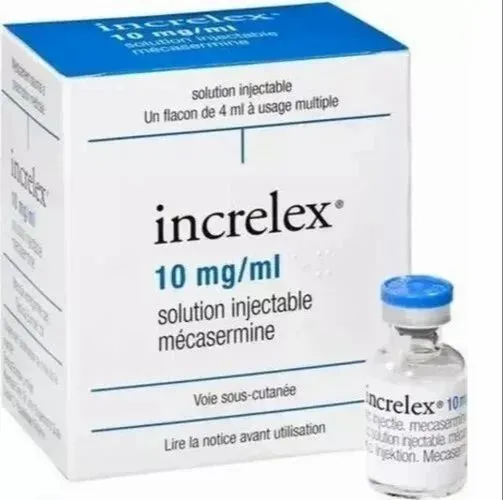
Table of Contents
Package leaflet: Information for the user
INCRELEX 10 mg/ml injection solution
Mecasermin
This medicinal product is subject to additional monitoring. This will allow for rapid identification of new safety information. You can help by reporting any side effects you experience while taking this medicine. See the end of section 4 for information on how to report side effects.
Please read all of this leaflet carefully before using this medicine because it contains important information for you.
- Keep this leaflet. You may need to read it again.
- If you have any questions, ask your doctor or pharmacist.
- This medicine has been prescribed for you personally. Never give it to others. It may be harmful to other people, even if their symptoms are the same as yours.
- If you experience any side effect, including those not listed in this leaflet, contact your doctor or pharmacist. See section 4.
Contents of this leaflet:
- What INCRELEX is and what it is used for
- What you need to know before using INCRELEX
- How to use INCRELEX
- Possible side effects
- How to store INCRELEX
- Contents of the pack and other information
1. What INCRELEX is and what it is used for
- INCRELEX is a liquid containing mecasermin, which is a synthetic insulin-like growth factor I (IGF-1), similar to the IGF-1 normally produced by the human body.
- It is used to treat children and adolescents from 2 to 18 years of age who are very short for their age because their body does not produce enough IGF-1. This condition is called primary IGF-1 deficiency.
2. What you need to know before using INCRELEX:
Do not take INCRELEX:
- If you have any tumour or growth, whether cancerous or non-cancerous
- If you have had cancer in the past
- If you have any condition that may increase the risk of cancer
- if you are allergic to mecasermin or to any of the excipients of the medicine (listed in section 6)
- in premature infants or newborns, as the medicine contains benzyl alcohol.
Warnings and precautions
In children and adolescents treated with INCRELEX, there is an increased risk of tumours and growth (both cancerous and non-cancerous). Report immediately to your specialist doctor if any new growth, skin lesion or any unexpected symptom occurs during or after treatment, as mecasermin may play an important role in cancer development.
Talk to your doctor or pharmacist before using INCRELEX:
- if you have a curved spine (scoliosis): you should undergo monitoring to assess progression of scoliosis.
- if limping or pain in the hip or knee develops
- if you have enlarged tonsils (tonsillar hypertrophy): in this case, you should undergo periodic appropriate evaluations.
- if you experience symptoms of increased intracranial pressure (intracranial hypertension), such as changes in vision, headache, nausea and/or vomiting, consult your doctor.
- consult your doctor if you experience a local reaction at the injection site or a generalized allergic reaction to INCRELEX. Contact your doctor as soon as possible if you develop a localized skin rash. Seek immediate medical help if you experience a generalized allergic reaction (urticaria, breathing difficulties, feeling unwell or collapse, or generalised malaise).
- if you have stopped growing (epiphyseal growth plates are closed). In this case, INCRELEX cannot promote growth and must not be used.
Children under 2 years of age
The use of this medicine has not been studied in children under 2 years of age and therefore must not be used in these subjects.
Other medicines and INCRELEX:
Inform your doctor or pharmacist if you are taking, have recently taken, or might take any other medicines.
In particular, inform your doctor if you are taking insulin or other antidiabetic medicines. Dose adjustments may be necessary for all these medicines.
Pregnancy, breastfeeding and fertility
If you are pregnant, suspect you may be pregnant, are planning a pregnancy, or are breastfeeding, consult your doctor before taking this medicine.
For all women of childbearing potential, negative pregnancy tests are recommended before starting treatment with mecasermin. It is also recommended that all women of childbearing potential use adequate contraception.
Treatment with mecasermin must be discontinued if pregnancy occurs.
Mecasermin must not be administered to a breastfeeding mother.
Driving and using machines
Mecasermin may cause hypoglycaemia (a very common side effect, see section 4), which may impair the ability to drive and use machines, as concentration and reaction abilities may be reduced.
You should avoid high-risk activities (e.g., driving, etc.) during the 2–3 hours following dose administration, particularly at the beginning of treatment with INCRELEX, until a dose of INCRELEX is established that does not cause side effects that could make these activities risky.
INCRELEX contains benzyl alcohol and sodium
INCRELEX contains benzyl alcohol as a preservative, which may cause toxic reactions and allergic reactions in newborns and children up to 3 years of age.
This medicine contains less than 1 mmol (23 mg) of sodium per vial, i.e., essentially “sodium-free”.
3. How to use INCRELEX
Use this medicine exactly as directed by your doctor. If you have any doubts, consult your
doctor or pharmacist.
The usual dose ranges between 0.04 and 0.12 mg/kg of the patient's body weight, administered twice daily.
Refer to the "Instructions for Use" at the end of this leaflet.
Inject INCRELEX subcutaneously shortly before or after a meal or snack, as it may have insulin-like
hypoglycaemic effects and thus may reduce blood sugar levels (hypoglycaemia, see section 4). Do not
administer the dose of INCRELEX if you are unable to eat for any reason. If a dose is missed, do not
compensate by taking a double dose next time. The next dose should be taken as usual, with a meal or
snack.
Inject INCRELEX under the skin of the arm, thigh, abdominal area (abdomen), or buttocks. Change the
injection site with each injection. Never inject INCRELEX intravenously or into a muscle.
Use INCRELEX only if it is clear and colourless.
Treatment with mecasermin is a long-term therapy. For further information, consult your doctor.
If you take more INCRELEX than you should
Mecasermin, like insulin, can reduce blood sugar levels (see hypoglycaemia in section 4).
If more INCRELEX has been injected than recommended, inform your doctor immediately.
Acute overdose may lead to hypoglycaemia (low blood sugar levels).
Treatment of acute mecasermin overdose should aim to reverse hypoglycaemia. Consume liquids or foods
containing sugar. If the patient is unconscious or not sufficiently alert to drink sugar-containing liquids,
an intramuscular injection of glucagon may be necessary to reverse low blood sugar levels. Your doctor or
nurse will instruct you on how to administer a glucagon injection.
Long-term overdose may cause enlargement of certain body parts (e.g., hands, feet, facial features) or
excessive growth of the entire body. If you suspect long-term overdose, contact your doctor immediately.
If you forget to take INCRELEX
Do not take a double dose to make up for a forgotten dose.
If a dose is missed, do not increase the next dose to compensate. The next dose should be taken as usual,
with a meal or snack.
If you stop using INCRELEX
Stopping or prematurely discontinuing treatment with mecasermin may impair the therapy’s effectiveness
on growth. Consult your doctor before stopping treatment.
If you have any questions about how to use this medicine, consult your doctor or pharmacist.
4. Possible side effects
Like all medicines, this medicine can cause side effects, although not everyone gets them. If you experience any side effect, contact your doctor or pharmacist. This includes any possible side effect not listed in this leaflet. The most common side effects with mecasermin are: low blood sugar levels (hypoglycaemia), vomiting, injection site reactions, headache, and middle ear infections. Severe allergic reactions have also been reported with INCRELEX. If you experience any of these events, please follow the advice provided for each event in the sections below.
Frequency not known (frequency cannot be estimated from the available data)
Cancerous and non-cancerous tumours
An increased risk of cancerous and non-cancerous tumours has been observed in patients treated with INCRELEX. The risk of such tumours may be higher if INCRELEX is used for indications different from those stated in section 1 or used at doses higher than those recommended in section 3.
Severe allergic reactions (anaphylaxis)
Generalised hives, difficulty breathing, dizziness, swelling of the face and/or throat have been reported following the use of mecasermin. Immediately stop using INCRELEX and urgently consult a doctor if you develop a severe allergic reaction.
Local allergic reactions at the injection site (itching, hives) have also been reported.
Hair loss (alopecia)
Hair loss has also been reported after the use of mecasermin.
Very common (may affect more than 1 in 10 people)
Low blood sugar levels (hypoglycaemia)
Mecasermin can lower blood sugar levels. Signs of low blood sugar levels include: dizziness, fatigue, nervousness, hunger, irritability, difficulty concentrating, sweating, nausea, and rapid or irregular heartbeat.
Severe hypoglycaemia can lead to unconsciousness, seizures/epileptic fits, or death. Immediately stop administration of INCRELEX and urgently consult a doctor if you develop seizures/epileptic fits or loss of consciousness.
If you are taking INCRELEX, you should avoid high-risk activities (such as intense physical exercise) within 2 or 3 hours after injection of INCRELEX, especially at the beginning of treatment with INCRELEX.
Before starting treatment with INCRELEX, your doctor or nurse will explain how to treat hypoglycaemia. You should always have a source of sugar available, such as orange juice, sugar gel, sweets, or milk, in case symptoms of hypoglycaemia occur. For severe hypoglycaemia, if you are unresponsive and cannot drink sugar-containing liquids, a glucagon injection must be administered. Your doctor or nurse will explain how to give the injection. Glucagon increases blood glucose when injected. It is important that you follow a well-balanced diet including proteins and fats, such as meat and cheese, in addition to sugar-containing foods.
Blood glucose (glucose) must be monitored by capillary blood sampling from the fingertip before each meal at the beginning of treatment and until a well-tolerated dose is established. If frequent symptoms of hypoglycaemia or severe hypoglycaemia occur, blood glucose monitoring should continue regardless of whether you have eaten or not, and, if possible, during episodes of hypoglycaemia.
Injection site hypertrophy (tissue swelling at the injection site) and bruising
This can be avoided by alternating the injection site with each administration (injection site rotation).
Gastrointestinal system
Vomiting and upper abdominal pain have occurred in patients treated with mecasermin.
Infections
Middle ear infections have been observed in children treated with mecasermin.
Musculoskeletal system
Joint pain and limb pain have occurred during treatment with mecasermina.
Nervous system
Headache has occurred during treatment with mecasermin.
Common (may affect up to 1 in 10 people)
Seizures
Seizures (epileptic fits) have been observed during treatment with mecasermin.
Dizziness and tremor have also been reported during treatment with mecasermin.
Cardiac disorders
Rapid heartbeat and abnormal heart sounds have been reported during treatment with mecasermin.
Increased blood sugar (hyperglycaemia)
Increased blood sugar has been observed during treatment with mecasermin.
Tonsillar/adenoidal hypertrophy
Mecasermin may cause enlargement of the tonsils. Some signs of tonsillar hypertrophy include: snoring, difficulty breathing or swallowing, sleep apnoea syndrome (a condition in which breathing is briefly interrupted during sleep), or fluid in the middle ear and ear infections. Sleep apnoea can cause excessive daytime sleepiness. Contact your doctor if you experience these symptoms. Your doctor should regularly examine your tonsils/adenoids.
Thymus enlargement
Enlargement of the thymus (a specialised organ of the immune system) has been observed during treatment with mecasermin.
Papilloedema
Swelling at the back of the eye (due to increased pressure inside the brain) may be detected by your doctor or optician during treatment with mecasermin.
Hearing loss (hypoacusis)
Hearing loss (hypoacusis), ear pain, and fluid in the middle ear have been observed during treatment with mecasermin. Inform your doctor if hearing problems develop.
Worsening of scoliosis (caused by rapid growth)
If you have scoliosis, frequent checks are needed to monitor progression and increase in curvature of the spine. Muscle pain has also been observed during treatment with mecasermin.
Reproductive system
Breast enlargement has been observed with treatment using mecasermin.
Gastrointestinal system
Abdominal pain has occurred during treatment with mecasermin.
Skin and appendages disorders
Skin thickening, nevus, and hair growth abnormalities have been observed during treatment with mecasermin.
Injection site reactions
During treatment with mecasermin, reactions such as pain, irritation, bleeding, bruising, redness, and hardening have been reported. Injection site reactions can be avoided by varying the injection site at each administration (injection site rotation).
Uncommon (may affect up to 1 in 100 people)
Increased pressure in the brain (intracranial hypertension)
INCRELEX may sometimes cause a temporary increase in pressure inside the brain. Symptoms of intracranial hypertension may include visual changes, headache, nausea and/or vomiting. Inform your doctor immediately if you experience any of these symptoms. Your doctor may check whether intracranial hypertension is present. If it is, your doctor may decide to temporarily reduce or stop treatment with mecasermin. Treatment with mecasermin may be restarted after the episode has resolved.
Cardiac abnormalities
In some patients treated with mecasermin, a heart ultrasound examination (echocardiogram) has shown an increase in heart muscle size and abnormalities in heart valve function. Your doctor may perform an echocardiogram before, during, and after treatment with mecasermin.
Injection site reactions
Skin rashes, swelling, and fat accumulation have been reported during treatment with mecasermin. Injection site reactions can be avoided by varying the injection site at each administration (injection site rotation).
Weight gain
Weight gain has been observed during treatment with mecasermin.
Other uncommon side effects observed with mecasermin treatment include depression and nervousness.
Reporting of side effects
If you experience any side effect, including those not listed in this leaflet, talk to your doctor or pharmacist. You can also report side effects directly via the national reporting system listed in Appendix V.
By reporting side effects, you can help provide more information on the safety of this medicine.
5. How to store INCRELEX
Keep this medicine out of the sight and reach of children.
Do not use this medicine after the expiry date stated on the pack and label after "EXP". The expiry date refers to the last day of the month.
Store in a refrigerator (2°C – 8°C). Do not freeze.
Keep the vial in the outer packaging to protect it from light.
After first use, the vial can be stored for up to 30 days at 2°C – 8°C.
Do not dispose of medicines via wastewater or household waste. Ask your pharmacist how to dispose of medicines you no longer use. This will help protect the environment.
6. Package Contents and Other Information
What INCRELEX Contains
- The active substance is mecasermin. One ml contains 10 mg of mecasermin. Each vial contains 40 mg of mecasermin.
- The excipients are: benzyl alcohol, sodium chloride, polysorbate 20, glacial acetic acid, sodium acetate and water for injections (see section 2 “INCRELEX contains benzyl alcohol and sodium”).
Description of the Appearance of INCRELEX and Contents of the Package
INCRELEX is a solution for injection, ranging from colourless to slightly yellow and from clear to slightly opalescent, supplied in a glass vial closed with a stopper and a seal. The vial contains 4 ml of solution.
Packaged in packs of one vial.
Marketing Authorisation Holder and Manufacturer
Marketing Authorisation Holder:
Esteve Pharmaceuticals S.A.
Passeig de la Zona Franca 109, 4th Floor
08038 Barcelona
Spain
Manufacturer:
Tjoapack Netherlands B.V.
Nieuwe Donk 9
4879 AC Etten-Leur
The Netherlands
For further information on INCRELEX, please contact the local representative of the Marketing Authorisation Holder.
België/Belgique/Belgien, Italia, Luxembourg/Luxemburg
Esteve Pharmaceuticals SRL
Esteve Pharmaceuticals SPRL België
Tel: +39 345 9214959 / Tél/Tel: +32 479 98 92 88
България, Latvija
Esteve Pharmaceuticals S.A.
Tel: +34 93 446 60 00
Česká republika, Lietuva
Esteve Pharmaceuticals S.A.
Tel: +34 93 446 60 00
Hrvatska
Esteve Pharmaceuticals S.A.
Tel: +34 93 446 60 00
Danmark, Norge, Suomi/Finland, Sverige, Ísland, Magyarország
Esteve Pharmaceuticals S.A.
Tlf/Puh/Tel/Sími: +34 93 446 60 00
Deutschland, Österreich
Esteve Pharmaceuticals GmbH
Germany Tel.: +49 30 338427-100
Nederland
Esteve Pharmaceuticals S.A.
Tel: +34 93 446 60 00
Eesti, Polska
Esteve Pharmaceuticals S.A.
Tel: +34 93 446 60 00
Ελλάδα, Κύπρος, Malta
Esteve Pharmaceuticals S.A.
Greece Tel: +34 93 446 60 00
España
Esteve Pharmaceuticals S.A.
Tel: +34 93 446 60 00
Slovenija
Esteve Pharmaceuticals S.A.
Tel: +34 93 446 60 00
France
Esteve Pharmaceuticals S.A.S
Tél: +33 1 42 31 07 10
Slovenská republika
Esteve Pharmaceuticals S.A.
Tel: +34 93 446 60 00
Ireland, United Kingdom (Northern Ireland)
Esteve Pharmaceuticals S.A.
Ireland Tel: +34 93 446 60 00
România
Esteve Pharmaceuticals S.A.
Tel/Тел.: +34 93 446 60 00
This patient information leaflet was last approved on
The marketing authorisation for this medicinal product was granted under "exceptional circumstances".
This means that, due to the rarity of the disease, it has not been possible to obtain complete information about this medicinal product.
The European Medicines Agency will review any new information on the medicinal product annually, and this patient information leaflet will be updated if necessary.
Other Sources of Information:
More detailed information on this medicinal product is available on the website of the European Medicines Agency: http://www.emea.europa.eu/
In addition, links to other websites on rare diseases and their treatments are provided.
This patient information leaflet is available in all EU/EEA languages on the website of the European Medicines Agency.
<------------------------------------------------------------------------------------------------------------------------
INSTRUCTIONS FOR USE
INCRELEX must be administered using sterile, single-use syringes and needles, which may be provided by the doctor, pharmacist or nurse. The syringe volume should be small enough to allow accurate withdrawal of the dose from the vial.
Preparing the Dose:
- Wash your hands before preparing INCRELEX for injection.
- Use a new sterile needle and syringe each time a dose is administered. Use syringes and needles only once. Dispose of them properly in a dedicated sharps container (e.g. a biological hazard container), a rigid plastic container (e.g. a detergent bottle), or a metal container (e.g. an empty coffee tin). Never share needles or syringes.
- Check the solution to ensure it is clear and colourless. Do not use the medicine after the expiry date (shown on the label, referring to the last day of the month) or if the solution is cloudy or if particles are visible. If the vial has been frozen, dispose of it properly. Ask your pharmacist how to dispose of unused medicine.
- If using a new vial, remove the protective cap. Do not remove the rubber stopper.
- Clean the rubber stopper of the vial with an alcohol swab to prevent contamination of the vial by germs that may be introduced through repeated needle insertions (see Figure 1).
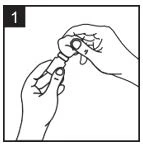
Figure 1: clean the
top with alcohol
- Before inserting the needle into the vial, pull back the plunger to draw into the syringe an amount of air equal to the prescribed dose. Insert the needle through the rubber stopper at the top of the vial and push the plunger to inject the air into the vial (see Figure 2).
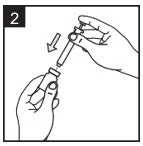
Figure 2: inject air
into the vial
- Leave the syringe in the vial and invert them. Hold the syringe and vial firmly (see Figure 3).
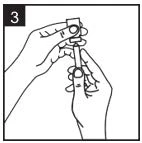
Figure 3: prepare
for withdrawal
- Ensure the tip of the needle is in the liquid (see Figure 4). Pull back the plunger to withdraw the correct dose into the syringe (see Figure 5).
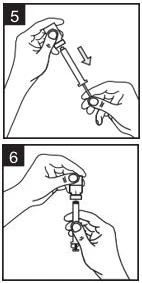
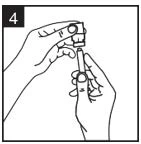
Figure 4: tip in
the liquid
Figure 5: withdraw
the correct dose
- Before removing the needle from the vial, check the syringe to ensure there are no air bubbles. If air bubbles are present, hold the vial and syringe with the needle pointing straight up and tap the side of the syringe until the bubbles rise to the surface. Push the bubbles out with the plunger and withdraw the liquid again until the correct dose is in the syringe (see Figure 6).
Figure 6: remove air bubbles
and refill the syringe
- Remove the needle from the vial and replace the protective cap. Avoid letting the needle touch anything. You are now ready for injection (see Figure 7).
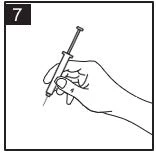
Figure 7: ready
for injection
Administering the Dose:
Inject INCRELEX as prescribed by your doctor.
Do not administer the dose if you are unable to eat shortly before or after the injection.
- Choose the injection site – arm, thigh, buttock or abdomen (see below). The injection site should be rotated with each injection to avoid the formation of fatty tissue build-up under the skin (lipohypertrophy) caused by repeated injections at the same site.
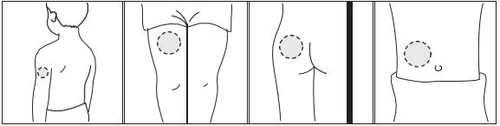
Arm Thigh Buttock Abdomen
- Use alcohol or soap and water to clean the skin at the injection site. The injection site must be dry before injecting.
- Gently pinch the skin. Insert the needle as instructed by your doctor. Release the skin (see Figure A).
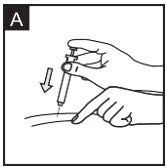
Figure A: gently pinch the skin
and inject as directed by your doctor
- Slowly push the syringe plunger fully down, ensuring all the liquid is injected. Remove the needle and gently press with a gauze pad or cotton ball over the injection site for several seconds. Do not rub the area (see Figure B).
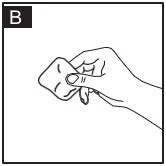
Figure B: press (do not rub)
with gauze or cotton ball
- Follow your doctor’s instructions for disposal of the used needle and syringe. Do not recap the needle. Used syringes and needles must be placed in a dedicated container (such as a biological waste container), a rigid plastic container (such as a detergent bottle), or a metal container (such as an empty coffee tin). These containers should be sealed and disposed of appropriately as directed by your doctor.