Inbrija
Italy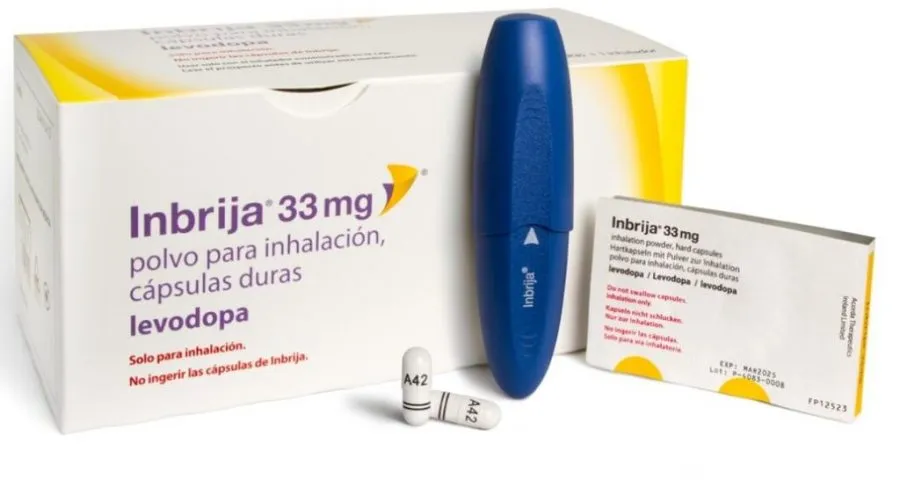
Table of Contents
- Package leaflet: Information for the patient
- Inbrija 33 mg inhalation powder, hard capsules
- 1. What Inbrija is and what it is used for
- 2. What you should know before using Inbrija
- 3. How to use Inbrija
- 4. Possible side effects
- 5. How to store Inbrija
- 6. Package contents and other information
- Instructions for use:
Package leaflet: Information for the patient
Inbrija 33 mg inhalation powder, hard capsules
levodopa
Please read this leaflet carefully before you use this medicine because it contains important information for you.
- Keep this leaflet. You may need to read it again.
- If you have any questions, ask your doctor or pharmacist.
- This medicine has been prescribed for you only. Do not give it to other people, even if their symptoms are the same as yours, as it may be harmful.
- If you experience any side effects, including those not listed in this leaflet, tell your doctor or pharmacist. See section 4.
Contents of this leaflet
- What Inbrija is and what it is used for
- What you need to know before using Inbrija
- How to use Inbrija
- Possible side effects
- How to store Inbrija
- Contents of the pack and other information
1. What Inbrija is and what it is used for
The active substance of Inbrija is levodopa. Inbrija is a medicinal product for inhalation used to treat the worsening of symptoms during "off" periods in Parkinson's disease.
Parkinson's disease affects movement and is treated with a medicine you take regularly. During "off" periods, your usual medicine does not control the disease well enough and movement is likely to become more difficult.
You must continue taking your main Parkinson's medicine and use Inbrija to manage the worsening of symptoms (such as inability to move) during off periods.
2. What you should know before using Inbrija
Do not use Inbrija
- if you are allergic to levodopa or to any of the other ingredients of this medicine (listed in section 6).
- if you experience blurred vision, red eyes, severe eye and head pain, see halos around lights, have pupils larger than normal, and nausea. If you have any of these symptoms, you may have a sudden-onset eye condition called narrow-angle glaucoma: do not take Inbrija and seek immediate medical advice.
- if you have a rare tumour of the adrenal gland, called a phaeochromocytoma.
- if you are taking certain antidepressant medicines known as non-selective MAO inhibitors (e.g. isocarboxazid and phenelzine). You must stop taking these medicines at least 14 days before starting treatment with Inbrija. See also section “Other medicines and Inbrija”.
- if you have previously had neuroleptic malignant syndrome, a potentially fatal reaction to certain medicines used to treat severe mental disorders, or if you have had non-traumatic rhabdomyolysis, a rare muscle disorder in which damaged muscles are rapidly broken down.
Warnings and precautions
Seek immediate medical advice if you experience tremors, agitation, confusion, fever, rapid pulse,
dizziness and fainting upon standing, or if you notice your muscles becoming extremely
rigid or violently contracting. These may be symptoms of “withdrawal hyperpyrexia”. For further information, see section 4.
Talk to your doctor or pharmacist before using Inbrija if you have, have had in the past, or develop:
- asthma, breathing difficulties such as chronic obstructive pulmonary disease (COPD), or other chronic lung diseases or breathing problems;
- any form of severe mental disorder, such as psychosis;
- a heart attack or heart rhythm problems. Your doctor will monitor you closely when starting treatment;
- a stomach or intestinal ulcer;
- a disease of the eye called glaucoma, as monitoring of eye pressure may be necessary;
- severe kidney problems;
- severe liver problems.
If you are unsure whether any of the conditions listed above apply to you, speak to your doctor or pharmacist before using Inbrija.
Talk to your doctor or pharmacist if you develop any of the following symptoms while using
Inbrija:
- sudden attacks of sleep or if you sometimes feel a strong urge to sleep;
- worsening or change in your mental state, even severely, such as psychotic-like behaviour and suicidal thoughts;
- hallucinations, confusion, inability to sleep, and excessive dreaming. Abnormal thoughts including anxiety, depression, agitation, paranoia, delirium or disorientation, aggressive and delusional behaviour;
- worsening of any respiratory symptoms or presence of a respiratory infection;
- impulses or urges to behave in ways that are unusual for you, or if you cannot resist the impulse, urge, or temptation to carry out certain activities that could harm you or others. These behaviours are known as impulse control disorders and may include pathological gambling, excessive eating or spending, abnormally high sex drive, or increased sexual thoughts or feelings. Your doctor may need to review your treatment.
- onset or worsening of abnormal movements (dyskinesia);
- dizziness upon standing (low blood pressure);
- melanoma (a type of skin cancer) or suspicious skin growths or skin changes.
If you are scheduled for surgery, inform your doctor that you are using Inbrija.
Tests
During long-term treatment with this medicine, tests of the heart, liver, kidneys, and blood cells may be required. If you are having blood or urine tests, inform your doctor or nurse that you are taking Inbrija. This is because the medicine may affect the results of certain tests.
Children and adolescents
The use of Inbrija is not recommended in patients under 18 years of age.
Other medicines and Inbrija
Tell your doctor or pharmacist if you are taking, have recently taken, or might take any other medicine. This is because other medicines may affect how Inbrija works.
Do not use Inbrija if you have taken medicines called non-selective MAO inhibitors for depression in the last 14 days. These medicines include isocarboxazid and phenelzine. If this applies to you, do not take Inbrija and consult your doctor or pharmacist.
Tell your doctor or pharmacist if you are taking:
- medicines for Parkinson’s disease called selective MAO inhibitors such as rasagiline, selegiline and safinamide, COMT inhibitors such as entacapone, tolcapone and opicapone, or anticholinergics such as orphenadrine and trihexyphenidyl;
- medicines for mental illnesses, including schizophrenia, such as benperidol, haloperidol, risperidone, chlorpromazine, fluphenazine decanoate, phenothiazines, butyrophenones or trifluoperazine;
- metoclopramide for the treatment of nausea;
- isoniazid, an antibiotic used to treat tuberculosis;
- medicines for high blood pressure, as your dose may need to be adjusted;
- medicines for depression called tricyclic antidepressants such as clomipramine, desipramine or doxepine;
- amantadine used to treat influenza or Parkinson’s disease.
Pregnancy and breastfeeding
If you are pregnant, think you may be pregnant, are planning to become pregnant, or are breastfeeding, consult your doctor or pharmacist before taking this medicine.
Treatment with Inbrija is not recommended during pregnancy and in women of childbearing potential who are not using contraceptive measures.
Women must not breastfeed during treatment with Inbrija.
Driving and using machines
Inbrija may cause excessive sleepiness, dizziness, and sudden attacks of sleep. If this happens to you, do not drive and do not operate tools or machinery. Before resuming driving or operating machines, you must be certain that you are not experiencing sudden attacks of sleep, dizziness, or sleepiness. You could risk serious injury or death to yourself or others.
3. How to use Inbrija
Use this medicine exactly as instructed by your doctor or pharmacist. If you have
any doubts, consult your doctor or pharmacist.
Before starting Inbrija, you must already be on regular treatment for Parkinson's disease with a
combination of a so-called dopa-decarboxylase inhibitor and levodopa.
The recommended dose of Inbrija is 2 capsules for the treatment of each off period. Do not use more than
2 capsules per off period. You may use 2 capsules up to five times a day.
The maximum dose of Inbrija is 10 capsules per day.
Important information before using Inbrija:
- Inbrija capsules must not be swallowed.
- This medicine is for inhalation use only.
- The capsules must be removed from the blister pack immediately before use.
- To receive the full dose, two capsules of the medicine must be inhaled.
- The medicine must only be used with the Inbrija inhaler.
- When opening a new package, always use the new inhaler provided.
- Your doctor or pharmacist will show you how to use the medicine correctly.
See the "Instructions for use" at the end of this leaflet for information on how to use the
medicine with the provided inhaler.
If you use more Inbrija than you should
If you use more Inbrija than you should (or if someone accidentally swallows Inbrija), seek medical help immediately.
You may feel confused or agitated, and your heart rate may be slower or faster than normal.
If you forget to use Inbrija
Use Inbrija only during off periods. If the off period has passed, do not use Inbrija until the next
off period.
If you stop using Inbrija
Do not stop treatment with Inbrija without consulting your doctor.
If you have any questions about how to use this medicine, consult your doctor or pharmacist.
4. Possible side effects
Like all medicines, this medicine can cause side effects, although not everyone experiences them.
Contact your doctor urgently if you have an allergic swelling including the following symptoms:
urticaria, itching, skin rash, swelling of the face, lips, tongue or throat. This may cause difficulty in
breathing or swallowing.
Contact your doctor urgently if your muscles become extremely stiff or contract violently, or if you
develop tremors, agitation, confusion, fever, rapid pulse or large fluctuations in blood pressure. These
may be symptoms of neuroleptic malignant syndrome (NMS, a rare and serious reaction to medicines
used to treat diseases of the central nervous system) or rhabdomyolysis (a rare and serious muscle
disease).
Contact your doctor urgently if you have bleeding in the stomach or intestines, which may present
as blood in the stool or dark stools.
The following side effects may occur with this medicine:
Very common (may affect more than 1 in 10 people):
- cough
Common (may affect up to 1 in 10 people):
- onset or worsening of abnormal movements (dyskinesia);
- infections of the nose, sinuses, throat or lungs;
- change in mucus colour;
- change in nasal mucus colour (e.g. non-clear mucus);
- throat irritation or throat itching;
- feeling unwell (nausea); vomiting;
- increased tendency to fall.
Additional side effects whose frequency is not known include:
- sensation of choking due to contact of the powder medicine with the back of the throat, immediately after use;
- skin cancer;
- deficiency of red blood cells, resulting in paleness and fatigue; increased susceptibility to infections due to deficiency of white blood cells; deficiency of platelets which may lead to bruising and tendency to bleed;
- reduced appetite;
- confusion; hallucinations; depression; anxiety; nightmares; inability to sleep; abnormal thoughts and perceptions, loss of touch with reality; agitation; suicidal thoughts; disorientation; exaggerated happiness; increased sexual desire; teeth grinding; paranoia and delusions;
- movement disorders with uncontrollable muscle contractions; sudden and sometimes unpredictable fluctuations in symptoms due to the return of Parkinson’s disease symptoms; drowsiness; dizziness; worsening of Parkinson’s disease; tingling; headache; tremors; epileptic seizure; sudden sleep episodes; restless legs syndrome; ataxia (disorder of coordination, balance and speech); altered sense of taste; mental health disorders affecting learning, memory, perception and problem solving; Horner’s syndrome (an eye disorder); dementia;
- blurred vision; double vision; pupil dilation; prolonged upward rotation of the eyes; tight and involuntary closing of the eyelids;
- heart problems, fast, strong or irregular heartbeat;
- low blood pressure when standing up; high blood pressure; fainting; blood clot in a vein; hot flushes;
- shortness of breath; difficulty breathing; difficulty speaking; hiccups;
- stomach ache; constipation; diarrhoea; dry mouth; bleeding in the stomach and intestines; gastric ulcer; difficulty swallowing; indigestion; burning sensation in the mouth; flatulence; change in saliva colour; excessive salivation;
- swelling of the face, lips, tongue, limbs and genitals; excessive sweating; skin rash; severe skin itching; a condition called Henoch-Schoenlein purpura, whose symptoms include a purple-spotted skin rash; allergic reaction resulting in a rash with round, red, intensely itchy lesions; hair loss; change in sweat colour;
- muscle spasms; jaw spasm;
- difficulty emptying the bladder; abnormal urine colour; loss of bladder control;
- painful and prolonged erection;
- swelling of the lower legs or hands; feeling of weakness and lack of energy; fatigue; lack of energy; difficulty walking; chest pain;
- abnormal blood test results; weight loss; weight gain.
You may also experience the following side effects:
- inability to resist the impulse to carry out behaviours that could be harmful, which may include:
- strong urge to gamble excessively, despite serious personal or family consequences;
- altered or increased sexual interest and behaviour, and behaviours that seriously concern you or others, for example, increased sexual drive;
- excessive and uncontrollable spending or shopping;
- overeating (eating large amounts of food in a short period of time) or compulsive eating (eating more food than normal and more than needed to satisfy hunger).
Inform your doctor if you experience any of these behaviours; your doctor will discuss ways to manage or reduce the symptoms.
Reporting of side effects
If you experience any side effect, including those not listed in this leaflet, contact your doctor or pharmacist. You can also report side effects directly via the national reporting system listed in Annex V. By reporting side effects, you can help provide more information on the safety of this medicine.
5. How to store Inbrija
Keep this medicine out of the sight and reach of children.
Do not use this medicine after the expiry date which is stated on the blister and the carton after Exp or EXP. The expiry date refers to the last day of that month.
Store this medicine at a temperature not exceeding 25°C. Keep this medicine in the original packaging to protect it from light and moisture, and remove it from the packaging immediately before use.
Do not use capsules that appear broken, damaged, or wet.
Do not dispose of any medicine via wastewater or household waste. Ask your pharmacist how to dispose of medicines no longer required. This will help protect the environment.
6. Package contents and other information
What Inbrija contains
- The active substance is levodopa. Each hard capsule contains 42 mg of levodopa. The amount released from the mouthpiece of the inhaler (delivered dose) is 33 mg of levodopa.
- The other components of the powder and capsules are colfosceril palmitate (DPPC), sodium chloride, hypromellose, titanium dioxide (E 171), carrageenan, potassium chloride, carnauba wax, corn starch, shellac, black iron oxide (E 172), propylene glycol and potassium hydroxide.
Description of the appearance of Inbrija and contents of the pack
Inbrija powder for inhalation, hard capsules consists of a white powder for inhalation contained in opaque white hard capsules with the marking “A42” printed in black on the cap of the capsule and two black bands printed on the body of the capsule.
This pack contains an inhaler and peelable foil blisters containing 4 hard capsules each.
The packs are:
- a box containing 16 hard capsules (4 blister strips) and one inhaler
- a box containing 32 hard capsules (8 blister strips) and one inhaler
- a box containing 60 hard capsules (15 blister strips) and one inhaler
- a box containing 92 hard capsules (23 blister strips) and one inhaler
Not all pack sizes may be marketed.
Marketing Authorisation Holder
Merz Therapeutics GmbH
Eckenheimer Landstraße 100
60318 Frankfurt am Main
Germany
Manufacturer
ADOH B.V.
Godfried Bomansstraat 31
6543 JA Nijmegen
The Netherlands
For further information on this medicinal product, please contact the local representative of the Marketing Authorisation Holder:
België/Belgique/Belgien Lietuva
Merz Therapeutics Benelux B.V. Merz Therapeutics GmbH
Bredaseweg 63 Eckenheimer Landstraße 100
4844 CK Terheijden 60318 Frankfurt am Main
Nederland/Pays-Bas/Niederlande Vokietija
Tél/Tel: +31 (0) 762057088 Tel: +49 (0) 69 15 03 0
България Luxembourg/Luxemburg
Merz Therapeutics GmbH Merz Therapeutics Benelux B.V.
Eckenheimer Landstraße 100 Bredaseweg 63
60318 Frankfurt am Main 4844 CK Terheijden
Germany Pays-Bas/Niederlande
Tel: +49 (0) 69 15 03 0 Tél/Tel: +31 (0) 762057088
Česká republika Magyarország
Merz Therapeutics GmbH Merz Therapeutics GmbH
Eckenheimer Landstraße 100 Eckenheimer Landstraße 100
60318 Frankfurt am Main 60318 Frankfurt am Main
Germany Németország
Tel: +49 (0) 69 15 03 0 Tel.: +49 (0) 69 15 03 0
Danmark Malta
Merz Therapeutics Nordics AB Merz Therapeutics GmbH
Gustav III:s Boulevard 32 Eckenheimer Landstraße 100
169 73 Solna 60318 Frankfurt am Main
Sweden Ġermanja
Tlf.: +46 8 368000 Tel: +49 (0) 69 15 03 0
Deutschland Nederland
Merz Therapeutics GmbH Merz Therapeutics Benelux B.V.
Eckenheimer Landstraße 100 Bredaseweg 63
60318 Frankfurt am Main 4844 CK Terheijden
Germany Nederland
Tel: +49 (0) 69 15 03 0 Tel: +31 (0) 762057088
Eesti Norge
Merz Therapeutics GmbH Merz Therapeutics Nordics AB
Eckenheimer Landstraße 100 Gustav III:s Boulevard 32
60318 Frankfurt am Main 169 73 Solna
Germany Sweden
Tel: +49 (0) 69 15 03 0 Tlf: +46 8 368000
Ελλάδα Österreich
Merz Therapeutics GmbH Merz Pharma Austria GmbH
Eckenheimer Landstraße 100 Guglgasse 17
60318 Frankfurt am Main 1110 Wien
Germany Tel: +43 (0) 1 865 88 95
Tel: +49 (0) 69 15 03 0
España Polska
Esteve Pharmaceuticals S.A. Merz Therapeutics GmbH
Passeig de la Zona Franca, 109, planta 4 Eckenheimer Landstraße 100
08038 Barcelona 60318 Frankfurt am Main
Spain Niemcy
Tel: +34 93 446 60 00 Tel.: +49 (0) 69 15 03 0
France Portugal
Merz Pharma France Merz Therapeutics Iberia S.L.
Tour EQHO Avenida de Bruselas 6
2, Avenue Gambetta 28108 Alcobendas Madrid
92400 Courbevoie Spain
Tél: +33 1 47 29 16 77 Tel: +34 91 117 8917
Hrvatska România
Merz Therapeutics GmbH Merz Therapeutics GmbH
Eckenheimer Landstraße 100 Eckenheimer Landstraße 100
60318 Frankfurt am Main 60318 Frankfurt am Main
Germany Germany
Tel: +49 (0) 69 15 03 0 Tel: +49 (0) 69 15 03 0
Ireland Slovenija
Merz Pharma UK Ltd. Merz Therapeutics GmbH
Suite B, Breakspear Park, Breakspear Way Eckenheimer Landstraße 100
Hemel Hempstead 60318 Frankfurt am Main
Hertfordshire Germany
HP2 4TZ Tel: +49 (0) 69 15 03 0
United Kingdom
Tel: +44 (0) 208 236 0000
Ísland Slovenská republika
Merz Therapeutics GmbH Merz Therapeutics GmbH
Eckenheimer Landstraße 100 Eckenheimer Landstraße 100
60318 Frankfurt am Main 60318 Frankfurt am Main
Germany Germany
Tel: +49 (0) 69 15 03 0 Tel: +49 (0) 69 15 03 0
Italia Suomi/Finland
Merz Pharma Italia Srl Merz Therapeutics Nordics AB
Via Fabio Filzi 25 A Gustav III:s Boulevard 32
20124 Milan 169 73 Solna
Italy Ruotsi
Puh/Tel: +46 8 368000
Κύπρος Sverige
Merz Therapeutics GmbH Merz Therapeutics Nordics AB
Eckenheimer Landstraße 100 Gustav III:s Boulevard 32
60318 Frankfurt am Main 169 73 Solna
Germany Tel: +46 8 368000
Tel: +49 (0) 69 15 03 0
Latvija
Merz Therapeutics GmbH
Eckenheimer Landstraße 100
60318 Frankfurt am Main
Germany
Tel: +49 (0) 69 15 03 0
More detailed information on this medicinal product is available on the European Medicines Agency website: http://www.ema.europa.eu.
Instructions for use:
| Read these instructions before starting to use Inbrija. | ||
| Summary•Make sure your hands are clean and dry when handling the inhaler and capsules. •Remove the capsules from the blister pack immediately before use. •A complete dose consists of 2 capsules used one after the other. •Load 1 capsule into the Inbrija inhaler, close your lips tightly around the mouthpiece, then inhale (breathe in) and hold your breath for 5 seconds. You should hear the sound of the capsule "whirling" inside. Then remove the used capsule and load a second capsule into the inhaler. Close your lips tightly around the mouthpiece and inhale again, holding your breath for another 5 seconds. •The contents of the second capsule must be inhaled within 10 minutes of the first. •Do not load 2 capsules at the same time. •Dispose of all used capsules immediately after use. •Discard the inhaler after using all capsules in the package. | ||
Components of the Inbrija inhaler Alignment arrows Blue grip Capsule chamber White mouthpiece Blue cap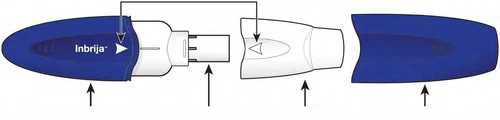 | ||
| Capsules | ||
Each box contains blister packs of 4 capsules.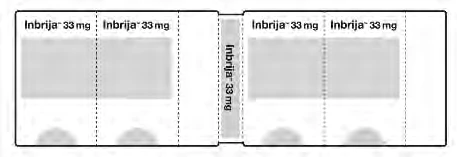 | Prepare and use a total of 2 capsules. Use one capsule at a time.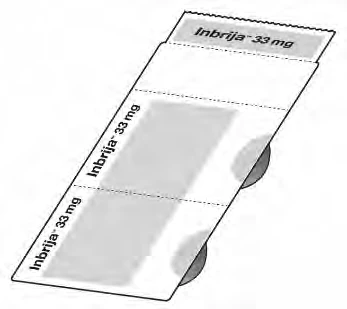 | Full dose = 2 capsules.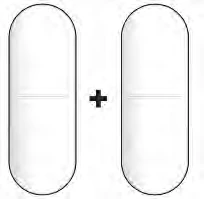 |
Prepare the dose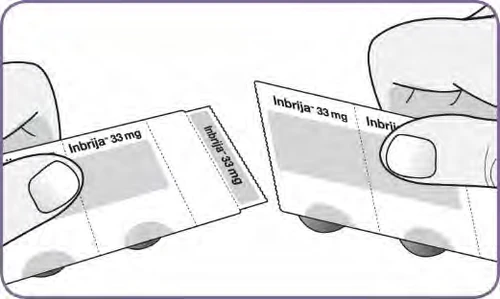 | |
| Step 1: Gather the necessary items | Choose a clean and dry surface. Make sure your hands are clean and dry. Take the inhaler and a strip of capsules. Detach a package containing 2 capsules. A full dose consists of 2 capsules. |
Step 2: Remove the blue cap from the inhaler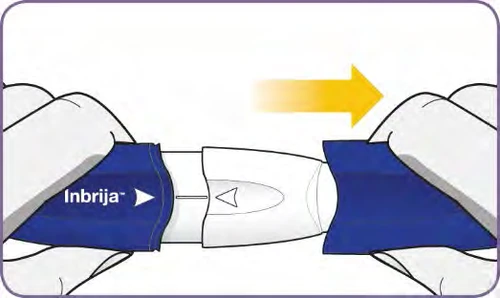 | Remove the cap by pulling it straight off. Set it aside. It will be needed later to store the inhaler. |
Step 3: Rotate and remove the white mouthpiece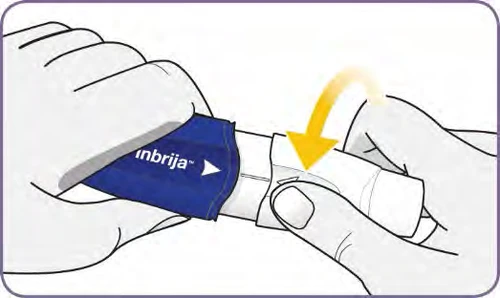 | Rotate and pull off the mouthpiece to detach it from the handle. Place the mouthpiece and inhaler on a clean, dry surface. |
Step 4: Remove 1 capsule from the package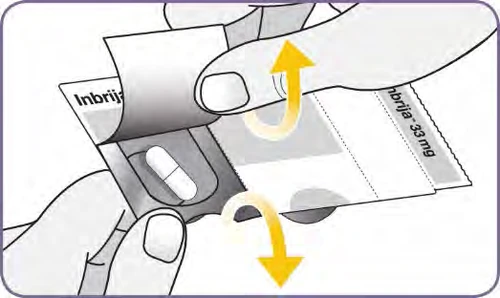 | Carefully peel back the foil and remove 1 capsule. Remove only 1 capsule at a time, and only shortly before use. Do not use capsules that appear cracked, damaged, or wet. Discard them and take a new, intact capsule. |
Step 5: Load the capsule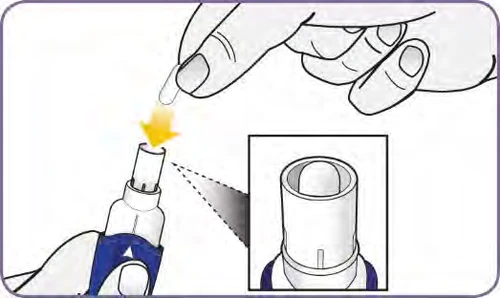 | Hold the inhaler vertically by the handle. Drop 1 capsule into the opening of the designated chamber. Do not load 2 capsules at the same time. |
| Step 6: Attach the white mouthpiece | |
Alignment arrows on mouthpiece and handle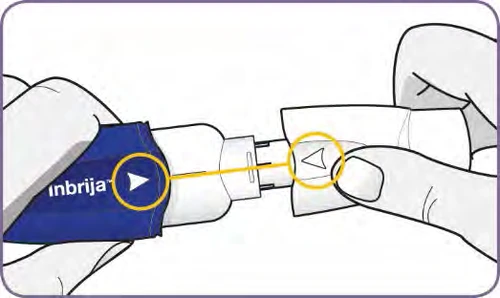 | Align the white arrows located on the handle and the mouthpiece. |
Press only once on the mouthpiece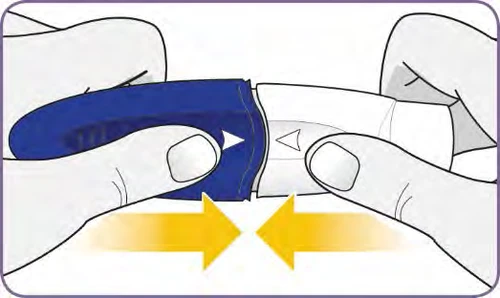 | Firmly press the mouthpiece onto the handle until you hear a click. This action perforates the capsule. Do not press the handle and mouthpiece together more than once. |
Release the mouthpiece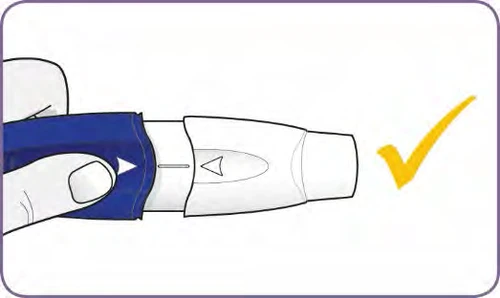 | Release the mouthpiece. The mouthpiece will snap back into place while remaining attached. |
| The inhaler is now ready for use. Do not press the handle and mouthpiece together more than once. Otherwise, the capsule may be damaged and you might not receive the full dose. If this happens, restart from Step 4 using a new capsule. Ensure the mouthpiece is securely attached and will not fall off before proceeding to Step 7. | |
Take the dose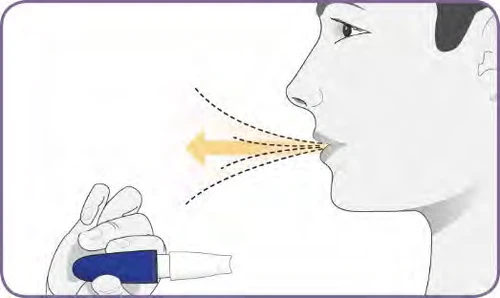 | |
Step 7: Move inhaler away and exhale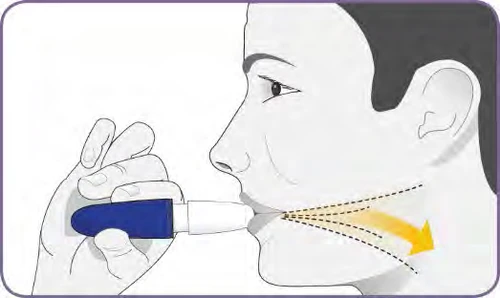 | Stand or sit with your head and torso upright. Hold the inhaler horizontally and away from your mouth. Breathe out fully, emptying your lungs. Do not exhale (do not blow) into the mouthpiece. |
| Step 8: Breathe in deeply to inhale the powder | Holding the inhaler horizontally, seal your lips tightly around the mouthpiece. Take a slow, deep breath in until your lungs are full. This usually takes several seconds. During inhalation, you will hear and feel the "whirling motion" of the capsule. This indicates that the inhaler is working and you are receiving your medication. If you cough or interrupt the dose, restart from the beginning of Step 7 using the same capsule. Important: If during inhalation you do not hear or feel the "whirling motion" of the capsule, you may need to take a longer, deeper breath, or the mouthpiece may need cleaning (do not rinse the mouthpiece or wet the inhaler). See Step 13 – Cleaning the mouthpiece. Restart from the beginning of Step 7 using the same capsule. |
Step 9: Hold breath for 5 seconds, then exhale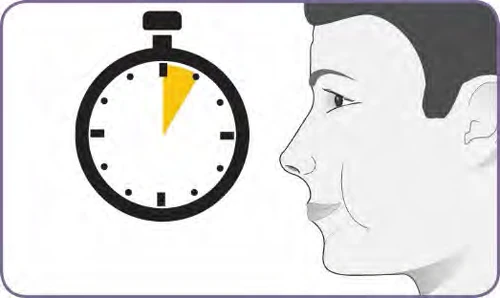 | Remove the inhaler from your mouth and hold your breath for 5 seconds. Then exhale. |
| Step 10: Remove the used capsule from the inhaler | |
Rotate and remove the mouthpiece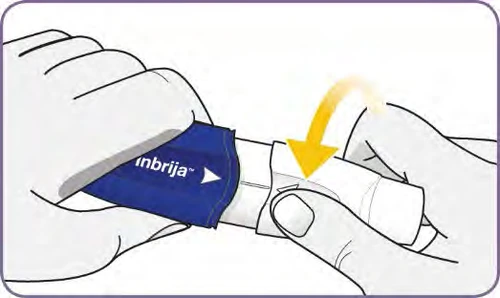 | Rotate and pull off the mouthpiece. |
Remove the used capsule.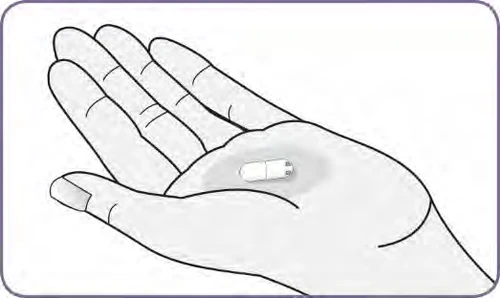 | Remove the used capsule. |
Step 11: Dose with the 2nd capsule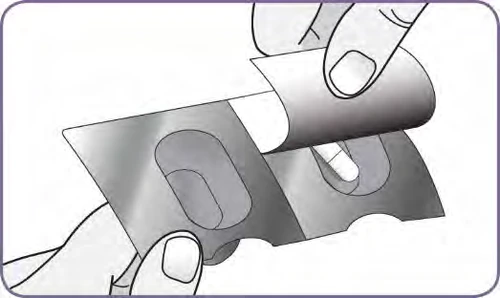 | Repeat Steps 4 to 10 with the second capsule to complete the dose. The contents of the second capsule must be inhaled within 10 minutes of the first. |
| Disposal and storage | |
Step 12: Dispose of used capsules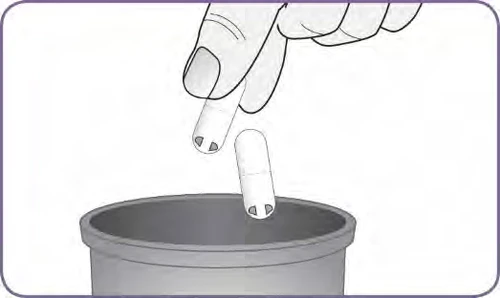 | Dispose of used capsules according to local regulations. |
| Step 13: Clean the mouthpiece It is normal for some powder to remain inside or outside the inhaler. To prevent buildup, remove powder from the mouthpiece holes using circular motions with a new, dry cotton swab as needed. | |
Clean the holes at the upper end of the mouthpiece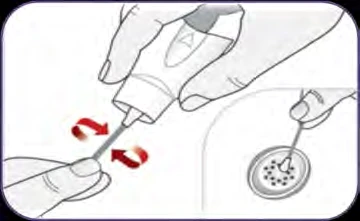 | Clean the holes at the upper end of the mouthpiece. |
| Clean the holes at the lower end of the mouthpiece | Clean the holes at the lower end of the mouthpiece. |
You may also use a dry cloth to wipe the outside of the mouthpiece as needed. Do not clean other parts of the inhaler. Do not rinse the mouthpiece and do not wet the inhaler.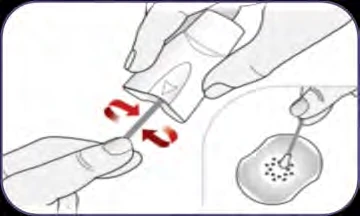 | |
| Step 14: Storing the inhaler | |
Ensure no capsules remain in the inhaler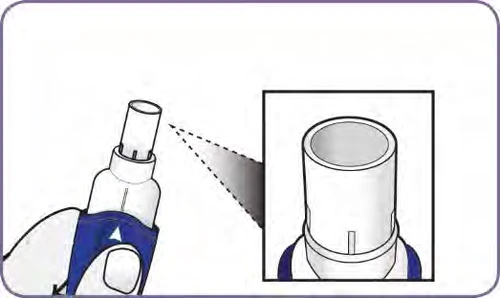 | Before storing, ensure no capsules remain in the inhaler. |
Attach the mouthpiece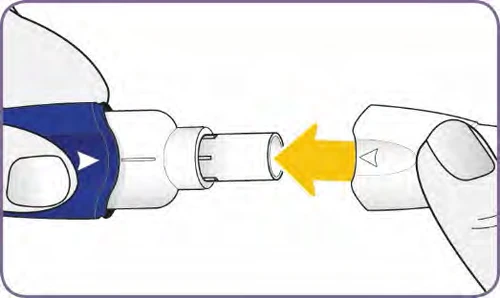 | Attach the mouthpiece to the handle by pushing until you hear a click. |
Replace the cap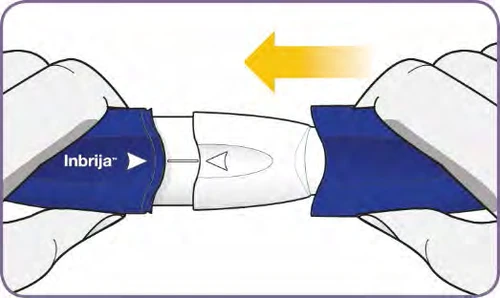 | Place the cap over the mouthpiece. |
Ready for storage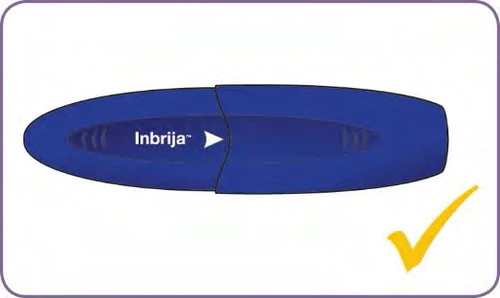 | The inhaler is now ready to be stored. |
| Cleaning the inhaler•It is normal for some powder to remain inside or outside the inhaler. •To prevent buildup, remove powder from the mouthpiece holes using circular motions with a new, dry cotton swab as needed. •You may also use a dry cloth to wipe the inside or outside of the inhaler mouthpiece. •Do not clean other parts of the inhaler. Do not rinse the mouthpiece and do not wet the inhaler. | |