Imvanex
Italy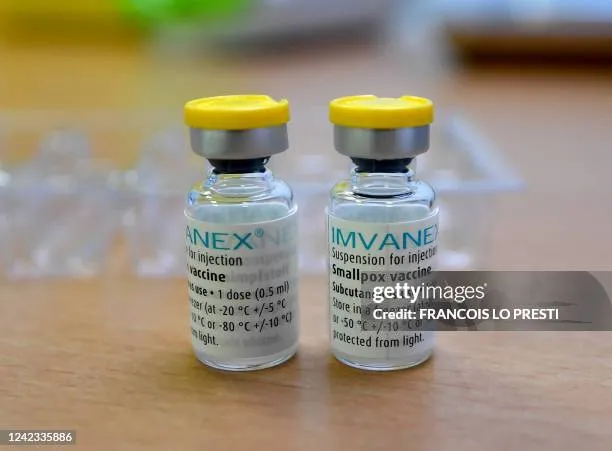
Table of Contents
- Package leaflet: Information for the user
- IMVANEX injectable suspension
- 1. What IMVANEX is and what it is used for
- 2. What you should know before being given IMVANEX
- 3. How IMVANEX is administered
- 4. Possible side effects
- 5. How to store IMVANEX
- 6. Package contents and other information
- The following information is intended for healthcare professionals only:
Package leaflet: Information for the user
IMVANEX injectable suspension
Smallpox and monkeypox vaccine (modified vaccinia Ankara virus live)
This medicinal product is subject to additional monitoring. This will allow rapid identification of new safety information. You can help by reporting any side effects you experience while receiving this medicine. See the end of section 4 for information on how to report side effects.
Please read this leaflet carefully before you are given this vaccine as it contains important information for you.
- Keep this leaflet. You may need to read it again.
- If you have any questions, ask your doctor or nurse.
- If you experience any side effects, including those not listed in this leaflet, tell your doctor or nurse. See section 4.
What this leaflet contains
- What IMVANEX is and what it is used for
- What you need to know before you are given IMVANEX
- How IMVANEX is administered
- Possible side effects
- How to store IMVANEX
- Contents of the pack and other information
1. What IMVANEX is and what it is used for
IMVANEX is a vaccine used to prevent smallpox, monkeypox, and vaccinia virus disease in adults and adolescents aged 12 years and older.
When a person is given the vaccine, the immune system (the body's natural defence system) produces its own protective factors, the antibodies, against the viruses that cause smallpox, monkeypox, and vaccinia virus.
IMVANEX does not contain the smallpox virus, the monkeypox virus, or the vaccinia virus. It cannot spread or cause infection or disease from smallpox, monkeypox, or vaccinia virus.
2. What you should know before being given IMVANEX
IMVANEX must not be administered to you:
- if you are allergic or have previously had a sudden, potentially life-threatening allergic reaction to the active substance or to any of the other ingredients of this medicine (listed in section 6) or to chicken proteins, benzonase, gentamicin, or ciprofloxacin, which may be present in the vaccine in trace amounts.
Warnings and precautions
Talk to your doctor or nurse before receiving IMVANEX:
- if you have atopic dermatitis (see section 4)
- if your immune system is weakened due to HIV infection, or any other illness or treatment.
- if you feel anxious about the vaccination process or if you have previously fainted following an injection with a needle.
No human studies have been conducted to confirm the effectiveness of protection provided by
IMVANEX against smallpox, monkeypox, and vaccinia virus disease.
If you have a high fever, your doctor will postpone vaccination until you feel better.
A minor infection, such as a cold, should not delay vaccination, but consult your doctor or nurse before receiving the vaccine.
IMVANEX may not provide complete protection in all vaccinated individuals.
A previous vaccination with IMVANEX may alter the skin response to a subsequently administered replicating smallpox vaccine, resulting in a reduced or absent skin reaction.
Other medicines or vaccines and IMVANEX
Inform your doctor or nurse if you are taking or have recently taken any other medicines or if you have recently received any other vaccines.
Pregnancy and breastfeeding
If you are pregnant, think you might be pregnant, planning a pregnancy, or are breastfeeding, consult your doctor.
The use of this vaccine is not recommended during pregnancy and breastfeeding. However, your doctor will assess whether the potential benefit of protection against smallpox, monkeypox, and vaccinia virus disease outweighs the potential risks for you and the fetus/child.
Driving and using machines
There are no data on the effects of IMVANEX on the ability to drive vehicles or operate machinery.
However, any of the adverse reactions listed in section 4 may occur, and some of these may affect your ability to drive or operate machinery (e.g., dizziness).
IMVANEX contains sodium
This medicine contains less than 1 mmol (23 mg) of sodium per dose, i.e., essentially ‘sodium-free’.
3. How IMVANEX is administered
This vaccine may be administered to you regardless of whether you have previously received
a smallpox vaccination or not.
The vaccine is injected by a doctor or nurse under the skin, preferably in the arm. The
vaccine must not be injected into a blood vessel.
If you have never been vaccinated against the smallpox virus, monkeypox virus, or vaccinia
virus
- you will receive two injections
- the second injection will be given no less than 28 days after the first
- make sure to complete the two-dose vaccination schedule.
If you have previously been vaccinated against the smallpox virus, monkeypox virus, or vaccinia
virus
- you will receive one injection
- if your immune system is weakened, you will receive two injections, and the second injection will be given no less than 28 days after the first.
If you forget an appointment for the IMVANEX injection
If you miss an appointment for the injection, inform your doctor or nurse and schedule a new
appointment.
If you have any doubts about the use of this vaccine, consult your doctor or nurse.
4. Possible side effects
Like all medicines, this vaccine can cause side effects, although not everybody will get them.
Serious side effects
Contact a doctor immediately or go immediately to the nearest hospital emergency department if you
experience any of the following symptoms:
- difficulty breathing
- dizziness
- swelling of the face and neck.
These symptoms may be signs of a severe allergic reaction.
Other side effects
If you already suffer from atopic dermatitis, you may experience more intense local skin reactions (such
as redness, swelling and itching) and other general symptoms (such as headache, muscle pain, nausea
or fatigue), as well as a worsening of skin conditions.
The most commonly reported side effects have been at the injection site. Most of these were mild to
moderate in severity and resolved within seven days without any treatment.
Inform your doctor if any of the following side effects occur.
Very common (may affect more than 1 in 10 people)
- headache
- muscle pain
- nausea
- fatigue
- pain, redness, swelling, hardening or itching at the injection site.
Common (may affect up to 1 in 10 people)
- chills
- fever
- joint pain, pain in arms or legs
- loss of appetite
- lump, colour change, bruising or warmth at the injection site.
Uncommon (may affect up to 1 in 100 people)
- nose and throat infection, upper respiratory tract infection
- swollen lymph nodes
- sleep disorders
- dizziness, abnormal sensations on the skin
- muscle stiffness
- sore throat, runny nose, cough
- diarrhoea, vomiting
- skin rash, itching, skin inflammation
- bleeding, irritation
- swelling under the arm, feeling unwell, hot flushes, chest pain, pain in the armpit
- increased heart laboratory parameters (such as troponin I), increased liver enzymes, decreased white blood cell count, decreased mean platelet volume.
Rare (may affect up to 1 in 1,000 people)
- sinusitis
- influenza
- redness and discomfort in the eyes
- urticaria
- skin colour changes
- sweating
- bruising
- night sweats
- skin nodule
- back pain
- neck pain
- muscle cramps
- muscle pain
- muscle weakness
- swelling of ankles, feet or fingers
- rapid heartbeat
- ear and throat pain
- abdominal pain
- dry mouth
- sensation of loss of balance (vertigo)
- migraine
- nervous system disorder causing weakness, tingling or numbness
- drowsiness
- peeling, inflammation, abnormal sensation of the skin, reaction at the injection site, skin rash, numbness, dryness, movement disorders, blisters at the injection site
- weakness
- influenza-like illness
- swelling of the face, mouth and throat
- increased white blood cell count
- bruising.
Not known (frequency cannot be estimated from the available data)
- temporary drooping of one side of the face (Bell’s palsy).
Reporting of side effects
If you get any side effects, including those not listed in this leaflet, talk to your doctor or nurse. You can
also report side effects directly via the national reporting system listed in Annex V. By reporting side
effects, you can help provide more information on the safety of this medicine.
5. How to store IMVANEX
Keep this medicinal product out of the sight and reach of children.
Do not use this vaccine after the expiry date which is stated on the label after "Exp". The expiry date refers to the last day of that month.
Store in a freezer (at -20 °C ± 5 °C or at -50 °C ± 10 °C or at -80 °C ± 10 °C). The expiry date depends on the storage temperature. Do not refreeze the vaccine after it has been thawed. After thawing, the vaccine may be stored in the dark at 2 °C – 8 °C for up to 2 months, within the approved shelf life, prior to use.
Keep in the original packaging to protect the medicinal product from light.
6. Package contents and other information
What IMVANEX contains
One dose (0.5 mL) contains:
- the active substance is modified vaccinia virus Ankara - Bavarian Nordic, not less than 5 x 10 U.Inf.* *infectious units produced in chicken embryo cells
- The other components are: tromethamine, sodium chloride and water for injections.
This vaccine contains trace residues of chicken proteins, benzonase, gentamicin and ciprofloxacin.
Description of the appearance of IMVANEX and contents of the pack
Once the frozen vaccine has been thawed, IMVANEX is an injectable milky suspension ranging from light yellow to pale white.
IMVANEX is supplied as an injectable suspension in a vial (0.5 mL).
IMVANEX is available in packs containing 1 single-dose vial, 10 single-dose vials or 20 single-dose vials.
Not all pack sizes may be marketed.
Marketing Authorisation Holder and Manufacturer
Marketing Authorisation Holder
Bavarian Nordic A/S
Philip Heymans Alle 3
DK-2900 Hellerup
Denmark
Manufacturer
Bavarian Nordic A/S
Hejreskovvej 10A,
3490 Kvistgaard
Denmark
This medicinal product has been authorised under “exceptional circumstances”. This means that, because the disease is rare, complete information about this medicinal product could not be obtained.
The European Medicines Agency will review any new information on this medicinal product annually, and this package leaflet will be updated if necessary.
More detailed information on this medicinal product is available on the website of the European Medicines Agency, http://www.ema.europa.eu
This leaflet is available in all languages of the European Union/European Economic Area on the website of the European Medicines Agency.
The following information is intended for healthcare professionals only:
Instructions for vaccine preparation and administration:
Allow the vial to reach a temperature between 8 °C and 25 °C before use.
Gently rotate before use. IMVANEX is a suspension ranging from clear to milky, pale yellow to
off-white. It may contain floccules of pale yellow to off-white color.
Before administration, visually inspect the suspension. If extraneous particles or an abnormal
appearance are observed, the vaccine must be discarded.
Each vial is for single use only.
Withdraw a 0.5 mL dose using a syringe suitable for injectable preparations.
After thawing, the vaccine may be stored at 2 °C – 8 °C in the dark for up to 2 months, within the approved shelf life, prior to use.
Do not refreeze the vaccine after it has been thawed.
In the absence of compatibility studies, this vaccine must not be mixed with other vaccines.