Immunohbs
Italy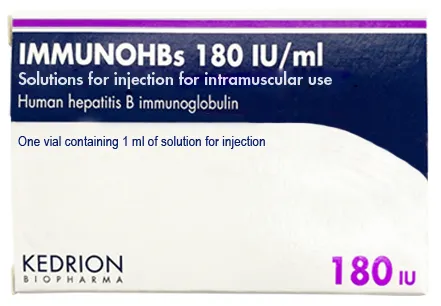
Table of Contents
- Package leaflet: Information for the user
- IMMUNOHBs 180 UI/ml Solution for injection, 540 UI/3 ml Solution for injection, 1000 UI/3 ml Solution for injection
- 1. What IMMUNOHBs is and what it is used for
- 2. What you need to know before using IMMUNOHBs
- 3. How to use IMMUNOHBs
- 4. Possible side effects
- 5. How to store IMMUNOHBs
- 6. Contents of the pack and other information
Package leaflet: Information for the user
IMMUNOHBs 180 UI/ml Solution for injection, 540 UI/3 ml Solution for injection, 1000 UI/3 ml Solution for injection
Human anti-hepatitis B immunoglobulin
Please read this leaflet carefully before using this medicine because it contains important information for you.
- Keep this leaflet. You may need to read it again.
- If you have any questions, ask your doctor, pharmacist, or nurse.
- This medicine has been prescribed for you only. Do not give it to other people, even if their symptoms are the same as yours, as it may be harmful.
- If you experience any adverse reactions, including those not listed in this leaflet, consult your doctor, pharmacist, or nurse. See section 4.
Contents of this leaflet:
- What IMMUNOHBs is and what it is used for
- What you need to know before using IMMUNOHBs
- How to use IMMUNOHBs
- Possible side effects
- How to store IMMUNOHBs
- Contents of the pack and other information
1. What IMMUNOHBs is and what it is used for
IMMUNOHBs is a solution of human specific anti-hepatitis B immunoglobulins, which are antibodies directed against the hepatitis B virus.
IMMUNOHBs is used in the following treatments:
to prevent recurrence of hepatitis B after liver transplantation due to liver failure caused by the hepatitis B virus.
to provide rapid availability of antibodies against the hepatitis B virus, thus preventing hepatitis B in the following cases:
- following accidental exposure in non-immunized individuals (i.e., in people who have not been vaccinated against the hepatitis B virus; including those who have not been fully vaccinated or whose vaccination status is unknown);
- in patients undergoing haemodialysis (i.e., patients with severe renal failure requiring blood purification through an artificial kidney), until vaccination becomes effective;
- in newborns of mothers who are carriers of the hepatitis B virus;
- in individuals who have not shown an immune response after vaccination (i.e., in people for whom vaccination has not been effective) and who require ongoing prevention due to persistent risk of contracting hepatitis B.
2. What you need to know before using IMMUNOHBs
Do not use IMMUNOHBs
- If you are allergic to human immunoglobulins or to any of the other ingredients of this medicine (listed in section 6).
- If you have immunoglobulin A (IgA) deficiency, you may develop antibodies against immunoglobulin A in the blood. IMMUNOHBs contains small amounts of IgA and therefore severe allergic reactions may occur. Your doctor must therefore evaluate the benefit of treatment with IMMUNOHBs against the potential risk of allergic reactions.
Warnings and precautions
Talk to your doctor, pharmacist, or nurse before using IMMUNOHBs.
The person administering IMMUNOHBs must ensure that the product is not injected into a blood vessel, as this could cause an acute (or severe) circulatory crisis, known as shock.
If you are a carrier of HBsAg, there is no benefit from administering this product.
Hypersensitivity
Severe allergic reactions are rare.
Rarely, anti-hepatitis B immunoglobulins may cause a sudden drop in blood pressure accompanied by breathing difficulties, fainting, sometimes fever and skin reactions (anaphylactic reaction). This may occur even if you have previously tolerated treatments with immunoglobulins.
If your doctor or the person administering the medicine suspects an allergic or anaphylactic reaction, the injection must be stopped immediately. In case of shock, your doctor must follow standard medical treatment for shock.
If you experience any of the following symptoms: difficulty breathing, pain and swelling in a limb, loss of movement or sensation in part of the body (focal neurological deficits), or chest pain, contact your doctor or the nearest hospital immediately, as these may be symptoms of an ongoing thrombotic event.
When medicines are prepared from human blood or plasma, specific measures are implemented to prevent transmission of infections to patients.
These measures include:
- careful selection of blood and plasma donors to ensure that potentially infected individuals are excluded;
- testing of donations to confirm the absence of infectious agents and/or viruses;
- inclusion during the manufacturing process of steps capable of inactivating or removing viruses.
Despite these measures, when medicines prepared from human blood or plasma are administered, the possibility of transmitting infectious agents cannot be completely ruled out. This applies also to emerging or unknown viruses or other types of infectious agents.
The measures adopted are considered effective against enveloped viruses such as human immunodeficiency virus (HIV), hepatitis B virus (HBV), hepatitis C virus (HCV), and against the non-enveloped hepatitis A virus (HAV).
The measures taken may have limited effectiveness against non-enveloped viruses such as parvovirus B19.
Immunoglobulins have not been associated with hepatitis A or parvovirus B19 infections, probably because the antibodies against these infections contained in the product have protective properties.
It is strongly recommended that each time IMMUNOHBs is administered to you, the name and batch number of the product are recorded, in order to maintain traceability of the batch used.
Effects on blood tests
If you are about to have a blood test after receiving IMMUNOHBs, inform the nurse or doctor that you have taken this medicine.
IMMUNOHBs may interfere with certain blood tests for red blood cell antibodies.
Children
No specific measures or monitoring are required for the paediatric population.
Other medicines and IMMUNOHBs
Tell your doctor or pharmacist if you are taking, have recently taken, or might take any other medicines.
IMMUNOHBs must not be mixed with other medicinal products.
Live attenuated virus vaccines
IMMUNOHBs may interfere with the development of an immune response to live attenuated virus vaccines, such as those for rubella, mumps, measles, and varicella. The administration of immunoglobulins may alter the efficacy of these vaccines for at least 3 months.
At least three months must elapse after administration of IMMUNOHBs before vaccination with live attenuated virus vaccines.
After vaccination with live attenuated virus vaccines, 3 to 4 weeks must pass before administering anti-hepatitis B human immunoglobulins. If administration of anti-hepatitis B human immunoglobulins is required within three or four weeks after vaccination, revaccination should be performed three months after administration of the anti-hepatitis B human immunoglobulins.
Pregnancy, breastfeeding, and fertility
If you are pregnant, suspect you may be pregnant, planning to become pregnant, or breastfeeding, consult your doctor or pharmacist before taking this medicine.
Pregnancy
The safety of this medicine during human pregnancy has not been established in controlled clinical studies and therefore it should be administered with caution in pregnant women.
Clinical experience with immunoglobulins suggests that harmful effects on the course of pregnancy, the fetus, or the newborn are not expected.
Breastfeeding
The safety of IMMUNOHBs during breastfeeding has not been established in controlled clinical studies and therefore it should be administered with caution in women who are breastfeeding.
Immunoglobulins are excreted in breast milk and may contribute to protecting the newborn from pathogens entering through mucosal surfaces.
Fertility
Clinical experience with immunoglobulins suggests that harmful effects on fertility are not expected.
Driving and using machines
IMMUNOHBs does not affect or has a negligible effect on the ability to drive vehicles or operate machinery. Patients who experience adverse reactions during treatment should wait until symptoms resolve before driving or operating machinery.
IMMUNOHBs contains sodium
This medicine contains up to a maximum of 3.9 mg of sodium per 1 ml vial and 11.7 mg of sodium per 3 ml vial and pre-filled syringe (main component of table salt).
This corresponds to 0.19% and 0.58% of the maximum daily recommended dietary intake of sodium for an adult, respectively.
3. How to use IMMUNOHBs
Use this medicine exactly as instructed by your doctor or pharmacist. If you have any doubts, consult your doctor or pharmacist.
IMMUNOHBs must be administered by intramuscular injection.
The product should be brought to room or body temperature before use.
Vials: Remove the central protective cap from the rubber stopper and withdraw the solution using an injection syringe. Replace the injection needle on the syringe and inject.
Once the solution has been drawn into the syringe from the container, the medicine must be administered immediately.
Pre-filled syringe: Screw on the plunger rod and inject.
Caution: The injection must be given only after ensuring that a blood vessel has not been entered.
The solution is clear and colourless or pale yellow or light brown. Do not use solutions that appear cloudy or contain deposits.
If high doses are required (> 2 ml for children or > 5 ml for adults), it is recommended to administer them as divided doses at different injection sites.
Furthermore, if you suffer from severe thrombocytopenia or other coagulation disorders, IMMUNOHBs must not be administered intramuscularly.
Dosage
Your doctor will determine the appropriate dose for you.
The commonly used dosages are as follows:
For the prevention of hepatitis B recurrence after liver transplantation due to liver failure caused by hepatitis B virus:
Adults
2000 IU every 15 days.
For long-term treatment, the dosage should aim to maintain serum levels of anti-HBsAg antibodies above 100 IU/l in HBV-DNA negative patients and above 500 IU/l in HBV-DNA positive patients. This dosage regimen should be adjusted during long-term treatment to ensure maintenance of serum anti-HBsAg antibody levels above 100 IU/l in HBV-DNA negative patients and above 500 IU/l in HBV-DNA positive patients.
Concomitant use of appropriate antiviral agents should be considered, if appropriate, as standard practice in the prophylaxis of hepatitis B reinfection.
Use in children
Data on the use of IMMUNOHBs in the paediatric population for the prevention of hepatitis B recurrence after liver transplantation due to liver failure caused by hepatitis B are not available.
For the prevention of hepatitis B in the following cases:
Prevention of hepatitis B following accidental exposure in non-immunized individuals:
At least 500 IU, depending on the extent of exposure, as soon as possible after exposure, preferably within 24–72 hours.
Immunoprophylaxis of hepatitis B in patients undergoing haemodialysis:
8–12 IU/kg up to a maximum of 500 IU, every 2 months until vaccination becomes effective.
Prevention of hepatitis B in newborns born to hepatitis B virus carrier mothers, at birth or as soon as possible after birth:
30–100 IU/kg. Repeated administration of hepatitis B immunoglobulins may be necessary until vaccination becomes effective.
In all these situations, hepatitis B vaccination is strongly recommended. The first dose of the vaccine and hepatitis B immunoglobulins may be administered on the same day, but at different sites.
If you have not shown an immune response following vaccination (undetectable hepatitis B antibodies) and ongoing prevention is required, your doctor may consider administering 500 IU (in adults) and 8 IU/kg (in children) every 2 months.
If you use more IMMUNOHBs than you should
The consequences of overdose are unknown.
4. Possible side effects
Like all medicines, this medicine can cause side effects, although not everyone experiences them.
If you notice any of the following side effects, consult your doctor immediately or contact the nearest hospital:
- Allergic reactions (hypersensitivity), anaphylactic shock (a severe, life-threatening allergic reaction). Symptoms of allergic reaction/anaphylactic shock may include, for example, itching, skin reactions, swelling of the lips, face and tongue, difficulty swallowing, breathing difficulties, fainting.
The following side effects may generally occur after treatment with immunoglobulins administered intramuscularly:
- Occasionally, adverse reactions such as tachycardia (fast heartbeat), vasospasm (sudden narrowing of blood vessels), glossitis (swollen tongue), sweating, chills, headache, dizziness, fever, vomiting, allergic reactions, nausea, arthralgia (joint pain), low blood pressure, and moderate lower back pain may occur.
- Human normal immunoglobulins may rarely cause a sudden drop in blood pressure (hypotension) and, in isolated cases, hypersensitivity reactions (anaphylactic shock), even when the patient has not previously shown hypersensitivity upon prior administration.
- Local reactions at the injection site: pain, swelling, redness (erythema), hardening, local warmth, itching, rash, and stinging sensation may occur frequently.
The following adverse events have been reported following administration of IMMUNOHBs after the medicine was placed on the market (frequency cannot be estimated from the available data):
- Hypersensitivity
- Anaphylactic shock
- Abdominal pain
- Diarrhea
- Vomiting
- Musculoskeletal pain
- Fever
- Malaise
- Chills
- Unusual weakness (asthenia)
For information regarding safety with respect to transmissible agents, see section 2 "What you need to know before using IMMUNOHBs".
Additional side effects in children
The frequency, type, and severity of adverse reactions are expected to be the same as in the adult population.
Reporting of side effects
If you experience any side effect, including those not listed in this leaflet, talk to your doctor, pharmacist, or nurse. You may also report side effects directly via the following website:
https://www.aifa.gov.it/content/segnalazioni-reazioni-avverse
By reporting side effects, you can help provide more information on the safety of this medicine.
5. How to store IMMUNOHBs
Keep this medicine out of the sight and reach of children.
Do not use this medicine after the expiry date stated on the label and outer packaging.
The expiry date refers to the last day of that month.
Store in a refrigerator (2°C - 8°C).
Keep in the original outer packaging to protect the medicine from light.
Do not freeze.
Do not use this medicine if you notice that the solution is cloudy or contains deposits (see also the "Description of the appearance of IMMUNOHBs and contents of the pack" in section 6). Do not dispose of any medicine via wastewater or household waste. Ask your pharmacist how to dispose of medicines you no longer use. This will help protect the environment.
6. Contents of the pack and other information
What IMMUNOHBs contains
The active substance is human anti-hepatitis B immunoglobulins.
| IMMUNOHBs 180 UI/ml IMMUNOHBs 540 UI/ 3 ml | IMMUNOHBs 1000 UI/ 3 ml | |
| Human proteins | 100-180 g/l | 100-180 g/l |
| of which human immunoglobulins (IgG) not less than | 90% | 90% |
| antibodies against HBs antigen (anti-HBs) not less than | 180 UI/ml (180 UI in 1 ml vial) (540 UI in 3 ml vial) | 334 UI/ml (1000 UI in 3 ml pre-filled syringe) |
Distribution of IgG subclasses:
IgG 63.7%
IgG 31.8%
IgG 3.3%
IgG 1.2%
The maximum IgA content is 300 micrograms/ml.
Produced from plasma of human donors.
The excipients are glycine, sodium chloride, and water for injections.
Description of the appearance of IMMUNOHBs and contents of the pack
IMMUNOHBs is an injectable solution.
The solution may be colorless or pale yellow or light brown; slight opalescence or a small amount of suspended particles may appear during storage.
IMMUNOHBs 180 IU injectable solution: vial containing 180 IU in 1 ml
IMMUNOHBs 180 IU injectable solution: vial containing 540 IU in 3 ml
IMMUNOHBs 334 IU injectable solution: pre-filled syringe containing 1000 IU in 3 ml
Marketing Authorization Holder and Manufacturer
Kedrion S.p.A. - Loc. Ai Conti, 55051 Castelvecchio Pascoli, Barga (Lucca).
Manufacturer
Kedrion S.p.A. - S.S. 7 bis Km 19.5, S. Antimo (Naples).
This leaflet was last approved on: