Imipenem and cilastatin Hikma
Italy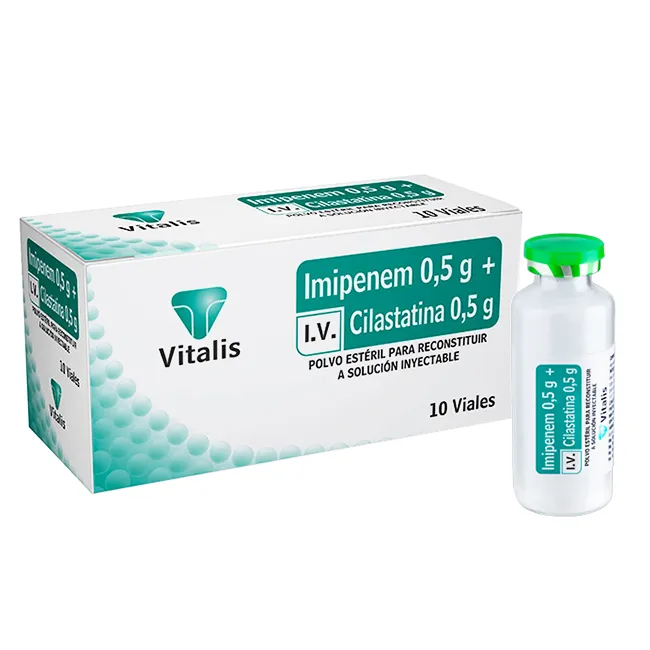
Table of Contents
- Package leaflet: Information for the user
- Imipenem and Cilastatin Hikma 500 mg/500 mg powder for solution for infusion
- 1. What Imipenem and Cilastatin Hikma is and what it is used for
- 2. What you need to know before taking Imipenem and Cilastatin Hikma
- 3. How to take Imipenem and Cilastatin Hikma
- 4. Possible side effects
- 5. How to store Imipenem and Cilastatin Hikma
- 6. Package Contents and Other Information
Package leaflet: Information for the user
Imipenem and Cilastatin Hikma 500 mg/500 mg powder for solution for infusion
Generic medicine
Imipenem and Cilastatin
Please read this leaflet carefully before using this medicine because it contains important information for you.
- Keep this leaflet. You may need to read it again.
- If you have any questions, ask your doctor or pharmacist.
- This medicine has been prescribed for you only. Do not give it to others, even if they have the same symptoms as yours, because it could be harmful.
- If you experience any side effects, including those not listed in this leaflet, tell your doctor or pharmacist. See section 4. Contents of this leaflet :
- What Imipenem and Cilastatin Hikma is and what it is used for
- What you need to know before using Imipenem and Cilastatin Hikma
- How to use Imipenem and Cilastatin Hikma
- Possible side effects
- How to store Imipenem and Cilastatin Hikma
- Contents of the pack and other information
1. What Imipenem and Cilastatin Hikma is and what it is used for
Imipenem and Cilastatin Hikma belongs to a group of medicines called carbapenem antibiotics.
It fights a wide range of bacteria (germs) that cause infections in various parts of the body in adults and children over one year of age.
Treatment
Your doctor has prescribed Imipenem and Cilastatin Hikma because you have one (or more) of the following types of infection:
- Complicated intra-abdominal infections
- An infection affecting the lungs (pneumonia)
- Infections that you may get during or after childbirth
- Complicated urinary tract infections
- Complicated skin and soft tissue infections
Imipenem and Cilastatin Hikma may be used to treat patients with low white blood cell counts who have a fever suspected to be due to a bacterial infection.
Imipenem and Cilastatin Hikma may be used to treat bacterial blood infections that may be associated with one of the above-mentioned infections.
2. What you need to know before taking Imipenem and Cilastatin Hikma
Do not take Imipenem and Cilastatin Hikma
- If you are allergic to imipenem or cilastatin, or to any of the other ingredients of this medicine (listed in section 6).
- If you are allergic to other antibiotics such as penicillins, cephalosporins or carbapenems.
Warnings and precautions
Before using Imipenem/cilastatin, inform your doctor or pharmacist about any medical conditions you have or have previously had, including:
- Allergies to any medicines, including antibiotics (sudden, life-threatening allergic reactions require immediate medical treatment)
- Colitis or other gastrointestinal problems
- Kidney or urinary problems, including reduced kidney function (blood levels of Imipenem and Cilastatin Hikma increase in patients with impaired kidney function. Adverse reactions affecting the central nervous system may occur if the dose is not adjusted according to kidney function)
- Any disorders of the central nervous system such as localized tremors or seizures (epileptic fits)
- Liver problems
You may develop a positive test (Coombs test) indicating the presence of antibodies that can destroy red blood cells. Your doctor will discuss this with you.
Children
Imipenem and Cilastatin Hikma is not recommended for use in children under one year of age or in children with kidney problems.
Other medicines and Imipenem and Cilastatin Hikma
Inform your doctor or pharmacist if you are taking or have recently taken any other medicines.
Tell your doctor if you are taking ganciclovir, which is used to treat certain viral infections.
Tell your doctor if you are taking valproic acid or sodium valproate (used to treat epilepsy, bipolar disorder, migraine or schizophrenia) or any blood thinners such as warfarin.
Your doctor will decide whether you should take Imipenem and Cilastatin Hikma in combination with these medicines.
Pregnancy and breastfeeding
It is important that you inform your doctor if you are pregnant or planning to become pregnant before taking Imipenem and Cilastatin Hikma. Imipenem and Cilastatin Hikma has not been tested in pregnant women. Imipenem and Cilastatin Hikma should not be used during pregnancy unless your doctor considers that the potential benefits outweigh the risk to the fetus.
It is important that you inform your doctor before taking Imipenem and Cilastatin Hikma if you are breastfeeding or intend to breastfeed. Small amounts of this medicine may pass into breast milk and harm the baby. Therefore, your doctor will decide whether you can use Imipenem and Cilastatin Hikma while breastfeeding.
Ask your doctor or pharmacist for advice before taking any medicine.
Driving and using machines
Some side effects associated with this medicine (such as seeing, hearing or feeling things that are not there, dizziness, drowsiness and a sensation like pins and needles) may impair the ability of some patients to drive or operate machinery (see section 4).
Imipenem and Cilastatin Hikma contains sodium
This medicine contains 37.5 mg of sodium (the main component of table/cooking salt) per vial. This is equivalent to 1.88% of the maximum recommended daily intake of sodium for an adult.
3. How to take Imipenem and Cilastatin Hikma
Imipenem and Cilastatin Hikma will be prepared and administered by a doctor or healthcare professional. Your doctor will determine the dose of Imipenem and Cilastatin Hikma you require.
Use in adults and adolescents
The recommended dose of Imipenem and Cilastatin Hikma for adults and adolescents is 500 mg/500 mg every 6 hours or 1000 mg/1000 mg every 6 or 8 hours. If you have kidney problems, your doctor may reduce your dose.
Use in children
The recommended dose for children aged one year and older is 15/15 or 25/25 mg/kg/dose every 6 hours. Imipenem and Cilastatin Hikma is not recommended for children under one year of age or for children with kidney problems.
Method of administration
Imipenem and Cilastatin Hikma is administered intravenously (into a vein) over approximately 20–30 minutes for doses < 500 mg/500 mg or over 40–60 minutes for doses > 500 mg/500 mg. The infusion rate may be reduced if you feel unwell.
If you receive more Imipenem and Cilastatin Hikma than you should
Symptoms of overdose may include seizures (fits), confusion, tremor, nausea, vomiting, low blood pressure, and slowed heart rate. If you think you have been given too much medicine, inform your doctor or another healthcare professional immediately.
If you forget to receive a dose of Imipenem and Cilastatin Hikma
If you think you have missed a dose, contact your doctor or another healthcare professional immediately.
If you have any doubts about how to use this medicine, contact your doctor or pharmacist.
4. Possible side effects
Like all medicines, Imipenem and Cilastatin Hikma can cause side effects, although
not everyone experiences them.
The following side effects occur rarely; however, if they occur
while you are receiving or after you have received Imipenem and Cilastatin Hikma,
administration of the medicine must be stopped immediately and you should contact your doctor
without delay:
- Allergic reactions including rash, swelling of the face, lips, tongue and/or throat (with difficulty breathing or swallowing), and/or low blood pressure.
- Skin peeling (toxic epidermal necrolysis)
- Severe skin reactions (Stevens-Johnson syndrome and erythema multiforme)
- Severe skin rashes with loss of skin and hair (exfoliative dermatitis)
Other possible side effects:
Common (may affect up to 1 in 10 people)
- Increase in specific white blood cells
- Swelling and redness of veins which become particularly painful when touched
- Skin rash
- Abnormal liver function detected by blood tests
- Nausea, vomiting, diarrhoea. Nausea and vomiting appear to affect more frequently patients with low white blood cell count
Uncommon (may affect up to 1 in 100 people)
- Local redness of the skin
- Local pain and formation of a lump at the injection site
- Skin itching
- Urticaria (hives)
- Fever
- Blood abnormalities affecting blood cells, usually detected by blood tests (symptoms may include fatigue, paleness of the skin, and prolonged bleeding time following an injury)
- Abnormalities in kidney, liver and blood function detected by blood tests
- Tremors and uncontrolled muscle movements
- Seizures (epileptic fits)
- Psychiatric disturbances (such as mood swings and impaired judgment)
- Seeing, hearing or sensing something that is not there (hallucinations)
- Confusion
- Dizziness, drowsiness
- Low blood pressure
Rare (may affect up to 1 in 1,000 people)
- Fungal infections (candidiasis)
- Discoloration of teeth and/or tongue
- Inflammation of the colon with severe diarrhoea
- Taste disturbances
- Inability of the liver to perform its normal functions
- Inflammation of the liver
- Inability of the kidneys to perform their normal functions
- Changes in urine volume, change in urine colour
- Brain disorders, tingling sensation (pins and needles), localized tremors
- Hearing loss
Very rare (may affect up to 1 in 10,000 people)
- Severe loss of liver function due to inflammation (fulminant hepatitis)
- Inflammation of stomach or intestine (gastroenteritis)
- Inflammation of the intestine with diarrhoea and blood (haemorrhagic colitis)
- Red and swollen tongue, excessive growth of normal tongue projections giving it a hairy appearance, sweating, sore throat, increased saliva production
- Stomach pain
- Sensation of spinning (dizziness), headache
- Ringing in the ears (tinnitus)
- Joint pain, weakness
- Irregular heartbeat, heart beating harder or more rapidly
- Chest discomfort, difficulty breathing, abnormally fast and shallow breathing, pain in the upper part of the spine
- Redness, bluish discoloration of the face and lips, change in skin texture, excessive sweating
- Vulval itching in women
- Changes in the number of blood cells
- Worsening of a rare condition associated with muscle weakness (worsening of myasthenia gravis)
Not known (frequency cannot be estimated from the available data)
- Abnormal movements
- Agitation
Reporting of side effects
If you experience any side effect, including those not listed in this leaflet, please
consult your doctor or pharmacist. You can also report side effects directly
via the national reporting system at
https://www.aifa.gov.it/content/segnalazioni-reazioni-avverse
By reporting side effects, you can help provide more information on the
safety of this medicine.
5. How to store Imipenem and Cilastatin Hikma
Keep this medicine out of the sight and reach of children.
Do not use this medicine after the expiry date stated on the cardboard carton and on the
vials (Exp.). The expiry date refers to the last day of that month.
Do not store above 25°C.
Keep the vials in the outer packaging.
After reconstitution:
Diluted solutions must be used immediately. The time interval between the start of
reconstitution and the end of intravenous infusion must not exceed two hours.
Do not freeze the reconstituted solution.
Do not dispose of any medicine via wastewater or household waste. Ask your pharmacist
how to dispose of medicines no longer required. This will help protect the environment.
6. Package Contents and Other Information
What Imipenem and Cilastatin Hikma Contains
- The active substances are imipenem and cilastatin. Each vial of Imipenem and Cilastatin Hikma 500 mg/500 mg contains 530 mg of imipenem monohydrate, equivalent to 500 mg of imipenem, and 530 mg of sodium cilastatin, equivalent to 500 mg of cilastatin.
- The excipient is 20 mg sodium bicarbonate.
Description of the Appearance of Imipenem and Cilastatin Hikma and Contents of the Pack
Imipenem and Cilastatin Hikma 500 mg/500 mg is a white to almost white or slightly yellowish powder for solution for infusion, available in 20 ml colourless glass type III vials closed with 20 mm bromobutyl rubber stoppers.
Pack sizes
1 vial/box (20 ml vial)
10 vials/box (20 ml vial)
Not all pack sizes may be marketed.
Marketing Authorisation Holder and Manufacturer
Marketing Authorisation Holder
Hikma Farmacêutica (Portugal) S.A.
Estrada do Rio da Mó, 8, 8A and 8B, Fervença
2705-906 Terrugem SNT
Portugal
Tel.: 351-21-960 84 10 / Fax: 351-21-961 51 02
E-mail: [email protected]
Manufacturer
ACS Dobfar S.p.A.
Nucleo Industriale S. Atto
S. Nicolò a Tordino
64020 TERAMO
Italy
Marketing Authorised Representative for Italy
Hikma Italia SpA
Viale Certosa 10, 27100 Pavia
This medicinal product is authorised in the Member States of the European Economic Area under the following names:
Austria: Imipenem/Cilastatin Hikma 500 mg/500 mg Pulver zur Herstellung einer Infusionslösung
Ireland: Imipenem/Cilastatin 500 mg/500 mg Powder for solution for infusion
Italy: Imipenem e Cilastatina Hikma 500 mg/500 mg Polvere per soluzione infusione
Germany: Imipenem/Cilastatin Hikma 500 mg/500 mg Pulver zur Herstellung einer Infusionslösung
Portugal: Imipenem/Cilastatina Hikma 500 mg/500 mg g Pό para solução para perfusão
Netherlands: Imipenem/Cilastatin Hikma 500 mg/500 mg
United Kingdom: Imipenem/Cilastatin 500 mg/500 mg Powder for solution for infusion
France: Imipenem/Cilastatine Hikma 500 mg/500 mg Poudre pour solution pour perfusion
Spain: Imipenem /Cilastatina Hikma 500 mg/500 mg Polvo para solución para perfusión
The following information is intended exclusively for healthcare professionals:
Each vial is for single use only.
Reconstitution
The contents of each vial should be transferred into 100 ml of an appropriate infusion solution: 0.9% sodium chloride (see Incompatibilities and After Reconstitution). In exceptional circumstances where 0.9% sodium chloride cannot be used for clinical reasons, 5% glucose should be used instead.
A recommended procedure is to add approximately 10 ml of the appropriate infusion solution to the vial. Shake well and transfer the resulting mixture into the infusion container.
WARNING: THE MIXTURE IS NOT INTENDED FOR DIRECT INFUSION.
Repeat with an additional 10 ml of infusion solution to ensure complete transfer of the vial contents into the infusion container. The resulting mixture should be shaken until a clear solution is obtained.
The concentration of the reconstituted solution obtained by this procedure is approximately 5 mg/ml for both imipenem and cilastatin.
Colour variations ranging from colourless to yellow do not affect the potency of the product.
Compatibility and Stability
Administer Imipenem/Cilastatin Hikma in accordance with good clinical and pharmaceutical practice, using freshly prepared solutions with the following solvent: 0.9% sodium chloride injection.
Incompatibilities
This medicinal product is chemically incompatible with lactate and must not be reconstituted with diluents containing lactate. However, it may be administered via an intravenous infusion system in which a lactate-containing solution has previously been administered.
This medicinal product must not be mixed with other medicinal products except those mentioned in the section “Reconstitution”.
After Reconstitution
Diluted solutions must be used immediately. The time interval between the start of reconstitution and the end of intravenous infusion must not exceed 2 hours.
Any unused medicine and waste material derived from this medicine must be disposed of in accordance with local regulations.