Ibandronic acid Sandoz
Italy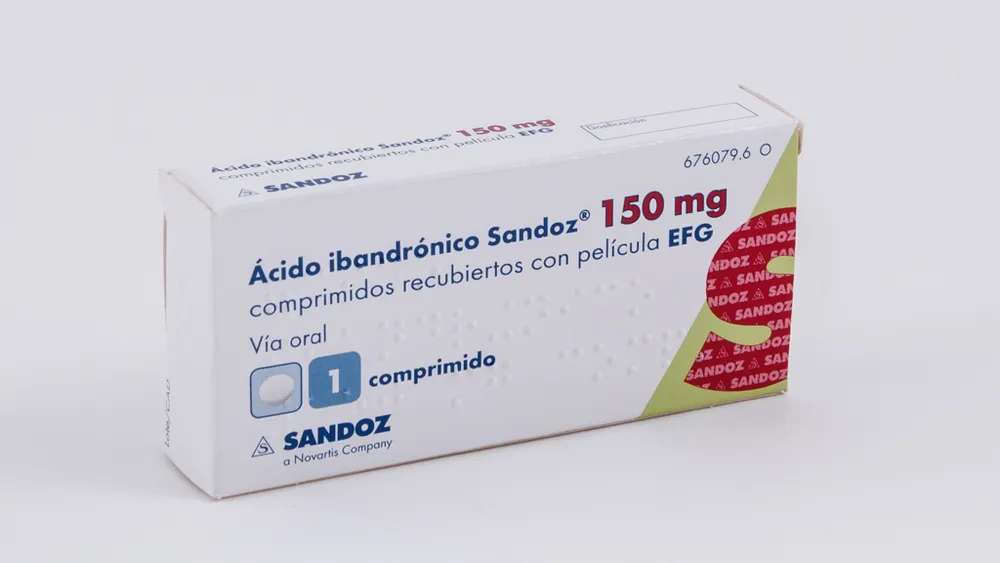
Table of Contents
- PACKAGE LEAFLET: INFORMATION FOR THE USER
- Ibandronic Acid Sandoz 150 mg film-coated tablets
- 1. WHAT ACIDO IBANDRONICO SANDOZ IS AND WHAT IT IS USED FOR
- 2. BEFORE TAKING IBANDRONIC ACID SANDOZ
- 3. HOW TO TAKE IBANDRONIC ACID SANDOZ
- 4. POSSIBLE ADVERSE REACTIONS
- 5. HOW TO STORE IBANDRONIC ACID SANDOZ
- 6. OTHER INFORMATION
PACKAGE LEAFLET: INFORMATION FOR THE USER
Ibandronic Acid Sandoz 150 mg film-coated tablets
Equivalent medicine
Please read all of this leaflet carefully before you start taking this medicine because it contains important information for you.
- Keep this leaflet. You may need to read it again.
- If you have any questions, ask your doctor or pharmacist.
- This medicine has been prescribed for you personally. Never give it to others. It could be harmful to them, even if their symptoms are the same as yours.
- If you experience any side effect, talk to your doctor or pharmacist. This includes any side effect not listed in this leaflet.
Contents of this leaflet:
- What Ibandronic Acid Sandoz is and what it is used for
- What you need to know before taking Ibandronic Acid Sandoz
- How to take Ibandronic Acid Sandoz
- Possible side effects
- How to store Ibandronic Acid Sandoz
- Further information
1. WHAT ACIDO IBANDRONICO SANDOZ IS AND WHAT IT IS USED FOR
Acido Ibandronico Sandoz belongs to a group of medicines called bisphosphonates (used
in the treatment of osteoporosis). It contains ibandronic acid. It does not contain hormones.
Acido Ibandronico Sandoz can reverse bone loss by preventing further bone loss
and increasing bone mass in most women who take it,
although these women may not see or feel any difference. Acido
Ibandronico Sandoz can help reduce the likelihood of bone breaks
(fractures). This reduction in fractures has been demonstrated for the spine
but not for the hip.
Acido Ibandronico Sandoz has been prescribed for you to treat osteoporosis because
you are at high risk of fractures. Osteoporosis is a condition characterized by thinning and
weakening of the bones, commonly occurring in women after menopause. At menopause,
a woman's ovaries stop producing the female hormone (estrogen) that helps maintain a healthy skeleton.
The earlier a woman reaches menopause, the greater the risk of fractures
in osteoporosis. Other factors that may increase the risk of fractures
include:
- inadequate dietary intake of calcium and vitamin D
- smoking or excessive alcohol consumption
- lack of physical activity, such as walking or other weight-bearing exercises
- family history of osteoporosis.
Many people with osteoporosis do not have symptoms. If you do not have symptoms,
you may not know whether you have this condition. However, osteoporosis makes you
more susceptible to fractures following falls or injuries. A fracture after the age of 50 may
be a sign of osteoporosis. Osteoporosis can also cause back pain,
loss of height, and curvature of the spine.
Acido Ibandronico Sandoz prevents bone loss caused by osteoporosis and
helps rebuild bone. Acido Ibandronico Sandoz therefore makes bones less likely
to fracture.
Also a healthy lifestyle will help you get the maximum benefit from treatment.
This includes following a balanced diet rich in calcium and vitamin D,
walking or performing other weight-bearing exercises, not smoking, and avoiding excessive alcohol intake.
2. BEFORE TAKING IBANDRONIC ACID SANDOZ
Do not take Ibandronic Acid Sandoz
- if you are allergic (hypersensitive) to ibandronic acid or to any of the excipients in Ibandronic Acid Sandoz (listed in section 6)
- if you have certain disorders of the oesophagus (the tube connecting the mouth to the stomach), such as narrowing or difficulty swallowing
- if you are unable to remain in an upright position (standing or sitting) for at least one hour (60 minutes) at a time
- if you have, or have previously had, low levels of calcium in the blood. In this case, consult your doctor.
Warnings and precautions
Some people should take particular care when taking Ibandronic Acid Sandoz. Consult your doctor:
- if you have any disorder of mineral metabolism (such as vitamin D deficiency)
- if your kidneys do not function normally
- if you have digestive problems or difficulty swallowing
- if you are undergoing or are scheduled for dental treatment or dental surgery, inform your dentist that you are being treated with Ibandronic Acid Sandoz.
Irritation, inflammation, or ulceration of the oesophagus (the tube connecting the mouth to the stomach) may occur, often accompanied by symptoms such as severe chest pain, severe pain after eating or drinking, severe nausea or vomiting, especially if you do not drink a full glass of plain water and/or if you lie down within one hour after taking Ibandronic Acid Sandoz. If you develop these symptoms, stop taking Ibandronic Acid Sandoz and inform your doctor immediately.
Children and adolescents
Do not administer Ibandronic Acid Sandoz to children or adolescents.
Other medicines and Ibandronic Acid Sandoz
If you are taking or have recently taken any other medicines, inform your doctor or pharmacist.
In particular:
- calcium, magnesium, iron, or aluminium-containing supplements, as these may affect the effects of Ibandronic Acid Sandoz
- aspirin and other non-steroidal anti-inflammatory drugs (NSAIDs, including ibuprofen, sodium diclofenac, and naproxen), which can irritate the stomach and intestines. Bisphosphonates (such as Ibandronic Acid Sandoz) may have similar effects. Be especially cautious if you are taking painkillers or anti-inflammatory drugs while being treated with Ibandronic Acid Sandoz.
After swallowing the monthly tablet of Ibandronic Acid Sandoz, wait one hour
before taking any other medicine, including antacids, calcium supplements, or vitamins.
Taking Ibandronic Acid Sandoz with food and drinks
Do not take Ibandronic Acid Sandoz with food. Ibandronic Acid Sandoz is less effective if taken with food. You may drink plain water, but no other beverages (see section 3, “HOW TO TAKE IBANDRONIC ACID SANDOZ”).
Pregnancy and breastfeeding
Do not take Ibandronic Acid Sandoz if you are pregnant or breastfeeding. If you are breastfeeding, you may need to stop breastfeeding while taking Ibandronic Acid Sandoz.
Ask your doctor or pharmacist for advice before taking any medicine.
Driving and using machines
You may drive and use machines, as it is highly unlikely that Ibandronic Acid Sandoz will impair your ability to drive or operate machinery.
Ibandronic Acid Sandoz contains lactose
If your doctor has diagnosed you with an intolerance to certain sugars, contact him/her before taking this medicine.
3. HOW TO TAKE IBANDRONIC ACID SANDOZ
Always take Ibandronic Acid Sandoz exactly as directed by your
doctor. If you have any doubts, consult your doctor or pharmacist.
The usual dose of Ibandronic Acid Sandoz is one tablet per month.
Taking the monthly tablet
It is important to follow the instructions below carefully. These instructions are designed to help the Ibandronic Acid Sandoz tablet reach the stomach quickly, reducing the likelihood of irritation.
- Take one 150 mg Ibandronic Acid Sandoz tablet once a month.
- Choose a day of the month that is easy to remember. For taking the Ibandronic Acid Sandoz tablet, you may choose the same date (e.g., the 1st of each month) or the same day (e.g., the first Sunday of each month). Choose the method that best fits your routine.
- Take the Ibandronic Acid Sandoz tablet at least 6 hours after eating or drinking anything other than plain water.
- Take the Ibandronic Acid Sandoz tablet
- first thing in the morning, upon waking
- before taking any food or drink (on an empty stomach).
- Swallow the tablet with a full glass of plain water (at least 180 ml). Do not take the tablet with mineral water, fruit juice, or any other beverage.
- Swallow the tablet whole – do not chew, break, or allow it to dissolve in the mouth.
- During the hour following tablet intake (60 minutes)
- do not lie down; if you do not remain in an upright position (standing or sitting), part of the medicine may reflux into the oesophagus.

- do not eat anything

- do not drink anything (except plain water, if needed)
- do not take any other medicine.
- After waiting one hour, you may eat your first meal and drink other beverages in the morning. After eating, you may lie down and take other medicines if necessary.
Do not take the tablet before going to bed in the evening or before getting up in the morning.
Continuing treatment with Ibandronic Acid Sandoz
It is important to continue taking Ibandronic Acid Sandoz every month for as long as your
doctor prescribes it. Ibandronic Acid Sandoz treats osteoporosis only as long as you continue taking it.
If you take more Ibandronic Acid Sandoz than you should
If you accidentally take more than one tablet, drink a glass of milk and contact your doctor immediately.
Do not induce vomiting and do not lie down – this could cause Ibandronic Acid Sandoz to irritate the oesophagus.
If you forget to take Ibandronic Acid Sandoz
If you forget to take the tablet on the scheduled morning, do not take it later during the day. Instead, check your calendar and determine when your next dose is due.
If 1 to 7 days remain until your next scheduled dose
Wait until the next scheduled dose day and take the tablet as usual. Then continue taking one tablet per month on the scheduled dates marked on your calendar.
If more than 7 days remain until your next scheduled dose
Take one tablet the morning after the day you remembered. Then continue taking one tablet per month on the scheduled dates marked on your calendar.
Never take two Ibandronic Acid Sandoz tablets within the same week.
4. POSSIBLE ADVERSE REACTIONS
Like all medicines, Acido Ibandronico Sandoz may cause adverse reactions,
although not everyone experiences them.
Contact a nurse or doctor immediately if you notice any of the following serious adverse reactions – urgent medical treatment may be required:
- rash, itching, swelling of the face, lips, tongue and throat, with difficulty breathing. You may be experiencing an allergic reaction to the medicine.
- severe chest pain, severe pain after eating or drinking, severe nausea or vomiting.
- flu-like symptoms (if symptoms become bothersome or last more than a few days).
- mouth or jaw pain
- eye pain or inflammation (if prolonged)
Other possible adverse reactions
Common (occurs in less than 1 in 10 patients)
- headache
- heartburn, stomach ache (such as “gastroenteritis” or “gastritis”), indigestion, nausea, diarrhoea and constipation
- rash
- muscle pain or stiffness, joint or back pain
- flu-like symptoms (fever, restlessness and tremor, feeling unwell, fatigue, bone pain, muscle and joint pain)
- fatigue
Uncommon (occurs in less than 1 in 100 patients)
- bone pain
- feeling weak
- dizziness
- flatulence
Rare (occurs in less than 1 in 1000 patients)
- hypersensitivity reaction; swelling of the face, lips and mouth (see allergy)
- itching
- eye pain or inflammation
- rarely, an unusual femoral fracture may occur, particularly in patients on long-term treatment for osteoporosis. Contact your doctor if you experience pain, weakness or discomfort in the thigh, hip or groin, as this could be an early sign of a possible femoral fracture.
Very rare (occurs in less than 1 in 10,000 patients)
- a condition involving exposed bone in the mouth called “osteonecrosis of the jaw”.
If any of the adverse reactions worsen, or if you notice any adverse reaction not listed in this leaflet, inform your doctor or pharmacist.
5. HOW TO STORE IBANDRONIC ACID SANDOZ
Keep Ibandronic Acid Sandoz out of the reach and sight of children.
Do not use Ibandronic Acid Sandoz after the expiry date stated on the packaging after the word EXP. The expiry date refers to the last day of the month.
This medicinal product does not require any special storage conditions.
Medicines must not be disposed of via wastewater or household waste. Ask your pharmacist how to dispose of medicines no longer required. This will help protect the environment.
6. OTHER INFORMATION
What Acido Ibandronico Sandoz contains
- The active substance is ibandronic acid. One tablet contains 150 mg of ibandronic acid (as ibandronate sodium monohydrate).
- The excipients are: Core: povidone, microcrystalline cellulose, pregelatinized corn starch, crospovidone, anhydrous colloidal silica, glyceryl dibehenate. Coating: Opadry OY-LS-28908 (White II) consisting of hypromellose, lactose monohydrate, titanium dioxide (E171), and macrogol 4000.
Description of the appearance of Acido Ibandronico Sandoz and contents of the pack
Acido Ibandronico Sandoz is presented as white, round, biconvex tablets.
Acido Ibandronico Sandoz is available in cardboard packs containing an appropriate number of tablets (1 or 3) in blisters made of PA/Aluminium/PVC-Aluminium (alu-alu blisters) and a leaflet.
It is possible that not all pack sizes are marketed.
Marketing Authorization Holder
Sandoz Spa
Largo U. Boccioni, 1 21040 Origgio (Va)
Italy
Manufacturer responsible for batch release
Pharmathen S.A
6 Dervenakion Str.
153 51 Pallini, Attiki
Greece
Lek Pharmaceuticals d.d.
Verovškova 57
1526 Ljubljana
Slovenia
S.C. Sandoz, S.R.L.
Str. Livezeni nr. 7A
RO-540472 Targu-Mures
Romania
Salutas Pharma GmbH
Otto-von-Guericke-Allee 1
39179 Barleben
Germany
LEK S.A.
Production site
ul. Domaniewska 50 C,
02-672 Warszawa
Poland
Lek Pharmaceuticals d.d.
Trimlini 2D
9220 Lendava
Slovenia
Pharmathen International S.A.
Industrial park Sapes, Street block 5
693 00 Sapes, Prefecture of Rodopi
Greece
This medicinal product has been authorised in the EEA Member States under the following names:
This Patient Information Leaflet was last approved in September 2012