Hyalgan
Italy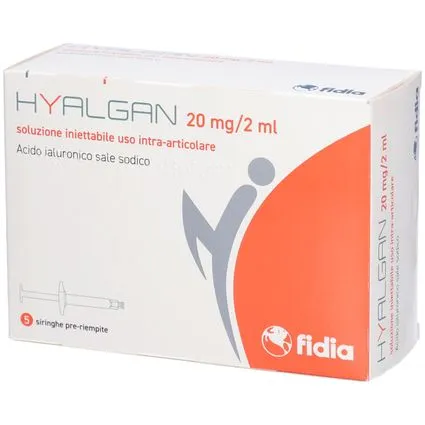
Package Leaflet
HYALGAN 20 mg/2 ml solution for injection for intra-articular use
Sodium hyaluronate
COMPOSITION
Active substance: Sodium hyaluronate 20 mg
Excipients: sodium chloride, sodium dihydrogen phosphate dihydrate, disodium hydrogen phosphate dodecahydrate, water for
injections q.s. to 2 ml
PHARMACEUTICAL FORM AND CONTENT
Solution for injection for intra-articular use
1 and 5 vials of 20 mg/2 ml
1 - 3 - 5 pre-filled syringes of 20 mg/2 ml
THERAPEUTIC CATEGORY
Other drugs for musculoskeletal disorders
MARKETING AUTHORISATION HOLDER
Fidia Farmaceutici S.p.A. - Via Ponte della Fabbrica, 3/A - 35031 Abano Terme (PD)
MANUFACTURER AND FINAL CONTROLLER
Fidia Farmaceutici S.p.A. - Via Ponte della Fabbrica, 3/A - 35031 Abano Terme (PD)
THERAPEUTIC INDICATIONS
Mild to moderate gonarthrosis.
CONTRAINDICATIONS
- Hypersensitivity to the active substance or to any of the excipients.
- History of allergy to chicken proteins.
- Patients with severe liver disease.
PRECAUTIONS FOR USE
- The use of disinfectants based on quaternary ammonium salts is not recommended, as they may cause precipitation in the presence of hyaluronic acid.
- Intra-articular injection must be performed by experienced medical personnel under appropriate aseptic conditions and following standard techniques for this route of administration.
- Particular caution should be exercised in patients with active infections near the site to be injected, in order to avoid the risk of bacterial arthritis.
- Prior to intra-articular injection, patients should be carefully examined to rule out signs of acute inflammation. In such cases, the physician must evaluate whether or not to proceed with the injection.
- If joint effusion is present, aspiration is recommended before injecting HYALGAN.
- It is recommended to avoid subjecting the injected joint to excessive stress during the hours immediately following the injection.
INTERACTIONS
Hyaluronic acid interacts with certain local anesthetics, prolonging the duration of anesthesia.
SPECIAL WARNINGS
Use during pregnancy and breastfeeding
Although no embryotoxic or teratogenic effects have been observed in animal studies, the use of this medicinal product during pregnancy and breastfeeding should only be considered by the physician in cases of absolute necessity, after careful assessment of potential risks versus expected benefits.
Effects on ability to drive and use of machines
This medicinal product does not impair the ability to drive or operate machinery.
DOSAGE, METHOD AND DURATION OF ADMINISTRATION
As a general guideline, unless otherwise directed by the physician, administer one intra-articular injection of 2 ml of HYALGAN (20 mg) once weekly for 5 weeks.
UNDESIRABLE EFFECTS
Reactions at the injection site such as pain, swelling/effusion, warmth, redness, itching, and synovitis have been reported rarely. These are generally short-lived and resolve spontaneously within a few days with rest and application of ice; only occasionally have they been more intense and prolonged.
In patients with objective signs indicating a reactivation of the underlying chronic inflammatory process, administration of hyaluronic acid has rarely led to an exacerbation of the clinical picture.
Intra-articular infection is extremely rare (see "Precautions for use").
Very rare cases of systemic hypersensitivity reactions (skin rash, urticaria, pruritus) have been reported, and anaphylaxis has occurred only exceptionally, with no fatal outcomes.
Following the instructions provided in this leaflet reduces the risk of undesirable effects.
It is important to inform your doctor or pharmacist of any adverse reaction, even if not described in this leaflet.
EXPIRY DATE AND STORAGE
Check the expiry date stated on the packaging.
The expiry date stated on the packaging refers to the product stored unopened and under recommended storage conditions.
Caution: do not use the medicinal product after this date.
Storage instructions: Do not store above 25 °C; do not freeze.
Keep this medicinal product out of the reach and sight of children.
DATE OF THIS LEAFLET: January 2013