HUMATIN
Italy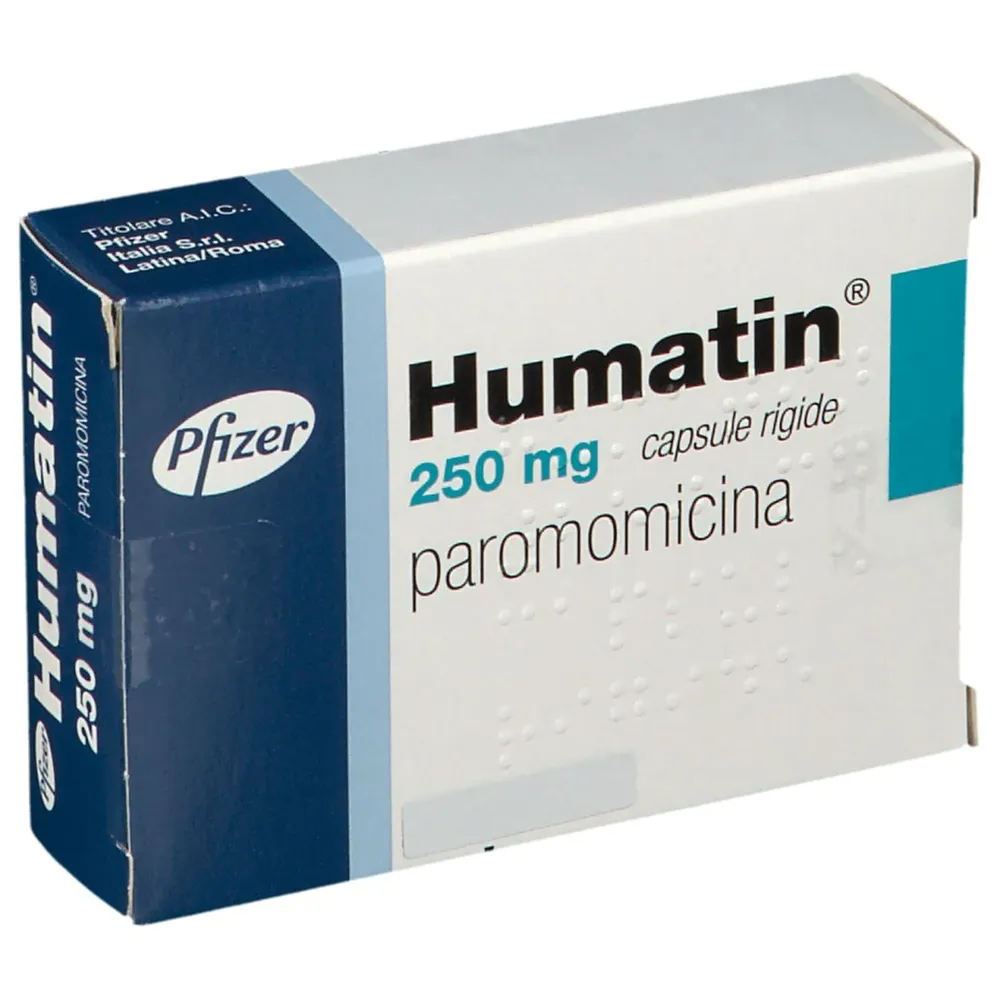
H U M A T I N
paromomycin
MEDICINAL NAME
HUMATIN 250 mg HARD CAPSULES
HUMATIN 25 mg/ml SYRUP
COMPOSITION
HUMATIN 250 mg HARD CAPSULES
Each capsule contains – Active substance: paromomycin sulfate 357.2 mg (equivalent to 250 mg of paromomycin).
Excipients: anhydrous colloidal silica, magnesium stearate, gelatin, titanium dioxide, red iron oxide, yellow iron oxide, black iron oxide.
HUMATIN 25 mg/ml SYRUP
100 ml contain – Active substance: paromomycin sulfate 3.572 g (equivalent to 2.5 g of paromomycin).
Excipients: sucrose, glycerin, saccharin, sodium hydroxide, sodium bicarbonate, methyl p-hydroxybenzoate, propyl p-hydroxybenzoate, ethanol, spiced flavour, purified water.
Each 5 ml (1 teaspoon) contains the equivalent of 125 mg of base paromomycin.
PHARMACEUTICAL FORM AND PACKAGING CONTENTS
ORAL HARD CAPSULES AND SYRUP
HUMATIN 250 mg HARD CAPSULES: pack of 16 capsules
HUMATIN 25 mg/ml SYRUP: pack containing 1 bottle of 60 ml
pack containing 1 bottle of 200 ml.
Not all pack sizes may be marketed.
THERAPEUTIC CATEGORY
Antibiotic, intestinal antimicrobial.
MARKETING AUTHORISATION HOLDER
Pfizer Italia S.r.l.
Via Isonzo, 71 - 04100 Latina, Italy
MANUFACTURER
FAMAR L’Aigle - Z.I. N° 1, Route de Crulai, 61 300 l’Aigle, France
THERAPEUTIC INDICATIONS
Intestinal tract infections caused by sensitive organisms (E. coli, Shigella, Salmonella except S. Typhi, etc.).
Intestinal content sterilization prior to intestinal surgery. Intestinal amoebiasis (acute and chronic). Adjunctive treatment in hepatic coma (for sterilization of ammonia-producing intestinal flora).
CONTRAINDICATIONS
Hypersensitivity to the active substance (paromomycin) or to any of the excipients.
HUMATIN is also contraindicated in cases of intestinal obstruction or severe ulcerative intestinal lesions; in children under two years of age; in renal failure; in myasthenic syndromes; in malabsorption syndromes.
PRECAUTIONS FOR USE
In pregnant women, the product should be administered only when clearly needed and under direct medical supervision.
Paromomycin is normally not absorbed through the gastrointestinal tract, but abnormal and unpredictable absorption may occur at the level of intestinal mucosal lesions. Since the antibiotic is potentially ototoxic and nephrotoxic, it is advisable, especially during prolonged therapy, to perform periodic checks of renal function and audiometric tests.
Concomitant administration of anticholinergic drugs should be avoided, as they may prevent timely recognition of early signs of ototoxicity.
Caution is also required when treating patients with hepatic impairment.
INTERACTIONS WITH OTHER MEDICINES AND OTHER TYPES OF INTERACTIONS
Do not administer the antibiotic concomitantly with other potentially nephrotoxic agents such as kanamycin, streptomycin, neomycin, etc.
SPECIAL WARNINGS
HUMATIN is administered orally. When given by this route, it is normally not absorbed and therefore exerts only a local antibacterial action at the intestinal level.
Treatment with HUMATIN, as with other antibiotics, may lead to superinfections caused by bacteria insensitive to the drug or by fungi.
Paromomycin, like all aminoglycosides, may precipitate or exacerbate myasthenic crises through a mechanism involving inhibition of acetylcholine release from the presynaptic neuron.
For athletes (syrup only):
The use of medicinal products containing ethanol may result in positive doping tests, depending on the blood alcohol concentration limits set by certain sports federations.
Keep this medicine out of the reach and sight of children.
DOSAGE, ADMINISTRATION METHOD AND DURATION
Doses expressed in mg of base paromomycin for the various indications are as follows:
Bacterial dysentery: 35–50 mg/kg body weight (in adults, 2–3 g). It is advisable to discontinue therapy once infection-related symptoms have resolved (treatment should generally not exceed 3–5 days).
Amoebiasis: 25–35 mg/kg body weight, administered in three divided doses with meals, for 5–10 days. In particularly resistant cases, the dose may be increased at the physician’s discretion.
Pre-operative intestinal sterilization: 35 mg/kg body weight for 4 days.
Intestinal sterilization in hepatic coma: adults: average dose 4 g per day, appropriately divided throughout the day, for 5–6 days.
OVERDOSE
Following ingestion of doses far exceeding the recommended amounts, nephrotoxicity and ototoxicity may occur, requiring appropriate treatment.
UNDESIRABLE EFFECTS
When administered at high doses (over 3 g per day), diarrhoea, abdominal cramps, and nausea have been observed in some individuals.
Additionally, in cases of abnormal absorption (see special warnings), particularly with high or excessive doses, nephrotoxic effects (oliguria, albuminuria, haematuria, etc.) or ototoxic effects (dizziness, tinnitus, hearing loss) have been reported. Hypersensitivity reactions such as skin rashes of various types or locations have been rarely reported.
Inform your doctor or pharmacist of any adverse effects not described in this leaflet.
EXPIRY DATE AND STORAGE INSTRUCTIONS
The expiry date stated on the packaging refers to the product stored in its original, undamaged packaging under proper storage conditions.
Warning: Do not use this medicine after the expiry date stated on the packaging.
Store at a temperature not exceeding 25°C. Keep the medicine in its original container to protect it from light and moisture.
Do not dispose of medicines into the environment after use. Use designated collection containers for the disposal of unused or expired medicines.