Hidonac
Italy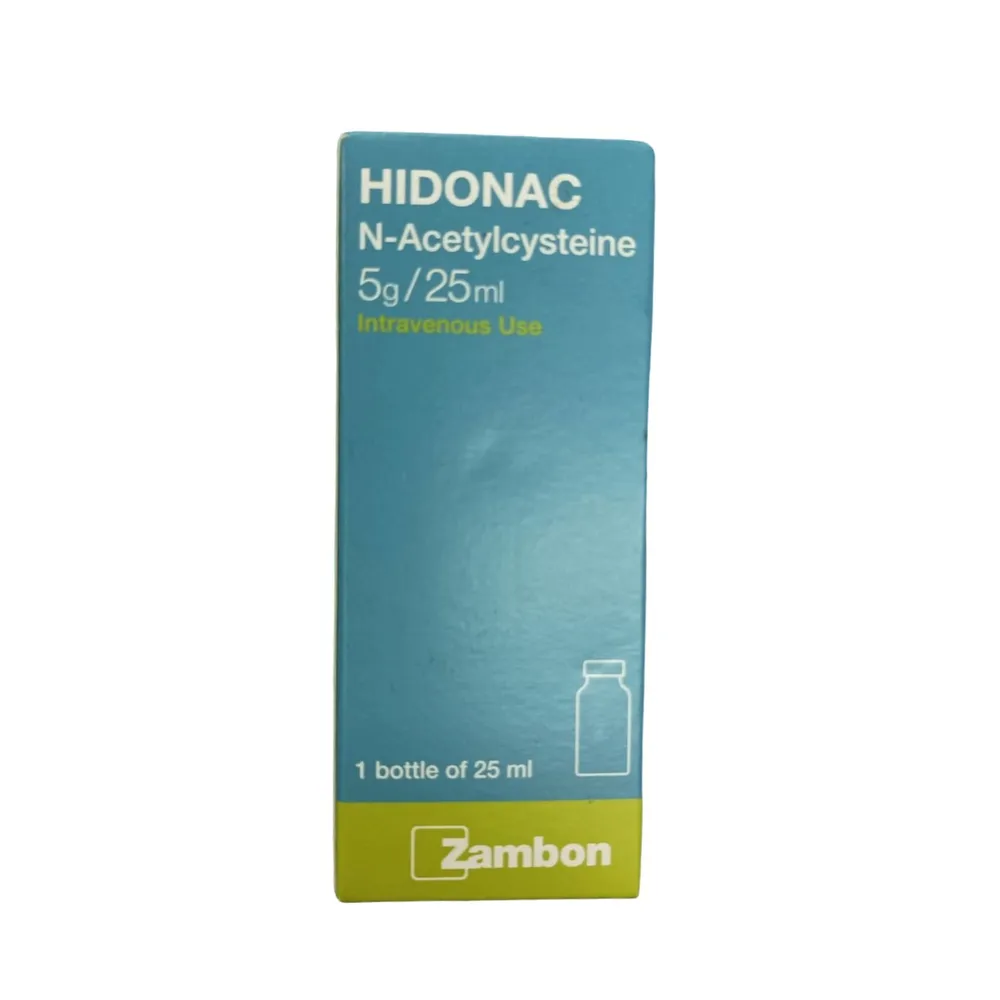
Table of Contents
Package leaflet: Information for the patient
Hidonac 5 g/25 ml infusion solution
N-acetylcysteine
Please read this leaflet carefully before using this medicine as it contains important information for you.
- Keep this leaflet. You may need to read it again.
- If you have any questions, consult your doctor or nurse.
- This medicine has been prescribed for you only. Do not give it to other people, even if their symptoms are the same as yours, as it could be harmful.
- If you experience any side effect, including those not listed in this leaflet, contact your doctor or nurse. See section 4.
Contents of this leaflet:
- What Hidonac is and what it is used for
- What you need to know before Hidonac is administered
- How Hidonac is administered
- Possible side effects
- How to store Hidonac
- Contents of the pack and other information
1. What Hidonac is and what it is used for
Hidonac contains the active substance N-acetylcysteine, which belongs to the category of antidotes,
medicines that counteract the harmful effects of another substance.
This medicine is administered as an antidote in cases of accidental or intentional paracetamol poisoning.
2. What you should know before receiving Hidonac
Warnings and precautions
Talk to your doctor or nurse before receiving Hidonac.
This medicine will be administered to you in a hospital setting under close medical supervision.
If Hidonac is administered rapidly intravenously or in excessive amounts, the occurrence of adverse effects may increase.
Hidonac may cause allergic reactions (hypersensitivity or anaphylactoid reactions), particularly at the beginning of treatment; therefore, monitoring by a doctor or nurse is required. In very rare cases, these reactions could be fatal.
If hypersensitivity or anaphylactoid reactions occur during administration, Hidonac must be temporarily discontinued and symptomatic treatment initiated.
If Hidonac is to be administered to patients who have previously suffered from atopy or asthma, there is a possible risk of developing allergic reactions.
If you suffer from bronchial asthma or have experienced episodes of bronchospasm (breathing difficulties caused by narrowing of the bronchi), you must be closely monitored during treatment with Hidonac. If symptoms of bronchospasm occur during administration, Hidonac must be immediately discontinued and symptomatic treatment initiated.
If Hidonac is administered to individuals weighing less than 40 kg, excessive fluid administration may occur, leading to low sodium levels in the blood (hyponatremia), seizures, and death.
Hidonac may prolong blood clotting time (reduction in prothrombin index and increase in INR); therefore, your doctor must check coagulation parameters before administering Hidonac, especially if you are about to undergo liver transplantation.
Children and adolescents
The same warnings and precautions apply to children and adolescents as for adults.
The presence of a sulfurous (sulfur-like) odor does not indicate deterioration of the preparation but is characteristic of the active substance contained in it.
Other medicines and Hidonac
Inform your doctor or nurse if you are taking, have recently taken, or might take any other medicines.
It is not recommended to mix other medicines with the Hidonac solution.
Pay particular attention if you are taking:
- nitroglycerin (a vasodilator used in the treatment of angina pectoris, a heart condition characterized by chest pain), as concomitant use causes a significant drop in blood pressure (hypotension) and dilation of the artery running laterally from the ear to the forehead (temporal artery). If concomitant administration of nitroglycerin and Hidonac is necessary, medical or nursing supervision is required due to the risk of hypotension, which may be severe, and headache.
- antibiotics.
Interference with laboratory tests
If you are undergoing laboratory tests, inform the staff that you are being treated with Hidonac, as this medicine may interfere with certain laboratory analyses.
Pregnancy, breastfeeding, and fertility
If you are pregnant, suspect you may be pregnant, planning pregnancy, or breastfeeding, consult your doctor or nurse before using this medicine.
During pregnancy and breastfeeding, use this medicine only after consulting your doctor and carefully evaluating the potential risks and expected benefits.
There are no data available on the effect of Hidonac on human fertility.
Driving and using machines
Hidonac contains sodium
This medicine contains 748 mg of sodium (the main component of table salt) per vial (32.5 mmol). This corresponds to 37.4% of the maximum recommended daily dietary intake of sodium for an adult.
3. How Hidonac is administered
Hidonac will be given to you slowly into a vein through intravenous infusion.
The medicine will be prepared and administered to you in a hospital setting by a doctor or nurse.
If you have any doubts, please consult your doctor or nurse.
Antidotal treatment must be started as soon as possible with the administration of the loading dose and must be continued for at least 21 hours.
If you are given more Hidonac than you should
Since this medicine will be administered to you by a doctor or nurse in a hospital, it is unlikely that you will receive an excessive dose.
However, if doses higher than recommended are administered to you, you must be closely monitored by the doctor or nurse.
If you think that you have been given or have taken the medicine too often, inform your doctor or nurse immediately.
If you have any doubts about the use of this medicine, consult your doctor or nurse.
4. Possible side effects
Like all medicines, this medicine can cause side effects, although not everybody will experience them.
Frequency not known (frequency cannot be estimated from the available data):
- severe, rapidly occurring allergic reactions such as anaphylactic shock, anaphylactic reaction, anaphylactoid reaction;
- hypersensitivity;
- increased heart rate (tachycardia);
- narrowing of the bronchial passages causing breathing difficulties (bronchospasm);
- shortness of breath (dyspnea);
- vomiting;
- nausea;
- swelling of the face, lips, mouth, tongue or throat which may cause difficulty in breathing and swallowing (angioedema);
- hives;
- redness;
- skin rash;
- itching;
- facial swelling (facial edema);
- decrease in blood pressure;
- prolonged blood clotting time (prothrombin time).
In very rare cases, serious skin reactions such as Stevens-Johnson syndrome and Lyell's syndrome have occurred.
If you notice any changes affecting the skin or mucous membranes, contact your doctor or nurse immediately and stop taking Hidonac.
Reporting of side effects
If you experience any side effect, including those not listed in this leaflet, consult your doctor, pharmacist or nurse. You may also report side effects directly via the national reporting system at the website
http://www.aifa.gov.it/content/segnalazioni-reazioni-avverse. By reporting side effects, you can help provide more information on the safety of this medicine.
5. How to store Hidonac
Keep this medicine out of the sight and reach of children.
This medicine, in its original intact packaging, does not require any special storage conditions.
The diluted solution can be used for up to 24 hours.
Do not use this medicine after the expiry date stated on the packaging after "Exp.". The expiry date refers to the last day of that month.
Do not dispose of any medicine via wastewater or household waste. Ask your pharmacist how to dispose of medicines no longer in use. This will help protect the environment.
6. Contents of the pack and other information
What Hidonac contains
- The active substance is N-acetylcysteine. One 25 ml vial contains 5 g of N-acetylcysteine.
- The other components are: sodium hydroxide, disodium edetate, water for injections.
Description of the appearance of Hidonac and contents of the pack
Hidonac is a solution for infusion.
One pack contains 1 vial of 25 ml solution for infusion.
Marketing Authorization Holder
ZAMBON ITALIA s.r.l. - Via Lillo del Duca 10 – 20091 Bresso (MI)
Manufacturer
Alfasigma S.p.A. – Via Enrico Fermi 1 – Alanno (PE)
The following information is intended exclusively for healthcare professionals.
Dosage
N-acetylcysteine must be administered by intravenous infusion, preferably using 5% glucose as the infusion fluid.
0.9% sodium chloride solution may be used if 5% glucose is not suitable.
The complete course of treatment with N-acetylcysteine consists of 3 consecutive intravenous infusions.
The doses must be administered sequentially without interruption between infusions. The patient must receive a total dose of 300 mg/kg body weight over a period of 21 hours.
Adults
Administration
- Weigh the patient to determine the correct weight range.
- Use the adult dosing table to determine the appropriate volume of N-acetylcysteine (vial volume) to add to the infusion fluid for each of the 3 infusion periods.
First infusion
Add the appropriate volume of N-acetylcysteine injection to 200 mL of infusion fluid to be infused over 1 hour.
Second infusion
Add the appropriate volume of N-acetylcysteine injection to 500 mL of infusion fluid to be infused over the next 4 hours.
Third infusion
Add the appropriate volume of N-acetylcysteine injection to 1 liter of infusion fluid to be infused over the next 16 hours.
When calculating the dose for obese patients, a maximum weight of 110 kg should be used.
The dose should be calculated using the patient's actual body weight.
Adult dosing table
| N-acetylcysteine prescription in adults (each vial = 200 mg/mL of N-acetylcysteine) | Circle the appropriate weight, dose, and volume | |||||
| Regimen | First Infusion | Second Infusion | Third Infusion | |||
| Infusion fluid | 200 mL of 5% dextrose solution or 0.9% sodium chloride | 500 mL of 5% dextrose solution or 0.9% sodium chloride | 1000 mL of 5% dextrose solution or 0.9% sodium chloride | |||
| Infusion duration | 1 hour | 4 hours | 16 hours | |||
| Drug dose | 150 mg/kg of N-acetylcysteine | 50 mg/kg of N-acetylcysteine | 100 mg/kg of N-acetylcysteine | |||
| Patient weight1 | Vial volume2 | Infusion rate | Vial volume2 | Infusion rate | Vial volume2 | Infusion rate |
| kg | mL | mL/h | mL | mL/h | mL | mL/h |
| 40-49 | 34 | 234 | 12 | 128 | 23 | 64 |
| 50-59 | 42 | 242 | 14 | 129 | 28 | 64 |
| 60-69 | 49 | 249 | 17 | 129 | 33 | 65 |
| 70-79 | 57 | 257 | 19 | 130 | 38 | 65 |
| 80-89 | 64 | 264 | 22 | 131 | 43 | 65 |
| 90-99 | 72 | 272 | 24 | 131 | 48 | 66 |
| 100-109 | 79 | 279 | 27 | 132 | 53 | 66 |
| >110 - maximum dose | 83 | 283 | 28 | 132 | 55 | 66 |
Dose calculations are based on the average weight within each weight range. If the patient weighs
less than 40 kg, use the pediatric dosing table.
The vial volume has been rounded to the nearest whole number.
Children
Children should be treated with the same dose and regimen as adults. However, the volume of intravenous fluid used must be adjusted according to age and weight, as fluid overdosage may be potentially harmful.
Doses must be administered sequentially using an appropriate intravenous infusion pump.
Preparation and administration of pediatric infusions
- Weigh the child to determine the correct weight range.
- Refer to the table for the total infusion volume required for each dose according to the child's weight, and prepare the solution following the instructions below.
The complete course of treatment with N-acetylcysteine consists of 3 consecutive intravenous infusions.
First infusion
- Prepare a 50 mg/mL solution by diluting each 10 mL of Hidonac (200 mg/mL) with 30 mL of 5% glucose or 0.9% sodium chloride to achieve a total volume of 40 mL.
- Prepare the appropriate volume according to the child's weight.
- Infuse the dose over 1 hour at the infusion rate indicated in the table.
Second infusion
- Prepare a 6.25 mg/mL solution by diluting each 10 mL of Hidonac (200 mg/mL) with 310 mL of 5% glucose or 0.9% sodium chloride to achieve a total volume of 320 mL.
- Prepare the appropriate volume according to the child's weight.
- Infuse the dose over 4 hours at the infusion rate indicated in the table.
Third infusion
- Prepare a 6.25 mg/mL solution by diluting each 10 mL of Hidonac (200 mg/mL) with 310 mL of 5% glucose or 0.9% sodium chloride to achieve a total volume of 320 mL.
- Prepare the appropriate volume according to the child's weight.
- Infuse the dose over 16 hours at the infusion rate indicated in the table.
For example, in a child weighing 12 kg, the first infusion should be 38 mL administered at a rate of 38 mL/h over 1 hour, the second infusion should be 100 mL administered at a rate of 25 mL/h over 4 hours, and the third infusion should be 208 mL administered at a rate of 13 mL/h over 16 hours.
Pediatric dosing table
| Pediatric dosing of acetylcysteine (each vial = 200 mg/mL acetylcysteine) | Circle the appropriate weight, dose, and volume | ||
| Regimen | First Infusion | Second Infusion | Third Infusion |
| Infusion | 50 mg/kg over 1 hour | 6.25 mg/kg over 4 hours | 6.25 mg/kg over 16 hours |
| Infusion rate | 3 mL/kg/h | 2 mL/kg/h | 1 mL/kg/h |
| Body weight1 | Infusion rate | Total infusion volume2 | Infusion rate | Total infusion volume2 | Infusion rate | Total infusion volume2 |
| kg | mL/h | mL | mL/h | mL | mL/h | mL |
| 1 | 3 | 3 | 2 | 8 | 1 | 16 |
| 2 | 6 | 6 | 4 | 16 | 2 | 32 |
| 3 | 9 | 9 | 6 | 24 | 3 | 48 |
| 4 | 12 | 12 | 8 | 32 | 4 | 64 |
| 5 | 15 | 15 | 10 | 40 | 5 | 80 |
| 6 | 18 | 18 | 12 | 48 | 6 | 96 |
| 7 | 21 | 21 | 14 | 56 | 7 | 112 |
| 8 | 24 | 24 | 16 | 64 | 8 | 128 |
| 9 | 27 | 27 | 18 | 72 | 9 | 144 |
| 10-14 | 38 | 38 | 25 | 100 | 13 | 208 |
| 15-19 | 53 | 53 | 35 | 140 | 18 | 288 |
| 20-24 | 68 | 68 | 45 | 180 | 23 | 368 |
| 25-29 | 83 | 83 | 55 | 220 | 28 | 448 |
| 30-34 | 98 | 98 | 65 | 260 | 33 | 528 |
| 35-39 | 113 | 113 | 75 | 300 | 38 | 608 |
Dose calculations are based on the average weight within each range. If the patient weighs more than 40 kg, use the adult dosing table.
Numbers have been rounded to the nearest whole number.
Special warnings and precautions for use
Intravenous administration requires careful monitoring in a hospital setting.
The occurrence of adverse effects following intravenous administration of N-acetylcysteine is more likely if the drug is administered too rapidly or in excessive amounts.
Anaphylactic reactions
Hypersensitivity/anaphylactoid reactions may occur with N-acetylcysteine, particularly during the initial loading dose.
In very rare cases, these reactions have been fatal.
Hypersensitivity/anaphylactoid reactions to N-acetylcysteine generally occur between 15 and 60 minutes after the start of infusion, and in many cases symptoms are relieved by interrupting the infusion and administering appropriate supportive therapy (antihistamines may be required, and occasionally corticosteroids).
Once an anaphylactoid reaction is under control, the infusion may be resumed at a rate of 50 mg/kg over 4 hours, followed by a final infusion of 100 mg/kg over 16 hours.
Bronchial asthma
There is some evidence that patients with a history of atopy and asthma may be at increased risk of developing an anaphylactoid reaction.
Patients with bronchial asthma or a history of bronchospasm must be closely monitored during therapy; if bronchospasm occurs, administration of N-acetylcysteine must be immediately discontinued and symptomatic treatment initiated.
Fluids and electrolytes
When antidotal doses are administered to patients weighing less than 40 kg, there is a potential risk of excessive fluid administration leading to hyponatremia, seizures, and death.
Therefore, it is recommended to strictly follow the instructions provided in the “Dosage and administration” section.
Coagulation
Administration of N-acetylcysteine at antidotal doses may prolong prothrombin time (reduced prothrombin index, increased INR), although it is unclear whether this effect represents an analytical interference or reflects a biological action of NAC. In any case, coagulation factors should be carefully evaluated in treated patients, especially when considering liver transplantation.
Overdose
Symptoms of overdose are similar in nature but more severe than those listed in the section “Possible side effects”.
Treatment
Management of overdose consists of immediate discontinuation of the infusion, symptomatic treatment, and resuscitation procedures. There are no specific antidotes; N-acetylcysteine is dialyzable.
Paediatric population
The same symptoms and treatments apply to the paediatric population.
Interactions
Drug-drug interaction
Concomitant administration of nitroglycerin and N-acetylcysteine has been shown to cause significant hypotension and temporal artery dilation.
If concomitant administration of nitroglycerin and N-acetylcysteine is necessary, patients should be monitored for the development of hypotension, which may be severe, and warned about the possible onset of headache.
Available data on antibiotic-N-acetylcysteine interactions come from in vitro studies in which the two substances were mixed, showing reduced antibiotic activity. However, as a precautionary measure, it is recommended not to mix antibiotics with N-acetylcysteine solution.
Paediatric population
Interaction studies have only been conducted in adults.
Drug-laboratory test interactions
N-acetylcysteine may interfere with the colorimetric assay method for salicylate determination.
N-acetylcysteine may interfere with urine ketone testing.
Incompatibilities
It is recommended not to mix other medicinal products with the Hidonac solution.
N-acetylcysteine may interact with rubber and metals (including iron, nickel, copper); glass or plastic equipment is therefore recommended.
Storage
This medicinal product, in its original unopened packaging, requires no special storage conditions.
The diluted solution for infusion is stable for 24 hours.