Havrix
Italy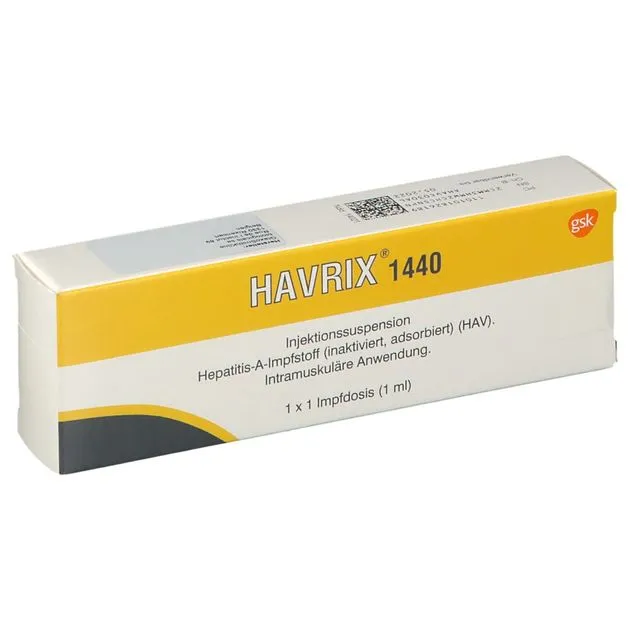
Table of Contents
- Package leaflet: Information for the user
- HAVRIX
- 1. What Havrix (720 Pediatric) is and what it is used for
- 2. What you should know before receiving Havrix (720 Children)
- 3. How to administer Havrix (720 Paediatric)
- 4. Possible side effects
- 5. How to store Havrix (720 Paediatric)
- 6. Package contents and other information
- Package leaflet: information for the user
- HAVRIX
- 1. What Havrix (1440 Adults) is and what it is used for
- 2. What you should know before receiving Havrix (1440 Adults)
- 3. How to administer Havrix (1440 Adults)
- 4. Possible side effects
- 5. How to store Havrix (1440 Adults)
- 6. Package contents and other information
Package leaflet: Information for the user
HAVRIX
Children Injectable Suspension in Pre-filled Syringe
Hepatitis A Vaccine (inactivated) (adsorbed)
Please read this leaflet carefully before receiving this vaccine as it contains important information for you.
- Keep this leaflet. You may need to read it again.
- If you have any questions, ask your doctor, pharmacist or nurse.
- This vaccine has been prescribed for you or your child only. Do not give it to other people.
- If any adverse reaction occurs, including those not listed in this leaflet, inform your doctor, pharmacist or nurse. See section 4.
This patient information leaflet has been written assuming the person receiving the vaccine is reading it,
but the vaccine may be administered to children and adolescents, so you may be reading it on behalf of your child.
Contents of this leaflet:
- What Havrix (720 Children) is and what it is used for
- What you need to know before receiving Havrix (720 Children)
- How to administer Havrix (720 Children)
- Possible side effects
- How to store Havrix (720 Children)
- Contents of the pack and other information
1. What Havrix (720 Pediatric) is and what it is used for
What Havrix (720 Pediatric) is used for
Havrix (720 Pediatric) is a vaccine used in children and adolescents aged between 1 and 15 years to protect against infection caused by the hepatitis A virus.
Havrix (720 Pediatric) may also be administered to adolescents aged between 16 and 18 years, if necessary.
What is hepatitis A
- Hepatitis A is a liver disease caused by the hepatitis A virus.
- The hepatitis A virus can be transmitted from person to person or through contact with contaminated water, food, and drinks.
- Symptoms of hepatitis A range from mild to severe and may include fever, malaise, loss of appetite, diarrhoea, nausea, abdominal discomfort, dark-coloured urine, and jaundice (yellowing of the eyes and skin). Most people recover completely, but sometimes the disease can be severe, requiring hospitalization, and rarely may lead to acute liver failure.
How Havrix (720 Pediatric) works
- Havrix (720 Pediatric) helps the body produce its own protection (antibodies) against the virus. These antibodies help protect you from the disease.
- Like all vaccines, Havrix (720 Pediatric) may not fully protect all vaccinated individuals.
2. What you should know before receiving Havrix (720 Children)
Havrix (720 Children) must not be administered if:
- you have previously had an allergic reaction to any of the components of the vaccine (listed in section 6) or to neomycin or formaldehyde,
- you have previously had an allergic reaction to any hepatitis A vaccine. Signs of an allergic reaction may include an itchy rash, shortness of breath, and swelling of the face and tongue.
Havrix (720 Children) must not be administered if any of the above conditions have occurred. If you are unsure, speak with your doctor, pharmacist, or nurse before Havrix (720 Children) is administered.
Warnings and precautions
Speak with your doctor, pharmacist, or nurse before receiving Havrix (720 Children) if:
- you have a severe infection with high fever. The vaccine can be given after recovery. A mild infection such as a cold should not be a problem, but you should discuss it with your doctor first,
- you have a weakened immune system due to illness or treatment with medicines. Your doctor will assess whether additional doses are needed,
- you have bleeding problems or bruise easily.
Fainting may occur during or even before any injection with a needle. Therefore, inform your doctor, pharmacist, or nurse if you have previously fainted after an injection.
Other medicines and Havrix (720 Children)
Inform your doctor, pharmacist, or nurse if you are taking, have recently taken, or might take any other medicines.
Havrix (720 Children) may be administered simultaneously with other vaccines and immunoglobulins. Each vaccine must be given at a different injection site.
Pregnancy and breastfeeding
If you are pregnant or breastfeeding, suspect you may be pregnant, or are planning to become pregnant, consult your doctor, pharmacist, or nurse before receiving Havrix (720 Children).
Driving and using machines
Havrix (720 Children) has no effect or only a negligible effect on the ability to drive vehicles and use machinery.
Havrix (720 Children) contains phenylalanine, polysorbate 20, sodium, and potassium
This vaccine contains 0.083 mg of phenylalanine per dose.
Phenylalanine may be harmful if you have phenylketonuria (PKU), a rare genetic disorder causing accumulation of phenylalanine because the body cannot eliminate it properly.
This vaccine contains 0.025 mg of polysorbate 20 per dose. Polysorbates may cause allergic reactions. Inform your doctor if you have known allergies.
This vaccine contains less than 1 mmol (23 mg) of sodium per dose, i.e. essentially "sodium-free".
This vaccine contains less than 1 mmol (39 mg) of potassium per dose, i.e. essentially "potassium-free".
3. How to administer Havrix (720 Paediatric)
How the vaccine is administered
- The doctor or nurse will administer Havrix (720 Paediatric) as an injection into the muscle. Usually into the upper arm muscle in children and adolescents.
- In young children, the injection may be given into the muscle of the thigh.
- Havrix (720 Paediatric) may exceptionally be injected under the skin if you suffer from thrombocytopenia or have severe bleeding disorders.
Recommended dose
- You will receive 1 dose of Havrix (720 Paediatric) (0.5 ml suspension) on the date agreed with your doctor or nurse.
- The second dose (booster) is recommended between 6 and 12 months after the first dose, but may be given up to five years after the first dose to ensure long-term protection.
If you receive more Havrix (720 Paediatric) than you should
Overdose is very unlikely since the vaccine is supplied in a single-dose syringe and is administered by a doctor or nurse. A few cases of accidental administration have been reported, and the side effects reported were similar to those seen with normal administration of the vaccine (listed in section 4).
If you forget to receive a dose of Havrix (720 Paediatric)
Contact your doctor, who will decide whether a dose is needed and when it should be administered.
4. Possible side effects
Like all medicines, this medicine can cause side effects, although not everybody gets them.
Serious side effects
Tell your doctor immediately if you notice any of the following serious side effects –
urgent medical treatment may be required:
- allergic reactions – signs may include localized or widespread skin rashes that may cause itching or blistering, swelling of the eyes and face, difficulty breathing or swallowing, a sudden drop in blood pressure, and loss of consciousness. These reactions may occur before you leave the doctor's office. Tell your doctor immediately if you notice any of the serious side effects listed above.
The side effects observed during clinical studies with Havrix (720 Children) were as follows:
Very common (may occur in more than 1 in 10 doses of vaccine)
‐ irritability
‐ pain and redness at the injection site
Common (may occur in up to 1 in 10 doses of vaccine)
‐ loss of appetite
‐ headache
‐ drowsiness
‐ nausea (feeling unwell)
‐ general feeling of malaise
‐ fever of 37.5 °C or higher
‐ swelling at the injection site
Uncommon (may occur in up to 1 in 100 doses of vaccine)
‐ blocked or runny nose
‐ vomiting (feeling unwell)
‐ diarrhoea
‐ skin rash
‐ hard lump at the injection site
The side effects reported after marketing of Havrix (720 Children) were as follows:
‐ seizures or convulsions
‐ inflammation of blood vessels leading to narrowing or blockage (vasculitis)
‐ severe allergic reaction causing swelling of the face, tongue or throat, which may cause difficulty in swallowing or breathing
‐ hives, red spots, often itchy, starting on the limbs and sometimes on the face and rest of the body
‐ joint pain
Reporting of side effects
If you get any side effects, including ones not listed in this leaflet, talk to your doctor, pharmacist, or nurse. You can also report side effects directly via the national reporting system at: https://www.aifa.gov.it/content/segnalazioni-reazioni-avverse . Reporting side effects can help provide more information on the safety of this medicine.
5. How to store Havrix (720 Paediatric)
Keep this vaccine out of the sight and reach of children.
Do not use this vaccine after the expiry date stated on the packaging. The expiry date refers to the last day of that month.
Store in a refrigerator (2 °C – 8 °C).
Do not freeze.
Keep in the original packaging to protect from light.
Do not dispose of any medicine via wastewater or household waste. Ask your pharmacist how to dispose of medicines no longer required. This will help protect the environment.
6. Package contents and other information
What Havrix (720 Paediatric) contains
The active substance is inactivated hepatitis A virus adsorbed onto hydrated aluminium hydroxide. Each 0.5 ml dose of vaccine contains 720 ELISA Units of hepatitis A virus.
The other components are amino acids for injectable preparations (containing phenylalanine), disodium phosphate, monopotassium phosphate, polysorbate 20 (E432), potassium chloride, sodium chloride, water for injectable preparations (see section 2).
Description of the appearance of Havrix (720 Paediatric) and contents of the pack
Injectable suspension.
Havrix (720 Paediatric) is a cloudy liquid for injection.
Havrix (720 Paediatric) is available in a 1-dose pre-filled syringe with or without needles, in pack sizes of 1, 5, 10 and 25.
Not all pack sizes may be marketed.
Marketing Authorisation Holder and Manufacturer
Marketing Authorisation Holder
GlaxoSmithKline S.p.A. – Viale dell’Agricoltura, 7 - 37135 Verona - Italy
Manufacturer
GlaxoSmithKline Biologicals s.a. - Rue de l’Institut, 89 - Rixensart, Belgium
This medicinal product is authorised in the Member States of the European Economic Area under the following names:
Austria Havrix (Hepatitis A vaccine)
Junior 720 EI.U/0.5 ml
Belgium, Cyprus, Luxembourg Havrix Junior 720
Bulgaria HAVRIX 720 suspension for injection (Junior
monodose)
Хаврикс 720 инжекционна суспензия (доза за деца)
Czech Republic Havrix Junior monodose
Denmark, Finland, Iceland, Norway Havrix
Estonia Havrix, 720 ELISA ühikut/ml süstesuspensioon
France HAVRIX NOURRISSONS ET ENFANTS 720 U/0.5 ml
Germany Havrix 720 Kinder
Greece, Italy HAVRIX
Hungary Havrix 720 Junior
Ireland Havrix Junior Monodose
Latvia Havrix 720 ELISA units/0.5 ml suspension for injection
Lithuania Havrix 720 ELISA units/0.5 ml injection suspension
Malta Havrix Junior Monodose Vaccine
Netherlands Havrix Junior
Poland HAVRIX 720 JUNIOR
Portugal Havrix 720 Júnior
Romania HAVRIX JUNIOR 720 VACCIN HEPATITIC A
Slovakia HAVRIX 720 Junior monodose
Slovenia HAVRIX 720 PAEDIATRIC
Spain Havrix 720 Junior suspensión inyectable en jeringa precargada
Sweden Havrix 720 ELISA U/0.5 ml
Further sources of information
More detailed information on this medicinal product is available on the website of the Italian Medicines Agency (Agenzia Italiana del Farmaco).
<----------------------------------------------------------------------------------------------------------------------------->
The following information is intended for healthcare professionals only:
Havrix (720 Paediatric) is a cloudy liquid suspension. During storage, a fine white deposit may form with a colourless supernatant.
The vaccine should be inspected visually before use to ensure there are no foreign particulate matter and/or any changes in physical appearance. Prior to administration of Havrix (720 Paediatric), the syringe should be shaken well to obtain a uniformly white, slightly opaque suspension. If the contents appear different, discard the vaccine.
Instructions for the pre-filled syringe
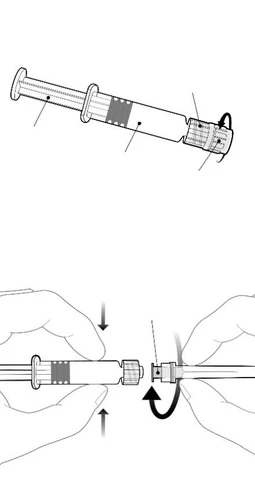
Luer Lock adapter
Hold the syringe by the barrel, not by the plunger.
Unscrew the syringe cap by turning it anticlockwise.
Plunger
Barrel
Needle hub
To attach the needle to the syringe, gently connect the needle hub to the Luer Lock adapter and rotate a quarter turn clockwise until a click is felt.
Do not remove the syringe plunger from the barrel.
If this occurs, do not administer the vaccine.
Disposal
Any unused medicinal product and waste materials derived from its use should be disposed of in accordance with local regulations.
Package leaflet: information for the user
HAVRIX
Adults Injectable Suspension in Pre-filled Syringe
Hepatitis A vaccine (inactivated, adsorbed)
Please read this leaflet carefully before receiving this vaccine, as it contains important information for you.
- Keep this leaflet. You may need to read it again.
- If you have any questions, ask your doctor, pharmacist, or nurse.
- This vaccine has been prescribed only for you or your child. Do not give it to others.
- If you experience any adverse reaction, including those not listed in this leaflet, contact your doctor, pharmacist, or nurse. See section 4.
This patient information leaflet has been written assuming the person receiving the vaccine is reading it,
but it may also be administered to adolescents from 16 years of age; therefore, you may be reading it on behalf of your child.
Contents of this leaflet:
- What Havrix (1440 Adults) is and what it is used for
- What you need to know before receiving Havrix (1440 Adults)
- How to administer Havrix (1440 Adults)
- Possible side effects
- How to store Havrix (1440 Adults)
- Package contents and other information
1. What Havrix (1440 Adults) is and what it is used for
What Havrix (1440 Adults) is used for
Havrix (1440 Adults) is a vaccine used to protect adolescents from the age of 16 years and adults
against infection caused by the hepatitis A virus.
What is hepatitis A
‐ Hepatitis A is a liver disease caused by the hepatitis A virus.
‐ The hepatitis A virus can be transmitted from person to person or through contact with contaminated water, food, or drinks.
‐ Symptoms of hepatitis A range from mild to severe and may include fever, malaise, loss of appetite, diarrhea, nausea, abdominal discomfort, dark-colored urine, and jaundice (yellowing of the eyes and skin). Most people recover completely, but sometimes the disease can be severe and require hospitalization, and rarely may lead to acute liver failure.
How Havrix (1440 Adults) works
‐ Havrix (1440 Adults) helps the body produce its own protection (antibodies) against the virus. These antibodies help protect you from the disease.
- As with all vaccines, Havrix (1440 Adults) may not fully protect all vaccinated individuals.
2. What you should know before receiving Havrix (1440 Adults)
Do not administer Havrix (1440 Adults) if:
- you have previously had an allergic reaction to any of the components of the vaccine (listed in section 6) or to neomycin or formaldehyde,
- you have previously had an allergic reaction to any hepatitis A vaccine.
Signs of an allergic reaction may include an itchy rash, shortness of breath, and swelling of the face and tongue.
Havrix (1440 Adults) must not be administered if any of the conditions listed above have occurred. If you are unsure, speak with your doctor, pharmacist, or nurse before receiving Havrix (1440 Adults).
Warnings and precautions
Talk to your doctor, pharmacist, or nurse before receiving Havrix if:
- you have a serious infection with high fever. The vaccine can be given after recovery. A mild infection such as a cold should not be a problem, but discuss it with your doctor first,
- you have a weakened immune system due to illness or treatment with medicines. Your doctor will assess whether additional doses are needed,
- you have bleeding problems or bruise easily.
Fainting may occur during or even before any injection with a needle. Therefore, inform your doctor, pharmacist, or nurse if you have previously fainted after an injection.
Other medicines and Havrix (1440 Adults)
Tell your doctor, pharmacist, or nurse if you are taking, have recently taken, or might take any other vaccines or medicines.
Havrix (1440 Adults) can be administered at the same time as other vaccinations and immunoglobulins. Each vaccine must be given at a different injection site.
Pregnancy and breastfeeding
If you are pregnant or breastfeeding, suspect you may be pregnant, or are planning to become pregnant, consult your doctor, pharmacist, or nurse before receiving Havrix (1440 Adults).
Driving and using machines
Havrix (1440 Adults) has no effect or only a negligible effect on the ability to drive and use machinery.
Havrix (1440 Adults) contains phenylalanine, polysorbate 20, sodium, and potassium
This vaccine contains 0.166 mg of phenylalanine per dose.
Phenylalanine may be harmful if you have phenylketonuria (PKU), a rare genetic disorder causing accumulation of phenylalanine because the body cannot properly eliminate it.
This vaccine contains 0.050 mg of polysorbate 20 per dose. Polysorbates may cause allergic reactions. Inform your doctor if you have known allergies.
This vaccine contains less than 1 mmol (23 mg) of sodium per dose, i.e. essentially "sodium-free".
This vaccine contains less than 1 mmol (39 mg) of potassium per dose, i.e. essentially "potassium-free".
3. How to administer Havrix (1440 Adults)
How the vaccine is administered
- Your doctor or nurse will administer Havrix (1440 Adults) as an intramuscular injection, usually in the upper arm.
- Havrix (1440 Adults) may exceptionally be injected subcutaneously if you have thrombocytopenia or suffer from severe bleeding disorders.
Recommended dose
- You will receive 1 dose of Havrix (1440 Adults) (1 ml suspension) on the date scheduled by your doctor or nurse.
- The second dose (booster) is recommended between 6 and 12 months after the first dose, but may be given up to five years after the first dose to ensure long-term protection.
If you receive more Havrix (1440 Adults) than you should
Overdose is highly unlikely because the vaccine is supplied in a single-dose syringe and is administered by a doctor or nurse. A few cases of accidental administration have been reported, and the side effects observed were similar to those reported with normal vaccine administration (listed in section 4).
If you forget to receive a dose of Havrix (1440 Adults)
Contact your doctor, who will decide whether a dose is needed and when it should be administered.
4. Possible side effects
Like all medicines, this vaccine can cause side effects, although not everybody gets them.
Serious side effects
Tell your doctor immediately if you notice any of the following serious side effects – you may need urgent medical treatment:
- Allergic reactions – signs may include localised or widespread skin rash which may cause itching or blistering, swelling of the eyes and face, difficulty breathing or swallowing, a sudden drop in blood pressure, and loss of consciousness. These reactions may occur before you leave the doctor's office. Immediately inform your doctor if you notice any of the serious side effects listed above.
The side effects observed during clinical studies with Havrix (1440 Adults) were as follows:
Very common (may occur in more than 1 in 10 doses of vaccine)
- headache – pain and redness at the injection site – fatigue
Common (may occur in up to 1 in 10 doses of vaccine)
- loss of appetite
- nausea (feeling unwell)
- vomiting (feeling unwell)
- diarrhoea
- general feeling of being unwell
- fever of 37.5 °C or higher
- swelling or hard lump at the injection site
Uncommon (may occur in up to 1 in 100 doses of vaccine)
- upper respiratory tract infection
- blocked or runny nose
- dizziness
- muscle pain, muscle stiffness not caused by exercise
- influenza-like symptoms such as high fever, sore throat, runny nose, cough and chills
Rare (may occur in up to 1 in 1,000 doses of vaccine)
- decreased or loss of skin sensitivity to pain or touch
- tingling
- itching
- chills
The side effects reported after marketing of Havrix have been the following:
- seizures or convulsions
- inflammation of blood vessels leading to narrowing or blockage (vasculitis)
- severe allergic reaction causing swelling of the face, tongue or throat which may cause difficulty in swallowing or breathing
- hives, red spots, often itchy, starting on the limbs and sometimes on the face and rest of the body
- joint pain
Reporting of side effects
If you get any side effects, including any not listed in this leaflet, talk to your doctor, pharmacist or nurse. You can also report side effects directly via the national reporting system at https://www.aifa.gov.it/content/segnalazioni-reazioni-avverse . By reporting side effects, you can help provide more information on the safety of this medicine.
5. How to store Havrix (1440 Adults)
Keep this vaccine out of the sight and reach of children.
Do not use this vaccine after the expiry date stated on the packaging. The expiry date refers to the last day of that month.
Store in a refrigerator (2 °C – 8 °C).
Do not freeze.
Keep in the original packaging to protect from light.
Do not dispose of any medicine via wastewater or household waste. Ask your pharmacist how to dispose of medicines no longer used. This will help protect the environment.
6. Package contents and other information
What Havrix (1440 Adults) contains
The active substance is inactivated hepatitis A virus adsorbed onto aluminium hydroxide hydrate. Each 1 ml
dose of vaccine contains 1440 ELISA Units of hepatitis A virus.
The other components are amino acids for injectable preparations (containing phenylalanine), disodium
phosphate, monopotassium phosphate, polysorbate 20 (E432), potassium chloride, sodium chloride, water
for injectable preparations (see section 2).
Description of the appearance of Havrix (1440 Adults) and contents of the pack
Injectable suspension.
Havrix (1440 Adults) is a cloudy liquid for injection.
Havrix (1440 Adults) is available in a single-dose pre-filled syringe with or without needles, in packs of 1, 5,
10 and 25.
Not all pack sizes may be marketed.
Marketing Authorisation Holder and Manufacturer
Marketing Authorisation Holder
GlaxoSmithKline S.p.A. – Viale dell’Agricoltura, 7 - 37135 Verona - Italy
Manufacturer
GlaxoSmithKline Biologicals s.a. - Rue de l’Institut, 89 - Rixensart, Belgium
This medicinal product is authorised in the European Economic Area countries under the following
names:
Austria Havrix (Hepatitis A vaccine)
1440 EI.U/1 ml
Belgium, Germany, Hungary, Luxembourg, Havrix 1440
Netherlands
Bulgaria HAVRIX 1440 suspension for injection (Adult dose)
Хаврикс 1440 инжекционна суспензия (доза за
възрастни)
Cyprus Havrix Adults 1440
Czech Republic, Denmark, Finland, Havrix
Iceland, Norway
Estonia Havrix, 1440 ELISA ühikut/ml süstesuspensioon
France HAVRIX 1440 U/1ml ADULTES
Greece, Italy HAVRIX
Ireland Havrix Monodose
Latvia Havrix 1440 ELISA vienības/ml suspensija injekcijām
Lithuania Havrix 1440 ELISA vienetų/ml injekcinė suspensija
Malta Havrix Monodose Vaccine
Poland HAVRIX ADULT
Portugal Havrix 1440 Adulto
Romania HAVRIX ADULT 1440 HEPATITIS A VACCINE
Slovakia HAVRIX 1440 Dosis adulta
Slovenia HAVRIX 1440
Spain Havrix 1440 Adulto, suspension for injection in pre-filled syringe
Sweden Havrix 1440 ELISA U/1 ml
Further information
More detailed information on this medicinal product is available on the website of the Italian Medicines Agency (AIFA).
<----------------------------------------------------------------------------------------------------------------------------->
The following information is intended for healthcare professionals only:
Havrix (Adults 1440) is a cloudy liquid suspension. During storage, a fine white deposit may form with a colourless supernatant.
The vaccine should be inspected visually before use to ensure there are no foreign particulate matter and/or abnormal physical appearance. Before administering Havrix (1440 Adults), the syringe must be shaken well to obtain a uniformly white, slightly opaque suspension. If the contents appear different, discard the vaccine.
Instructions for use of the pre-filled syringe
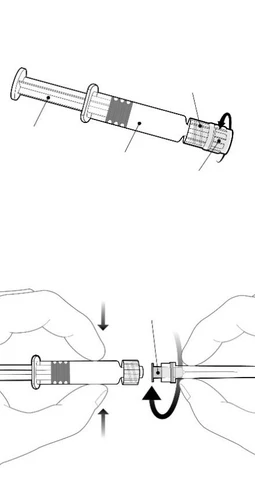
Luer Lock adapter
Hold the syringe by the barrel, not by the plunger.
Unscrew the syringe cap by turning it
Plunger
counter-clockwise.
Barrel
Cap
Needle hub
To attach the needle to the syringe, gently connect
the needle hub to the Luer Lock adapter and rotate
a quarter turn clockwise until a click is felt.
Do not remove the plunger from the syringe barrel.
If this occurs, do not administer the vaccine.
Disposal
Unused medicine and waste material derived from this medicine must be disposed of in accordance with local regulations.