Grasustek
Italy
Table of Contents
- Package leaflet: Information for the user
- Grasustek 6 mg solution for injection in a pre-filled syringe
- 1. What Grasustek is and what it is used for
- 2. What you need to know before using Grasustek
- 3. How to use Grasustek
- 4. Possible side effects
- 5. How to store Grasustek
- 6. Package contents and other information
Package leaflet: Information for the user
Grasustek 6 mg solution for injection in a pre-filled syringe
pegfilgrastim
.
Please read all of this leaflet carefully before you start using this medicine as it contains important information for you.
-
- Keep this leaflet. You may need to read it again.
-
- If you have any questions, ask your doctor, pharmacist or nurse.
-
- This medicine has been prescribed for you only. Do not pass it on to others, even if they have the same symptoms as yours, because it may be harmful to them.
-
- If you experience any side effects, including those not listed in this leaflet, tell your doctor, pharmacist or nurse. See section 4.
Contents of this leaflet
- What Grasustek is and what it is used for
- What you need to know before you use Grasustek
- How to use Grasustek
- Possible side effects
- How to store Grasustek
- Contents of the pack and other information
1. What Grasustek is and what it is used for
Grasustek is indicated in adults aged 18 years and older.
Grasustek contains the active substance pegfilgrastim. Pegfilgrastim is a protein produced using biotechnology in bacteria called Escherichia coli. It belongs to a group of proteins known as cytokines and is very similar to a natural protein (granulocyte colony-stimulating factor) produced by our body.
Grasustek is used to reduce the duration of neutropenia (low white blood cell count) and the occurrence of febrile neutropenia (low white blood cell count with fever) that may be caused by cytotoxic chemotherapy (medicines that destroy rapidly growing cells). White blood cells are important because they help the body fight infections. These cells are highly sensitive to the effects of chemotherapy; this can cause a decrease in the number of these cells present in the body. If the number of white blood cells drops to a low level, there may not be enough left to fight bacteria, and you may be at increased risk of developing an infection.
Your doctor has prescribed Grasustek to stimulate the bone marrow (the part of the bone that produces blood cells) to produce more white blood cells, which help the body fight infections.
2. What you need to know before using Grasustek
Do not use Grasustek
-
- if you are allergic to pegfilgrastim, filgrastim, proteins derived from E. coli, or any of the other ingredients of this medicine (listed in section 6). Warnings and precautions Talk to your doctor, pharmacist, or nurse before using Grasustek:
-
- if you experience an allergic reaction including weakness, low blood pressure, difficulty breathing, swelling of the face (anaphylaxis), redness and flushing, rash, or areas of itchy skin
-
- if you have cough, fever, and difficulty breathing. This may be a sign of Acute Respiratory Distress Syndrome (ARDS)
-
- if you experience one or a combination of the following side effects: - swelling or fluid retention, which may be associated with reduced frequency of urination, difficulty breathing, abdominal swelling and a feeling of fullness, and a general feeling of fatigue. These could be symptoms of a condition called "Capillary Leak Syndrome," which causes leakage of blood from small vessels in the body (see section 4)
-
- if you have pain in the upper left side of the abdomen or shoulder tip pain. This could be a sign of a problem with the spleen (splenomegaly)
-
- if you have recently had a severe lung infection (pneumonia), fluid in the lungs (pulmonary edema), lung inflammation (interstitial lung disease), or an abnormal finding on X-ray (pulmonary infiltration)
-
- if you know you have abnormal blood cell counts (e.g. elevated white blood cells or anemia) or reduced platelet levels, which decreases the body’s ability to clot blood (thrombocytopenia). Your doctor may wish to monitor you closely
-
- if you have sickle cell anemia. Your doctor may wish to monitor you closely
-
- if you have breast or lung cancer, Grasustek in combination with chemotherapy and/or radiotherapy may increase the risk of a pre-leukemic blood condition called myelodysplastic syndrome (MDS) or a blood cancer called acute myeloid leukemia (AML). Symptoms may include fatigue, fever, and easy bruising or bleeding
-
- if you suddenly develop signs of allergy such as skin rash, hives, or itching, swelling of the face, lips, tongue, or other parts of the body, shortness of breath, wheezing, or difficulty breathing. These could be signs of a severe allergic reaction
-
- if you have symptoms of inflammation of the aorta (the large blood vessel carrying blood from the heart to the rest of the body), which has been rarely reported in cancer patients and healthy individuals. Symptoms may include fever, abdominal pain, malaise, back pain, and elevated markers of inflammation. Inform your doctor if you experience these symptoms. Your doctor will regularly monitor your blood and urine, as Grasustek may damage the tiny filters in your kidneys (glomerulonephritis). Severe skin reactions (Stevens-Johnson syndrome) have been observed with the use of Grasustek. If you notice any of the symptoms described in section 4, stop using Grasustek and seek immediate medical help. You should discuss with your doctor the risks of developing blood cancer. If you have or may have blood cancer, you must not use Grasustek unless instructed otherwise by your doctor.
Loss of response to pegfilgrastim
If you experience a decreased response or failure to maintain response to pegfilgrastim treatment, your doctor will investigate the reasons, including the possibility that you have developed antibodies that neutralize the activity of pegfilgrastim.
Other medicines and Grasustek
Tell your doctor or pharmacist if you are taking, have recently taken, or might take any other medicines.
Pregnancy, breastfeeding, and fertility
Ask your doctor or pharmacist for advice before taking any medicine. Grasustek has not been studied in pregnant women. It is important that you inform your doctor if:
-
- you are pregnant or breastfeeding
-
- you suspect you may be pregnant, or
-
- you are planning to become pregnant.
If you become pregnant during treatment with Grasustek, inform your doctor.
Unless otherwise advised by your doctor, you must stop breastfeeding while using Grasustek.
Driving and using machines
Grasustek does not affect or has negligible effect on the ability to drive or operate machinery.
Grasustek contains sorbitol (E420) and sodium
This medicine contains 30 mg of sorbitol in each 6 mg dose, equivalent to 50 mg/mL.
This medicine contains less than 1 mmol of sodium (23 mg) per 6 mg dose, i.e., it is practically sodium-free.
3. How to use Grasustek
Use this medicine exactly as instructed by your doctor. If you have any doubts, consult your
doctor or pharmacist. The usual dose is one 6 mg subcutaneous injection (injection under the skin) using a pre-filled syringe, which must be administered at least 24 hours after the last dose of
chemotherapy at the end of each chemotherapy cycle.
How to self-administer the Grasustek injection
Your doctor may consider it preferable for you to self-administer the Grasustek injection. Your doctor or
nurse will show you how to perform the injection yourself. Do not attempt to self-inject unless you have been properly instructed.
Read the section at the end of this leaflet for further information on how to self-administer the Grasustek injection.
Do not shake Grasustek vigorously, as this may impair its activity.
If you use more Grasustek than you should
If you use more Grasustek than prescribed, contact your doctor, pharmacist, or nurse.
If you forget to inject Grasustek
If you have missed a dose of Grasustek, contact your doctor to determine when to administer the next injection.
If you have any doubts about how to use this medicine, consult your doctor, pharmacist, or
nurse.
4. Possible side effects
Like all medicines, this medicine can cause side effects, although not everyone gets them.
Inform your doctor immediately if you experience any one or a combination of the following side effects:
-
- Swelling or puffiness, which may be associated with reduced frequency of urination, difficulty breathing, abdominal swelling and a feeling of fullness, and a general feeling of fatigue. These symptoms usually develop rapidly. These could be symptoms of an uncommon condition (may affect up to 1 in 100 people) called "Capillary Leak Syndrome", which causes blood to leak from small blood vessels into the body and requires urgent medical treatment. Very common side effects (may affect more than 1 in 10 people)
-
- Bone pain. Your doctor will advise you on what to take to relieve bone pain.
-
- Nausea and headache. Common side effects (may affect up to 1 in 10 people)
-
- Pain at the injection site.
-
- General discomfort, joint and muscle pain.
-
- Some changes may occur in the blood, but these will be detected during routine blood tests. White blood cell levels may rise temporarily. Platelet levels may decrease, leading to bruising. Uncommon side effects (may affect up to 1 in 100 people)
-
- Allergic-type reactions, including flushing and hot flushes, skin rash (reddening of the skin), and itchy skin swellings.
-
- Severe allergic reactions including anaphylaxis (weakness, drop in blood pressure, difficulty breathing, facial swelling).
-
- Enlargement of the spleen.
-
- Rupture of the spleen. Some cases of spleen rupture have been fatal. It is important that you contact your doctor immediately if you feel pain in the upper left side of the abdomen or left shoulder, as this may indicate spleen problems.
-
- Breathing problems. If you have cough, fever, and difficulty breathing, contact your doctor.
-
- Cases of Sweet’s syndrome (purple-colored, raised and painful skin lesions on the limbs and sometimes on the face and neck, associated with fever) have been reported, although other factors may have contributed.
-
- Cutaneous vasculitis (inflammation of the small blood vessels in the skin).
-
- Damage to the tiny filters within the kidneys (glomerulonephritis).
-
- Redness at the injection site.
-
- Coughing up blood (haemoptysis).
- Blood disorders (myelodysplastic syndrome [MDS] or acute myeloid leukaemia [AML]). Rare side effects (may affect up to 1 in 1,000 people)
-
- Inflammation of the aorta (the large blood vessel carrying blood from the heart to the body), see section 2.
-
- Bleeding from the lungs (pulmonary haemorrhage), Stevens-Johnson syndrome, which may present as reddish patches or round spots, often with central blisters, located on the trunk, skin peeling, mouth, throat, nose, genital and eye ulcers, and which may be preceded by fever and flu-like symptoms. If you develop these symptoms, stop using Grasustek and contact your doctor or seek immediate medical assistance. See also section 2.
Reporting of side effects
If you experience any side effect, including those not listed in this leaflet, talk to your doctor, pharmacist, or nurse. You can also report side effects directly via the national reporting system listed in Annex V. By reporting side effects, you can help provide more information on the safety of this medicine.
5. How to store Grasustek
Keep this medicine out of the sight and reach of children.
Do not use this medicine after the expiry date which is stated on the carton and on the label of the
syringe after Exp. The expiry date refers to the last day of that month.
Store in the refrigerator (2 °C - 8 °C).
You may remove Grasustek from the refrigerator and keep it at room temperature (not above 30 °C) for
no more than 3 days. Once the syringe has been removed from the refrigerator and has reached room
temperature (not above 30 °C), it must be used within 3 days or must be discarded.
Do not freeze. Grasustek may be used if it has been accidentally frozen only once for less than 24 hours.
Keep the container in the outer packaging to protect the medicine from light.
Do not use this medicine if you notice that it is cloudy or if particles are visible.
Do not dispose of any medicine via wastewater or household waste. Ask your pharmacist how to
dispose of medicines no longer required. This will help protect the environment.
6. Package contents and other information
What Grasustek contains
-
- The active substance is pegfilgrastim. Each pre-filled syringe contains 6 mg of pegfilgrastim in 0.6 mL of injectable solution.
-
- The other components are sodium acetate, sorbitol (E420), polysorbate 20 and water for injections (see section 2). Description of the appearance of Grasustek and contents of the pack Grasustek is a clear, colourless injectable solution in a pre-filled syringe (6 mg/0.6 mL). Each pack contains 1 glass pre-filled syringe with a stainless steel needle and needle cap. The syringes are supplied with automatic needle protection. Marketing Authorisation Holder Juta Pharma GmbH, Gutenbergstr. 13, 24941 Flensburg, Germany Manufacturer Juta Pharma GmbH, Gutenbergstr. 13, 24941 Flensburg, Germany
For further information about this medicinal product, please contact the local representative of the Marketing Authorisation Holder:
Ελλάδα България
RAFARM A.E.B.E Alvogen Pharma Bulgaria EOOD
Κορίνθου 12, Ν. Ψυχικό, Ελλάδα bul. Bulgaria 86A, floor 1, Sofia 1680,
tel 210 6776550-1 Bulgaria
+359 2 441 7136
Hrvatska Ísland
Alvogen d.o.o. Alvogen ehf.
Av. V. Holjevca 40, 10000 Zagreb, Hrvatska Sæmundargötu 15-19, 101 Reykjavík, Ísland
Tel: +385 1 6641 830 Tel: +354 522 2900
Magyarország Polska
Aramis Pharma Kft Alvogen Pharma Sp. Z o.o.
1095 Mester u. 28 Budapest Hungary Ul. Kniaźnina 4a lok 7
Tel: +36-1-299-1051 01-607 Warsaw, Poland
Tel: +48 22 460 92 00
România Österreich
Alvogen Romania SRL Vertrieb
44B, Theodor Pallady Blvd. G.L.Pharma GmbH
3rd district, 032266 Schlossplatz 1, 8502 Lannach,
Bucharest, Romania Austria
Tel: +40 21 318 0377 Tel: +43 3136 82577
Česká republika Slovenská republika
EGIS Praha, spol. s r.o., EGIS Slovakia spol. s r.o.,
Praha1-Staré Město, Ovocný trh 1096/8, PSČ Prievozská 4D, 821 09 Bratislava
11000 Tel: +421 2 32409422
Tel: +420 227 129 111
Eesti Deutschland
Apteegikaubanduse Hulgimüük OÜ (Auxilia medac GmbH
Pharma)
Karamelli 6, 11317 Tallinn Theaterstr. 6
Tel: +372 605 0005 22880 Wedel, Germany
Tel: +49 4103 / 8006-777
Italia Sverige, Danmark, Norge
medac Pharma S.r.l. medac GmbH
Via Viggiano 90, 00178 Roma Malmöhusvägen 1
Italy 211 18 Malmö
Tel: +39 06 51 59 121 Sweden
Tel: +46 0340 64 54 70
Suomi/Finland Lietuva
medac GmbH SIA „Unikmed Baltija“
Hirsalantie 11 Gertrūdos g. 33/35-2,
02420 Jorvas LV-1011, Riga, Latvia
Finland Tel: +371 64 412-474
Tel: +358 10 420 4000
Latvija Slovenija
SIA Unikmed Baltija Distribucija
Ģertrūdes iela 33/35-2, G.L.Pharma GmbH
LV-1011, Rīga, Latvija Schlossplatz 1, 8502 Lannach,
Tel: +371 64 412-474 Austria
Tel: +43 3136 82577
België / Belgique / Belgien, España, Ireland, France
Κύπρος, Luxembourg / Luxemburg, Malta, Zentiva France
Nederland, Portugal, United Kingdom 35 Rue du Val de Marne
(Northern Ireland) 75013 Paris
Juta Pharma GmbH Tel: +33 (0) 800 089 219
Tel: +49(0)461995799-0
Other sources of information
More detailed information on this medicinal product is available on the European Medicines Agency website: http://www.ema.europa.eu.
Instructions for use:
Guide to parts
Syringe before administration
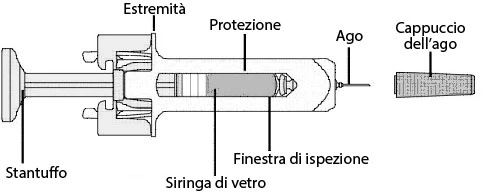
Caution: Avoid touching the plunger or the needle during syringe preparation. The safety device is normally activated by pushing the plunger on the syringe.
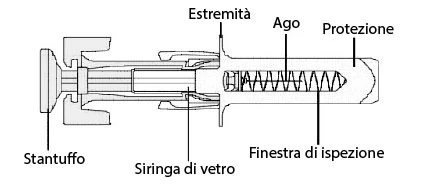
Syringe after administration
(protection is released and covers the needle)
| Important | |
| Before using an auto-needle-protected prefilled syringe of Grasustek, read these important instructions: It is important that you do not attempt to perform the injection yourself unless you have received proper instructions from your doctor or healthcare provider. Grasustek is administered as an injection into the tissue just beneath the skin (subcutaneous injection). Do not remove the gray needle cap from the prefilled syringe until you are ready for injection. Do not use the prefilled syringe if it has fallen on a hard surface. Use a new prefilled syringe and contact your doctor or healthcare provider. Do not attempt to activate the prefilled syringe before injection. Do not attempt to remove the transparent safety shield from the prefilled syringe. Do not attempt to remove the detachable label from the prefilled syringe before administering the injection. Contact your doctor or healthcare provider for any questions. | |
| Step 1: Preparation | |
| A. | Remove the prefilled syringe from its packaging and prepare the materials needed for injection: alcohol swabs, a cotton ball or gauze, a plaster, and a sharps disposal container (not included). |
| For a more comfortable injection, allow the prefilled syringe to reach room temperature for about 30 minutes before injection. Wash your hands thoroughly with soap and water. Place the new prefilled syringe on a clean, well-lit work surface along with the necessary injection materials. Do not attempt to heat the syringe using a heat source such as hot water or microwave. Do not expose the prefilled syringe to direct sunlight. Do not shake the prefilled syringe excessively. Keep the prefilled syringe out of sight and reach of children. | |
| B. | Warning/precaution: Check that there are no loose fragments or fluid inside the package. If in doubt, DO NOT open this package and instead take another one. Open the blister by completely removing the cover as shown. |
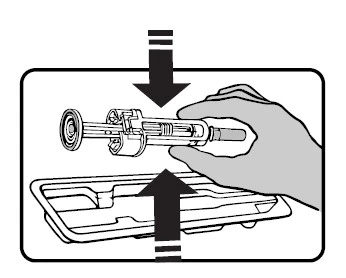
C.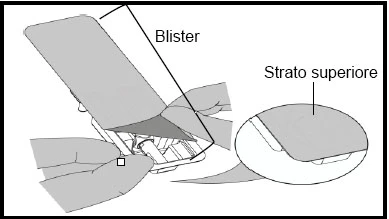 | Warning/Precaution: DO NOT lift the product by the plunger or the needle cover. Remove the prefilled syringe from the blister as shown. |
 | |||
| D. | Inspect the medicine through the viewing window of the prefilled syringe. | ||
| Do not use the prefilled syringe if: The medicine is cloudy or contains particles. It should be a clear, colourless liquid. Any parts appear cracked or broken. The grey needle cap is missing or not securely attached. The expiry date printed on the label has passed the last day of the month indicated. In all cases, contact your doctor or healthcare professional. | |||
| Step 2: Preparation | |||
A.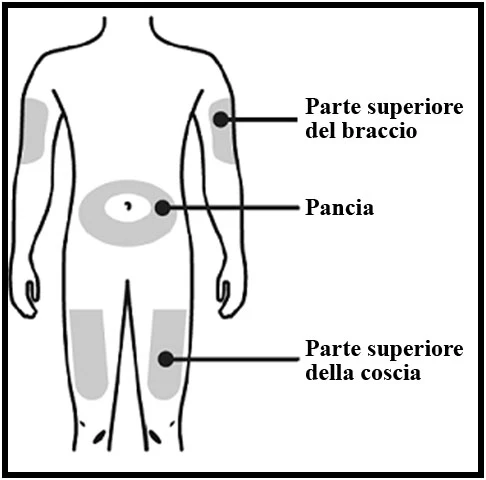 | Wash your hands thoroughly. Prepare and clean the injection site. | ||
| You may use: The upper thigh The abdomen, except for an area of 5 centimetres directly around the navel. The outer upper arm (only if someone else is giving you the injection). Clean the injection site with an alcohol swab. Allow the skin to dry. Do not touch the injection site before injecting. Do not inject into areas where the skin is tender, bruised, red, or hardened. Avoid injecting into areas with scars or stretch marks. | |||
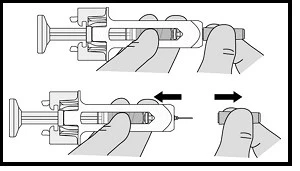
| B. | Warning/precaution: DO NOT twist the needle cover or touch the needle or plunger. | ||
| Remove the needle cap as shown, and hold the protective cover to avoid injury or needle bending. | |
 | |
| C. | Lift the injection site to create a stable surface. | ||
It is important to keep the skin lifted during the injection.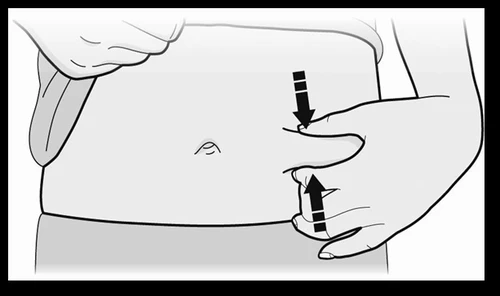 | |||
| Step 3: Injection | |||
| A. | INSERT the needle into the skin. Push the plunger while holding the ends. Push the plunger all the way down to inject the entire solution. | ||
Do not touch the injection site before the injection.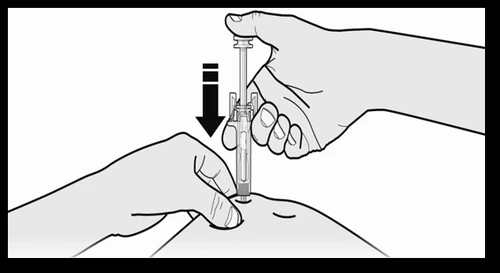 | |||
| B. | To activate the safety protection, the full dose must be administered. | ||
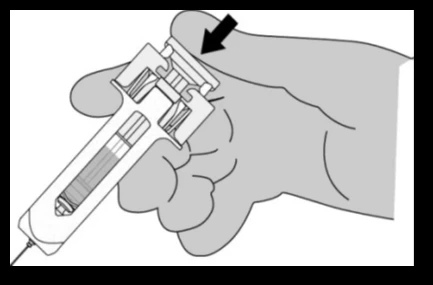 | |
| C. | After completing the injection, either of the following options may be followed: -Remove the needle from the injection site and release the plunger until the entire needle is covered by the safety shield. -Release the plunger until the entire needle is covered by the safety shield and then remove the needle from the injection site.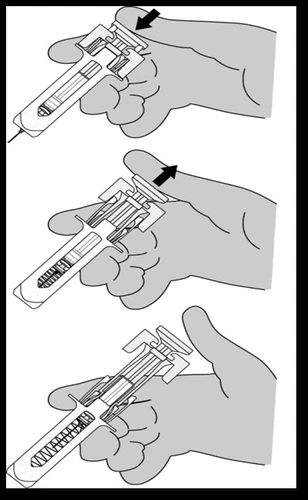 |
| Warning/Precaution: If the safety shield is not activated or is only partially activated, discard the syringe without replacing the needle cap. | |
| For healthcare professionals only. The brand name of the medicine must be clearly documented in the patient's medical record. | ||
Rotate the plunger to move the label to a position where it can be removed.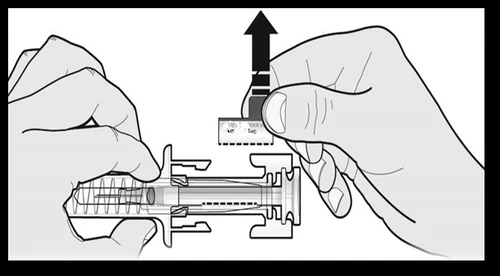 | ||
| Step 4: End | ||
| A. | Immediately dispose of the used medicine in a sharps disposal container or as instructed by the healthcare professional. | |
Medicines must be disposed of in accordance with local regulations. Ask your pharmacist how to dispose of medicines you no longer use. This will help protect the environment. Keep the syringe and the sharps disposal container out of sight and reach of children. Do not reuse the prefilled syringe. Do not recycle prefilled syringes or dispose of them in household waste.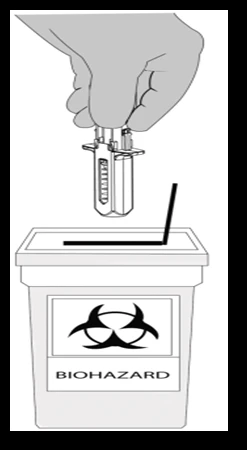 | ||
| B. | Examine the injection site. | |
| If you see blood, press a cotton ball or gauze pad over the injection site. Do not rub the injection site. Apply a bandage if needed. | ||