Glycophos
Italy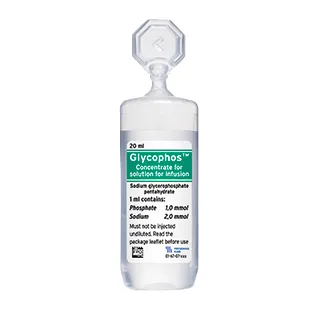
Table of Contents
- Package leaflet: Information for the patient
- GLYCOPHOS 6 g/20 ml concentrate for solution for infusion
- 1. What GLYCOPHOS is and what it is used for
- 2. What you need to know before using GLYCOPHOS
- 3. How to use GLYCOPHOS
- 4. Possible side effects
- 5. How to store GLYCOPHOS
- 6. Contents of the pack and other information
- The following information is intended for healthcare professionals only:
Package leaflet: Information for the patient
GLYCOPHOS 6 g/20 ml concentrate for solution for infusion
Read this leaflet carefully before using this medicine because it contains important information for you.
- Keep this leaflet. You may need to read it again.
- If you have any questions, ask your doctor, pharmacist, or nurse.
- If you get any side effects, including those not listed in this leaflet, tell your doctor, pharmacist, or nurse. See section 4.
Contents of this leaflet
- What GLYCOPHOS is and what it is used for
- What you need to know before you use GLYCOPHOS
- How to use GLYCOPHOS
- Possible side effects
- How to store GLYCOPHOS
- Contents of the pack and other information
1. What GLYCOPHOS is and what it is used for
Glycerophosphoric acid sodium salt is a concentrate for the preparation of an infusion solution for
phosphate supply.
Glycerophosphoric acid sodium salt is used as a phosphate substitute in adults, adolescents and children
- in case of phosphate deficiency and
- in artificial nutrition.
2. What you need to know before using GLYCOPHOS
Do not use GLYCOPHOS
- if you are allergic to the active substance or to any of the other ingredients of this medicine (listed in section 6).
- if you have increased phosphate levels in the blood (hyperphosphatemia),
- if you have increased sodium levels in the blood (hypernatremia),
- if you have renal dysfunction (absence or reduced urine output),
- if you have abnormally low calcium levels in the blood (hypocalcemia),
- if you have general contraindications to infusion therapy, such as severe heart failure, pulmonary or cerebral edema, or conditions of hyperhydration.
Warnings and precautions
Talk to your doctor before using GLYCOPHOS.
Regular monitoring of serum levels of sodium, calcium, and phosphate, as well as serum creatinine and blood urea nitrogen, is required.
Acid-base imbalances should be corrected prior to treatment.
Phosphate replacement should be performed taking into account serum calcium levels. At higher doses, concomitant calcium administration may be indicated.
Other medicines and GLYCOPHOS
Inform your doctor if you are taking/using, have recently taken/used, or might take/use any other medicines.
Phosphate and calcium metabolism are closely linked. An increase in serum phosphate concentration is accompanied by a decrease in serum calcium concentration. Therefore, at higher doses, simultaneous calcium administration may be necessary.
Pregnancy and breastfeeding
If you are pregnant, suspect you may be pregnant, planning a pregnancy, or breastfeeding, consult your doctor before using this medicine.
There are no data available on the use of this medicine in pregnant or breastfeeding women.
However, it should be noted that the phosphate requirement in pregnant women may be slightly higher compared to non-pregnant women.
Your doctor will decide whether sodium glycerophosphate should be used during pregnancy and breastfeeding.
Driving and using machines
GLYCOPHOS does not affect or affects negligibly the ability to drive and use machinery.
GLYCOPHOS contains sodium
This medicine contains 46 mg of sodium (a main component of table salt) per ml. This corresponds to 2% of the maximum daily recommended dietary intake for an adult.
3. How to use GLYCOPHOS
GLYCOPHOS will be administered to you by a doctor. The doctor will decide how much you need and
when it will be given. This depends on your body weight and your health condition.
The dosage is individually tailored to your needs and depends on the required correction.
Adults
In artificial nutrition, the daily maintenance requirement of phosphate for adults is 10–30 mmol.
In clinical practice, usually 0.4 mmol of phosphate per kg of body weight per day is administered.
The normal infusion rate is approximately 10 mmol/hour. Do not administer more than 20 mmol/hour.
Use in children and adolescents
In case of phosphate deficiency, the following daily doses are recommended according to age:
Premature infants and newborns: 0.75 – 3 mmol/kg body weight
Infants and toddlers: 0.2 – 0.5 mmol/kg body weight
Children and adolescents: 0.2 mmol/kg body weight
In artificial nutrition of newborns, infants and toddlers, a maintenance dose of 1.5 mmol of phosphate per kg of body weight per day has been established.
With increasing age, phosphate requirements decrease, and from the third year of life onwards, the requirement is approximately 1 mmol of phosphate per kg of body weight per day.
Sodium glycerophosphate is generally administered by a doctor as an intravenous infusion (intravenous use) after being added to a carrier solution (e.g. carbohydrate solution, amino acid solution or electrolyte solution).
GLYCOPHOS must not be used undiluted!
GLYCOPHOS may only be mixed with solutions whose compatibility has been confirmed. Caution is especially advised when bivalent cations (e.g. calcium) are present. Like all electrolyte concentrates, sodium glycerophosphate must not be added alone to a lipid emulsion.
If added to other nutrients such as carbohydrates, lipid emulsions, electrolytes, vitamins or trace elements, sterility, adequate mixing and, above all, compatibility must be ensured.
Mixtures of sodium glycerophosphate with amino acid solutions or glucose solutions (e.g. glucose 5%, glucose 20%, glucose 50%) have been tested to confirm compatibility.
Mixtures must be prepared in the following sequence: amino acids, carbohydrates, electrolytes and trace elements, water-soluble vitamins, lipid components and fat-soluble vitamins.
Compatibility applies only to defined mixing ratios. Information on mixing ratios can be obtained by contacting the pharmaceutical company (see section 6).
The infusion of the mixed solution must be completed within 24 hours.
If you use more GLYCOPHOS than you should
If you are concerned that you have received too much GLYCOPHOS, inform a doctor or nurse immediately.
Overdosing may lead to increased levels of sodium and phosphate in the blood (hypernatraemia, hyperphosphataemia). This may cause: kidney damage, reduced levels of calcium in the blood (hypocalcaemia), and precipitation of calcium phosphate in tissues.
In severe cases, dialysis may be required.
If you have any doubts about the use of this medicine, consult your doctor.
4. Possible side effects
Like all medicines, this medicine can cause side effects, although not everyone experiences them.
Administration of GLYCOPHOS may lead to abnormally low levels of calcium in the blood (hypocalcaemia), causing bone and joint pain. The frequency of this adverse reaction is unknown (the frequency cannot be determined from the available data).
Reporting of side effects
If you experience any side effects, including those not listed in this leaflet, consult your doctor, pharmacist, or nurse. You may also report side effects directly through the national reporting system at https://www.aifa.gov.it/content/segnalazioni-reazioni-avverse. By reporting side effects, you can help provide further information on the safety of this medicine.
5. How to store GLYCOPHOS
This medicinal product does not require any special storage conditions.
Keep this medicine out of the sight and reach of children.
Do not use this medicinal product after the expiry date stated on the carton and vial after "Exp". The expiry date refers to the last day of that month.
Do not use this medicinal product if you notice that the solution is not clear and colourless and/or the container is damaged.
GLYCOPHOS must be used immediately after opening the container. For single use only. Any residual solution must be discarded.
From a microbiological point of view, solutions mixed under uncontrolled and non-validated conditions must be used immediately. The responsibility for the storage time/conditions of the ready-to-use solution lies with the user.
Mixtures for which compatibility is guaranteed and which have been prepared aseptically under controlled and validated conditions are stable at room temperature for 24 hours after mixing and must be administered within this time.
Do not dispose of any medicinal product via wastewater or household waste. Ask your pharmacist how to dispose of medicines no longer in use. This will help protect the environment. This medicine will be disposed of by healthcare personnel.
6. Contents of the pack and other information
What GLYCOPHOS contains
- The active substance is: glycerophosphoric acid sodium
One 20 ml vial of GLYCOPHOS contains 6.12 g of glycerophosphoric acid sodium 5H₂O
(equivalent to 306.1 mg/ml)
corresponding to
Na 2 mmol/ml
Phosphate 1 mmol/ml
- The other excipients are: Hydrochloric acid (for pH adjustment), Water for injections
Description of the appearance of GLYCOPHOS and contents of the pack
GLYCOPHOS is a concentrate for solution for infusion (a clear, colourless solution).
pH: 7.4
Osmolarity: 2760 mosm/kg water
Pack: 20 x 20 ml polypropylene vials
Marketing Authorisation Holder and Manufacturer
Marketing Authorisation Holder
Fresenius Kabi Italia s.r.l.
Via Camagre, 41
37063 Isola Della Scala (VR), Italy
Manufacturer
Fresenius Kabi Norge AS
Svinesundsveien, 80
1788 Halden, Norway
The following information is intended for healthcare professionals only:
Special warnings and precautions for use
The limitations regarding the use of the vector solution must be taken into consideration.
When mixing with other medicinal products or during particular handling procedures, care must be taken to reduce the risk of microbial contamination.
Paravenous administration may lead to tissue induration and calcium deposits in the subcutaneous tissue; therefore, strict intravenous use must be ensured.
It is necessary to ensure that 2 mmol of sodium are added per mmol of phosphate, and this must be taken into account in the electrolyte balance. This consideration is particularly important if the patient is on a sodium-restricted diet.
When replacing phosphates as part of parenteral nutrition, it should be noted that many parenteral nutrition solutions (e.g. lipid emulsions) already contain phosphate.