Glurenor
Italy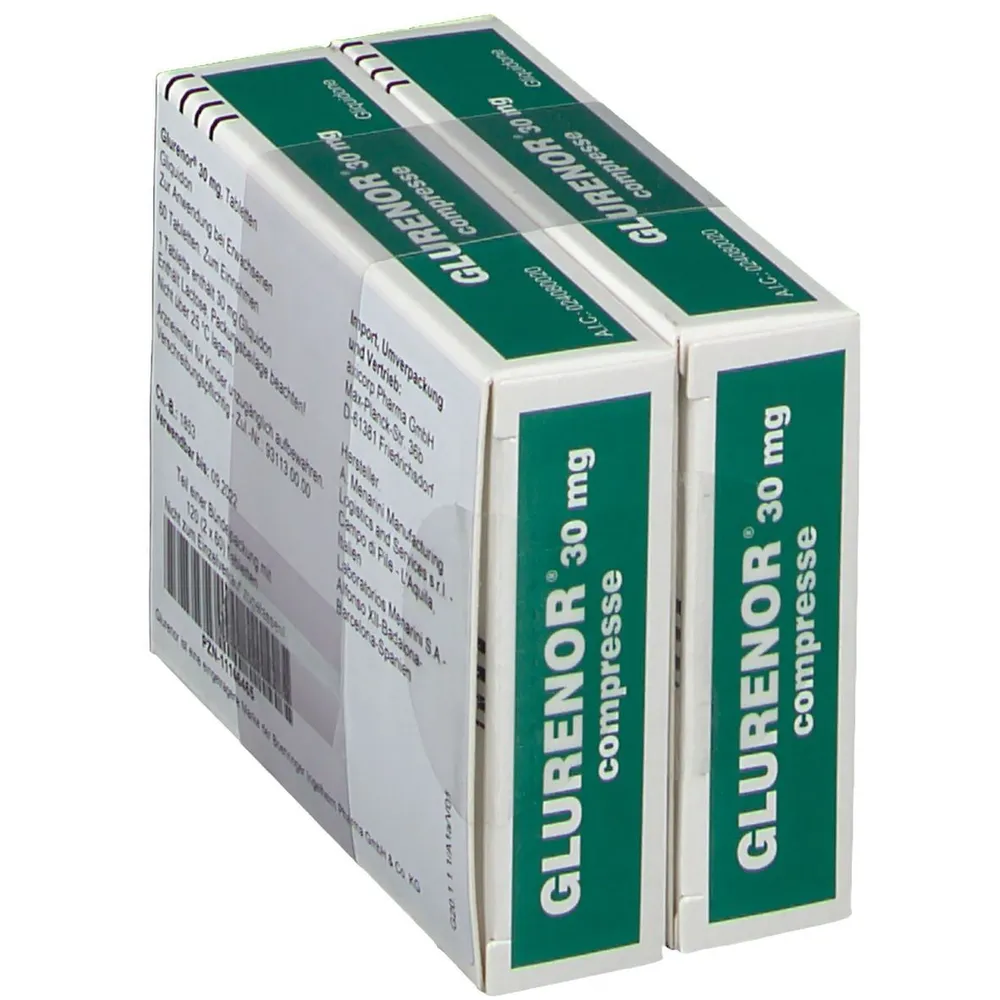
GLURENOR 30 mg tablets
Gliquidone
THERAPEUTIC PHARMACOLOGICAL CATEGORY
Oral hypoglycaemic agent.
THERAPEUTIC INDICATIONS
Treatment of non-insulin-dependent (type II) diabetes mellitus when diet and physical exercise alone are insufficient to achieve adequate glycaemic control.
CONTRAINDICATIONS
Hypersensitivity to the active substance, to sulphonamides in general, or to any of the excipients.
Sulphonylureas are contraindicated in type I (insulin-dependent) diabetes, ketoacidotic diabetes, latent or suspected diabetes, diabetic coma and pre-coma, prediabetic states, during pregnancy and lactation, in cases of severely impaired renal or hepatic function, and in adrenal insufficiency.
PRECAUTIONS FOR USE
The use of oral hypoglycaemic agents of the sulphonylurea group should be restricted to adult patients with symptomatic type II (non-ketogenic) diabetes mellitus not controlled by diet, in whom insulin administration is not indicated.
In case of hypoglycaemic symptoms (see undesirable effects), administer carbohydrates; in more severe cases, which rarely may progress to loss of consciousness, a slow intravenous infusion of glucose solution is required.
In the presence of trauma, surgical procedures, infections or febrile illnesses, temporary insulin therapy may be necessary to maintain adequate metabolic control.
Patients must be instructed to recognise early symptoms of hypoglycaemia (typically headache, irritability and nervous depression, sleep disturbances, tremor, profuse sweating) so that they can promptly inform their physician. The physician must also be informed in case of intercurrent febrile illness or gastrointestinal disturbances.
INTERACTIONS
The hypoglycaemic effect of sulphonylureas may be enhanced by dicoumarol and its derivatives, monoamine oxidase inhibitors, beta-blockers, sulphonamides, phenylbutazone and its derivatives, chloramphenicol, tetracyclines, cyclophosphamide, probenecid, pheniramidol, antituberculosis agents, and salicylates. Conversely, the effect may be reduced by sympathomimetics, chlorpromazine, corticosteroids, oral contraceptives, thyroid hormones, thiazide diuretics, and nicotinic acid preparations.
Caution is also required when administering beta-blockers concomitantly.
In patients treated with sulphonylureas, antabuse-like reactions may occur after ingestion of alcoholic beverages.
Inform your doctor or pharmacist if you are taking or have recently taken any other medicine, including those without a prescription.
SPECIAL WARNINGS
Treatment with sulphonylureas in patients with glucose-6-phosphate dehydrogenase (G6PD) deficiency may lead to haemolytic anaemia.
Gliquidone should therefore be used with caution in such patients, and alternative therapeutic options should be considered.
This medicine contains lactose. If you have been diagnosed with an intolerance to certain sugars, consult your doctor before taking this medicine.
Pregnancy and lactation
Pregnancy
Glurenor is contraindicated during pregnancy. Insulin therapy is required in such cases.
Women planning a pregnancy should inform their doctor.
Ask your doctor or pharmacist for advice before taking any medicine.
Lactation
As there are no data on the passage of gliquidone into breast milk, Glurenor must not be taken by women who are breastfeeding.
Effects on ability to drive and use machines
No studies have been conducted on the ability to drive or use machinery. However, Glurenor may cause hypoglycaemia. Patients should be instructed to recognise the symptoms of hypoglycaemia and should exercise caution while driving or operating machinery.
DOSAGE, METHOD AND TIME OF ADMINISTRATION
Dosage must be individually determined and based on the results of metabolic monitoring performed by the physician.
As a general rule, 1 to 3 tablets daily with main meals, as prescribed by the physician. Doses exceeding 4 tablets (120 mg) per day generally do not provide better therapeutic outcomes.
If you have any doubts about how to use this medicine, consult your doctor or pharmacist.
OVERDOSE
Signs and symptoms
In case of abnormal intake of the drug, a severe hypoglycaemic condition may develop, potentially progressing to coma. Possible symptoms of hypoglycaemia include: headache, intense hunger, nausea, vomiting, fatigue, disturbed sleep, agitation, aggressiveness, impaired concentration, vigilance and reaction time, depression, confusion, speech disturbances, aphasia, visual disturbances, tremor, paresis, sensory disturbances, dizziness, feeling of helplessness, loss of self-control, delirium, cerebral seizures, drowsiness and loss of consciousness up to coma, shallow breathing and bradycardia.
Additionally, signs of adrenergic counter-regulation may occur, such as sweating, moist skin, anxiety, tachycardia, hypertension, palpitations, angina pectoris, and cardiac arrhythmias.
The clinical picture of a severe hypoglycaemic attack may resemble that of a stroke.
Symptoms of hypoglycaemia almost always resolve with correction of the low blood glucose.
Treatment
Therefore, in addition to standard emergency measures, prompt initiation of glucose therapy is necessary, appropriate to restore and maintain normal blood glucose levels.
In case of accidental ingestion of an excessive dose, contact your doctor immediately or go to the nearest hospital.
UNDESIRABLE EFFECTS
Like all medicines, this one may cause undesirable effects, although not everyone experiences them.
Hypoglycaemia
Hypoglycaemic episodes may occur, although rarely, during treatment with sulphonylureas, particularly in debilitated patients, elderly subjects, those undergoing unusual physical exertion, those with irregular eating habits or alcohol consumption, or those with impaired renal and/or hepatic function (see also warnings).
Gastrointestinal tract
Very rarely, gastrointestinal disturbances (such as nausea and epigastric fullness) and headache may occur; these are dose-related and usually resolve with dose reduction – provided this is compatible with maintaining metabolic balance.
Other undesirable effects
Cutaneous allergic reactions have occasionally been reported in patients receiving sulphonylureas.
Very rare and generally reversible haematological system alterations have also been reported.
Following the instructions provided in this leaflet reduces the risk of undesirable effects.
If any of the undesirable effects worsens, or if you notice any undesirable effect not listed in this leaflet, inform your doctor or pharmacist.
EXPIRY DATE AND STORAGE
EXPIRY DATE: see expiry date printed on the packaging.
The expiry date refers to the product stored in its original, unopened packaging under appropriate storage conditions.
Warning: Do not use the medicine after the expiry date stated on the packaging.
Medicines must not be disposed of via wastewater or household waste. Ask your pharmacist how to dispose of medicines no longer in use. This will help protect the environment.
KEEP THE MEDICINE OUT OF THE REACH AND SIGHT OF CHILDREN
COMPOSITION
Each tablet contains:
Gliquidone 30 mg.
Excipients: Lactose, starch, pregelatinized starch, magnesium stearate.
PHARMACEUTICAL FORM AND CONTENT
Box containing 40 tablets
MARKETING AUTHORISATION HOLDER
Laboratori Guidotti S.p.A., Via Livornese, 897 - PISA – La Vettola
Under licence from Boehringer Ingelheim - Florence
BATCH RELEASE RESPONSIBLE PRODUCER
A. Menarini Manufacturing Logistics and Services s.r.l. - Campo di Pile - L'Aquila.
Laboratorios Menarini S.A. - Alfonso XII, 587 - Badalona - Barcelona (Spain)
November 2010