Glucose S.A.L.F.
Italy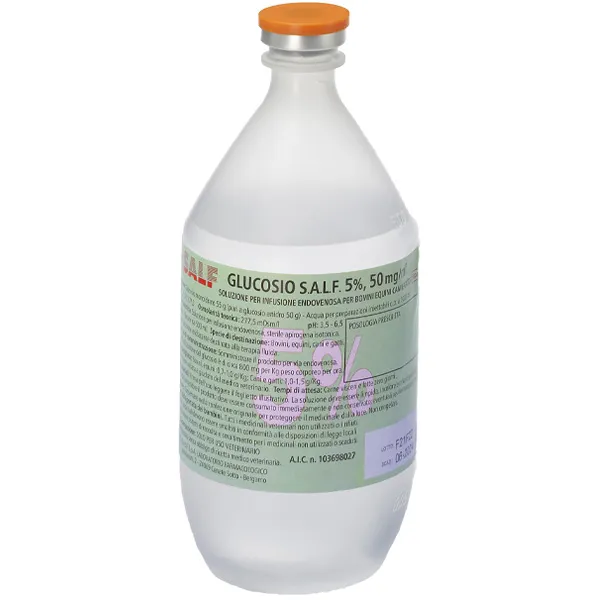
Table of Contents
- Package leaflet: Information for the user
- GLUCOSIO S.A.L.F. 5%, 10%, 20%, 33%, 50% infusion solution
- 1. What GLUCOSIO S.A.L.F. is and what it is used for
- 2. What you need to know before using GLUCOSE S.A.L.F.
- 3. How to use GLUCOSIO S.A.L.F.
- 4. Possible side effects
- 5. How to store GLUCOSIO S.A.L.F.
- 6. Package contents and other information
- The following information is intended exclusively for physicians or healthcare professionals
Package leaflet: Information for the user
GLUCOSIO S.A.L.F. 5%, 10%, 20%, 33%, 50% infusion solution
Glucose monohydrate
Equivalent medicinal product
Please read all of this leaflet carefully before you start using this medicine because it contains important information for you.
- Keep this leaflet. You may need to read it again.
- If you have any questions, ask your doctor, pharmacist, or nurse.
- This medicine has been prescribed for you only. Do not give it to other people, even if their symptoms are the same as yours, as it may be harmful.
- If you experience any adverse reactions, including those not listed in this leaflet, contact your doctor, pharmacist, or nurse. See section 4.
Contents of this leaflet:
- What GLUCOSIO S.A.L.F. is and what it is used for
- What you need to know before using GLUCOSIO S.A.L.F.
- How to use GLUCOSIO S.A.L.F.
- Possible side effects
- How to store GLUCOSIO S.A.L.F.
- Contents of the pack and other information
1. What GLUCOSIO S.A.L.F. is and what it is used for
GLUCOSIO S.A.L.F. is a solution intended for direct intravenous administration (intravenous infusion) containing the active substance glucose, belonging to the class of parenteral nutritional solutions.
This medicinal product is indicated to provide water and sugars to the body, suitable to supply caloric intake, particularly in patients who do not require salts or in cases where salts should be avoided, and for the treatment of low blood sugar levels (hypoglycemia).
2. What you need to know before using GLUCOSE S.A.L.F.
Do not use GLUCOSE S.A.L.F.
- if you are allergic to glucose or to any of the other ingredients of this medicine (listed in section 6);
- if you have problems with urination (anuria);
- if you have bleeding (haemorrhage) occurring at the spinal level or within the skull with bleeding into brain tissue (intracranial haemorrhage);
- if you suffer from hallucinations, tremor, and sweating (delirium tremens) caused by excessive loss of body water (dehydration);
- if you have severely low levels of fluids in the body (severe dehydration);
- if you suffer from liver problems leading to loss of consciousness (hepatic coma). Glucose solutions must not be administered through the same infusion catheter as whole blood due to the possible risk of red blood cell clumping (pseudoagglutination) or red blood cell breakdown (haemolysis).
Warnings and precautions
Talk to your doctor, pharmacist, or nurse before using GLUCOSE S.A.L.F.
Use this medicine with caution and inform your doctor in the following cases:
- if you have diabetes or are glucose intolerant. During infusion, blood sugar levels (glycaemia) and sugar in urine (glycosuria) should be closely monitored to minimize the risk of high levels; if necessary, insulin will be administered;
- if you suffer from severe heart problems (heart failure);
- if you suffer from severe kidney problems (severe renal failure);
- if you have swelling caused by fluid accumulation and salt retention (oedema with hydro-saline retention);
- if you are taking corticosteroid anti-inflammatory medicines;
- if you are taking certain hormonal medicines (corticotrophin);
- if you are elderly;
- if you are in any of the following conditions that may cause high levels of vasopressin, a hormone that regulates your body fluids:
- you have a serious acute illness
- you have pain
- you have recently undergone surgery
- you have infections or burns
- you have brain disorders
- you have liver, heart, or kidney diseases
- you are taking certain medicines (see also Other medicines and Glucose S.A.L.F.).
This may increase the risk of low sodium levels in the blood (hyponatraemia) and may lead to headache, nausea, seizures, lethargy, vomiting, and cerebral oedema. Cerebral oedema increases the risk of dangerous brain damage. People at higher risk of cerebral oedema include:
- children
- women (especially those of childbearing age)
- individuals with altered fluid levels in the brain (e.g. due to meningitis, intracranial bleeding, or cerebral contusion).
During prolonged treatment with this medicine, excess body water (fluid overload and congestive state) and excessive loss of minerals such as potassium and phosphate (electrolyte deficiency) may occur. Your doctor should periodically monitor the concentration of minerals (electrolytes), including sodium (as hyponatraemia may develop), especially in patients with non-osmotic vasopressin release and in patients receiving concomitant therapy with vasopressin agonists, correcting any excessive losses with administration of minerals and vitamins as needed.
Concentrated glucose solutions must NOT be administered by subcutaneous injection (subcutaneous route) or by intramuscular injection (intramuscular route).
Children
In children, particularly in neonates and low-birth-weight infants, administration of glucose may increase the risk of elevated blood glucose levels (hyperglycaemia). Furthermore, in low-birth-weight children, rapid or excessive infusion may cause increased blood osmolarity and bleeding within brain tissue due to rupture of a blood vessel (intracerebral haemorrhage).
Other medicines and GLUCOSE S.A.L.F.
Inform your doctor or pharmacist if you are using, have recently used, or might use any other medicines.
GLUCOSE S.A.L.F. should be administered with caution if you are taking the following medicines:
- corticosteroids (steroidal anti-inflammatory agents) or hormonal medicines (corticotrophin), as they may increase your blood sugar levels, potentially unmasking latent diabetes mellitus;
- medicines that enhance the effect of vasopressin, e.g. chlorpropamide, clofibrate, carbamazepine, oxcarbazepine, vincristine, selective serotonin reuptake inhibitors, 3,4-methylenedioxy-N-methamphetamine, ifosfamide, antipsychotics, narcotics, NSAIDs, cyclophosphamide, desmopressin, oxytocin, vasopressin, terlipressin, diuretics in general, as they may increase the risk of reduced sodium concentration in plasma (hyponatraemia). If you need to take these medicines, medical monitoring during treatment is required. Glucose solutions may be incompatible with other infusion solutions.
Pregnancy and breastfeeding
If you are pregnant, think you may be pregnant, planning to become pregnant, or breastfeeding, consult your doctor or pharmacist before this medicine is administered to you.
Do not use this medicine during pregnancy unless absolutely necessary and always under strict medical supervision.
There are no available data on the effects of this medicine during breastfeeding; therefore, exercise particular caution if you are breastfeeding.
If you are pregnant, this medicine should be administered with particular caution during labour due to the risk of hyponatraemia, especially if administered in combination with a medicine inducing labour (oxytocin).
Driving and using machines
There are no available data regarding the effects of this medicine on driving or using machines.
3. How to use GLUCOSIO S.A.L.F.
This medicine will be administered to you by a doctor or other trained medical personnel. If you have any doubts, consult your doctor, pharmacist, or nurse.
This medicine will be administered carefully directly into a vein (intravenous infusion) at a closely controlled infusion rate. Concentrated glucose solutions MUST NOT BE ADMINISTERED by injection under the skin (subcutaneous route) or into the muscle (intramuscular route), but exclusively by intravenous route.
The usual infusion rate is 0.4 – 0.8 g/hour per kg of body weight.
The doctor will select the appropriate glucose solution concentration based on your age, weight, health condition, and blood electrolyte and pH levels.
Below are general guidelines for selecting different glucose concentrations:
- 5% – 10% solutions are used for fluid and caloric replacement;
- 20% – 33% solutions are used for caloric replacement with limited fluid replacement;
- 50% solutions are used for the treatment of low blood glucose levels (hypoglycemia) due to excessive insulin production (hyperinsulinemia) or other causes.
Use in children and adolescents
In children with low body weight, this medicine must be administered carefully and at a controlled rate (see section “Children”). Dosage and infusion rate must be adjusted according to the patient's age, weight, and clinical condition. Generally, solutions with concentrations higher than 10% are not used.
All standard precautions to maintain sterility before and during intravenous infusion should be observed. Do not use if the packaging is damaged. Do not use the glucose solution if it is not clear and colourless or slightly yellowish, or if it contains particles.
If you use more GLUCOSIO S.A.L.F. than you should
Since this medicine is administered by a doctor or trained medical personnel, it is unlikely that you will receive an excessive dose. However, if you think you have been given too much GLUCOSIO S.A.L.F., inform your doctor immediately or go to the nearest hospital.
In case of accidental administration of excessive doses of GLUCOSIO S.A.L.F., an increase in water and solute concentration in the body (overhydration and solute overload) may occur. In such cases, the doctor or nurse must immediately stop administering the medicine and initiate corrective therapy.
If you stop treatment with GLUCOSIO S.A.L.F.
If the infusion of concentrated glucose needs to be suddenly stopped, it is recommended to gradually reduce the dose by administering 5% or 10% glucose, in order to avoid a rapid drop in blood sugar (rebound hypoglycemia).
If you have any questions about how to use this medicine, consult your doctor, pharmacist, or nurse.
4. Possible side effects
Like all medicines, this medicine can cause side effects, although not everybody gets them.
The following side effects may occur:
Not known (frequency cannot be estimated from the available data):
- leakage of medicine into the surrounding tissues at the injection site (extravasation);
- infection at the infusion site and local pain;
- circulatory problems due to blood clot formation and inflammation of the veins at the infusion site (thrombosis and thrombophlebitis);
- increased body temperature (fever);
- excess fluid in the body (hyperhydration);
- decrease in sodium (hyponatremia)**, potassium (hypokalemia), magnesium (hypomagnesemia), and phosphate (hypophosphatemia);
- increased metabolic rate;
- increased blood sugar (hyperglycemia);
- increased blood osmotic pressure (hyperosmolarity);
- increased blood volume in the body (hypervolemia);
- decreased blood sugar (hypoglycemia);
- increased insulin levels;
- increased adrenaline levels;
- fluid retention with swelling in the legs and ankles (peripheral edema);
- fluid accumulation in the lungs (pulmonary edema);
- bleeding in the brain (cerebral hemorrhage);
- brain damage due to poor cerebral blood circulation (cerebral ischemia) or fluid accumulation (cerebral edema).
**(hospital-acquired hyponatremia, which may cause irreversible brain damage and death due to the development of acute hyponatremic encephalopathy).
Reporting of side effects
If you experience any side effect, including those not listed in this leaflet, please inform your doctor, pharmacist, or nurse. You can also report side effects directly via the national reporting system at http://www.agenziafarmaco.gov.it/content/come-segnalare-una-sospetta-reazione-avversa. By reporting side effects, you can help provide more information on the safety of this medicine.
5. How to store GLUCOSIO S.A.L.F.
Keep this medicine out of the sight and reach of children.
Do not use this medicine after the expiry date which is stated on the packaging after "Exp".
The expiry date refers to the last day of that month.
Store in the original packaging. Do not refrigerate.
After the first opening of the container, the medicine must be used immediately for a single and uninterrupted administration; any remaining solution must be discarded.
Do not administer if the solution is not clear, colourless, or slightly straw-yellow, or if it contains particles.
Do not dispose of medicines via wastewater or household waste. Ask your pharmacist how to dispose of medicines you no longer use. This will help protect the environment.
6. Package contents and other information
What GLUCOSIO S.A.L.F. contains
GLUCOSIO S.A.L.F. 5% solution for infusion
- The active substance is glucose monohydrate. Each litre of solution contains 55 g of glucose monohydrate (50 g of anhydrous glucose) (278 mOsmol/L, pH 3.5 - 6.5).
- The other component is water for injections.
GLUCOSIO S.A.L.F. 10% solution for infusion
- The active substance is glucose monohydrate. Each litre of solution contains 110 g of glucose monohydrate (100 g of anhydrous glucose) (555 mOsmol/L, pH 3.5 - 6.5).
- The other component is water for injections.
GLUCOSIO S.A.L.F. 20% solution for infusion
- The active substance is glucose monohydrate. Each litre of solution contains 220 g of glucose monohydrate (200 g of anhydrous glucose) (1110 mOsmol/L, pH 3.5 - 6.5).
- The other component is water for injections.
GLUCOSIO S.A.L.F. 33% solution for infusion
- The active substance is glucose. Each litre of solution contains 363 g of glucose monohydrate (330 g of anhydrous glucose) (1832 mOsmol/L, pH 3.5 - 6.5).
- The other component is water for injections.
GLUCOSIO S.A.L.F. 50% solution for infusion
- The active substance is glucose. Each litre of solution contains 550 g of glucose monohydrate (500 g of anhydrous glucose) (2775 mOsmol/L, pH 3.5 - 6.5).
- The other component is water for injections.
Description of the appearance of GLUCOSIO S.A.L.F. and contents of the pack
GLUCOSIO S.A.L.F. 5%
Glass vials of 50, 100, 250 and 500 ml
PP vials of 100, 250 and 500 ml
PVC bags of 100, 250, 500, 1000, 2000 ml
PVC-free bags: 20 bags of 100 ml, 20 bags of 250 ml, 15 bags of 500 ml, 10 bags of 1000 ml, 5 bags of 2000 ml
GLUCOSIO S.A.L.F. 10%
Glass vials of 50, 100, 250 and 500 ml
GLUCOSIO S.A.L.F. 20%
Glass vials of 500 ml
GLUCOSIO S.A.L.F. 33%
Glass vials of 100, 250 and 500 ml
PVC bags of 3000, 5000 ml
GLUCOSIO S.A.L.F. 50%
Glass vials of 100, 250 and 500 ml
PVC bags of 5000 ml
Marketing Authorization Holder
S.A.L.F. S.p.A. Laboratorio Farmacologico – via Marconi, 2 – 24069 Cenate Sotto (BG) – Italy.
Manufacturers
S.A.L.F. S.p.A. Laboratorio Farmacologico – via Marconi, 2 – 24069 Cenate Sotto (BG) – Italy.
BIEFFE MEDITAL S.p.A. – via Nuova Provinciale – 23034 Grosotto (SO) – Italy.
The following information is intended exclusively for physicians or healthcare professionals
CLINICAL INFORMATION
Glucose solutions are administered intravenously.
The 5% solution is isotonic with blood.
The 10%, 20%, 33%, and 50% solutions are hypertonic with blood and must be infused cautiously and at a controlled infusion rate.
The 20%, 33%, and 50% solutions must be administered exclusively via central venous catheter.
If peripheral administration is necessary, for example in emergency treatment of hypoglycemic crises, the solutions must be injected very slowly into a large-caliber vein of the arm.
One gram of glucose provides a caloric contribution of 3.74 kcal (approximately 15.6 kJoule).
Monitoring of electrolyte balance, serum glucose, serum sodium, and other electrolytes may be required before and during administration, particularly in patients with non-osmotic vasopressin release (syndrome of inappropriate antidiuretic hormone secretion, SIADH) and in patients receiving concomitant therapy with vasopressin agonists, due to the risk of hyponatremia. Monitoring of serum sodium is particularly important for physiologically hypotonic solutions.
Depending on the tonicity of the solution, volume and frequency of infusion, underlying clinical conditions of the patient, and the patient's ability to metabolize glucose, intravenous administration of glucose may cause electrolyte disturbances, especially hypo- or hyperosmolar hyponatremia.
Hyponatremia:
Patients with non-osmotic vasopressin release (e.g., in the acute phase of illness, pain, postoperative stress, infections, burns, and central nervous system disorders), patients with cardiac, hepatic, or renal diseases, and patients treated with vasopressin agonists are particularly at risk of acute hyponatremia following infusion of hypotonic solutions.
Acute hyponatremia may cause acute hyponatremic encephalopathy (cerebral edema), characterized by headache, nausea, seizures, lethargy, and vomiting. Patients with cerebral edema are at particular risk of severe, irreversible, and life-threatening brain injury.
Children, women of childbearing age, and patients with reduced cerebral compliance (e.g., meningitis, intracranial hemorrhage, and cerebral contusion) are particularly at risk of severe, life-threatening cerebral edema caused by acute hyponatremia.
Pregnancy:
This medicinal product must be administered with particular caution when oxytocin or other labor-inducing agents are used, due to the risk of hyponatremia.
Incompatibilities
Intravenous glucose solutions are incompatible with:
- cyanocobalamin;
- kanamycin sulfate;
- sodium novobiote;
- sodium warfarin.
Furthermore, there are conflicting opinions regarding the compatibility of glucose with the following solutions:
- calcium chloride;
- magnesium chloride;
- potassium chloride;
- sodium chloride;
- sodium lactate;
- hetastarch.
Glucose solutions without added electrolytes should not be administered through the same infusion catheter as whole blood, due to the possible formation of aggregates and the risk of hemolysis.
Ampicillin and amoxicillin remain stable in glucose solutions only for a short period.
For further information, consult the Summary of Product Characteristics.