Glucobay
Italy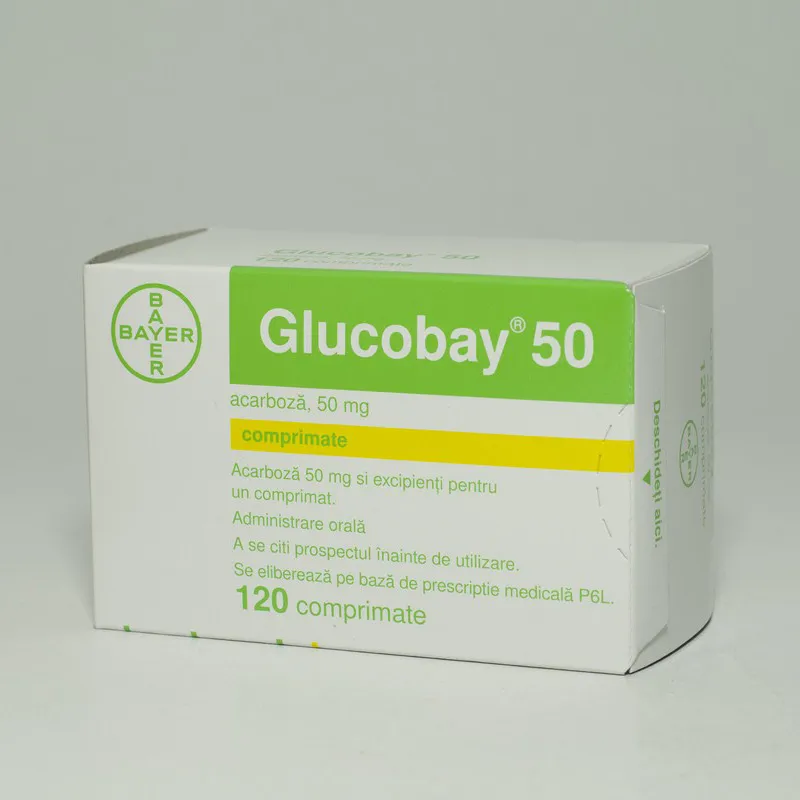
Table of Contents
Package leaflet: Information for the user
Glucobay 50 mg tablets, 100 mg tablets
Acarbose
Please read this leaflet carefully before taking this medicine because it contains
important information for you.
- Keep this leaflet. You may need to read it again.
- If you have any questions, consult your doctor or pharmacist.
- This medicine has been prescribed for you only. Do not give it to others, even if their symptoms are the same as yours, as it could be harmful.
- If you experience any side effects, including those not listed in this leaflet, consult your doctor or pharmacist. See section 4.
Contents of this leaflet:
- What Glucobay is and what it is used for
- What you need to know before taking Glucobay
- How to take Glucobay
- Possible side effects
- How to store Glucobay
- Contents of the pack and other information
1. What Glucobay is and what it is used for
Glucobay contains the active substance acarbose, which belongs to a group of medicines known as oral hypoglycaemic agents.
Glucobay is a medicine used in the treatment of:
- Non-insulin-dependent diabetes mellitus in patients treated with diet alone or with diet in combination with oral hypoglycaemic agents.
- Insulin-dependent diabetes mellitus in patients receiving insulin therapy and dietary treatment.
2. What you need to know before taking Glucobay
Do not take Glucobay:
- if you are allergic to acarbose or to any of the other ingredients of this medicine (listed in section 6);
- if you are pregnant or breastfeeding (see 'Pregnancy and breastfeeding');
- if you suffer from chronic enteropathies (intestinal inflammation or ulceration, intestinal obstruction or partial obstruction, or predisposition to intestinal obstruction), with or without digestive and absorptive disorders (e.g. gluten-related diseases);
- if you are under 18 years of age;
- if you suffer from conditions that may be worsened by increased intestinal gas production, such as Roemheld syndrome, large hernias, intestinal obstructions or ulcerations;
- if you have undergone gastrectomy (surgical removal of part or all of the stomach);
- if you have severe kidney problems (severe renal impairment [creatinine clearance < 25 ml/min]);
- if you have severe liver problems (severe hepatic dysfunction, e.g. hepatic cirrhosis).
Warnings and precautions
Talk to your doctor or pharmacist before taking Glucobay.
It is essential to follow your dietary regimen, even while taking Glucobay. Failure to adhere to your diet increases the risk of adverse effects (see section 4).
Do not stop treatment with Glucobay without first consulting your doctor, as blood glucose levels (blood sugar levels) may rise upon discontinuation of treatment.
Glucobay has an anti-hyperglycaemic effect but does not, by itself, cause hypoglycaemia (excessively low blood sugar) in patients following diet alone.
If Glucobay is prescribed in addition to other hypoglycaemic medicines (e.g. sulphonylureas, metformin or insulin), a drop in blood glucose levels may require adjustment of the dose of these medicines. If acute hypoglycaemia occurs, your doctor will prescribe glucose to rapidly correct the hypoglycaemic state.
Cases of fulminant hepatitis have been reported during treatment with Glucobay. Your doctor will monitor your liver enzyme levels (proteins found in the liver) during the first 6–12 months of treatment, and if an increase is observed, may reduce the dose of Glucobay or discontinue treatment (see section 4).
Treatment with Glucobay should be recorded in the patient's diabetes certification document.
Children and adolescents
The safety and efficacy of acarbose in patients under 18 years of age have not been established.
Other medicines and Glucobay
Tell your doctor or pharmacist if you are taking, have recently taken, or might take any other medicines, including those without a prescription.
It is important to inform your doctor if you are taking:
- other antidiabetic medicines (sulphonylureas, metformin or insulin). In patients treated simultaneously with Glucobay and these medicines, blood glucose levels may fall to hypoglycaemic levels, and therefore dose adjustment of these medicines may be necessary. Glucobay has an anti-hyperglycaemic effect but does not cause hypoglycaemia by itself. Isolated cases of hypoglycaemic shock have been reported.
- digoxin (a medicine used to increase the force and rate of heart contractions). In isolated cases, Glucobay may affect the bioavailability of digoxin, requiring dose adjustment.
- cholestyramine (a medicine used to treat high cholesterol), intestinal adsorbents (substances used in symptomatic treatment of diarrhoea that adsorb water in the intestine and thereby firm stools), or digestive enzymes (medicines used to aid digestion). You should not take these medicines at the same time as Glucobay, as they may interfere with Glucobay's action.
- neomycin (an antibiotic used to treat infections). Concomitant administration of Glucobay and oral neomycin may lead to greater reduction in postprandial blood glucose (sugar levels after meals) and an increased risk of gastrointestinal adverse effects. In such cases, your doctor may decide to temporarily reduce your Glucobay dose.
- no interaction has been observed with dimethicone or simethicone (medicines used for intestinal disorders such as meteorism, i.e. excessive accumulation of air in the abdomen).
- medicines of the fluoroquinolone class (antibiotics used to treat infections). Concomitant administration of these medicines with Glucobay may alter glucose levels and increase the risk of hypoglycaemia (excessively low blood sugar) or hyperglycaemia (excessively high blood sugar).
Glucobay with food and drink
Consuming sucrose (sugar) and foods containing sugar during treatment with Glucobay often causes gastrointestinal disturbances or even diarrhoea due to increased fermentation of carbohydrates in the colon.
Pregnancy and breastfeeding
If you are pregnant, think you may be pregnant, are planning a pregnancy, or are breastfeeding, consult your doctor or pharmacist before taking this medicine.
Glucobay is contraindicated during pregnancy and breastfeeding.
Pregnancy
Glucobay should not be used during pregnancy, as there are no clinical data on the use of acarbose in pregnant women.
Breastfeeding
There are no available human data; however, since a risk to infants cannot be excluded, Glucobay is not recommended during breastfeeding.
Driving and using machines
No data are available regarding impairment of the ability to drive vehicles or operate machinery during treatment with Glucobay.
3. How to take Glucobay
Take this medicine exactly as directed by your doctor or pharmacist. If you have any doubts, consult your doctor or pharmacist.
Your doctor will determine the appropriate dosage for your individual case, as the effectiveness and tolerability of the medicine vary from patient to patient.
Unless otherwise prescribed by your doctor, the recommended dose for an adult is:
- 1 tablet of 50 mg (or half a tablet of 100 mg) 3 times daily at the beginning of treatment;
- 2 tablets of 50 mg or 1 tablet of 100 mg 3 times daily for maintenance therapy; if necessary, this may be increased to 2 tablets 3 times daily. If your condition does not improve within 4–8 weeks after starting treatment, your doctor may increase your dose.
Inform your doctor if you experience any adverse effects, even if you are strictly following the prescribed diet. In such cases, your doctor may reduce your dose of Glucobay.
On average, the effective dose for an adult is 100 mg of Glucobay taken 3 times daily.
If you are taking 200 mg of Glucobay 3 times daily, your doctor must monitor your condition very closely.
Instructions for use
Swallow the Glucobay tablet with a small amount of liquid, or chew and swallow the tablet together with the first bites of food. In either case, take the tablet at the beginning of the meal.
Recommended monitoring during treatment
Your doctor will check your liver enzyme levels during the first 6–12 months of treatment.
In isolated cases, an increase in liver enzymes without symptoms may occur.
In documented cases, these effects disappeared after discontinuation of Glucobay therapy.
Use in the elderly
Dosage adjustments based on patient age are not necessary.
Use in children and adolescents
Since sufficient data on the efficacy and tolerability of the medicine in children and adolescents are not available, Glucobay must not be administered to patients under 18 years of age.
Use in patients with impaired liver function (liver)
Dosage adjustments are not required in patients with pre-existing mild or moderate liver impairment (for patients with severe liver impairment, see section “Do not take Glucobay”).
Use in patients with impaired kidney function (kidneys)
Glucobay must not be used in patients with severe renal impairment (creatinine clearance < 25 ml/min).
Duration of treatment
Glucobay may be taken without any time restrictions.
If you take more Glucobay than you should
If an overdose of Glucobay is taken together with foods or drinks containing carbohydrates (sugar, bread, rice, pasta, etc.), it may cause bloating, flatulence (intestinal gas), and diarrhoea.
However, if an overdose of Glucobay is taken without concomitant food intake, significant intestinal symptoms are not expected.
In case of overdose, do not consume any foods or drinks containing carbohydrates for the next 4–6 hours after taking the medicine.
In the event of accidental ingestion of an excessive dose of Glucobay, contact your doctor immediately or go to the nearest hospital.
If you have any further questions about the use of this medicine, consult your doctor or pharmacist.
4. Possible side effects
Like all medicines, this medicine can cause side effects, although not everybody gets them.
Within each frequency class, side effects are listed in order of decreasing severity. Frequencies are defined as follows:
Very common (may affect more than 1 in 10 people)
- gas in the intestine (flatulence)
Common (may affect up to 1 in 10 people)
- diarrhoea and gastrointestinal and abdominal pain.
Uncommon (may affect up to 1 in 100 people)
- nausea, vomiting and indigestion (dyspepsia);
- increased liver enzymes.
Rare (may affect up to 1 in 1,000 people)
- fluid retention in tissues causing swelling (oedema);
- yellowing of the skin and whites of the eyes (jaundice).
Not known (frequency cannot be estimated from the available data)
- abnormally low platelet count in the blood (thrombocytopenia);
- hypersensitivity reactions (drug-induced hypersensitivity) such as rash, erythema (reddening of the skin), exanthema (skin rash) and urticaria;
-
- partial or complete blockage of the intestine causing pain and vomiting (subileus/ileus) and intestinal pneumatosis cystoides (characterized by the presence of gas-filled cysts within the intestinal wall);
- severe liver impairment (hepatitis);
- red skin rash with small blisters filled with white/yellow fluid (generalized acute exanthematous pustulosis);
- cases of liver abnormalities, abnormal liver function and liver damage have been reported;
- individual cases of fulminant hepatitis with fatal outcome, particularly in Japan.
Failure to follow the prescribed diabetic diet may increase the intensity of gastrointestinal side effects (flatulence, diarrhoea and gastrointestinal and abdominal pain, nausea, vomiting and dyspepsia). If these occur despite proper adherence to the diet, inform your doctor, who will likely consider temporarily or permanently reducing the dose of Glucobay you are taking.
In patients treated with the recommended dose of 150–300 mg/day of Glucobay, clinically relevant abnormalities in liver function tests (three times above the upper limit of normal) have rarely been observed. During treatment with Glucobay, temporary abnormal test results may occur (see section “Warnings and precautions”).
Following the instructions provided in this leaflet reduces the risk of side effects.
Reporting of side effects
If you experience any side effect, including those not listed in this leaflet, talk to your doctor or pharmacist. You can also report side effects directly via the national reporting system at the website
www.agenziafarmaco.gov.it/it/responsabili. By reporting side effects, you can help provide more information on the safety of this medicine.
5. How to store Glucobay
Keep this medicine out of the sight and reach of children.
Do not use this medicine after the expiry date stated on the outer packaging after EXP. The expiry date refers to the last day of that month. The stated expiry date applies to the product stored in its original, unopened packaging and kept under the recommended storage conditions.
Store in the original packaging, at a temperature not exceeding 30°C. Protect from moisture.
Do not dispose of any medicine via wastewater or household waste. Ask your pharmacist how to dispose of medicines you no longer use. This will help protect the environment.
6. Package contents and other information
What Glucobay contains
- The active substance is acarbose. Each tablet contains 50 mg or 100 mg of acarbose.
- The other components are: maize starch, microcrystalline cellulose, magnesium stearate, anhydrous colloidal silicon dioxide.
Description of the appearance of Glucobay and contents of the pack
40 tablets of 50 mg
40 tablets of 100 mg
Marketing Authorization Holder and Manufacturer
Marketing Authorization Holder
Bayer S.p.A., Viale Certosa 130 – Milan
Manufacturer responsible for batch release
Bayer HealthCare Manufacturing S.r.l., via delle Groane 126, Garbagnate Milanese (MI)