Givlaari
Italy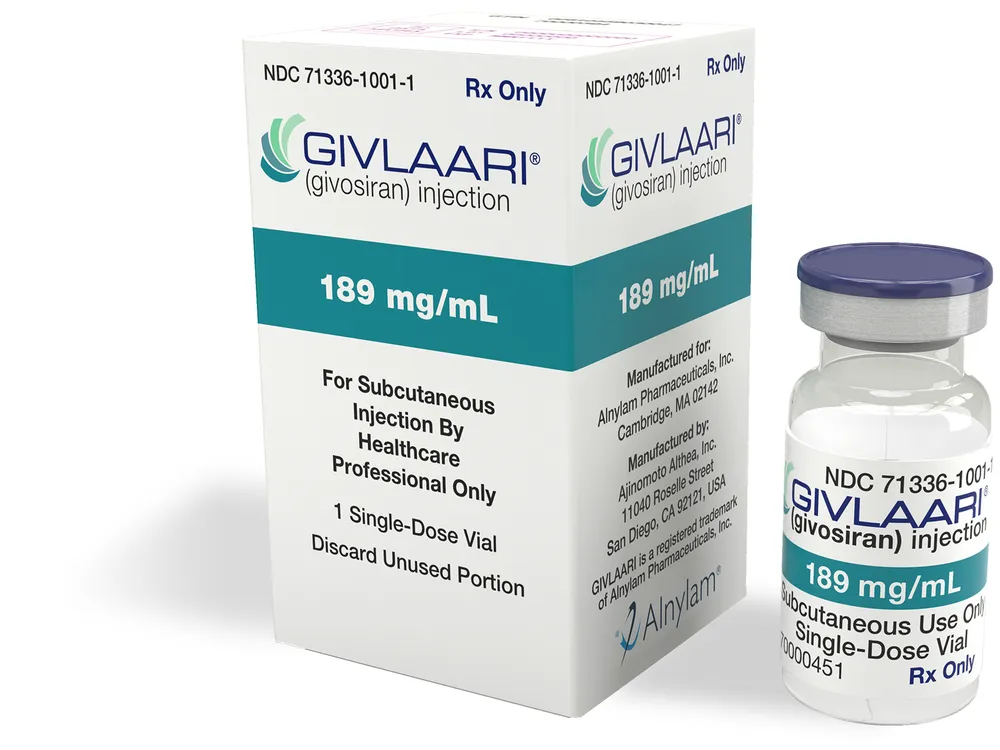
Table of Contents
- Package leaflet: Information for the user
- Givlaari 189 mg/mL solution for injection
- 1. What Givlaari is and what it is used for
- 2. What you need to know before receiving Givlaari
- 3. How Givlaari is administered
- 4. Possible side effects
- 5. How to store Givlaari
- 6. Package Contents and Other Information
Package leaflet: Information for the user
Givlaari 189 mg/mL solution for injection
givosiran
Please read all of this leaflet carefully before you are given this medicine because it contains
important information for you.
- Keep this leaflet. You may need to read it again.
- If you have any questions, ask your doctor or nurse.
- If you get any side effects, talk to your doctor or nurse. This includes any side effects not listed in this leaflet. See section 4.
Contents of this leaflet
- What Givlaari is and what it is used for
- What you need to know before you are given Givlaari
- How Givlaari is given
- Possible side effects
- How to store Givlaari
- Contents of the pack and other information
1. What Givlaari is and what it is used for
What Givlaari is
Givlaari contains the active substance givosiran.
What Givlaari is used for
Givlaari is used for the treatment of acute hepatic porphyria in adults and adolescents aged 12 years and older.
What is acute hepatic porphyria
Acute hepatic porphyria is a rare disease that is inherited within families. It is caused by a defect in one of the proteins involved in forming a molecule in the liver called haem. Because there is a problem in one of the proteins required to produce haem, certain substances that are used to make haem—namely aminolevulinic acid (ALA) and porphobilinogen (PBG)—accumulate. Excess amounts of ALA and PBG can damage nerves and cause severe painful attacks, nausea, muscle weakness, and changes in mental function. Some people with acute hepatic porphyria may also experience symptoms such as pain and nausea between attacks. Long-term complications that may occur in individuals with acute hepatic porphyria include high blood pressure, and chronic kidney and liver disease.
How Givlaari works
This medicine works by reducing the amount of an enzyme called ALAS1, which regulates the production of ALA and PBG in the liver. By lowering ALAS1 levels, the liver produces less ALA and PBG. This mechanism may help reduce the effects of this disease.
2. What you need to know before receiving Givlaari
Do not use Givlaari
- if you have had a severe allergic reaction to givosiran or to any of the other ingredients of this medicine (listed in section 6).
Warnings and precautions
Talk to your doctor or nurse before you are given Givlaari.
Severe allergic reaction
- Inform your doctor or nurse immediately if you experience signs of a severe allergic reaction. The signs are listed in section 4 “Serious side effects”.
- If you experience a severe allergic reaction, your doctor or nurse will immediately stop using this medicine and you may need to take other medicines to control your symptoms.
Liver problems
This medicine may affect the liver. You will have blood tests to check liver function before starting treatment with Givlaari and periodically during treatment. If blood tests show abnormal results, your doctor or nurse will decide whether to suspend or permanently stop treatment. Abnormal test results have been observed in some patients treated with this medicine, mainly after 3–5 months of starting treatment.
Kidney problems
This medicine may affect the kidneys, especially if you already have been diagnosed with kidney problems. During treatment with this medicine, your doctor will monitor how well your kidneys are working, particularly if you already have kidney problems.
Tests for homocysteine levels
While taking this medicine, blood tests may show an increase in homocysteine, a type of amino acid, compared to levels before starting treatment. Your doctor will check your homocysteine levels in the blood before and during treatment. If your homocysteine levels are high, your doctor may prescribe treatment to reduce homocysteine levels.
Children
This medicine must not be used in children under 12 years of age, as there is no experience with use of the medicine in this age group.
Other medicines and Givlaari
Tell your doctor or pharmacist if you are taking, have recently taken, or might take any other medicines.
When certain medicines are used together, this medicine may prolong or intensify their effects or alter their side effects.
Pregnancy
If you are pregnant, think you might be pregnant or are planning to become pregnant, ask your doctor or nurse for advice before using this medicine.
Breast-feeding
Animal studies suggest that this medicine may pass into breast milk. If you are breast-feeding, ask your doctor for advice before using this medicine. Your doctor will help you decide whether to stop breast-feeding or stop treatment with Givlaari, taking into account the benefits of breast-feeding for your child and the benefits of treatment for you.
Driving and using machines
It is unlikely that this medicine will affect your ability to drive or operate machinery.
Givlaari contains sodium
This medicine contains less than 1 mmol (23 mg) of sodium per mL, i.e. essentially ‘sodium-free’.
3. How Givlaari is administered
How much Givlaari is administered
Your doctor will determine the amount of medicine to administer based on your body weight.
- The recommended dose is 2.5 milligrams per kilogram of body weight.
- This medicine will be administered once a month (every 4 weeks).
- If blood tests show liver problems, your doctor may suspend or permanently discontinue treatment with Givlaari. Your doctor may consider restarting treatment at a lower dose.
How Givlaari is administered
This medicine will be administered to you once a month by your doctor or nurse. It is given as a subcutaneous injection (under the skin) in the abdominal area (abdomen), or in some cases, in the upper arm or thigh. Injection sites will be rotated. If the dose is greater than 1 mL, more than one vial will be required and multiple subcutaneous injections may be necessary.
If you are given more Givlaari than you should
In the unlikely event that your doctor or nurse administers more than the prescribed amount (overdose), you will be monitored for the possible occurrence of adverse effects.
If you miss your appointment for Givlaari administration
If you miss your injection appointment, contact your doctor or nurse as soon as possible.
If you have any questions about the use of this medicine, consult your doctor or nurse.
4. Possible side effects
Like all medicines, this medicine can cause side effects, although not everybody gets them.
Serious side effects
Severe allergic reactions (uncommon: may affect up to 1 in 100 people)
Immediately inform your doctor or nurse if you experience any of the following signs of a severe allergic reaction (anaphylactic reaction), as the injection will need to be stopped and you may require other medicines to treat the reaction:
- swelling, mainly of the lips, tongue or throat, which may make swallowing or breathing difficult;
- breathing problems or wheezing;
- feeling dizzy or fainting;
- skin rash, hives;
- itching.
Other side effects
Inform your doctor or nurse if you experience any of the following side effects:
Very common: may affect more than 1 in 10 people
- nausea
- blood tests showing increased transaminase levels, which are liver enzymes (a sign of possible liver inflammation)
- skin rashes, including red, itchy or dry skin, eczema or hives
- blood tests showing increased creatinine levels—a substance eliminated from the body by the kidneys—or decreased glomerular filtration rate (signs of possible kidney problems)
- redness, pain, itching or swelling at the injection site (injection site reaction)
- feeling tired
Common: may affect up to 1 in 10 people
- a type of allergic reaction (hypersensitivity), with symptoms such as hives, skin rash, swelling of the eyes, mouth or face, breathing difficulties, itching
- inflammation of the pancreas (pancreatitis)
- blood test showing increased homocysteine (a type of amino acid)
Reporting of side effects
If you get any side effect, including those not listed in this leaflet, talk to your doctor or nurse. You can also report side effects directly via the national reporting system referred to in Annex V. By reporting side effects, you can help provide more information on the safety of this medicine.
5. How to store Givlaari
Keep this medicine out of the sight and reach of children.
Do not use this medicine after the expiry date stated on the carton and vial after
Exp. The expiry date refers to the last day of that month.
This medicine is for single use only. Once the product has been opened, it must be
used immediately.
Do not store above 25°C.
Keep the vial in the outer packaging to protect the medicine from light.
Do not dispose of any medicine via wastewater or household waste. Ask your pharmacist how to
dispose of medicines no longer in use. This will help protect the environment.
6. Package Contents and Other Information
What Givlaari Contains
- The active substance is givosiran.
- Each mL of solution contains givosiran sodium equivalent to 189 mg of givosiran.
- The other components are sodium hydroxide, phosphoric acid, and water for injections. See section 2, “Givlaari contains sodium”.
Description of the Appearance of Givlaari and Contents of the Pack
This medicine is a clear, colourless to yellow injectable solution.
Each pack contains one 1 mL vial of injectable solution.
Marketing Authorisation Holder and Manufacturer
Alnylam Netherlands B.V.
Antonio Vivaldistraat 150
1083 HP Amsterdam
The Netherlands
For further information about this medicine, please contact the local representative of the Marketing Authorisation Holder:
België/Belgique/Belgien Luxembourg/Luxemburg
Alnylam Netherlands B.V. Alnylam Netherlands B.V.
Tél/Tel: 0800 81 443 (+32 234 208 71) Tél/Tel: 80085235 (+352 203 014 48)
[email protected] [email protected]
България Malta
Genesis Pharma Bulgaria EOOD Genesis Pharma (Cyprus) Ltd
Tel: +359 2 969 3227 Tel: +357 22765715
[email protected] [email protected]
Česká republika Nederland
Alnylam Czech s.r.o. Alnylam Netherlands B.V.
Tel: 800 050 450 (+420 234 092 195) Tel: 08002820025 (+31 203697861)
[email protected] [email protected]
Danmark Norge
Alnylam Sweden AB Alnylam Sweden AB
Tlf.: 433 105 15 (+45 787 453 01) Tlf: 800 544 00 (+472 1405 657)
[email protected] [email protected]
Deutschland Österreich
Alnylam Germany GmbH Alnylam Austria GmbH
Tel: 08002569526 (+49 8920190112) Tel: 0800070339 (+43 720 778 072)
[email protected] [email protected]
Ελλάδα Portugal
ΓΕΝΕΣΙΣ ΦΑΡΜΑ Α.Ε Alnylam Portugal
Τηλ: +30 210 87 71 500 Tel: 707201512 (+351 707502642)
[email protected] [email protected]
España România
Alnylam Pharmaceuticals Spain SL Genesis Biopharma Romania SRL
Tel: 900810212 (+34 910603753) Tel: +40 21 403 4074
[email protected] [email protected]
France Slovenija
Alnylam France SAS Genesis Biopharma SL d.o.o.
Tél: 0805542656 (+33 187650921) Tel: +386 1 292 70 90
[email protected] [email protected]
Hrvatska Suomi/Finland
Genesis Pharma Adriatic d.o.o Alnylam Sweden AB
Tel: +385 1 5530 011 Puh/Tel: 0800 417 452 (+358 942 727 020)
[email protected] [email protected]
Ireland Sverige
Alnylam Netherlands B.V. Alnylam Sweden AB
Tel: 1800 924260 (+353 818 882213) Tel: 020109162 (+46 842002641)
[email protected] [email protected]
Italia Eesti, Ísland, Latvija, Lietuva, Magyarország,
Alnylam Italy S.r.l. Polska, Slovenská republika
Tel: 800 90 25 37 (+39 02 89 73 22 91) Alnylam Netherlands B.V.
[email protected] Tel/Sími: +31 20 369 7861
[email protected]
Κύπρος
Genesis Pharma (Cyprus) Ltd
Tel: +357 22765715
[email protected]
Other Sources of Information
More detailed information on this medicine is available on the website of the European Medicines Agency: https://www.ema.europa.eu/.
<------------------------------------------------------------------------------------------------------------------------>
The following information is intended for healthcare professionals only:
Instructions for Use
For subcutaneous use only.
- Prepare sterile materials not included in the pack required for administration: one sterile syringe (1 mL or 3 mL), one 21 gauge (G) or larger gauge needle, one 25 G or 27 G needle, and a sharps container.
- Calculate the required volume of Givlaari based on the recommended dose according to body weight. If the dose exceeds 1 mL, more than one vial will be needed and multiple subcutaneous injections may be required. The maximum acceptable volume for a single injection is 1.5 mL.
- To withdraw Givlaari, hold the vial upright or slightly tilted, ensuring the flat end of the needle is directed downward.
- Withdraw the required injection volume using the 21 G or larger gauge needle.
- For doses requiring a volume greater than 1.5 mL, divide the total volume equally among multiple syringes so that each injection is approximately the same volume.
- Point the needle and syringe upward and tap the syringe gently to bring any air bubbles to the top. Then, gently push the plunger to expel the air bubbles from the syringe. Confirm that the correct volume of medicine remains in the syringe.
- Once the dose has been prepared in the syringe for administration, replace the 21 G or larger gauge needle with a 25 G or 27 G needle.
- Note: Do not push the medicine into the 25 G or 27 G needle.
- Administer the injection into the abdomen, or, if necessary, into the upper back or lateral upper arm or thigh. Rotate injection sites. Do not administer the medicine into scar tissue or in areas that are red, inflamed, or swollen.
- Note: When administering a subcutaneous injection into the abdomen, avoid an area of 5.0 cm in diameter around the umbilicus.
- Clean the intended injection site with an alcohol swab and allow it to dry completely.
- Ensure correct injection technique is used. Do not inject intravenously or intramuscularly.
- Pinch and lift the skin at the chosen injection site. Insert the needle at a 90-degree angle to deliver the solution just under the skin. In patients with minimal subcutaneous tissue or if the needle is longer than 2.5 cm, insert the needle at a 45-degree angle.
- Do not press the plunger while piercing the skin. Once the needle is inserted into the skin, release the pinched skin and administer the dose slowly and steadily. After administering the medicine, wait at least 5 seconds before withdrawing the needle from the skin. Apply light pressure with gauze or a cotton ball at the injection site if needed. Do not recap the needle.
- Note: Do not aspirate after needle insertion to avoid tissue damage, haematoma, and bruising.
- If more than one injection is required for a single dose of Givlaari, injection sites should be at least 2 cm apart from each other.
- Use the vial only once. After injecting the dose, dispose of any unused medicine in the vial according to local regulations.
- Use syringes, transfer needles, and injection needles only once. Dispose of used syringes and needles according to local regulations.