Giapreza
Italy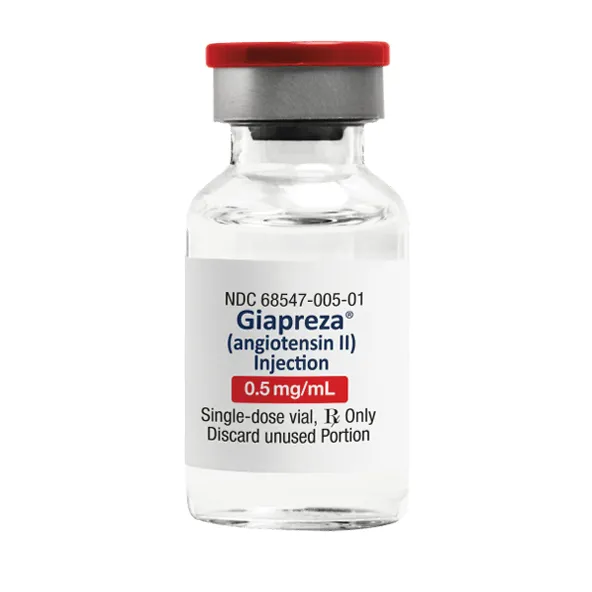
Table of Contents
- Package leaflet: Information for the patient
- Giapreza 2.5 mg/mL concentrate for solution for infusion
- 1. What Giapreza is and what it is used for
- 2. What you should know before receiving Giapreza
- 3. How Giapreza is used
- 4. Possible side effects
- 5. How to store Giapreza
- 6. Package contents and other information
- The following information is intended exclusively for healthcare professionals:
Package leaflet: Information for the patient
Giapreza 2.5 mg/mL concentrate for solution for infusion
angiotensin II
This medicinal product is subject to additional monitoring. This will allow rapid identification of new safety information. You can help by reporting any side effects you experience while taking this medicine. See the end of section 4 for information on how to report side effects.
Please read this leaflet carefully before you are given this medicine because it contains important information for you.
- Keep this leaflet. You may need to read it again.
- If you have any questions, ask your doctor.
- If you experience any side effect, including those not listed in this leaflet, tell your doctor. See section 4.
Contents of this leaflet
- What Giapreza is and what it is used for
- What you need to know before receiving Giapreza
- How Giapreza is used
- Possible side effects
- How Giapreza is stored
- Contents of the pack and other information
1. What Giapreza is and what it is used for
Giapreza contains the active substance angiotensin II, a compound normally produced by the body that
constricts blood vessels, thereby increasing blood pressure.
Giapreza is used in an emergency setting to raise blood pressure to normal levels in
adult patients with severely low blood pressure who do not respond to fluids or other medications
that increase blood pressure.
2. What you should know before receiving Giapreza
Do not receive Giapreza:
- if you are allergic to angiotensin II or to any of the other ingredients of this medicine (listed in section 6).
Your doctor or nurse must be informed if any of the conditions described above apply to you before this medicine is used.
Warnings and precautions
Giapreza has only been studied in patients with septic and distributive shock. It has not been studied in other types of shock.
This medicine has been associated with blood clot formation. As part of your treatment, you may be given a medicine to prevent blood clots, unless your doctor considers it inappropriate.
When you first receive Giapreza, your blood pressure is likely to increase. You will be closely monitored to ensure your blood pressure is at the appropriate level.
Immediately inform your doctor or nurse if you notice any change in skin colour (redness or paleness), pain, numbness in any of your limbs, or if any limb feels cold to the touch, as these signs may indicate that a blood clot has blocked blood flow to part of the body.
Children and adolescents
Giapreza must not be used in children or adolescents under 18 years of age, as it has not been studied in these age groups.
Other medicines and Giapreza
Inform your doctor if you are taking, have recently taken, or might take any other medicines. Some medicines can affect how Giapreza works, such as:
- angiotensin-converting enzyme (ACE) inhibitors, including enalapril (medicines used to lower blood pressure). ACE inhibitors may increase the effect of Giapreza;
- angiotensin II receptor blockers, including candesartan (medicines used to lower blood pressure), which may reduce the effect of Giapreza.
Your doctor may already have prescribed other medicines used to increase blood pressure. Adding Giapreza to these medicines may require reducing the doses of the other medicines.
Pregnancy, breastfeeding, and fertility
Inform your doctor if you are pregnant, suspect you may be pregnant, are planning a pregnancy, or are breastfeeding before you are given this medicine.
Information on the effects of Giapreza during pregnancy is limited. Use of this medicine during pregnancy should be avoided if possible. Your doctor will administer this medicine only if the potential benefit outweighs the potential risks.
It is not known whether Giapreza is excreted in human milk. Inform your doctor if you are breastfeeding before you are given this medicine.
Breastfeeding must be discontinued during treatment.
Sodium
This medicine contains less than 1 mmol of sodium (23 mg) per 2.5 mg/1 mL, i.e. essentially "sodium-free".
3. How Giapreza is used
Giapreza will be administered to you in a hospital by a doctor or nurse. It is first diluted and then given as an intravenous infusion, delivering a specific dose every minute.
The dose is based on your body weight. The recommended initial infusion rate for Giapreza is 20 nanograms (ng) per kilogram of body weight per minute. After the initial dose, your doctor will adjust the infusion rate every 5 minutes until the target blood pressure is achieved. Your doctor will continue to monitor your response and adjust the dose accordingly, up to a maximum of 80 ng per kilogram per minute during the first 3 hours of treatment. The maximum dose after the first 3 hours will be 40 ng per kilogram per minute.
Giapreza will be administered at the lowest dose that helps you achieve or maintain blood pressure. To minimize the risk of adverse effects with this medicine, administration of Giapreza will be discontinued as soon as your condition improves.
Elderly
Giapreza has been studied in a limited number of patients over 75 years of age. Dose adjustments are not required for patients over 75 years of age. Your doctor will monitor your blood pressure and adjust the dose as needed.
Liver or kidney impairment
Dose adjustments are not required for patients with impaired liver or kidney function. Your doctor will monitor your blood pressure and adjust the dose as needed.
If you receive more Giapreza than you should
Giapreza will be administered by a doctor or nurse; therefore, it is unlikely that you will receive an incorrect dose. However, if you experience any adverse effects or think you have received an excessive amount of Giapreza, inform your doctor or nurse immediately. If you have received too much Giapreza, you may develop high blood pressure. In this case, hospital staff will monitor your vital signs and provide supportive care.
Discontinuation of Giapreza treatment
Your doctor will gradually reduce the amount of Giapreza administered over time once your blood pressure has increased to appropriate levels. If Giapreza administration is stopped suddenly or too early, a drop in blood pressure or worsening of your condition may occur.
If you have any questions about the use of this medicine, consult your doctor or nurse.
4. Possible side effects
Like all medicines, this medicine can cause side effects, although not everyone experiences them.
Contact your doctor immediately if you experience:
- pain, redness or pale skin colour, swelling or coldness to the touch of the skin or limbs, as these may be symptoms of a blood clot in one of the veins. These clots may travel through blood vessels to the lungs, causing chest pain and difficulty breathing. If you notice any of these symptoms, consult a doctor immediately. These types of symptoms occur in more than 1 in 10 patients. Even though not all of these symptoms lead to potentially life-threatening complications, inform your doctor immediately.
Other side effects include:
Very common side effects (may affect more than 1 in 10 people):
- high blood pressure
Common side effects (may affect up to 1 in 10 people):
- rapid heartbeat
- poor circulation in hands, feet or other body areas, which may be severe and cause tissue damage.
Reporting of side effects
If you experience any side effect, including those not listed in this leaflet, consult your doctor. You can also report side effects directly via the national reporting system listed in Annex V. By reporting side effects, you can help provide more information on the safety of this medicine.
5. How to store Giapreza
Keep this medicine out of the sight and reach of children.
Do not use this medicine after the expiry date stated on the vial label and on the carton after “EXP” and “Scad.”. The expiry date refers to the last day of that month.
Store in the refrigerator (2 °C - 8 °C).
The diluted solution must be used immediately. Chemical and physical in-use stability has been demonstrated for 24 hours at room temperature and between 2 °C and 8 °C.
Do not use if visible signs of damage or discoloration are observed.
Do not dispose of any medicine via wastewater or household waste. Ask your pharmacist how to properly dispose of medicines no longer in use. This will help protect the environment.
6. Package contents and other information
What Giapreza contains
- The active substance is angiotensin II acetate. Each mL contains angiotensin II acetate equivalent to 2.5 mg of angiotensin II.
- A 1 mL vial of concentrate for solution for infusion contains 2.5 mg of angiotensin II.
- A 2 mL vial of concentrate for solution for infusion contains 5 mg of angiotensin II.
- The other components are mannitol and water for injections, pH adjusted with sodium hydroxide and/or hydrochloric acid (see section 2 under the heading “Sodium”).
Description of the appearance of Giapreza and contents of the pack
Giapreza 2.5 mg/mL is a concentrate for solution for infusion (sterile concentrate). The solution is clear, colourless and free from visible particles.
Giapreza is supplied in a carton containing single-use vials of 1 mL, 10 x 1 mL or 2 mL. Not all pack sizes may be marketed.
Marketing Authorisation Holder
PAION Pharma GmbH
Heussstraße 25
52078 Aachen
Germany
Manufacturer
PAION Deutschland GmbH
Heussstraße 25
52078 Aachen
Germany
PAION Pharma GmbH
Heussstraße 25
52078 Aachen
Germany
For further information about this medicinal product, please contact the local representative of the Marketing Authorisation Holder:
| Belgium/Belgium/Belgium Viatris Tél/Tel: + 32 (0)2 658 61 00 | Lithuania PAION Pharma GmbH Tel: + 49 800 4453 4453 |
| Bulgaria PAION Pharma GmbH Tel.: + 49 800 4453 4453 | Luxembourg/Luxembourg PAION Pharma GmbH Tél/Tel: + 49 800 4453 4453 |
| Czech Republic PAION Pharma GmbH Tel: + 49 800 4453 4453 | Hungary PAION Pharma GmbH Tel.: + 49 800 4453 4453 |
| Denmark PAION Pharma GmbH Tlf: + 49 800 4453 4453 | Malta PAION Pharma GmbH Tel: + 49 800 4453 4453 |
| Germany PAION Pharma GmbH Tel: + 49 800 4453 4453 | Netherlands PAION Pharma GmbH Tel: + 49 800 4453 4453 |
| Estonia PAION Pharma GmbH Tel: + 49 800 4453 4453 | Norway PAION Pharma GmbH Tlf: + 49 800 4453 4453 |
| Greece Viatris Hellas Ltd Tel: +30 210 0100002 | Austria PAION Pharma GmbH Tel: + 49 800 4453 4453 |
| Spain Viatris Pharmaceuticals, S.L. Tel: + 34 900 102 712 | Poland Viatris Healthcare Sp. z o.o. Tel.: + 48 22 546 64 00 |
| France Viatris Santé Tél: +33 4 37 25 75 00 | Portugal PAION Pharma GmbH Tel: + 49 800 4453 4453 |
| Croatia PAION Pharma GmbH Tel: + 49 800 4453 4453 | Romania BGP Products SRL Tel: +40 372 579 000 |
| Ireland PAION Pharma GmbH Tel: + 49 800 4453 4453 | Slovenia PAION Pharma GmbH Tel: + 49 800 4453 4453 |
| Iceland PAION Pharma GmbH Sími: + 49 800 4453 4453 | Slovakia PAION Pharma GmbH Tel: + 49 800 4453 4453 |
| Italy Viatris Italia S.r.l. Tel: + 39 02 612 46921 | Finland/Finland PAION Pharma GmbH Puh/Tel: + 49 800 4453 4453 |
| Cyprus PAION Pharma GmbH Tel: + 49 800 4453 4453 | Sweden PAION Pharma GmbH Tel: + 49 800 4453 4453 |
| Latvia PAION Pharma GmbH Tel: + 49 800 4453 4453 | United Kingdom (Northern Ireland) PAION Pharma GmbH Tel: + 49 800 4453 4453 |
More detailed information on this medicine is available on the website of the European Medicines Agency, http://www.ema.europa.eu.
The following information is intended exclusively for healthcare professionals:
Dosing and administration
For intravenous use only after dilution. Giapreza is recommended to be administered via a central venous line.
Giapreza must be administered only by continuous intravenous infusion under close hemodynamic monitoring and assessment of end-organ perfusion.
Instructions for dilution
- Inspect each vial for the presence of particles prior to dilution.
- Dilute 1 or 2 mL of Giapreza in an injectable solution of sodium chloride 9 mg/mL (0.9%) to obtain a final concentration of 5,000 ng/mL or 10,000 ng/mL.
- The diluted solution must be clear and colourless.
- Dispose of the vial and any unused portions of the medicinal product after use.
Table 1: Preparation of the diluted solution
| Fluid restriction? | Vial dosage | Volume to be withdrawn (mL) | Infusion bag size (mL) | Final concentration (ng/mL) |
| No | 2.5 mg/mL | 1 | 500 | 5,000 |
| Yes | 2.5 mg/mL | 1 | 250 | 10,000 |
| 5 mg/2 mL | 2 | 500 | 10,000 |
Administration
When initiating treatment with Giapreza, it is important to closely monitor blood pressure response and adjust the dose accordingly.
Once the infusion has been established, the dose may be titrated every 5 minutes in increments of up to 15 ng/kg per minute, as needed, depending on the patient's condition and target mean arterial pressure. In clinical trials, approximately one in four patients experienced transient hypertension with the initial dose of 20 ng/kg per minute of angiotensin II, requiring dose reduction. For critically ill patients, the usual target mean arterial pressure is 65–75 mmHg. Do not exceed 80 ng/kg per minute during the first 3 hours of treatment. Maintenance doses should not exceed 40 ng/kg per minute. Lower doses down to a minimum of 1.25 ng/kg per minute may be used.
It is important to administer Giapreza at the lowest compatible dose required to achieve or maintain adequate blood pressure and tissue perfusion. The median duration of treatment in clinical trials was 48 hours (range: 3.5 to 168 hours).
To minimize the risk of adverse events due to prolonged vasoconstriction, Giapreza treatment should be discontinued once the underlying shock has sufficiently improved. Taper the dose gradually, reducing in steps down to 15 ng/kg per minute, as needed, based on blood pressure, to avoid hypotension caused by abrupt discontinuation.
Storage precautions
Store in a refrigerator (2 °C – 8 °C). Dilute before use. Administer as a diluted solution.
The diluted solution may be stored at room temperature or in the refrigerator. Discard the prepared solution after 24 hours, whether stored at room temperature or in the refrigerator.
Any unused medicinal product and waste materials derived from this medicinal product must be disposed of in accordance with local regulations.