Gencebok
Italy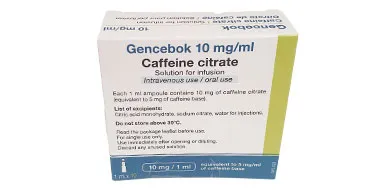
Table of Contents
- Package leaflet: Information for the user
- Gencebok 10 mg/ml solution for infusion
- 1. What Gencebok is and what it is used for
- 2. What you should know before Gencebok is administered to your child
- 3. How to use Gencebok
- 4. Possible side effects
- 5. How to store Gencebok
- 6. Package contents and other information
- The following information is intended exclusively for healthcare professionals:
Package leaflet: Information for the user
Gencebok 10 mg/ml solution for infusion
caffeine citrate
Please read this leaflet carefully before your baby is given this medicine as it contains important information for your newborn.
- Keep this leaflet. You may need to read it again.
- If you have any questions, ask your child's doctor.
- If your newborn experiences any side effects, including those not listed in this leaflet, contact your child's doctor. See section 4.
Contents of this leaflet
- What Gencebok is and what it is used for
- What you need to know before Gencebok is given to your baby
- How to use Gencebok
- Possible side effects
- How to store Gencebok
- Contents of the pack and other information
1. What Gencebok is and what it is used for
Gencebok contains the active substance caffeine citrate, which is a central nervous system stimulant belonging to a group of medicines called methylxanthines.
Gencebok is used for the treatment of breathing pauses in premature infants (primary apnea of prematurity).
These brief interruptions in breathing in premature infants are caused by the infant's underdeveloped respiratory centres.
This medicine has been shown to reduce the number of episodes of breathing pauses in premature infants.
2. What you should know before Gencebok is administered to your child
Do not use Gencebok:
- if your child is allergic to citrated caffeine or to any of the other ingredients of this medicine (listed in section 6).
Warnings and precautions
Talk to your child's doctor before administering Gencebok.
Before starting treatment for apnea of prematurity with Gencebok, your child's doctor must have ruled out or appropriately treated any other possible causes of apnea.
Gencebok must be used with caution. Inform the doctor if:
- your child suffers from seizures
- your child has any heart disease
- your child has kidney or liver problems
- your child experiences frequent episodes of regurgitation
- your child produces more urine than usual
- your child has low body weight or is not taking sufficient food
- if you (the mother) have taken caffeine before delivery.
Other medicines and Gencebok
Inform your child's doctor if the newborn is taking, has recently taken, or might take any other medicines.
Inform your child's doctor if the newborn has previously been treated with theophylline.
Do not use the following medicines during treatment with Gencebok without first consulting your child's doctor. The doctor may need to adjust the dosage or change one of the medicines:
- theophylline (used to treat breathing difficulties)
- doxapram (used to treat breathing difficulties)
- cimetidine (used to treat stomach disorders)
- ketoconazole (used to treat fungal infections)
- phenobarbital (used to treat epilepsy)
- phenytoin (used to treat epilepsy)
This medicine may increase the risk of a serious intestinal disease with blood in the stool (necrotizing enterocolitis) if administered concomitantly with medicines used to treat stomach disorders (such as H2-receptor blocking antihistamines or proton pump inhibitors that reduce gastric acid secretion).
Pregnancy and breastfeeding
If you (the mother) are breastfeeding while your child is being treated with Gencebok, you must not drink coffee or consume other products high in caffeine, as caffeine is excreted in breast milk.
Gencebok contains sodium
This medicine contains less than 1 mmol of sodium (23 mg) per dose, i.e. it is essentially "sodium-free".
3. How to use Gencebok
Gencebok must only be used in a neonatal intensive care unit equipped with
appropriate equipment for patient monitoring and surveillance. Treatment must be
initiated under the supervision of a physician experienced in neonatal intensive care.
Dosage
Your child's doctor will prescribe the correct dose of Gencebok based on body weight.
The initial dose is 20 mg per kg of body weight (equivalent to 2 ml per kg of body weight).
The maintenance dose is 5 mg per kg of body weight (equivalent to 0.5 ml per kg of body weight)
every 24 hours.
Route and method of administration
Gencebok will be administered via a controlled intravenous infusion using a syringe pump or another
measured delivery device. This method is also known as an "infusion".
Some of the maintenance doses may be administered orally.
It may be necessary for your child's doctor to periodically monitor caffeine levels in the blood during
treatment to avoid toxic effects.
Duration of treatment
Your child's doctor will determine exactly how long treatment with Gencebok should continue. If your
child has been free from apnea episodes for 5 to 7 days, the doctor will discontinue treatment.
If your child receives more Gencebok than they should
Your child may experience fever, rapid breathing (tachypnea), restlessness, muscle tremors, vomiting,
elevated blood sugar levels (hyperglycaemia), low potassium levels (hypokalaemia) in the blood,
elevated levels of certain chemicals (urea) in the blood, an increased number of certain blood cells
(leucocytes), and seizures if they receive more caffeine citrate than they should.
In such a case, treatment with Gencebok must be stopped immediately and the child's doctor must
manage the overdose.
If you have any doubts about the use of this medicine, consult your child's doctor.
4. Possible side effects
Like all medicines, this medicine can cause side effects, although not everyone experiences them. However, it may be difficult to distinguish them from some common complications occurring in premature infants and from complications due to the underlying disease.
During treatment with Gencebok, your newborn may experience some of the following reactions:
Serious side effects
Side effects whose frequency cannot be estimated from the available data
- severe intestinal disease with blood in the stool (necrotizing enterocolitis)
The other side effects listed below may also be considered serious by your child's doctor within the context of the overall clinical assessment.
Other side effects
Common side effects reported (may affect up to 1 in 10 people)
- local inflammatory reactions at the infusion site
- heart disorders such as increased heart rate (tachycardia)
- changes in blood or serum sugar levels (hyperglycaemia)
Uncommon side effects reported (may affect up to 1 in 100 people)
- stimulation of the central nervous system such as seizures
- heart disorders such as irregular heart rate (arrhythmia)
Rare side effects (may affect up to 1 in 1,000 people):
- allergic reactions
Side effects whose frequency cannot be estimated from the available data
- blood infections (sepsis)
- changes in blood or serum sugar levels (hypoglycaemia), growth retardation, feeding intolerance
- stimulation of the central nervous system such as irritability, nervousness and restlessness; brain lesions
- deafness
- regurgitation, increased gastric aspirate
- increased urine output, increased levels of certain components in the urine (sodium and calcium)
- changes in blood tests (reduced haemoglobin levels after prolonged treatment and reduced thyroid hormone levels at the beginning of treatment)
Reporting of side effects
If your newborn experiences any side effects, including those not listed in this leaflet, please consult your child's doctor. You may also report side effects directly through the national reporting system listed in Annex V.
By reporting side effects, you can help provide more information on the safety of this medicine.
5. How to store Gencebok
Keep this medicine out of the sight and reach of children.
Do not use this medicine after the expiry date stated on the label. The expiry date refers to the last day of that month.
This medicine does not require any special storage conditions.
Before administration, parenteral solution vials should be inspected visually for any suspended particles.
After opening the vial, the medicine should be used immediately.
6. Package contents and other information
What Gencebok contains
The active substance is caffeine citrate.
Each ml contains 10 mg of caffeine citrate (equivalent to 5 mg/ml of base caffeine).
Each 1 ml vial contains 10 mg of caffeine citrate (equivalent to 5 mg of base caffeine).
The other components are citric acid, sodium citrate and water for injections.
Description of the appearance of Gencebok and contents of the pack
Gencebok is a solution for infusion.
Gencebok is a clear, colourless solution supplied in glass vials marked with 2 blue rings. Each carton contains 50 vials.
Marketing Authorisation Holder
Gennisium Pharma
Swen Parc de Vitrolles
Chemin de la Bastide Blanche
13127 Vitrolles - France
Manufacturer (Batch Release)
Cenexi
52 rue Marcel et Jacques Gaucher
94120 Fontenay Sous-Bois
France
Gennisium Pharma
Swen Parc de Vitrolles (Bâtiment E)
Chemin de la Bastide Blanche
13127 Vitrolles
France
For further information about this medicinal product, please contact the local representative of the Marketing Authorisation Holder:
België/Belgique/Belgien Lietuva
Gennisium Pharma UAB PharmaDIA
Tél/Tel: +33 9 70 19 79 90 Tel: +370 69 94 76 12
[email protected] [email protected]
България Luxembourg/Luxemburg
Gennisium Pharma Gennisium Pharma
Teл.: +33 9 70 19 79 90 Tél/Tel: +33 9 70 19 79 90
[email protected] [email protected]
Česká republika Magyarország
Gennisium Pharma Gennisium Pharma
Tel: +33 9 70 19 79 90 Tel.: +33 9 70 19 79 90
[email protected] [email protected]
Danmark Malta
Nordic Prime ApS Cherubino
Tlf.: +45 75 15 13 40 Tel: +365 2134 3270
[email protected] [email protected]
Deutschland Nederland
Gennisium Pharma Gennisium Pharma
Tel: +33 9 70 19 79 90 Tel: +33 9 70 19 79 90
[email protected] [email protected]
Eesti Norge
UAB PharmaDIA Nordic Prime ApS
Tel: +370 69 94 76 12 Tlf: +45 75 15 13 40
[email protected] [email protected]
Ελλάδα Österreich
Specialty Therapeutics IKE Gennisium Pharma
Τηλ: +30 213 02 33 913 Tel: +33 9 70 19 79 90
[email protected] [email protected]
España Polska
Gennisium Pharma Gennisium Pharma
Tel: +33 9 70 19 79 90 Tel: +33 9 70 19 79 90
[email protected] [email protected]
France Portugal
Gennisium Pharma Gennisium Pharma
Tél: +33 9 70 19 79 90 Tel: +33 9 70 19 79 90
[email protected] [email protected]
Hrvatska România
Gennisium Pharma Euromedex
Tel: +33 9 70 19 79 90 Tel: 0745.038.006
[email protected] [email protected]
Ireland Slovenija
Gennisium Pharma Gennisium Pharma
Tel: +33 9 70 19 79 90 Tel: +33 9 70 19 79 90
[email protected] [email protected]
Ísland Slovenská republika
Nordic Prime ApS Gennisium Pharma
Sími: +45 75 15 13 40 Tel: +33 9 70 19 79 90
[email protected] [email protected]
Italia Suomi/Finland
Gennisium Pharma Nordic Prime ApS
Tel: +33 9 70 19 79 90 Puh/Tel: +45 75 15 13 40
[email protected] [email protected]
Κύπρος Sverige
Specialty Therapeutics IKE Nordic Prime ApS
Τηλ: +30 213 02 33 913 Tel: +45 75 15 13 40
[email protected] [email protected]
Latvija
UAB PharmaDIA
Tel: +370 69 94 76 12
[email protected]
Other sources of information
More detailed information on this medicinal product is available on the European Medicines Agency website: http://www.ema.europa.eu.
The following information is intended exclusively for healthcare professionals:
For detailed information, refer to the enclosed summary of product characteristics for
Gencebok.