GelAspan
Italy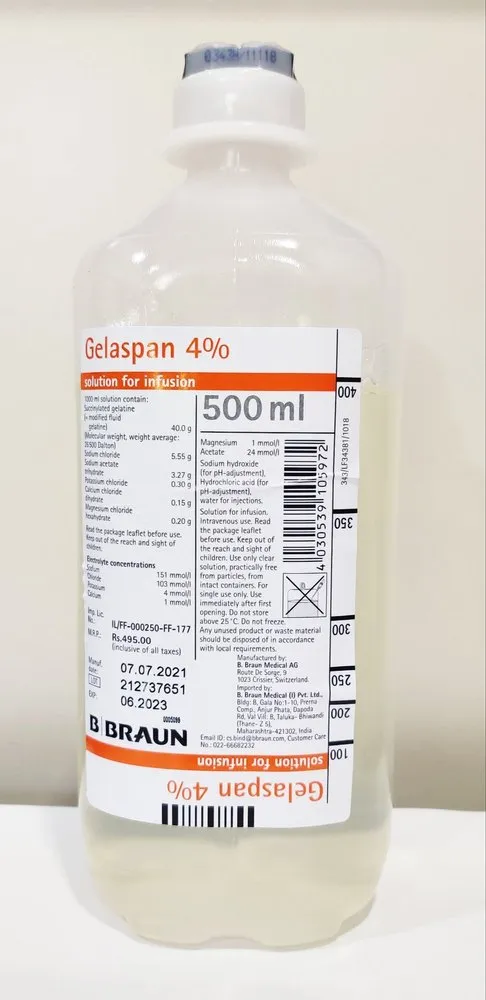
Table of Contents
PACKAGE LEAFLET: INFORMATION FOR THE USER
Gelaspan 4% solution for infusion
Please read this leaflet carefully before using this medicine.
- Keep this leaflet. You may need to read it again.
- If you have any questions, consult your doctor or pharmacist.
- This medicine has been prescribed for you. Do not give it to others, even if their symptoms are the same as yours, as it may be dangerous.
- If any of the side effects worsen, or if you notice any side effects not listed in this leaflet, inform your doctor or pharmacist.
Contents of this leaflet:
- What Gelaspan is and what it is used for
- What you need to know before using Gelaspan
- How to use Gelaspan
- Possible side effects
- How to store Gelaspan
- Further information
1. What Gelaspan is and what it is used for
Gelaspan is a so-called plasma volume substitute. This means it is used to replace liquid components that have leaked out of blood vessels.
Gelaspan is used for:
- Replacing blood and bodily fluids lost, for example, following surgery, an accident, or a burn injury. If necessary, it can be used in combination with blood transfusions
- Preventing low blood pressure (hypotension) that may occur during spinal or epidural anaesthesia, or due to imminent and significant blood loss in a surgical setting
- Restoring circulating blood volume during procedures involving, for example, a heart-lung machine, in combination with other infusion fluids
2. What you need to know before using Gelaspan
Do not use Gelaspan
- if you are allergic to gelatin or to any of the other ingredients of this medicine (listed in section 6);
- if you are allergic to an allergen called “galactose-α-1,3-galactose (alpha-Gal)”, or to red meat (mammalian meat) and offal;
- if you have too high a blood volume;
- if there is too much water in your body;
- if you suffer from a particular type of heart failure (acute congestive heart failure);
- if you have higher than normal levels of potassium in your blood.
Warnings and precautions
Talk to your doctor, pharmacist, or nurse before using Gelaspan.
Inform your doctor:
- if you suffer from an allergic condition such as asthma. In this case, the risk of an allergic reaction may be higher;
- in these cases, Gelaspan must not be administered to you due to possible cross-reactions:
- if you know you are allergic to red meat (mammalian meat) or offal;
- if you have tested positive for antibodies (IgE) directed against the allergen alpha-Gal.
Your doctor will pay particular attention if you have: - heart problems;
- high blood pressure;
- fluid in the lungs;
- severe kidney problems.
The administration of large amounts of fluids via intravenous infusion may worsen your condition.
In addition, your doctor will proceed with caution:
- if you have a severe increase in sodium or chloride levels in your blood;
- if you have water and salt retention, which may be associated with tissue swelling;
- if you have high levels of potassium in your blood, or if you are taking or are being treated with medicines that cause potassium retention;
- if your blood clotting is severely impaired;
- if you are elderly.
During administration of Gelaspan, monitoring of your blood composition will be performed.
If necessary, your doctor may administer other medicines, such as electrolytes and fluids.
Children
Experience with the use of Gelaspan in children is limited. For this reason, your doctor will administer this medicine to children only if absolutely necessary.
Laboratory test results
Your doctor may collect blood or urine samples before administering Gelaspan, as the results of certain laboratory tests may be altered and become unreliable after administration of this medicine.
Other medicines and Gelaspan
Inform your doctor or pharmacist if you are taking, using, or have recently taken or used any other medicines, including those not requiring a prescription.
In particular, your doctor must know if you are taking or are being treated with medicines that cause sodium retention (e.g. spironolactone, triamterene, amiloride, ACE inhibitors such as captopril or enalapril, corticosteroids such as cortisone, or non-steroidal anti-inflammatory drugs such as diclofenac). Concomitant administration with this medicine may cause swelling of the arms, hands, legs, and feet (edema). In addition, inform your doctor if you are taking medicines that cause potassium loss, such as diuretics that increase water excretion.
Pregnancy, breastfeeding, and fertility
If you are pregnant, think you may be pregnant, planning to become pregnant, or breastfeeding, ask your doctor or pharmacist for advice before taking any medicine.
Pregnancy
Inform your doctor if you are pregnant. Due to possible allergic reactions, the use of this medicine should be avoided during pregnancy. However, your doctor may administer this medicine in emergency situations.
Breastfeeding
Inform your doctor if you are breastfeeding. There is limited information on the excretion of this medicine in breast milk. Your doctor will decide whether to discontinue breastfeeding or discontinue the medicine, taking into account the benefits of breastfeeding for the child and the benefits of therapy for you.
Fertility
There are no data on the effect of this medicine on human or animal fertility. However, due to the nature of its constituents, it is considered unlikely to affect fertility.
Driving and using machines
This medicine does not impair the ability to drive or operate machinery.
3. How to use Gelaspan
Your doctor will give you Gelaspan only if they consider that other products, called crystalloids, are not sufficient on their own.
Your doctor will carefully adjust the dose of Gelaspan to prevent circulatory overload, particularly if you have problems with your lungs, heart, or circulation.
Dosage
Gelaspan is administered intravenously, i.e. by infusion.
Adults
The amount you will receive and the duration of administration will depend on how much blood or fluid you have lost and on your clinical condition.
During treatment, your doctor will carry out regular checks (for example, of blood and blood pressure), and the dose of Gelaspan will be adjusted according to the patient's needs. If necessary, you may also receive blood or blood cell concentrates.
Use in children
Experience with the use of this medicine in children is limited. Your doctor will administer this medicine only if they consider it necessary for the child's recovery. In such cases, the child's clinical condition will be taken into account, and therapy will be monitored particularly closely.
If you use more Gelaspan than you should
An overdose of Gelaspan may cause an excessive increase in blood volume (hypervolemia) and circulatory overload, which may impair heart and lung function.
You may experience headache and difficulty breathing.
In case of overdose, your doctor will administer the necessary treatment.
If you have any doubts about how to use this medicine, consult your doctor or pharmacist.
4. Possible side effects
Like all medicines, Gelaspan can cause side effects, although not everyone experiences them.
All plasma substitutes carry a slight risk of allergic reactions, mostly mild or moderate, but in rare cases they may become severe. Such reactions are believed to be more frequent in patients with known allergic disorders, such as asthma. For this reason, a healthcare professional will closely monitor you, especially at the beginning of the infusion.
The following side effects could be serious. If you experience any of the following side effects, contact your doctor immediately:
Rare (may affect up to 1 in 1,000 people):
- allergic reactions (anaphylactic/anaphylactoid reactions), which may include, for example, difficulty breathing, wheezing, nausea, vomiting, dizziness, sweating, tightness in the chest or throat, stomach pain, swelling of the neck and face.
If an allergic reaction occurs, the infusion will be immediately stopped and you will be given the necessary treatment (see also section 2 "What you need to know before using Gelaspan", particularly regarding allergies to the allergen called galactose-α-1,3-galactose (alpha-Gal), red meat, and offal).
Other side effects include:
Very common (may affect more than 1 in 10 people):
- reduction in red blood cells and blood proteins
Common (may affect up to 1 in 100 people):
- blood may not clot as well as before, and you may notice increased tendency to bleed
Very rare (may affect up to 1 in 10,000 people):
- increased heart rate
- low blood pressure
- fever, chills
Not known (frequency cannot be estimated from available data):
- feeling unwell, nausea, stomach ache
- reduced oxygen levels in the blood, which may cause dizziness
Additional side effects in children
There are no data available regarding differences in side effects in children.
Reporting of side effects
If you experience any side effect, including those not listed in this leaflet, talk to your doctor or pharmacist. You can also report side effects directly via the national reporting system at: www.aifa.gov.it/content/segnalazioni-reazioni-avverse. By reporting side effects, you can help provide more information on the safety of this medicine.
5. How to store Gelaspan
Keep this medicine out of the sight and reach of children.
Do not use Gelaspan after the expiry date stated on the label and outer carton. The expiry date refers to the last day of that month.
Do not store above 25°C. Do not freeze.
Do not use Gelaspan if you notice:
- cloudiness or change in colour of the solution;
- leakage from the container.
Any opened or partially used Gelaspan must be discarded. Partially used vials or bags must not be reconnected.
6. Contents of the Pack and Other Information
What Gelaspan contains
Active substances:
1,000 mL of solution contain:
Modified fluid gelatin (succinylated gelatin) 40.0 g
Sodium chloride 5.55 g
Sodium acetate trihydrate 3.27 g
Potassium chloride 0.30 g
Calcium chloride dihydrate 0.15 g
Magnesium chloride hexahydrate 0.20 g
Electrolyte concentrations:
Sodium 151 mmol/L
Chloride 103 mmol/L
Potassium 4 mmol/L
Calcium 1 mmol/L
Magnesium 1 mmol/L
Acetate 24 mmol/L
The other ingredients are:
Water for injections, hydrochloric acid, diluted (for pH adjustment) and sodium hydroxide (for pH adjustment).
Description of the appearance of Gelaspan and contents of the pack
Gelaspan is an infusion solution administered intravenously via an intravenous drip (into a vein).
It is a clear, sterile, colourless or slightly yellowish solution.
Gelaspan is supplied in:
- Low-density polyethylene bottles "Ecoflac plus" of 500 mL, available in packs of 10 × 500 mL.
- Sealed plastic bags "Ecobag" (non-PVC) with rubber stoppers, 500 mL, available in packs of 20 × 500 mL.
Not all pack sizes may be marketed.
Marketing Authorization Holder and Manufacturer
B. Braun Melsungen AG
Carl-Braun-Straße 1
34212 Melsungen, Germany
Postal address
34209 Melsungen
Telephone: +49-5661-71-0
Fax: +49-5661-4567
This medicinal product is authorized in the Member States of the European Economic Area under the following names:
| Austria | Gelofusin Iso 40mg/ml Infusion Solution |
| Belgium | Isogelo solution for infusion, solution for perfusion, Infusionslösung |
| Bulgaria | Gelofusine Balance 4% solution for infusion |
| Czech Republic | Gelaspan 4% |
| Germany | Gelafundin ISO 40mg/ml Infusion Solution |
| Denmark | Gelaspan |
| Estonia | Gelaspan 4% infusion solution |
| Greece | Gelaspan solution for infusion 4% |
| Spain | Gelaspan 40mg/ml solution for perfusion |
| France | Gelaspan, solution for perfusion |
| Hungary | Gelaspan 4% infusion solution |
| Ireland | Gelaspan Solution for Infusion |
| Italy | Gelaspan |
| Lithuania | Gelaspan 4% infusion solution |
| Luxembourg | Gelafundin ISO 40mg/ml Infusion Solution |
| Latvia | Gelaspan 4% Solution for Infusion |
| Malta | Gelaspan 4% Solution for Infusion |
| Norway | Gelaspan |
| Netherlands | Gelaspan, solution for infusion |
| Portugal | Gelaspan |
| Poland | Gelaspan |
| Romania | Gelaspan 40 mg/ml solution for perfusion |
| Sweden | Gelaspan |
| Slovenia | Gelaspan 40 mg/ml solution for infusion |
| Slovakia | Gelaspan 4% |
| United Kingdom | Gelaspan solution for infusion |
The following information is intended exclusively for physicians or healthcare professionals:
Precautions for use
Gelaspan must not be infused through the same infusion line as blood or blood products (cell concentrates, plasma, and plasma fractions).
During correction of severe blood loss by infusion of large amounts of Gelaspan, hematocrit and electrolyte levels should be monitored. Hematocrit should not fall below 25%, or below 30% in elderly or seriously ill patients.
In such situations, the dilution effect on coagulation factors should also be monitored, especially in patients with existing hemostatic disorders.
Since the product does not replace lost plasma proteins, it is advisable to monitor their concentrations.
In severe and acute cases, Gelaspan may be rapidly infused using pressure infusion; administration of 500 mL of the product within 5–10 minutes is possible, until signs of hypovolemia are no longer detectable.
For rapid infusions, Gelaspan may be warmed to a temperature not exceeding 37 °C.
In the case of pressure infusion, which may be necessary during life-threatening emergencies, all air must be removed from the container and infusion set before administration to avoid the risk of gas embolism that could otherwise be associated with the infusion.
Effect on laboratory tests
After infusion of Gelaspan, hematological laboratory tests (blood group or irregular antigens) may be performed. Nevertheless, blood sampling is recommended before infusion of Gelaspan to avoid misinterpretation of test results.
Gelaspan may affect the following clinical chemistry analyses, causing falsely elevated values:
- erythrocyte sedimentation rate,
- urine specific gravity,
- nonspecific protein determination tests, e.g. biuret method.
Incompatibilities
In the absence of compatibility studies, this medicinal product must not be mixed with other medicinal products.