Ganciclovir Accord
Italy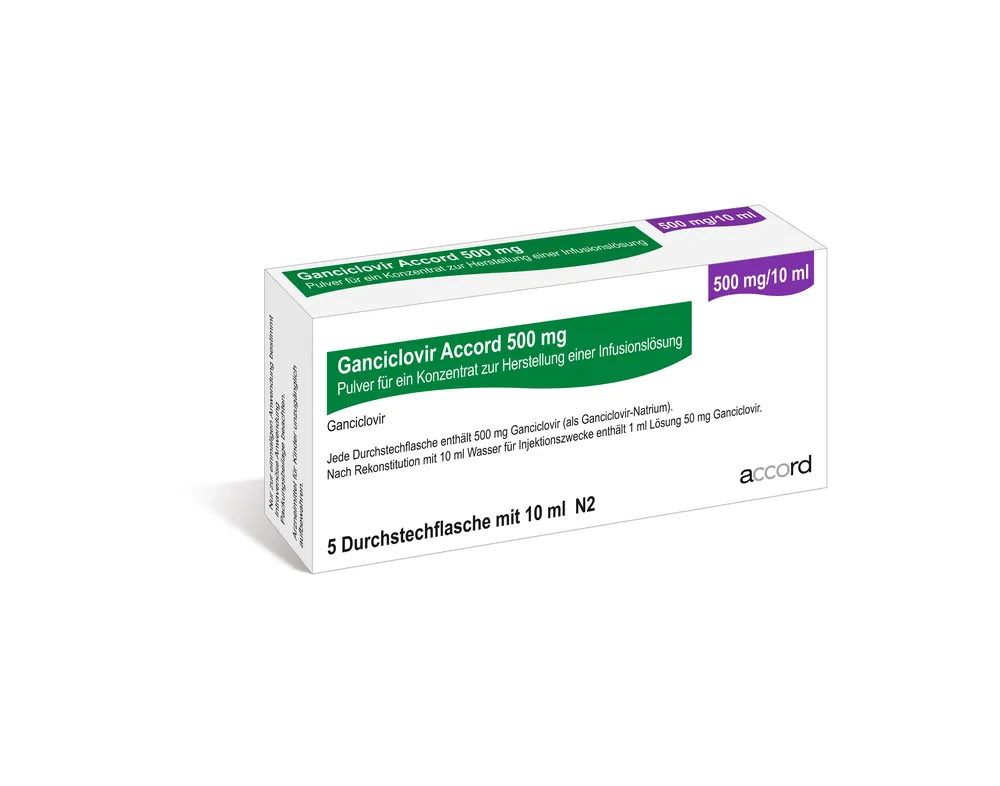
Table of Contents
- PACKAGE LEAFLET
- Package leaflet: Information for the patient
- Ganciclovir Accord 500 mg powder for concentrate for solution for infusion
- 2. What you need to know before taking Ganciclovir Accord
- 3. How to take Ganciclovir Accord
- 4. Possible side effects
- 5. How to store Ganciclovir Accord
- 6. Package contents and other information
- INSTRUCTIONS FOR USE AND HANDLING
PACKAGE LEAFLET
Package leaflet: Information for the patient
Ganciclovir Accord 500 mg powder for concentrate for solution for infusion
Generic medicine
Please read this leaflet carefully before using this medicine because it contains important information for you.
- Keep this leaflet. You may need to read it again.
- If you have any questions, ask your doctor, pharmacist or nurse.
- This medicine has been prescribed for you only. Do not give it to others, even if their symptoms are the same as yours, as it could be harmful.
- If you experience any side effect, including those not listed in this leaflet, contact your doctor, pharmacist or nurse. See section 4.
Contents of this leaflet:
-
What Ganciclovir Accord is and what it is used for
-
What you need to know before using Ganciclovir Accord
-
How to use Ganciclovir Accord
-
Possible side effects
-
How to store Ganciclovir Accord
-
Contents of the pack and other information
-
What Ganciclovir Accord is and what it is used for
What Ganciclovir Accord is
Ganciclovir Accord contains the active substance ganciclovir, which belongs to a group of medicines called antivirals.
What Ganciclovir Accord is used for
Ganciclovir Accord is used to treat diseases caused by a virus called cytomegalovirus (CMV) in adult and adolescent patients aged 12 years and older with a weakened immune system. It is also used to prevent CMV infections after organ transplantation or during chemotherapy in adults and children from birth.
- The virus can affect any part of the body, including the retina, a layer located at the back of the eye – this means the virus can cause vision problems.
- The virus can affect anyone, but it poses a particular risk for individuals with a weakened immune system. In these people, CMV can cause serious illness. Immune system weakness may be due to other medical conditions (such as AIDS) or to medications (such as chemotherapy or immunosuppressants).
2. What you need to know before taking Ganciclovir Accord
Do not use Ganciclovir Accord if:
- you are allergic to ganciclovir, valganciclovir, or any of the other ingredients of this medicine (listed in section 6);
- you are breastfeeding (see subsection “Breast-feeding”).
Do not use Ganciclovir Accord if any of the above situations apply to you. If you have any doubts, consult your doctor, pharmacist, or nurse before using Ganciclovir Accord.
Warnings and precautions
Talk to your doctor, pharmacist, or nurse before using Ganciclovir Accord:
- if you are allergic to aciclovir, valaciclovir, penciclovir, or famciclovir – these are other medicines used to treat viral infections;
- if you have a low number of white blood cells, red blood cells, or platelets – your doctor will carry out blood tests before and during treatment;
- if you have previously had problems with blood cell counts due to medicines you have taken;
- if you have kidney problems – your doctor will need to give you a lower dose of the medicine and monitor your blood cell counts more frequently during treatment;
- if you are undergoing radiotherapy.
If any of the above situations apply to you (or if you have any doubts), consult your doctor, pharmacist, or nurse before using Ganciclovir Accord.
Be aware of side effects
Ganciclovir Accord may cause some serious side effects that must be reported immediately to your doctor. Pay attention to the serious side effects listed in section 4 and inform your doctor if you notice any of them during treatment with Ganciclovir Accord – your doctor may advise you to stop taking Ganciclovir Accord, and urgent medical intervention may be necessary.
Tests and monitoring
During treatment with Ganciclovir Accord, your doctor will carry out regular blood tests to ensure that the dose you are taking is appropriate for you. During the first 2 weeks, these blood tests will be performed more frequently than after this initial period.
Children and adolescents
Information on the safety or efficacy of Ganciclovir Accord in children under 12 years of age is limited. Newborns and children taking Ganciclovir Accord for prevention of CMV disease will be monitored regularly with blood tests.
Other medicines and Ganciclovir Accord
Tell your doctor or pharmacist if you are taking, have recently taken, or might take any other medicines.
In particular, inform your doctor or pharmacist if you are taking any of the following medicines:
- imipenem/cilastatin – used to treat bacterial infections;
- pentamidine – used to treat parasitic or lung infections;
- flucytosine, amphotericin B – used to treat fungal infections (mycoses);
- trimethoprim, trimethoprim/sulfamethoxazole, dapsone – used to treat bacterial infections;
- probenecid – used to treat gout;
- mycophenolate mofetil, ciclosporin, tacrolimus – used after organ transplantation;
- vincristine, vinblastine, doxorubicin – used to treat cancer;
- hydroxyurea – used to treat a condition called polycythaemia, sickle cell anaemia, and cancer;
- didanosine, stavudine, zidovudine, tenofovir, or other medicines used to treat HIV;
- adefovir or other medicines used to treat Hepatitis B.
If any of the above situations apply to you (or if you have any doubts), consult your doctor or pharmacist before using Ganciclovir Accord.
Pregnancy, breast-feeding and fertility
Pregnancy
Ganciclovir Accord must not be used in pregnant women unless the benefits to the mother outweigh the possible risks to the fetus.
If you are pregnant or suspect you may be pregnant, do not use this medicine unless specifically instructed by your doctor, as Ganciclovir Accord could be harmful to the fetus.
Contraception
You must not become pregnant during treatment with this medicine, as it could be harmful to the fetus.
Women
If you are a woman of childbearing potential, you must use a contraceptive method during treatment with Ganciclovir Accord and for at least 30 days after stopping Ganciclovir Accord.
Men
If you are a man whose partner is of childbearing potential, you must use a barrier method of contraception (e.g. condom) during treatment with Ganciclovir Accord and for at least 90 days after stopping Ganciclovir Accord.
If you or your partner become pregnant during treatment with Ganciclovir Accord, inform your doctor immediately.
Breast-feeding
Do not use Ganciclovir Accord if you are breastfeeding. If your doctor prescribes treatment with Ganciclovir Accord, you must stop breastfeeding before starting this medicine, as Ganciclovir Accord may pass into breast milk.
Fertility
Ganciclovir Accord may affect fertility. In men, Ganciclovir Accord may temporarily or permanently stop sperm production. If you are planning a pregnancy, consult your doctor or pharmacist before using Ganciclovir Accord.
Driving and using machines
During treatment with Ganciclovir Accord, you may feel drowsy, dizzy, confused, or experience tremors, loss of balance, or seizures. If this occurs, do not drive and do not operate tools or machinery.
Ganciclovir Accord contains sodium
This medicine contains 43 mg of sodium (a key component of household/table salt) in each 500 mg vial. This is equivalent to 2.15% of the maximum recommended daily dietary intake of sodium for adults.
3. How to take Ganciclovir Accord
Use this medicine exactly as your doctor or pharmacist has told you. If you have any doubts, consult your doctor or pharmacist.
Use of this medicine
Ganciclovir Accord will be administered to you by a doctor or nurse through a tube inserted into a vein. This method of administration is called intravenous infusion and usually takes about one hour.
The required amount of Ganciclovir Accord varies from patient to patient. Your doctor will calculate the dose to be administered. This will depend on:
- body weight (in children, height must also be considered)
- age
- kidney function
- blood cell count
- the reason why you are using this medicine.
The frequency with which Ganciclovir Accord is administered and the duration of treatment may also vary.
- Usually, treatment starts with one or two infusions per day.
- If two infusions per day are prescribed, this regimen will continue for up to 21 days.
- Afterwards, your doctor may prescribe one infusion per day.
Patients with kidney or blood problems
If you have kidney or blood problems, your doctor may advise you to receive a lower dose of Ganciclovir Accord and monitor your blood cell count more frequently during treatment.
If you use more Ganciclovir Accord than you should
If you suspect that the dose of Ganciclovir Accord you have been given exceeds the recommended amount, speak to your doctor or go to hospital immediately. If you have received an excessive dose, you may experience the following symptoms:
- stomach pain, diarrhoea or vomiting
- tremors or seizures
- blood in the urine
- kidney or liver problems
- changes in blood cell counts.
If you stop treatment with Ganciclovir Accord
Do not stop treatment with Ganciclovir Accord without first talking to your doctor.
If you have any doubts about how to use this medicine, consult your doctor, pharmacist or nurse.
4. Possible side effects
Like all medicines, this medicine can cause side effects, although not everyone gets them. With this medicine you may experience the following side effects:
Serious side effects
Tell your doctor immediately if you notice any of the following serious side effects – your doctor may advise you to stop taking Ganciclovir Accord, and urgent medical treatment may be necessary:
Very common: may affect more than 1 in 10 people
-
low white blood cell count – with signs of infection such as sore throat, mouth ulcers or fever
-
low red blood cell count – signs of which include shortness of breath, feeling tired, palpitations or paleness
Common: may affect up to 1 in 10 people -
blood infection (sepsis) – signs of which include fever, chills, palpitations, confusion and difficulty speaking
-
low platelet count – signs of which include increased tendency to bleed or bruise, blood in urine or faeces, or bleeding gums. Bleeding may be severe
-
markedly low blood cell count
-
pancreatitis – signs of which include severe stomach pain spreading to the back
-
seizures
Uncommon: may affect up to 1 in 100 people
- failure of the bone marrow to produce blood cells
- hallucinations – hearing or seeing things that are not real
- unusual thoughts or feelings, loss of contact with reality
- impaired kidney function
Rare: may affect up to 1 in 1,000 people
- severe allergic reaction – signs of which include skin redness and itching, swelling of the throat, face, lips or mouth, difficulty swallowing or breathing
Tell your doctor immediately if you notice any of the above-listed side effects
Other side effects
If you notice any of the following side effects, tell your doctor, pharmacist or nurse:
Very common: may affect more than 1 in 10 people
- candidiasis and oral thrush
- upper respiratory tract infection (e.g. sinusitis, tonsillitis)
- loss of appetite
- headache
- cough
- shortness of breath
- diarrhoea
- nausea or vomiting
- abdominal pain
- eczema
- feeling tired
- fever
Common: may affect up to 1 in 10 people
- influenza
- urinary tract infection – signs of which include fever, more frequent urination, pain when passing urine
- skin and subcutaneous tissue infection
- mild allergic reaction – signs of which include red, itchy skin
- weight loss
- feeling depressed, anxious or confused
- sleep disorders
- feeling of weakness and numbness in hands or feet which may affect balance
- altered sense of touch, tingling, tickling, pricking or burning sensation
- altered sense of taste
- chills
- eye inflammation (conjunctivitis), eye pain or vision problems
- ear pain
- low blood pressure, which may cause dizziness or fainting
- difficulty swallowing
- constipation, flatulence, indigestion, stomach ache, abdominal swelling
- mouth ulcers
- abnormal laboratory test results regarding liver and kidney function
- night sweats
- itching, skin rash
- hair loss
- back pain, muscle or joint pain, muscle spasms
- feeling dizzy, weak or generally unwell
- skin reaction at the injection site – such as inflammation, pain and swelling
Uncommon: may affect up to 1 in 100 people
- feeling restless
- tremors, shaking
- deafness
- irregular heartbeat
- urticaria, dry skin
- blood in urine
- infertility in men – see section “Fertility”
- chest pain
Side effects in children and adolescents
A low white blood cell count is more likely to occur in children, particularly in newborns and infants.
Reporting of side effects
If you get any side effects, including those not listed in this leaflet, talk to your doctor, pharmacist or nurse. You can also report side effects directly via the national reporting system at https://www.aifa.gov.it/content/segnalazioni-reazioni-avverse.
By reporting side effects, you can help provide more information on the safety of this medicine.
5. How to store Ganciclovir Accord
Keep this medicine out of the sight and reach of children.
Powder: no special storage precautions are required. Do not use after the expiry date stated on the
container. The expiry date refers to the last day of that month.
After reconstitution:
The chemical and physical in-use stability of the reconstituted product has been demonstrated for 12 hours
at room temperature (below 25°C) after dissolution with water for injections. Do not refrigerate or
freeze.
From a microbiological standpoint, the reconstituted solution should be used immediately. Otherwise,
the times and conditions of in-use storage prior to use are the responsibility of the user.
After dilution in infusion solution (0.9% sodium chloride, 5% dextrose, Ringer's or Ringer's lactate
injection solutions):
The chemical and physical in-use stability has been demonstrated for 24 hours at a temperature between
2°C and 8°C (do not freeze).
From a microbiological standpoint, the Ganciclovir Accord infusion solution should be used
immediately. Otherwise, the times and conditions of in-use storage prior to use are the responsibility of
the user and must not exceed 24 hours at a temperature between 2°C and 8°C, unless the reconstitution
and dilution have been carried out under validated controlled and aseptic conditions.
Do not dispose of medicines via wastewater or household waste. Ask your pharmacist how to dispose of
medicines no longer required. This will help protect the environment.
6. Package contents and other information
What Ganciclovir Accord contains
The active substance is ganciclovir. Each glass vial contains 500 mg of ganciclovir as
ganciclovir sodium. After reconstitution of the powder, 1 ml of solution contains 50 mg of
ganciclovir.
Description of the appearance of Ganciclovir Accord and contents of the pack
Ganciclovir Accord is a white, sterile, lyophilized powder for concentrate for solution for infusion,
supplied in a single-dose glass vial with a chlorobutyl rubber stopper and an aluminium seal with a plastic cap. The solution, after reconstitution with water for injections, is clear.
Ganciclovir Accord vials are available in packs of 1, 5 or 25.
Not all pack sizes may be marketed.
Marketing Authorisation Holder and Manufacturer
Marketing Authorisation Holder
Accord Healthcare S.L.U.,
World Trade Center, Moll de
Barcelona, s/n, Edifici Est,
6th floor, Barcelona 08039,
Spain
Manufacturer
Laboratorio Reig Jofre, S.A.
Gran Capitán 10, Sant Joan Despí, 08970, Spain
Laboratori Fundació DAU
C/C, 12-14 Pol. Ind. Zona Franca
Barcelona, 08040, Spain
The following information is intended for healthcare professionals only.
INSTRUCTIONS FOR USE AND HANDLING
For complete prescribing information, refer to the Summary of Product Characteristics.
Method of administration
Caution:
Ganciclovir must be administered by intravenous infusion over 1 hour at a maximum concentration of 10 mg/ml. Rapid intravenous injection or bolus administration must be avoided due to the potential for increased ganciclovir toxicity caused by excessively high plasma levels.
Intramuscular or subcutaneous injection must be avoided, as it may cause severe tissue irritation due to the high pH (~11) of ganciclovir solutions.
Do not exceed the recommended dosage, frequency, or infusion rate.
Ganciclovir Accord is a powder for solution for infusion. After reconstitution, Ganciclovir Accord is a colourless or slightly yellowish solution, practically free from visible particles.
The infusion should be administered into a vein with adequate blood flow, preferably using a plastic cannula.
Care must be taken when handling Ganciclovir Accord.
Since Ganciclovir Accord is considered potentially teratogenic and carcinogenic in humans, caution should be exercised during handling. Avoid inhalation or direct contact with the powder contained in the vials, as well as direct contact between the reconstituted solution and skin or mucous membranes. Ganciclovir Accord solutions are alkaline (pH ~11). In case of contact, wash the affected area thoroughly with soap and water, and rinse eyes abundantly with running water.
Preparation of the reconstituted concentrate
Reconstitution of Ganciclovir Accord lyophilized powder requires the use of aseptic techniques.
- Remove the tear-off cap to expose the central portion of the rubber stopper. Withdraw 10 ml of Water for Injections using a syringe, then slowly inject it into the vial by inserting the needle through the center of the rubber stopper and directing it toward the vial wall. Do not use bacteriostatic Water for Injections containing parabens (para-hydroxybenzoates), as they are incompatible with Ganciclovir Accord.
- Gently swirl the vial to ensure complete dissolution of the medicinal product.
- Gently rotate or swirl the vial for several minutes until a clear reconstituted solution is obtained.
- Prior to dilution with a compatible solvent, carefully inspect the reconstituted solution to ensure the medicinal product is completely dissolved and practically free from visible particles. The reconstituted solution of Ganciclovir Accord with Water for Injections is clear.
Preparation of the final diluted infusion solution
Withdraw from the vial the volume of concentrate required according to the patient's body weight using a syringe, and further dilute it in a suitable infusion solution. Add 100 ml of diluent to the reconstituted solution. Infusion concentrations exceeding 10 mg/ml are not recommended.
Sodium chloride solutions, 5% dextrose, Ringer's solution, or Ringer's lactate are considered chemically and physically compatible with Ganciclovir Accord.
Ganciclovir Accord must not be mixed with other intravenous products.
The diluted solution should then be administered intravenously over 1 hour, as indicated in section 4.2. It must not be administered by intramuscular or subcutaneous injection, as it may cause severe tissue irritation due to the high pH (~11) of the ganciclovir solution.
Disposal
For single use only. Unused medicine and waste material derived from this medicine must be disposed of in accordance with local regulations.