Galnora
Italy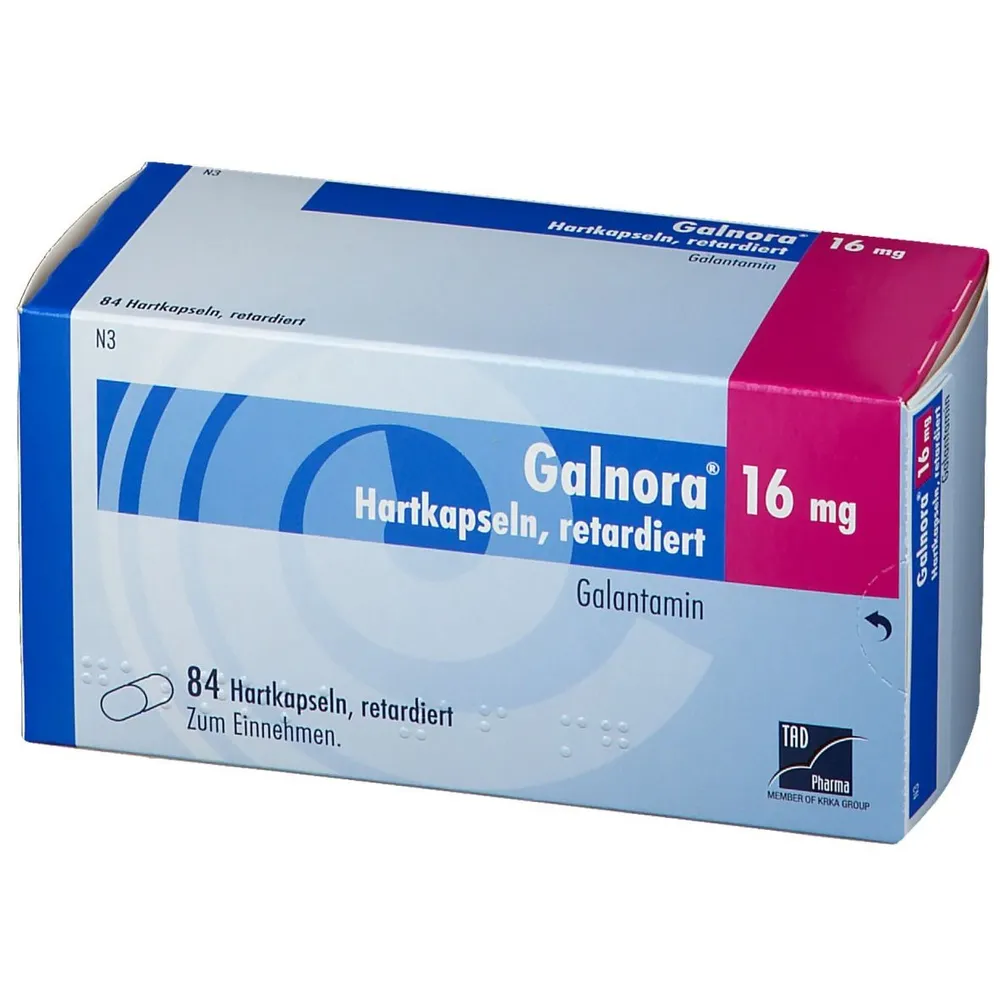
Table of Contents
- Patient Information Leaflet
- GALNORA 8 mg prolonged-release hard capsules, 16 mg prolonged-release hard capsules, 24 mg prolonged-release hard capsules
- 1. What GALNORA is and what it is used for
- 2. What you need to know before taking GALNORA
- 3. How to take GALNORA
- 4. Possible side effects
- 5. How to store GALNORA
- 6. Package contents and other information
Patient Information Leaflet
GALNORA 8 mg prolonged-release hard capsules, 16 mg prolonged-release hard capsules, 24 mg prolonged-release hard capsules
Galantamine
Generic medicine
Please read all of this leaflet carefully before taking this medicine, because it contains important information for you.
- Keep this leaflet. You may need to read it again.
- If you have any questions, ask your doctor or pharmacist.
- This medicine has been prescribed for you only. Do not give it to others, even if their symptoms are the same as yours, as it may be harmful.
- If you experience any side effect, including those not listed in this leaflet, talk to your doctor or pharmacist. See section 4.
Contents of this leaflet:
- What GALNORA is and what it is used for.
- What you need to know before taking GALNORA.
- How to take GALNORA.
- Possible side effects.
- How to store GALNORA.
- Contents of the pack and other information.
1. What GALNORA is and what it is used for
GALNORA contains the active substance "galantamine", which is an antidementia medication. It is used in adults for the symptomatic treatment of mild to moderately severe Alzheimer's dementia, a type of dementia that affects brain functions.
Alzheimer's disease causes increasing memory loss, confusion, and behavioural changes, making it progressively more difficult to carry out normal daily activities.
These effects are thought to be caused by a lack of "acetylcholine", a substance responsible for transmitting signals between nerve cells. GALNORA increases the amount of acetylcholine in the brain and improves the symptoms of the disease.
The capsules are in the form of prolonged-release capsules. This means they release the medication slowly.
2. What you need to know before taking GALNORA
Do not take GALNORA
- if you are allergic to galantamine or to any of the other ingredients of this medicine (listed in section 6).
- if you have severe liver or kidney disease.
Warnings and precautions
Talk to your doctor or pharmacist before taking GALNORA.
This medicine is used only for Alzheimer's disease and is not recommended for other types of memory loss or confusion.
Serious side effects
Galnora can cause severe skin reactions, heart problems, and epileptic seizures (convulsions). You should be aware of these adverse effects while taking Galnora. See section 4 “Be aware of serious adverse effects”.
Before taking Galnora, inform your doctor if you have or have had:
- liver or kidney problems;
- heart conditions (such as chest pain often triggered by physical activity, heart attack, heart failure, slow or irregular heartbeat);
- imbalances in your "electrolyte" levels (naturally occurring chemicals in the blood, such as potassium);
- peptic ulcer (stomach);
- blockage of the stomach or intestines;
- nervous system disorders (such as epilepsy or Parkinson's disease);
- respiratory diseases or infections affecting breathing (such as asthma, chronic obstructive pulmonary disease, pneumonia);
- problems with urination.
Your doctor will decide whether Galnora is suitable for you, or whether the dose needs to be adjusted.
Also inform your doctor if you have recently undergone surgery on your stomach, intestines, or bladder. Your doctor may assess whether Galnora is appropriate for you.
Galnora may cause weight loss. Your doctor will monitor your weight regularly while you are taking Galnora.
Children and adolescents
Galnora is not recommended for children and adolescents.
Other medicines and GALNORA
Inform your doctor or pharmacist if you are taking, have recently taken, or might take any other medicines.
GALNORA must not be taken together with medicines that have a similar mode of action, such as:
- donepezil or rivastigmine (for Alzheimer's disease);
- ambenonium, neostigmine, or pyridostigmine (for severe muscle weakness);
- pilocarpine (when taken orally for dry mouth or dry eyes).
Some medicines may cause adverse effects more frequently in people taking Galnora. These include: - paroxetine or fluoxetine (antidepressants);
- quinidine (for irregular heartbeat);
- ketoconazole (an antifungal);
- erythromycin (an antibiotic);
- ritonavir (for human immunodeficiency virus or 'HIV');
- non-steroidal anti-inflammatory drugs (such as ibuprofen) which increase the risk of ulcers;
- medicines taken for heart conditions or high blood pressure (such as digoxin, amiodarone, atropine, beta-blockers, calcium channel blockers).
If you are taking medicines for irregular heartbeat, your doctor may evaluate your heart condition by performing an electrocardiogram (ECG).
Your doctor may prescribe a lower dose of Galnora if you are also taking any of these medicines.
Galnora may affect certain anaesthetics. If you are scheduled for surgery requiring general anaesthesia, inform your doctor well in advance that you are taking Galnora.
If you have any doubts, consult your doctor or pharmacist.
Pregnancy and breastfeeding
If you are pregnant, think you may be pregnant, are planning a pregnancy, or are breastfeeding, ask your doctor or pharmacist for advice before taking this medicine.
You must not take GALNORA if you are breastfeeding.
Driving and using machines
GALNORA may cause dizziness and drowsiness, especially during the first few weeks of treatment.
Do not drive or operate tools or machinery if you experience these symptoms.
3. How to take GALNORA
Take this medicine exactly as prescribed by your doctor. If you have any doubts, consult your doctor or
pharmacist.
If you are currently taking galantamine tablets or oral solution and your doctor has advised you to
switch to prolonged-release galantamine capsules, please read carefully the instructions in this section
“Switching from galantamine tablets or oral solution to Galnora capsules”.
Dosage
You will start treatment with Galnora at a low dose. The usual starting dose is 8 mg once daily. Your doctor
may gradually increase the dose every 4 weeks or longer until reaching a dose suitable for you. The maximum
dose is 24 mg once daily.
Your doctor will advise you on the starting dose and when the dose should be increased. If you are unsure what to do,
or if you feel that the effect of GALNORA is too strong or too weak, inform your doctor or pharmacist.
Your doctor will need to see you regularly to monitor the medicine’s effect and discuss how you are feeling.
If you have liver or kidney problems, your doctor may prescribe a reduced dose of Galnora, or may decide that
this medicine is not suitable for you.
Switching from galantamine tablets or oral solution to Galnora capsules
If you are currently taking galantamine tablets or oral solution, your doctor may decide that you should switch to
Galnora prolonged-release capsules. If this happens:
- take your last dose of galantamine tablets or oral solution in the evening;
- the following morning, take your first dose of Galnora prolonged-release capsule.
DO NOT take more than one capsule per day. While taking Galnora capsules once daily, DO NOT
take galantamine tablets or oral solution.
How to take GALNORA
GALNORA capsules must be swallowed whole and not chewed or crushed. If you have difficulty swallowing the
capsules, you may open the capsule and swallow the entire contents. Do not chew or crush the contents.
Take your dose of Galnora once daily in the morning with water or other liquids. Try to take Galnora with food. Drink plenty of fluids while taking Galnora to stay hydrated.
If you take more GALNORA than you should
If you take too much GALNORA, contact your doctor or hospital immediately. Bring any remaining capsules and the container with you.
Signs of overdose may include:
- severe nausea and vomiting,
- muscle weakness, slowed heartbeat, seizures (convulsions), and loss of consciousness.
If you forget to take GALNORA
If you forget to take a dose, do not take the missed dose. Take the next dose at the usual time. Do not
take a double dose to make up for the forgotten dose.
If you miss more than one dose, contact your doctor.
If you stop taking GALNORA
Talk to your doctor before stopping treatment with GALNORA. It is important to continue taking
this medicine to treat your condition.
If you have any questions about how to use this medicine, consult your doctor or pharmacist.
4. Possible side effects
Like all medicines, this medicine can cause side effects, although not everyone gets them.
Be alert to serious adverse reactions.
Stop taking the medicine and see a doctor or go immediately to the nearest emergency room if you experience any of the following.
Skin reactions, including:
- Severe rash with blisters and peeling of the skin, particularly around the mouth, nose, eyes and genitals (Stevens-Johnson syndrome).
- Red rashes covered with small pus-filled bumps that may spread over the entire body, sometimes with fever (generalized acute exanthematous pustulosis).
- Rash that may lead to blistering, with spots resembling small marks. These skin reactions are rare in people taking galantamine (may affect up to 1 in 1,000 people).
Heart problems, including changes in heartbeat (such as slow heartbeat, extra beats) or
palpitations (awareness of a fast or irregular heartbeat). Heart problems may show up as abnormalities
on an electrocardiogram (ECG), and may be common in people taking Galnora (may affect up to 1 in 10 people).
Seizures (convulsions). These are uncommon in people taking Galnora (may affect up to 1
in 100 people).
You must stop taking Galnora and seek immediate medical help if you notice any of the
above-mentioned side effects.
Other side effects:
Very common side effects (may affect more than 1 in 10 people):
Nausea and vomiting.
These side effects are more likely to occur during the first weeks of treatment or when the dose is increased. These tend to gradually disappear as the body gets used to the medicine and usually do not last longer than a few days. If you experience these effects, your doctor may advise you to drink more fluids and may prescribe a medicine to relieve your discomfort.
Common side effects (may affect up to 1 in 10 people):
- Weight loss, decreased appetite.
- Seeing, hearing or sensing things that are not real (hallucinations).
- Depression.
- Dizziness or fainting.
- Muscle tremors or spasms.
- Headache.
- Feeling very tired, weak or generally unwell.
- Feeling very sleepy with low energy.
- High blood pressure.
- Stomach pain or discomfort.
- Diarrhoea.
- Indigestion.
- Falls.
- Injuries.
Uncommon side effects (may affect up to 1 in 100 people):
- Allergic reaction.
- Excessive loss of body water (dehydration).
- Tingling or numbness of the skin (pins and needles).
- Changes in taste sensation.
- Daytime sleepiness.
- Blurred vision.
- Ringing or buzzing sounds in the ears (tinnitus).
- Low blood pressure.
- Flushing.
- Feeling of nausea (nausea sensation).
- Excessive sweating.
- Muscle weakness.
- Increased liver enzymes in the blood.
Rare side effects (may affect up to 1 in 1,000 people):
- Inflammation of the liver (hepatitis).
Reporting of side effects
If you get any side effects, including those not listed in this leaflet, talk to your doctor or pharmacist.
You can also report side effects through the national reporting system at
http://www.agenziafarmaco.gov.it/content/come-segnalare-una-sospetta-reazione-avversa.
By reporting side effects, you can help provide more information on the safety of this medicine.
5. How to store GALNORA
Keep this medicine out of the sight and reach of children.
Do not use this medicine after the expiry date stated on the blister and carton after EXP. The expiry date refers to the last day of that month.
Do not store above 30 °C.
Store in the original packaging to protect the medicine from moisture.
Do not dispose of any medicine via wastewater or household waste. Ask your pharmacist how to dispose of medicines you no longer use. This will help protect the environment.
6. Package contents and other information
What GALNORA contains
- The active substance is galantamine. 8 mg: each prolonged-release hard capsule contains 8 mg of galantamine (as bromide). 16 mg: each prolonged-release hard capsule contains 16 mg of galantamine (as bromide). 24 mg: each prolonged-release hard capsule contains 24 mg of galantamine (as bromide).
- The excipients contained in the core of the prolonged-release capsules are sodium lauryl sulfate, methacrylic acid copolymer ammonium salt (type B), hypromellose, carbomers, hydroxypropylcellulose, magnesium stearate and talc.
- The excipients contained in the coating of the 8 mg capsule are gelatin, titanium dioxide (E171), and black ink (shellac, propylene glycol, concentrated ammonia solution, black iron oxide (E172), potassium hydroxide).
- The excipients contained in the coating of the 16 mg and 24 mg capsules are gelatin, titanium dioxide (E171), red iron oxide (E172), yellow iron oxide (E172), and black ink (shellac, propylene glycol, concentrated ammonia solution, black iron oxide (E172), potassium hydroxide).
Description of the appearance of GALNORA and package contents
8 mg: White capsules, size 2 (capsule length: 17.6 - 18.4 mm), with "G8" printed on the cap of the capsule. The capsule content consists of one oval prolonged-release tablet core, white in colour.
16 mg: Pink capsules, size 1 (capsule length: 19.0 - 19.8 mm), with "G16" printed on the cap of the capsule. The capsule content consists of two oval prolonged-release tablet cores, white in colour.
24 mg: Orange-pink capsules, size 0 (capsule length: 23.8 - 24.6 mm), with "G24" printed on the cap of the capsule. The capsule content consists of three oval prolonged-release tablet cores, white in colour.
The capsules are available in boxes containing blisters of 10, 14, 28, 30, 56, 60, 84, 90 and 100 prolonged-release hard capsules.
Not all pack sizes may be marketed.
Marketing Authorization Holder
KRKA, d.d., Novo mesto, Šmarješka cesta 6, 8501 Novo mesto, Slovenia
Responsible manufacturers for batch release
KRKA, d.d., Novo mesto, Šmarješka cesta 6, 8501 Novo mesto, Slovenia
TAD Pharma GmbH, Heinz-Lohmann-Straße 5, 27472 Cuxhaven, Germany
Local representative in Italy
KRKA Farmaceutici Milano S.r.l., Viale Achille Papa 30, 20149 Milano, Italy
This medicinal product is authorized in the European Economic Area countries under the following names:
| Member State | Medicinal product name |
| Slovenia | Vertusal SR |
| France | Galantamine Krka LP |
| Spain | GALANTAMINA KERN PHARMA |
| Italy | Galnora |
| Portugal | Galantamina Generis |
| United Kingdom | Galsya XL |