Gabitril
Italy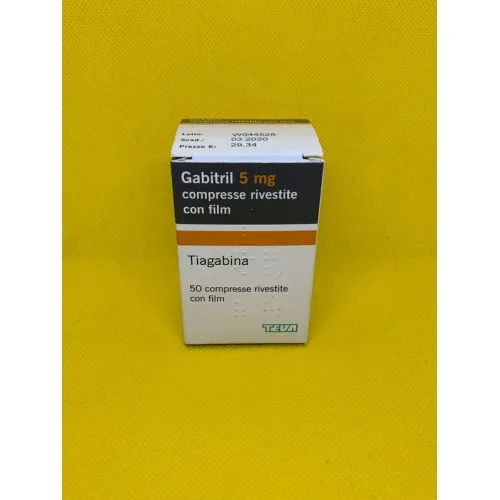
Table of Contents
- Package leaflet: Information for the user
- Gabitril 5 mg film-coated tablets, 10 mg film-coated tablets, 15 mg film-coated tablets
- 1. What Gabitril is and what it is used for
- 2. What you need to know before taking Gabitril
- 3. How to take Gabitril
- 4. Possible side effects
- 5. How to store Gabitril
- 6. Package contents and other information
Package leaflet: Information for the user
Gabitril 5 mg film-coated tablets, 10 mg film-coated tablets, 15 mg film-coated tablets
Tiagabine (as monohydrochloride)
Please read this leaflet carefully before taking this medicine because it contains important information for you.
- Keep this leaflet. You may need to read it again.
- If you have any questions, ask your doctor or pharmacist.
- This medicine has been prescribed for you only. Do not give it to other people, even if their symptoms are the same as yours, because it could be harmful.
- If you experience any side effects, including those not listed in this leaflet, tell your doctor or pharmacist. See section 4.
Contents of this leaflet:
- What Gabitril is and what it is used for
- What you need to know before taking Gabitril
- How to take Gabitril
- Possible side effects
- How to store Gabitril
- Contents of the pack and other information
1. What Gabitril is and what it is used for
Gabitril is a medicine used to treat epilepsy. Tiagabine, the active ingredient in Gabitril, increases the level of gamma-aminobutyric acid (GABA) in the brain, a substance that helps prevent or reduce the number of epileptic seizures.
Gabitril is used to help control epilepsy in adults and adolescents over 12 years of age who have partial seizures.
It is used in combination with other medicines when these are not sufficiently effective on their own.
2. What you need to know before taking Gabitril
Do not take Gabitril
- if you are allergic to tiagabine or to any of the other ingredients of this medicine (listed in section 6).
- if you have severe liver disease.
- in combination with herbal preparations containing St. John's Wort (Hypericum perforatum). See "Other medicines and Gabitril".
Warnings and precautions
Talk to your doctor or pharmacist before taking Gabitril
- if you are under 12 years of age.
- if you have generalized epilepsy, as absence seizures (brief periods of impaired consciousness) may worsen.
- if you stop treatment with Gabitril, as this may cause seizures to return. Do not stop treatment with Gabitril without consulting your doctor.
- if you feel anxious or depressed, or have had such symptoms in the past, as these may worsen or reappear during treatment with Gabitril. Inform your doctor if you feel withdrawn, depressed, or anxious.
- a small number of people treated with antiepileptic medicines such as tiagabine have had thoughts about harming themselves or committing suicide. If you experience such thoughts, contact your doctor immediately.
- if you notice an increase in the number of seizures or new types of seizures, you must inform your doctor. He or she will advise you on any changes that may be needed in your treatment.
- if you develop a severe skin rash, including fluid-filled blisters or vesicles, or if you notice spontaneous bruising or skin discoloration, contact your doctor immediately.
- if you notice any visual disturbances, contact your doctor, as Gabitril may rarely cause visual field defects.
- if your doctor has informed you that you have an intolerance to certain sugars, you must not take Gabitril, as it contains lactose.
- if you have mild or moderate liver problems, your doctor will need to adjust the prescribed dose of Gabitril.
If you have experienced or have previously experienced any of these symptoms, inform your doctor.
Other medicines and Gabitril
Tell your doctor or pharmacist if you are taking, have recently taken, or might take any other medicines.
In particular, before starting treatment with Gabitril, inform your doctor or pharmacist if you are taking or have recently taken any of the following medicines:
- Other antiepileptic medicines such as phenytoin, carbamazepine, phenobarbital, and primidone, as they may reduce and shorten the effects of Gabitril.
- Herbal preparations containing St. John's Wort (Hypericum perforatum), as they must not be taken together with Gabitril (see "Do not take Gabitril").
- Rifampicin (a medicine used to treat tuberculosis), as it may reduce or shorten the effects of Gabitril.
If you take Gabitril together with one or more of these medicines, your doctor may adjust the dose of Gabitril.
Gabitril with food and drink
Take Gabitril tablets during a meal or snack.
Pregnancy, breastfeeding, and fertility
As a precautionary measure, it is preferable not to take Gabitril during pregnancy or breastfeeding.
If you are pregnant, suspect you may be pregnant, plan to become pregnant, or are breastfeeding, consult your doctor or pharmacist before taking this medicine.
Driving and using machines
Ask your doctor whether it is safe for you to drive or use machinery. Gabitril may cause dizziness, drowsiness, or fatigue, especially at the beginning of treatment. Do not drive or operate machinery if you feel dizzy, drowsy, or tired.
Gabitril contains lactose.
If your doctor has diagnosed you with an intolerance to certain sugars, contact him or her before taking this medicine.
3. How to take Gabitril
Take this medicine exactly as your doctor has told you. If you are in doubt, consult your doctor or pharmacist.
Gabitril tablets should be swallowed with a glass of water, during a meal or a snack.
When you first start taking Gabitril, your doctor will guide you to find the dose that best controls your epilepsy. You will begin by taking Gabitril tablets once or twice daily. The dose will then be gradually increased until it is sufficient to control your epilepsy. Once your dose has been established, you may need to take Gabitril tablets two or three times a day.
At the beginning of treatment with Gabitril, the dose is 5–10 mg per day. The dosage is increased weekly by 5–10 mg per day.
Depending on other medicines you are taking, the average maintenance dose of Gabitril may range between 15 and 50 mg per day, although sometimes higher doses may be prescribed.
If you have mild or moderate liver problems, your doctor will need to adjust your Gabitril dose.
Gabitril tablets may be used with caution for the treatment of elderly patients. Your doctor will decide whether it is the most appropriate treatment for you.
If you take more Gabitril than you should
The most common symptoms of Gabitril overdose are seizures, mutism and apparent unresponsiveness, coma, difficulty with coordination of movements, drowsiness, dizziness, confusion, difficulty speaking, agitation, tremors, involuntary muscle contractions, vomiting, and hostile behaviour.
If you have taken too many tablets or if a child has taken any, contact your doctor or the nearest hospital immediately.
If you forget to take Gabitril
If you forget to take a dose, continue taking the medicine as prescribed by your doctor.
Do not take a double dose to make up for the forgotten tablet.
If you stop taking Gabitril
You must continue taking Gabitril for the length of time prescribed by your doctor.
Do not stop taking Gabitril without first talking to your doctor, as there is a risk of seizures returning. Your doctor will explain how to gradually reduce the dose (over a period of 2–3 weeks).
If you have further questions about the use of this medicine, ask your doctor or pharmacist.
4. Possible side effects
Like all medicines, this medicine can cause side effects, although not everyone gets them.
Side effects are generally mild to moderate. Most occur during the first months of treatment and are often temporary. They may include:
Very common side effects (may occur in more than 1 in 10 patients):
- Dizziness
- Tremor
- Drowsiness
- Depressed mood
- Nervousness
- Difficulty concentrating
- Fatigue
- Feeling unwell (nausea)
Common side effects (may occur in less than 1 in 10 patients, but in more than 1 in 100):
- Diarrhoea
- Bruising (skin discolouration). If you notice bruising, contact your doctor immediately.
Uncommon side effects (may occur in less than 1 in 100 patients, but in more than 1 in 1,000):
Rare side effects (may occur in less than 1 in 1,000 patients, but in more than 1 in 10,000):
- Non-convulsive epileptic status, slowing of brain activity measured by electroencephalogram (EEG), due to either rapid dose adjustment or an increase in the dose of the medicine
- Visual disturbances
- Confusion
- Hallucinations
- Agitation
- Delusions
Side effects with unknown frequency (the exact frequency cannot be determined from the available data):
- Encephalopathy (lethargy, mental confusion with or without seizures).
- Severe skin rash with blistering. If you notice any of these skin symptoms, contact your doctor immediately.
- Severe skin rash, including fluid-filled blisters or vesicles; or a severe rash with redness and peeling of the skin.
- Feeling unwell (vomiting), abdominal pain.
- Difficulty sleeping, excessive emotional feelings, hostile behaviours.
- Difficulty controlling movements; abnormal gait, walking or running; difficulty speaking.
- Muscle contraction.
- Blurred vision.
Reporting of side effects
If you experience any side effect, including those not listed in this leaflet, talk to your doctor, pharmacist, or nurse. You can also report side effects directly via the national reporting system at http://www.agenziafarmaco.gov.it/it/responsabili. By reporting side effects, you can help provide more information on the safety of this medicine.
5. How to store Gabitril
Keep this medicine out of sight and reach of children.
Do not use Gabitril after the expiry date which is stated on the carton and on the bottle after
“Exp.”. The expiry date refers to the last day of that month.
Do not refrigerate or freeze.
Store in the original packaging.
Remove the medicine from its packaging only when ready to use it.
Do not remove the desiccant container (small cylindrical jar) inside the bottle.
Do not use Gabitril if you notice any changes in the appearance of the tablets (for example, if their colour has changed: they are normally white).
Do not dispose of any medicine via wastewater or household waste. Ask your pharmacist how to dispose of medicines no longer required. This will help protect the environment.
6. Package contents and other information
What Gabitril contains:
- The active substance is tiagabine, present in the medicinal product as monohydrate hydrochloride. Each film-coated tablet of Gabitril 5 mg contains 5 mg of tiagabine. Each film-coated tablet of Gabitril 10 mg contains 10 mg of tiagabine. Each film-coated tablet of Gabitril 15 mg contains 15 mg of tiagabine.
- The other components are:
Tablet core: Microcrystalline cellulose (E460)
Ascorbic acid (E300)
Anhydrous lactose
Pregelatinized maize starch
Crospovidone
Anhydrous colloidal silica (E 551)
Hydrogenated vegetable oil (Type 1)
Stearic acid
Magnesium stearate
Film coating: Hypromellose
Hydroxypropylcellulose (E 463)
Titanium dioxide (E171)
Description of the appearance of Gabitril and package contents
Gabitril is available as white, film-coated tablets.
The film-coated tablets of Gabitril 5 mg are round and marked with “251”.
The film-coated tablets of Gabitril 10 mg are oval and marked with “252”.
The film-coated tablets of Gabitril 15 mg are oval and marked with “253”.
The film-coated tablets of Gabitril are supplied in plastic bottles with screw caps.
The plastic bottle of Gabitril contains a container for the desiccant, which appears as a cylindrical jar.
Caution: Do not swallow it.
The film-coated tablets of Gabitril are available in bottles containing 50 or 100 film-coated tablets.
Not all pack sizes may be marketed.
Marketing Authorization Holder and Manufacturer
Marketing Authorization Holder:
Teva Italia S.r.l. – Piazzale Luigi Cadorna, 4 - 20123 Milan, Italy
Manufacturer:
Almac Pharma Services
Seagoe Industrial Estate
Craigavon
Co Armagh
BT63 5UA United Kingdom
This medicinal product is authorized in the European Economic Area countries under the following names:
Gabitril