Fycompa
Italy
Table of Contents
- Patient Information Leaflet
- Fycompa 2 mg, 4 mg, 6 mg, 8 mg, 10 mg and 12 mg film-coated tablets
- 1. What Fycompa is and what it is used for
- 2. What you need to know before taking Fycompa
- 3. How to take Fycompa
- 4. Possible side effects
- 5. How to store Fycompa
- 6. Package contents and other information
- Package leaflet: Information for the user
- Fycompa 0.5 mg/ml oral suspension
- 1. What Fycompa is and what it is used for
- 2. What you should know before taking Fycompa
- 3. How to use Fycompa
- 4. Possible side effects
- 5. How to store Fycompa
- 6. Package contents and other information
Patient Information Leaflet
Fycompa 2 mg, 4 mg, 6 mg, 8 mg, 10 mg and 12 mg film-coated tablets
Perampanel
Please read all of this leaflet carefully before taking this medicine, as it contains
important information for you.
- Keep this leaflet. You may need to read it again.
- If you have any questions, ask your doctor or pharmacist.
- This medicine has been prescribed for you only. Do not pass it on to others, even if they have the same symptoms as you, because it may be harmful.
- If you experience any side effects, including those not listed in this leaflet, talk to your doctor or pharmacist. See section 4.
Contents of this leaflet
- What Fycompa is and what it is used for
- What you need to know before taking Fycompa
- How to take Fycompa
- Possible side effects
- How to store Fycompa
- Contents of the pack and other information
1. What Fycompa is and what it is used for
Fycompa contains a medicine called perampanel. It belongs to a group of medicines
called antiepileptics. These medicines are used to treat epilepsy, a condition in which a person has
repeated seizures (epileptic seizures). Your doctor has prescribed it for you to reduce the
number of epileptic seizures.
Fycompa is used in combination with other antiepileptic medicines for the treatment of certain types of
epilepsy:
In adults, adolescents (aged 12 years and older), and children (aged between 4 and
11 years)
- It is used to treat epileptic seizures affecting one part of the brain (called “partial seizures”).
- These partial seizures may or may not be followed by a seizure affecting the entire brain (called “secondary generalization”). In adults, adolescents (aged 12 years and older), and children (aged between 7 and 11 years)
- It is also used to treat certain epileptic seizures that affect the entire brain from the onset (called “generalized seizures”) and that cause convulsions or absence seizures.
2. What you need to know before taking Fycompa
DO NOT TAKE Fycompa:
- if you have ever developed a severe skin rash or skin peeling, blistering and/or mouth ulcers after taking perampanel.
- if you are allergic to perampanel or to any of the other ingredients of this medicine (listed in section 6).
Warnings and precautions
Talk to your doctor or pharmacist before taking Fycompa if you have liver problems or moderate to severe kidney problems.
You must not take Fycompa if you have severe liver problems or moderate to severe kidney problems.
Before taking this medicine, inform your doctor if you have previously had problems with alcoholism or drug dependence.
Increases in liver enzymes have been reported in some patients taking Fycompa in combination with other antiepileptic drugs.
- Fycompa may cause dizziness or drowsiness, especially at the beginning of treatment.
- Fycompa may increase the risk of falls, particularly in elderly people; this may be due to the underlying disease.
- Fycompa may cause aggression, anger or violence. It may also cause unusual or extreme changes in behaviour or mood, abnormal thinking and/or loss of contact with reality. If you or a family member or friend notices any of these reactions, consult your doctor or pharmacist.
A small number of people treated with antiepileptic medicines have had thoughts of harming themselves or taking their own life. If at any time you have such thoughts, contact your doctor immediately.
Serious skin reactions have been reported with the use of perampanel, including Drug Reaction with Eosinophilia and Systemic Symptoms (DRESS) and Stevens-Johnson Syndrome (SJS).
- DRESS usually presents, although not exclusively, with flu-like symptoms and a rash accompanied by high body temperature, increased levels of liver enzymes found in blood tests, an increase in a type of white blood cell (eosinophilia), and swollen lymph nodes.
- Stevens-Johnson Syndrome (SJS) may initially appear as red, "target-like" spots or circular patches, often with central blisters, located on the trunk. In addition, ulcers may develop in the mouth, throat, nose, genitals, and eyes (red and swollen eyes). These serious skin reactions are often preceded by fever and/or flu-like symptoms. Skin rashes may progress to widespread peeling and potentially life-threatening complications, or may be fatal.
If any of the above conditions occur after taking Fycompa (or if you are unsure), consult your doctor or pharmacist.
Children
Fycompa is not recommended in children under 4 years of age. Safety and efficacy have not yet been established in children under 4 years of age for partial seizures and under 7 years of age for generalized seizures.
Other medicines and Fycompa
Inform your doctor or pharmacist if you are taking, have recently taken, or might take any other medicines, including those without a prescription and herbal medicines.
Taking Fycompa with certain other medicines may cause side effects or affect how they work. Do not start or stop treatment with other medicines without consulting your doctor or pharmacist.
- Other antiepileptic medicines, such as carbamazepine, oxcarbazepine, and phenytoin, used to treat epileptic seizures, may affect Fycompa. Inform your doctor if you are taking or have recently taken these medicines, as your dose may need to be adjusted.
- Felbamate (a medicine used to treat epilepsy) may also affect Fycompa. Inform your doctor if you are taking or have recently taken this medicine, as your dose may need to be adjusted.
- Midazolam (a medicine used to stop prolonged acute (sudden) seizures, for sedation, and for sleep problems) may be affected by Fycompa. Inform your doctor if you are taking midazolam, as your dose may need to be adjusted.
- Other medicines, such as rifampicin (a medicine used to treat bacterial infections), St. John’s wort (a herbal medicine used to treat mild anxiety), and
ketoconazole (a medicine used to treat fungal infections), may affect Fycompa. Inform your doctor if you are taking or have recently taken these
medicines, as your dose may need to be adjusted.
- Hormonal contraceptives (including oral contraceptives, implants, injections, and patches). Inform your doctor if you are taking hormonal contraceptives. Fycompa may reduce the effectiveness of certain hormonal contraceptives, such as levonorgestrel. During treatment with Fycompa, you must use other effective and reliable contraceptive methods (such as condoms or an intrauterine device) and continue using them for one month after stopping treatment. Discuss with your doctor the contraceptive method suitable for you.
Fycompa and alcohol
Consult your doctor before drinking alcohol. Be cautious about consuming alcohol while taking medicines for epilepsy, including Fycompa.
- Drinking alcohol during treatment with Fycompa may reduce your level of alertness and affect your ability to drive or operate tools or machinery.
- Drinking alcohol during treatment with Fycompa may also worsen possible feelings of anger, confusion, or sadness.
Pregnancy and breastfeeding
If you are pregnant, think you may be pregnant, are planning to become pregnant, or are breastfeeding, consult your doctor before taking this medicine. Do not stop treatment without first discussing it with your doctor.
- Fycompa is not recommended during pregnancy.
- To avoid becoming pregnant during treatment with Fycompa, you must use a reliable method of contraception and continue using it for one month after stopping treatment. Inform your doctor if you are taking hormonal contraceptives. Fycompa may reduce the effectiveness of certain hormonal contraceptives, such as levonorgestrel. During treatment with Fycompa, you must use other effective and safe contraceptive methods (such as condoms or an intrauterine device) and continue using them for one month after stopping treatment. Discuss with your doctor the contraceptive method suitable for you. It is not known whether the components of Fycompa pass into breast milk. Your doctor will assess the benefits and risks to the infant if treatment with Fycompa is necessary during breastfeeding.
Driving and using machines
Do not drive and do not use machines until you are certain how Fycompa affects you. Talk to your doctor about the effects of epilepsy on driving and using machines.
- Fycompa may cause dizziness or drowsiness, especially at the beginning of treatment. If this occurs, do not drive and do not use tools or machinery.
- Drinking alcohol during treatment with Fycompa may worsen these effects.
Fycompa contains lactose
Fycompa contains lactose (a type of sugar). If your doctor has diagnosed you with an intolerance to certain sugars, contact them before taking this medicine.
3. How to take Fycompa
Take this medicine exactly as your doctor has told you. If you are unsure, consult your doctor or pharmacist.
Dosage
Adults and adolescents (aged 12 years and older) for the treatment of partial-onset seizures and generalized seizures:
The usual starting dose is 2 mg once daily taken before bedtime.
- Your doctor may increase this dose in increments of 2 mg, up to a maintenance dose between 4 mg and 12 mg, depending on your response to treatment.
- If you have mild or moderate liver problems, the dose must not exceed 8 mg per day, and dose increases should be made at intervals of at least 2 weeks.
- Do not take a dose of Fycompa higher than that recommended by your doctor. It may take several weeks to find the right Fycompa dose for you.
The table below summarizes the recommended doses for the treatment of partial-onset seizures in children aged 4 to 11 years and generalized seizures in children aged 7 to 11 years.
Further details are provided below the table.
| Children with weight: | |||
| over 30 kg | between 20 kg and less than 30 kg | under 20 kg | |
| Recommended initial dose | 2 mg/day | 1 mg/day | 1 mg/day |
| Recommended maintenance dose | 4–8 mg/day | 4–6 mg/day | 2–4 mg/day |
| Maximum recommended dose | 12 mg/day | 8 mg/day | 6 mg/day |
Children (aged between 4 and 11 years) weighing at least 30 kg or more, for the treatment of partial
seizures:
The usual starting dose is 2 mg once daily before bedtime.
- The doctor may increase this dose in increments of 2 mg, up to a maintenance dose between 4 mg and 8 mg, depending on response to treatment. Depending on individual clinical response and tolerability, the dose may be increased up to a maximum dose of 12 mg/day.
- If the child has mild or moderate liver problems, the dose must not exceed 4 mg per day, and dose increases should be made at intervals of at least 2 weeks.
- The child must not take a dose of Fycompa higher than that recommended by the doctor. It may take several weeks to find the right dose of Fycompa for the child.
Children (aged between 4 and 11 years) weighing between 20 kg and less than 30 kg, for the treatment of
partial seizures:
The usual starting dose is 1 mg once daily before bedtime.
- The doctor may increase this dose in increments of 1 mg, up to a maintenance dose between 4 mg and 6 mg, depending on response to treatment. Depending on individual clinical response and tolerability, the dose may be increased up to a maximum dose of 8 mg/day.
- If the child has mild or moderate liver problems, the dose must not exceed 4 mg per day, and dose increases should be made at intervals of at least 2 weeks.
- The child must not take a dose of Fycompa higher than that recommended by the doctor. It may take several weeks to find the right dose of Fycompa for the child.
Children (aged between 4 and 11 years) weighing less than 20 kg, for the treatment of partial seizures:
The usual starting dose is 1 mg once daily before bedtime.
- The doctor may increase this dose in increments of 1 mg, up to a maintenance dose between 2 mg and 4 mg, depending on response to treatment. Depending on individual clinical response and tolerability, the dose may be increased up to a maximum dose of 6 mg/day.
- If the child has mild or moderate liver problems, the dose must not exceed 4 mg per day and dose increases should be made at intervals of at least 2 weeks.
- The child must not take a dose of Fycompa higher than that recommended by the doctor. It may take several weeks to find the right dose of Fycompa for the child.
Children (aged between 7 and 11 years) weighing at least 30 kg, for the treatment of generalized
seizures:
The usual starting dose is 2 mg once daily before bedtime.
- The doctor may increase this dose in increments of 2 mg, up to a maintenance dose between 4 mg and 8 mg, depending on response to treatment. Depending on individual clinical response and tolerability, the dose may be increased up to a maximum dose of 12 mg/day.
- If the child has mild or moderate liver problems, the dose must not exceed 4 mg per day and dose increases should be made at intervals of at least 2 weeks.
- The child must not take a dose of Fycompa higher than that recommended by the doctor. It may take several weeks to find the right dose of Fycompa for the child.
Children (aged between 7 and 11 years) weighing between 20 kg and less than 30 kg, for the treatment of
generalized seizures:
The usual starting dose is 1 mg once daily before bedtime.
- The doctor may increase this dose in increments of 1 mg, up to a maintenance dose between 4 mg and 6 mg, depending on response to treatment. Depending on individual clinical response and tolerability, the dose may be increased up to a maximum dose of 8 mg/day.
- If the child has mild or moderate liver problems, the dose must not exceed 4 mg per day and dose increases should be made at intervals of at least 2 weeks.
- The child must not take a dose of Fycompa higher than that recommended by the doctor. It may take several weeks to find the right dose of Fycompa for the child.
Children (aged between 7 and 11 years) weighing less than 20 kg, for the treatment of generalized
seizures:
The usual starting dose is 1 mg once daily before bedtime.
- The doctor may increase this dose in increments of 1 mg, up to a maintenance dose between 2 mg and 4 mg, depending on response to treatment. Depending on individual clinical response and tolerability, the dose may be increased up to a maximum dose of 6 mg/day.
- If the child has mild or moderate liver problems, the dose must not exceed 4 mg per day and dose increases should be made at intervals of at least 2 weeks.
- The child must not take a dose of Fycompa higher than that recommended by the doctor. It may take several weeks to find the right dose of Fycompa for the child.
How to take Fycompa
The tablet should be swallowed whole with a glass of water. Fycompa can be taken with or without food.
Do not chew, crush, or split the tablet. The tablets cannot be accurately divided because they do not have a score line.
If you take more Fycompa than you should
If you have taken more Fycompa than you should, contact your doctor immediately. Symptoms may include confusion, agitation, aggressive behaviour, and reduced level of consciousness.
If you forget to take Fycompa
- If you forget to take a tablet, wait until the next scheduled dose and then continue as usual.
- Do not take a double dose to make up for the forgotten dose.
- If you have missed less than 7 days of Fycompa treatment, continue taking the daily tablet according to your doctor's initial instructions.
- If you have missed more than 7 days of Fycompa treatment, inform your doctor immediately.
If you stop taking Fycompa
Take Fycompa for the entire period recommended by your doctor. Do not stop treatment unless instructed by your doctor. Your doctor may gradually reduce the dose to prevent seizures (epileptic seizures) from returning or worsening.
If you have any questions about using this medicine, consult your doctor or pharmacist.
4. Possible side effects
Like all medicines, this medicine can cause side effects, although not everyone experiences them.
A small number of people treated with antiepileptic medicines have had thoughts of harming themselves or of suicide. If you experience such thoughts at any time, contact your doctor immediately.
Very common (may affect more than 1 in 10 people):
- dizziness
- feeling sleepy (lethargy or drowsiness)
Common (may affect more than 1 in 100 people):
- reduced or increased appetite, weight gain
- aggression, anger, irritability, anxiety or confusion
- difficulty walking or other balance problems [ataxia (loss of muscular coordination), gait disturbance, balance disorder]
- slowness of speech (dysarthria)
- blurred vision or double vision (diplopia)
- feeling of dizziness
- nausea
- back pain
- feeling very tired (fatigue)
- fall
Uncommon (may affect more than 1 in 1,000 people):
- thoughts of self-harm or of suicide (suicidal thoughts), suicide attempt
- hallucinations (seeing, hearing or sensing things that are not real)
- abnormal thinking and/or loss of contact with reality (psychotic disorder)
Not known (frequency cannot be estimated from the available data):
- Drug reaction with eosinophilia and systemic symptoms, also known as DRESS or drug hypersensitivity syndrome: widespread rash, elevated body temperature, increased liver enzymes, blood abnormalities (eosinophilia), swollen lymph nodes and involvement of other organs.
- Stevens-Johnson syndrome (SJS). This serious skin rash may appear as red, target-like spots or circular patches, often with central blisters, usually on the trunk, skin peeling, mouth, throat, nose, genital and eye ulcers, and may be preceded by fever and flu-like symptoms.
Stop taking perampanel if you develop any of these symptoms and contact your doctor or seek immediate medical attention. See also section 2.
Reporting of side effects
If you experience any side effect, including those not listed in this leaflet, talk to your doctor or pharmacist. You can also report side effects directly via the national reporting system listed in Annex V. Reporting side effects can help provide more information on the safety of this medicine.
5. How to store Fycompa
Keep this medicine out of the sight and reach of children.
Do not use this medicine after the expiry date stated on the carton and blister pack. The expiry date refers to the last day of that month.
This medicine does not require any special storage conditions.
Do not dispose of medicines via wastewater or household waste. Ask your pharmacist how to dispose of medicines you no longer use. This will help protect the environment.
6. Package contents and other information
What Fycompa contains
The active substance is perampanel. Each film-coated tablet contains 2 mg, 4 mg, 6 mg, 8 mg,
10 mg or 12 mg of perampanel.
The other components are:
Tablet core (2 mg and 4 mg tablets):
monohydrate lactose, low-substituted hydroxypropylcellulose, povidone, magnesium stearate (E470b)
Tablet core (6 mg, 8 mg, 10 mg and 12 mg tablets):
monohydrate lactose, low-substituted hydroxypropylcellulose, povidone, microcrystalline cellulose,
magnesium stearate (E470b)
Tablet coating (2 mg, 4 mg, 6 mg, 8 mg, 10 mg and 12 mg tablets):
hypromellose 2910, talc, macrogol 8000, titanium dioxide (E171), colourants*
* The colourants are:
2 mg tablet: Yellow iron oxide (E172), red iron oxide (E172)
4 mg tablet: Red iron oxide (E172)
6 mg tablet: Red iron oxide (E172)
8 mg tablet: Red iron oxide (E172), black iron oxide (E172)
10 mg tablet: Yellow iron oxide (E172), indigo carmine aluminium lake FD&C Blue #2 (E132)
12 mg tablet: Indigo carmine aluminium lake FD&C Blue #2 (E132)
Description of the appearance of Fycompa and pack contents
All Fycompa tablets are film-coated, biconvex, round tablets.
2 mg: orange, with "E275" engraved on one side and "2" on the other
4 mg: red, with "E277" engraved on one side and "4" on the other
6 mg: pink, with "E294" engraved on one side and "6" on the other
8 mg: purple, with "E295" engraved on one side and "8" on the other
10 mg: green, with "E296" engraved on one side and "10" on the other
12 mg: blue, with "E297" engraved on one side and "12" on the other
Fycompa is available in packs of:
2 mg tablet – pack of 7, 28 and 98
4 mg, 6 mg, 8 mg, 10 mg, 12 mg tablets – packs of 7, 28, 84 and 98
Not all pack sizes may be marketed.
Marketing Authorisation Holder
Eisai GmbH
Edmund-Rumpler-Straße 3
60549 Frankfurt am Main
Germany
e-mail: [email protected]
Manufacturer
Eisai GmbH
Edmund-Rumpler-Straße 3
60549 Frankfurt am Main
Germany
For further information on this medicinal product, please contact the local representative of the Marketing Authorisation Holder:
België/Belgique/Belgien Lietuva
Eisai SA/NV Eisai GmbH
Tél/Tel: +32 (0)800 158 58 Tel: + 49 (0) 69 66 58 50
(Vokietija)
България Luxembourg/Luxemburg
Eisai GmbH Eisai SA/NV
Teл.: + 49 (0) 69 66 58 50 Tél/Tel: +32 (0)800 158 58
(Германия) (Belgique/Belgien)
Česká republika Malta
Eisai GesmbH organizačni složka Cherubino LTD
Tel: + 420 242 485 839 Tel: +356 21343270
Danmark Nederland
Eisai AB Eisai B.V.
Tlf: + 46 (0) 8 501 01 600 Tel: + 31 (0) 900 575 3340
(Sverige)
Deutschland Norge
Eisai GmbH Eisai AB
Tel: + 49 (0) 69 66 58 50 Tlf: + 46 (0) 8 501 01 600
Eesti Österreich
Eisai GmbH Eisai GesmbH
Tel: + 49 (0) 69 66 58 50 Tel: + 43 (0) 1 535 1980-0
Ελλάδα Polska
Arriani Pharmaceutical S.A. Eisai GmbH
Τηλ: + 30 210 668 3000 Tel: + 49 (0) 69 66 58 50
(Niemcy)
España Portugal
Eisai Farmacéutica, S.A. Eisai Farmacêtica, Unipessoal Lda
Tel: + (34) 91 455 94 55 Tel: + 351 214 875 540
France România
Eisai SAS Eisai GmbH
Tél: + (33) 1 47 67 00 05 Tel: + 49 (0) 69 66 58 50
(Germania)
Hrvatska Slovenija
Eisai GmbH Eisai GmbH
Tel: + 49 (0) 69 66 58 50 Tel: + 49 (0) 69 66 58 50
(Njemačka) (Nemčija)
Ireland Slovenská republika
Eisai GmbH Eisai GesmbH organizačni složka
Tel: + 49 (0) 69 66 58 50 Tel.: + 420 242 485 839
(Germany) (Česká republika)
Ísland Suomi/Finland
Eisai AB Eisai AB
Sími: + 46 (0)8 501 01 600 Puh/Tel: + 46 (0) 8 501 01 600
(Svíþjóð) (Ruotsi)
Italia Sverige
Eisai S.r.l. Eisai AB
Tel: + 39 02 5181401 Tel: + 46 (0) 8 501 01 600
Κύπρος United Kingdom (Northern Ireland)
Arriani Pharmaceuticals S.A. Eisai GmbH
Τηλ: + 30 210 668 3000 Tel: + 49 (0) 69 66 58 50
(Ελλάδα) (Germany)
More detailed information on this medicinal product is available on the European Medicines Agency website: http://www.ema.europa.eu.
Package leaflet: Information for the user
Fycompa 0.5 mg/ml oral suspension
Perampanel
Please read this leaflet carefully before taking this medicine because it contains
important information for you.
- Keep this leaflet. You may need to read it again.
- If you have any questions, ask your doctor or pharmacist.
- This medicine has been prescribed for you only. Do not give it to other people, even if they have the same symptoms as you, because it could be harmful.
- If you experience any side effects, including those not listed in this leaflet, contact your doctor or pharmacist. See section 4.
Contents of this leaflet
- What Fycompa is and what it is used for
- What you need to know before taking Fycompa
- How to use Fycompa
- Possible side effects
- How to store Fycompa
- Contents of the pack and other information
1. What Fycompa is and what it is used for
Fycompa contains a medicine called perampanel. It belongs to a group of medicines
called antiepileptic drugs. These medicines are used to treat epilepsy, a condition in which a person
experiences repeated seizures (epileptic fits). Your doctor has prescribed it for you to reduce the
number of epileptic seizures.
Fycompa is used in combination with other antiepileptic medicines to treat certain types of
epilepsy:
In adults, adolescents (aged 12 years and older), and children (aged between 4 and
11 years)
- It is used to treat epileptic seizures affecting one part of the brain (called “partial seizures”).
- These partial seizures may or may not be followed by a seizure affecting the entire brain (called “secondary generalization”). In adults, adolescents (aged 12 years and older), and children (aged between 7 and 11 years)
- It is also used to treat certain epileptic seizures that affect the entire brain from the start (called “generalized seizures”) and that cause convulsions or absence seizures.
2. What you should know before taking Fycompa
DO NOT TAKE Fycompa:
- if you have ever developed a severe skin rash or skin peeling, blistering, and/or mouth ulcers after taking perampanel.
- if you are allergic to perampanel or to any of the other ingredients of this medicine (listed in section 6).
Warnings and precautions
Talk to your doctor or pharmacist before taking Fycompa if you have liver problems or moderate to severe kidney problems.
You must not take Fycompa if you have severe liver problems or moderate to severe kidney problems.
Before taking this medicine, inform your doctor if you have previously had problems with alcoholism or drug dependence.
Cases of increased liver enzymes have been reported in some patients taking Fycompa in combination with other antiepileptic drugs.
- Fycompa may cause dizziness or drowsiness, especially at the beginning of treatment.
- Fycompa may increase the risk of falls, particularly in elderly people; this may be due to the underlying disease.
- Fycompa may cause aggression, anger, or violent behaviour. It may also cause unusual or extreme changes in behaviour or mood, abnormal thinking and/or loss of contact with reality. If you or a family member and/or friend notice any of these reactions, consult your doctor or pharmacist.
A small number of people treated with antiepileptic medicines have had thoughts of harming themselves or of suicide. If you have these thoughts at any time, contact your doctor immediately.
Serious skin reactions, including drug reaction with eosinophilia and systemic symptoms (DRESS) and Stevens-Johnson syndrome (SJS), have been reported with the use of perampanel.
- DRESS usually presents, although not exclusively, with flu-like symptoms and a rash accompanied by high body temperature, elevated liver enzyme levels found in blood tests, increased levels of a type of white blood cells (eosinophilia), and swollen lymph nodes.
- Stevens-Johnson syndrome (SJS) may initially present as red spots ("target-like" lesions) or circular patches, often with central blisters, typically located on the trunk. In addition, ulcers may develop in the mouth, throat, nose, genitals, and eyes (red and swollen eyes). These serious skin reactions are often preceded by fever and/or flu-like symptoms. Skin rashes may progress to widespread peeling and potentially life-threatening complications, or may be fatal.
If any of the above conditions occur after taking Fycompa (or if you are unsure), consult your doctor or pharmacist.
Children
Fycompa is not recommended in children under 4 years of age. Safety and efficacy have not yet been established in children under 4 years of age for partial seizures and under 7 years of age for generalized seizures.
Other medicines and Fycompa
Inform your doctor or pharmacist if you are taking, have recently taken, or might take any other medicines, including those not requiring a prescription and herbal medicines.
Taking Fycompa with certain other medicines may cause side effects or affect their action. Do not start or stop treatment with other medicines without consulting your doctor or pharmacist.
- Other antiepileptic medicines, such as carbamazepine, oxcarbazepine, and phenytoin, used to treat epileptic seizures, may affect Fycompa. Inform your doctor if you are taking or have recently taken these medicines, as your dose may need to be adjusted.
- Felbamate (a medicine used to treat epilepsy) may also affect Fycompa. Inform your doctor if you are taking or have recently taken this medicine, as your dose may need to be adjusted.
- Midazolam (a medicine used to stop prolonged acute (sudden) seizures, for sedation, and for sleep problems) may be affected by Fycompa. Inform your doctor if you are taking midazolam, as your dose may need to be adjusted.
- Other medicines, such as rifampicin (a medicine used to treat bacterial infections), St. John’s wort (a herbal medicine used to treat mild anxiety), and
ketoconazole (a medicine used to treat fungal infections), may affect Fycompa. Inform your doctor if you are taking or have recently taken these
medicines, as your dose may need to be adjusted.
- Hormonal contraceptives (including oral contraceptives, implants, injections, and patches). Inform your doctor if you are taking hormonal contraceptives. Fycompa may reduce the effectiveness of certain hormonal contraceptives, such as levonorgestrel. During treatment with Fycompa, you must use other effective and reliable contraceptive methods (such as condoms or an intrauterine device) and continue using them for one month after stopping treatment. Discuss with your doctor the most suitable contraceptive method for you.
Fycompa and alcohol
Consult your doctor before drinking alcohol. Be cautious about consuming alcohol while taking medicines for epilepsy, including Fycompa.
- Drinking alcohol during treatment with Fycompa may reduce alertness and affect your ability to drive or operate tools or machinery.
- Drinking alcohol during treatment with Fycompa may also worsen possible feelings of anger, confusion, or sadness.
Pregnancy and breastfeeding
If you are pregnant, think you might be pregnant, are planning to become pregnant, or are breastfeeding, consult your doctor before taking this medicine. Do not stop treatment without first discussing it with your doctor.
- Fycompa is not recommended during pregnancy.
- To avoid becoming pregnant during treatment with Fycompa, you must use a reliable method of contraception and continue using it for one month after stopping treatment. Inform your doctor if you are taking hormonal contraceptives. Fycompa may reduce the effectiveness of certain hormonal contraceptives, such as levonorgestrel. During treatment with Fycompa, you must use other effective and reliable contraceptive methods (such as condoms or an intrauterine device) and continue using them for one month after stopping treatment. Discuss with your doctor the most suitable contraceptive method for you. It is not known whether the components of Fycompa pass into breast milk. Your doctor will assess the benefits and risks to the baby if treatment with Fycompa is needed during breastfeeding.
Driving and using machines
Do not drive or operate machinery until you are certain how Fycompa affects you.
Talk to your doctor about the effect of epilepsy on driving and operating machinery.
- Fycompa may cause dizziness or drowsiness, especially at the beginning of treatment. If this occurs, do not drive or operate tools or machinery.
- Drinking alcohol during treatment with Fycompa may worsen these effects.
Fycompa contains 175 mg of sorbitol (E420) per mL.
Sorbitol is a source of fructose. If your doctor has told you that you (or the child) have an intolerance to certain sugars, or if you have been diagnosed with hereditary fructose intolerance, a rare genetic disorder in which patients cannot metabolize fructose, talk to your doctor before you (or the child) take this medicine.
Taking Fycompa with other antiepileptic medicines containing sorbitol may affect their efficacy. Inform your doctor or pharmacist if you are taking other antiepileptic medicines containing sorbitol.
Fycompa contains < 0.005 mg of benzoic acid (E210) and 1.1 mg of sodium benzoate (E211) per mL.
Benzoic acid and sodium benzoate may increase jaundice (yellowing of the skin and eyes) in infants up to 4 weeks of age.
3. How to use Fycompa
Take this medicine exactly as directed by your doctor. If you have any doubts, consult your doctor or pharmacist.
Dosage
Adults and adolescents (aged 12 years and older) for the treatment of partial-onset seizures and generalized seizures:
The usual starting dose is 2 mg (4 ml) once daily before bedtime.
- Your doctor may increase this dose in increments of 2 mg (4 ml), up to a maintenance dose ranging from 4 mg (8 ml) to 12 mg (24 ml), depending on your response to treatment.
- If you have mild or moderate liver problems, the dose must not exceed 8 mg per day, and dose increases should be made at intervals of at least 2 weeks.
- Do not take a dose of Fycompa higher than that recommended by your doctor. It may take several weeks to find the right dose of Fycompa for you.
The table below summarizes the recommended doses for the treatment of partial-onset seizures in children aged 4 to 11 years and generalized seizures in children aged 7 to 11 years. Further details are provided below the table.
| Children with body weight: | |||
| greater than 30 kg | between 20 kg and less than 30 kg | less than 20 kg | |
| Recommended initial dose | 2 mg/day (4 ml/day) | 1 mg/day (2 ml/day) | 1 mg/day (2 ml/day) |
| Recommended maintenance dose | 4-8 mg/day (8-16 ml/day) | 4-6 mg/day (8-12 ml/day) | 2-4 mg/day (4-8 ml/day) |
| Maximum recommended dose | 12 mg/day (24 ml/day) | 8 mg/day (16 ml/day) | 6 mg/day (12 ml/day) |
Children (aged between 4 and 11 years) weighing at least 30 kg or more in the treatment of partial
seizures:
The usual initial dose is 2 mg (4 ml) once daily before bedtime.
- The doctor may increase this dose in increments of 2 mg (4 ml), up to a maintenance dose between 4 mg (8 ml) and 8 mg (16 ml), depending on the response to treatment. Depending on individual clinical response and tolerability, the dose may be increased up to a maximum dose of 12 mg/day (24 ml/day).
- If the child has mild or moderate liver problems, the dose must not exceed 4 mg (8 ml) per day, and dose increases should be made at intervals of at least 2 weeks.
- The child must not take a dose of Fycompa higher than that recommended by the doctor. It may take several weeks to find the correct dose of Fycompa for the child.
Children (aged between 4 and 11 years) weighing between 20 kg and less than 30 kg in the treatment
of partial seizures:
The usual initial dose is 1 mg once daily before bedtime.
- The doctor may increase this dose in increments of 1 mg (2 ml), up to a maintenance dose between 4 mg (8 ml) and 6 mg (12 ml), depending on the response to treatment. Depending on individual clinical response and tolerability, the dose may be increased up to a maximum dose of 8 mg/day (16 ml/day).
- If the child has mild or moderate liver problems, the dose must not exceed 4 mg (8 ml) per day, and dose increases should be made at intervals of at least 2 weeks.
- The child must not take a dose of Fycompa higher than that recommended by the doctor. It may take several weeks to find the correct dose of Fycompa for the child.
Children (aged between 4 and 11 years) weighing less than 20 kg in the treatment of partial seizures:
The usual initial dose is 1 mg once daily before bedtime.
- The doctor may increase this dose in increments of 1 mg (2 ml), up to a maintenance dose between 2 mg (4 ml) and 4 mg (8 ml), depending on the response to treatment. Depending on individual clinical response and tolerability, the dose may be increased up to a maximum dose of 6 mg/day (12 ml/day).
- If the child has mild or moderate liver problems, the dose must not exceed 4 mg (8 ml) per day, and dose increases should be made at intervals of at least 2 weeks.
- The child must not take a dose of Fycompa higher than that recommended by the doctor. It may take several weeks to find the correct dose of Fycompa for the child.
Children (aged between 7 and 11 years) weighing at least 30 kg in the treatment of generalized
seizures:
The usual initial dose is 2 mg (4 ml) once daily before bedtime.
- The doctor may increase this dose in increments of 2 mg (4 ml), up to a maintenance dose between 4 mg (8 ml) and 8 mg (16 ml), depending on the response to treatment. Depending on individual clinical response and tolerability, the dose may be increased up to a maximum dose of 12 mg/day (24 ml/day).
- If the child has mild or moderate liver problems, the dose must not exceed 4 mg (8 ml) per day, and dose increases should be made at intervals of at least 2 weeks.
- The child must not take a dose of Fycompa higher than that recommended by the doctor. It may take several weeks to find the correct dose of Fycompa for the child.
Children (aged between 7 and 11 years) weighing between 20 kg and less than 30 kg in the treatment
of generalized seizures:
The usual initial dose is 1 mg (2 ml) once daily before bedtime.
- The doctor may increase this dose in increments of 1 mg (2 ml), up to a maintenance dose between 4 mg (8 ml) and 6 mg (12 ml), depending on the response to treatment. Depending on individual clinical response and tolerability, the dose may be increased up to a maximum dose of 8 mg/day (16 ml/day).
- If the child has mild or moderate liver problems, the dose must not exceed 4 mg (8 ml) per day, and dose increases should be made at intervals of at least 2 weeks.
- The child must not take a dose of Fycompa higher than that recommended by the doctor. It may take several weeks to find the correct dose of Fycompa for the child.
Children (aged between 7 and 11 years) weighing less than 20 kg in the treatment of generalized
seizures:
The usual initial dose is 1 mg (2 ml) once daily before bedtime.
- The doctor may increase this dose in increments of 1 mg (2 ml), up to a maintenance dose between 2 mg (4 ml) and 4 mg (8 ml), depending on the response to treatment. Depending on individual clinical response and tolerability, the dose may be increased up to a maximum dose of 6 mg/day (12 ml/day).
- If the child has mild or moderate liver problems, the dose must not exceed 4 mg (8 ml) per day, and dose increases should be made at intervals of at least 2 weeks.
- The child must not take a dose of Fycompa higher than that recommended by the doctor. It may take several weeks to find the correct dose of Fycompa for the child.
How to take Fycompa
Fycompa is for oral use. You may take Fycompa with or without food, but always in the same way. For
example, if you decide to take Fycompa with food, always follow this method.
Use the oral syringe and adapter provided for administration.
Instructions for using the oral syringe and adapter are provided below:
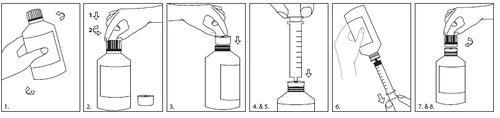
- Shake for at least 5 seconds before use.
- Press (1) and rotate (2) the cap to open the bottle.
- Insert the adapter into the neck of the bottle until a secure fit is achieved.
- Push the plunger of the syringe fully down.
- Insert the syringe as far as possible into the opening of the adapter.
- Invert and draw the prescribed amount of Fycompa from the bottle.
- Return to upright position and remove the syringe.
- Leave the adapter in place and replace the cap on the bottle.
- After administering the dose, separate the syringe barrel from the plunger and completely immerse both components in HOT soapy water.
- Immerse the syringe barrel and plunger in water to rinse off residual soap, remove excess water, and allow the components to air dry. Do not dry the administration devices by wiping them with a cloth.
- Do not clean and reuse the syringe after 40 uses, or if the markings on the syringe are removed during washing.
If you take more Fycompa than you should
If you have taken more Fycompa than you should, contact your doctor immediately. Symptoms may include confusion, agitation, aggression, and reduced level of consciousness.
If you forget to take Fycompa
- If you forget to take Fycompa, wait until the next scheduled dose and then continue as usual.
- Do not take a double dose to make up for a missed dose.
- If you have missed less than 7 days of Fycompa treatment, continue taking the daily dose according to your doctor's initial instructions.
- If you have missed more than 7 days of Fycompa treatment, inform your doctor immediately.
If you stop taking Fycompa
Take Fycompa for the entire period recommended by your doctor. Do not stop treatment unless instructed by your doctor. Your doctor may gradually reduce the dose to prevent seizures from returning or worsening.
If you have any questions about the use of this medicine, consult your doctor or pharmacist.
4. Possible side effects
Like all medicines, this medicine can cause side effects, although not everybody gets them.
A small number of people treated with antiepileptic medicines have had thoughts of harming themselves or taking their own life. If you have these thoughts at any time, contact your doctor immediately.
Very common (may affect more than 1 in 10 people):
- dizziness
- drowsiness (lethargy or somnolence)
Common (may affect more than 1 in 100 people):
- reduced or increased appetite, weight gain
- aggression, anger, irritability, anxiety or confusion
- difficulty walking or other balance problems [ataxia (loss of muscle coordination), gait abnormality, balance disorder]
- slowness of speech (dysarthria)
- blurred vision or double vision (diplopia)
- feeling of vertigo
- nausea
- back pain
- feeling very tired (fatigue)
- falls
Uncommon (may affect more than 1 in 1,000 people):
- thoughts of self-harm or of taking your own life (suicidal thoughts), suicide attempt
- hallucinations (seeing, hearing or sensing things that do not exist)
- abnormal thinking and/or loss of contact with reality (psychotic disorder)
Not known (frequency cannot be estimated from the available data):
- Drug reaction with eosinophilia and systemic symptoms, also known as DRESS or drug hypersensitivity syndrome: widespread rash, elevated body temperature, increased liver enzymes, blood abnormalities (eosinophilia), swollen lymph nodes and involvement of other body organs.
- Stevens-Johnson syndrome (SJS). This serious skin reaction may appear as red spots resembling "targets" or circular spots, often with central blisters, located on the trunk, skin peeling, mouth, throat, nose, genital and eye ulcers, and may be preceded by fever and flu-like symptoms.
Stop taking perampanel if you develop any of these symptoms and contact your doctor or seek immediate medical attention. See also section 2.
Reporting of side effects
If you get any side effects, including any not listed in this leaflet, talk to your doctor or pharmacist. You can also report side effects directly via the national reporting system listed in Annex V. By reporting side effects, you can help provide more information on the safety of this medicine.
5. How to store Fycompa
Keep this medicine out of the sight and reach of children.
Do not use this medicine after the expiry date stated on the label of the bottle and on the
carton. The expiry date refers to the last day of that month.
This medicine does not require any special storage conditions.
If any suspension remains in the bottle for more than 90 days after first opening, it must not be used.
Do not dispose of medicines via wastewater or household waste. Ask your pharmacist how to
dispose of medicines you no longer use. This will help protect the environment.
6. Package contents and other information
What Fycompa contains
- The active substance is perampanel. Each millilitre contains 0.5 mg of perampanel.
- The other components are liquid (crystallising) sorbitol (E420), microcrystalline cellulose (E460), sodium carmellose (E466), poloxamer 188, simethicone emulsion 30% (containing purified water, silicone oil, polysorbate 65, methylcellulose, silica gel, stearate macrogol, sorbic acid, benzoic acid (E210) and sulphuric acid), anhydrous citric acid (E330), sodium benzoate (E211) and purified water.
Description of the appearance of Fycompa and contents of the pack
Fycompa 0.5 mg/ml is an oral suspension, white to off-white in colour. It is supplied in a 340 ml bottle, with 2 graduated oral dosing syringes and a press-fit bottle adapter (PIBA) made of LDPE.
Marketing Authorisation Holder
Eisai GmbH
Edmund-Rumpler-Straße 3
60549 Frankfurt am Main
Germany
e-mail: [email protected]
Manufacturer
Eisai GmbH
Edmund-Rumpler-Straße 3
60549 Frankfurt am Main
Germany
For further information about this medicinal product, please contact the local representative of the Marketing Authorisation Holder:
België/Belgique/Belgien Lietuva
Eisai SA/NV Eisai GmbH
Tél/Tel: +32 (0)800 158 58 Tel: + 49 (0) 69 66 58 50
(Vokietija)
България Luxembourg/Luxemburg
Eisai GmbH Eisai SA/NV
Teл.: + 49 (0) 69 66 58 50 Tél/Tel: +32 (0)800 158 58
(Германия) (Belgique/Belgien)
Česká republika Magyarország
Eisai GesmbH organizačni složka Eisai GmbH
Tel: + 420 242 485 839 Tel.: + 49 (0) 69 66 58 50
(Németország)
Danmark Malta
Eisai AB Cherubino LTD
Tlf: + 46 (0) 8 501 01 600 Tel: +356 21343270
(Sverige)
Deutschland Nederland
Eisai GmbH Eisai B.V.
Tel: + 49 (0) 69 66 58 50 Tel: + 31 (0) 900 575 3340
Eesti Norge
Eisai GmbH Eisai AB
Tel: + 49 (0) 69 66 58 50 Tlf: + 46 (0) 8 501 01 600
(Saksamaa) (Sverige)
Ελλάδα Österreich
Arriani Pharmaceutical S.A. Eisai GesmbH
Τηλ: + 30 210 668 3000 Tel: + 43 (0) 1 535 1980-0
España Polska
Eisai Farmacéutica, S.A. Eisai GmbH
Tel: + (34) 91 455 94 55 Tel: + 49 (0) 69 66 58 50
(Niemcy)
France Portugal
Eisai SAS Eisai Farmacêtica, Unipessoal Lda
Tél: + (33) 1 47 67 00 05 Tel: + 351 214 875 540
Hrvatska România
Eisai GmbH Eisai GmbH
Tel: + 49 (0) 69 66 58 50 Tel: + 49 (0) 69 66 58 50
(Njemačka) (Germania)
Ireland Slovenija
Eisai GmbH Eisai GmbH
Tel: + 49 (0) 69 66 58 50 Tel: + 49 (0) 69 66 58 50
(Germany) ( Nemčija )
Ísland Slovenská republika
Eisai AB Eisai GesmbH organizačni složka
Sími: + 46 (0)8 501 01 600 Tel.: + 420 242 485 839
(Svíþjóð) (Česká republika)
Italia Suomi/Finland
Eisai S.r.l. Eisai AB
Tel: + 39 02 5181401 Puh/Tel: + 46 (0) 8 501 01 600
(Ruotsi)
Κύπρος Sverige
Arriani Pharmaceuticals S.A. Eisai AB
Τηλ: + 30 210 668 3000 Tel: + 46 (0) 8 501 01 600
(Ελλάδα)
Latvija United Kingdom (Northern Ireland)
Eisai GmbH Eisai GmbH
Tel: + 49 (0) 69 66 58 50 Tel: + 49 (0) 69 66 58 50
(Vācija) (Germany)
More detailed information on this medicinal product is available on the website of the European Medicines Agency: http://www.ema.europa.eu.
ANNEX IV
SCIENTIFIC CONCLUSIONS AND REASONS FOR THE VARIATION TO THE TERMS OF THE
MARKETING AUTHORISATION
Scientific conclusions
Taking into account the evaluation by the Pharmacovigilance Risk Assessment Committee (PRAC) of the Periodic Safety Update Report (PSUR) for perampanel, the scientific conclusions of the Committee for Human Medicinal Products (CHMP) are as follows:
In light of 18 cases of psychotic disorders observed in clinical studies, including 10 cases with a positive response upon treatment withdrawal (de-challenge), data from the literature (2 documented case reports), and spontaneous reports, including 10 cases with a close temporal relationship, a positive response upon treatment withdrawal (de-challenge) in 6 cases, and upon treatment re-introduction (re-challenge) in 1 case, the PRAC considers that there is at least a reasonable possibility of a causal relationship between perampanel and psychotic disorder. The PRAC concluded that the product information for medicinal products containing perampanel should be amended accordingly.
The CHMP agrees with the PRAC's scientific conclusions.
Reasons for the variation to the terms of the marketing authorisation
Based on the scientific conclusions regarding perampanel, the CHMP considers that the benefit-risk balance of the medicinal product containing perampanel remains favourable, subject to the proposed amendments to the product information.
The CHMP recommends a variation to the terms of the marketing authorisation.