Fulvestrant Zentiva
Italy
Table of Contents
- Package leaflet: Information for the patient
- Fulvestrant Zentiva 250 mg solution for injection in pre-filled syringe
- 1. What Fulvestrant Zentiva is and what it is used for
- 3. How to use Fulvestrant Zentiva
- 4. Possible side effects
- 5. How to store Fulvestrant Zentiva
- 6. Package contents and other information
- The following information is intended exclusively for healthcare professionals
Package leaflet
Package leaflet: Information for the patient
Fulvestrant Zentiva 250 mg solution for injection in pre-filled syringe
Generic medicine
Please read this leaflet carefully before using this medicine because it contains important information for you.
- Keep this leaflet. You may need to read it again.
- If you have any questions, ask your doctor, pharmacist or nurse.
- This medicine has been prescribed for you only. Do not give it to other people, even if their symptoms are the same as yours, as it may be harmful.
- If you experience any side effect, including those not listed in this leaflet, tell your doctor, pharmacist or nurse. See section 4.
Contents of this leaflet:
- What Fulvestrant Zentiva is and what it is used for
- What you need to know before using Fulvestrant Zentiva
- How to use Fulvestrant Zentiva
- Possible side effects
- How to store Fulvestrant Zentiva
- Contents of the pack and other information
1. What Fulvestrant Zentiva is and what it is used for
Fulvestrant Zentiva contains the active substance fulvestrant, which belongs to the group of estrogen blockers. Estrogens, a type of female sex hormone, can in some cases be involved in the growth of breast cancer.
Fulvestrant Zentiva is used either:
- Alone, for the treatment of postmenopausal women with a type of breast cancer called estrogen receptor-positive locally advanced or metastatic breast cancer, or
- In combination with palbociclib for the treatment of women with a type of breast cancer called hormone receptor-positive, human epidermal growth factor receptor 2-negative (HER2-negative), which is locally advanced or metastatic. Women who have not yet reached menopause will be treated with a medicine called a luteinizing hormone-releasing hormone (LHRH) agonist.
When Fulvestrant Zentiva is administered in combination with palbociclib, it is important to also read the palbociclib package leaflet. If you have any doubts about the use of palbociclib, please consult your doctor.
- What you should know before using Fulvestrant Zentiva
Do NOT use Fulvestrant Zentiva
- if you are allergic to fulvestrant or to any of the other ingredients of this medicine (listed in section 6)
- if you are pregnant or breastfeeding
- if you have severe liver disease
Warnings and precautions
Talk to your doctor, pharmacist, or nurse before using Fulvestrant Zentiva if you are in any of the following situations:
- Kidney or liver problems
- low platelet count (platelets help blood to clot) or bleeding disorders
- history of blood clots
- osteoporosis (loss of bone density)
- alcoholism
Children and adolescents
Fulvestrant Zentiva is not indicated for use in children and adolescents under 18 years of age.
Other medicines and Fulvestrant Zentiva
Tell your doctor or pharmacist if you are taking, have recently taken, or might take any other medicines. In particular, you must inform your doctor if you are using anticoagulants (medicines that prevent blood clots).
Pregnancy and breastfeeding
You must not use Fulvestrant Zentiva if you are pregnant. Women of childbearing potential must use an effective method of contraception during treatment with Fulvestrant Zentiva and for 2 years after the last dose.
You must not breastfeed during treatment with Fulvestrant Zentiva.
Driving and using machines
Fulvestrant Zentiva is not expected to affect your ability to drive or use machinery. However, if you feel tired after treatment, do not drive or operate machinery.
Fulvestrant Zentiva contains 500 mg of alcohol (ethanol) per injection, which is equivalent to 100 mg/ml (10% w/v). The amount in each injection of this medicine is equivalent to 13 ml of beer or 5 ml of wine.
It is unlikely that the amount of alcohol in this medicine will have a negative effect in adults and adolescents.
The alcohol contained in this medicine may alter the effects of other medicines. Talk to your doctor or pharmacist if you are taking other medicines.
If you are pregnant or breastfeeding, talk to your doctor or pharmacist before taking this medicine.
If you are dependent on alcohol, talk to your doctor or pharmacist before using this medicine.
Fulvestrant Zentiva contains 500 mg of benzyl alcohol per injection, equivalent to 100 mg/ml.
Benzyl alcohol may cause allergic reactions.
Fulvestrant Zentiva contains 750 mg of benzyl benzoate per injection, equivalent to 150 mg/ml.
For athletes: using this medicine without a therapeutic need constitutes doping and may lead to a positive anti-doping test.
3. How to use Fulvestrant Zentiva
Your doctor or nurse will administer Fulvestran Zentiva as a slow intramuscular injection, one into each buttock.
The recommended dose is 500 mg of fulvestrant (two injections of 250 mg/5 ml) given once a month, with an additional 500 mg dose administered 2 weeks after the initial dose.
If you have any questions about the use of this medicine, speak to your doctor, pharmacist, or nurse.
4. Possible side effects
Like all medicines, this medicine can cause side effects, although not everyone experiences them.
Serious side effects
Medical attention should be sought immediately if any of the following side effects occur
- Allergic reactions (hypersensitivity), including swelling of the face, lips, tongue and/or throat which may be signs of anaphylactic reactions
- Thromboembolism (increased risk of blood clots)*
- Inflammation of the liver (hepatitis)
- Liver failure
If any of the following side effects occur, inform your doctor, pharmacist or nurse:
Very common side effects (may affect more than 1 in 10 people)
- Reactions at the injection site, such as pain and/or inflammation
- Abnormal liver enzyme levels (in blood tests)*
- Nausea (feeling unwell)
- Weakness, fatigue*
- Musculoskeletal and joint pain
- Hot flushes
- Rash
- Allergic reactions (hypersensitivity), including swelling of the face, lips, tongue and/or throat
All other side effects:
Common side effects (may affect up to 1 in 10 people)
- Headache
- Vomiting, diarrhoea or loss of appetite*
- Urinary tract infections
- Back pain*
- Increased levels of bilirubin (a bile pigment produced by the liver)
- Thromboembolism (increased risk of blood clots)*
- Reduced platelet levels (thrombocytopenia)
- Vaginal bleeding
- Lower back pain radiating to one leg (sciatica)
- Sudden weakness, numbness, tingling, or loss of movement in the leg, particularly on one side of the body, sudden problems with walking or balance (peripheral neuropathy)
Uncommon side effects (may affect up to 1 in 100 people)
- Thick, white vaginal discharge and candidiasis (infection)
- Bruising and bleeding at the injection site
- Increased levels of gamma-GT, a liver enzyme detected by blood tests
- Inflammation of the liver (hepatitis)
- Liver failure
- Numbness, tingling and pain
- Anaphylactic reactions
* Includes adverse drug reactions for which the exact contribution of Fulvestrant Zentiva cannot be assessed due to the underlying disease.
Reporting of side effects
If you experience any side effect, including those not listed in this leaflet, talk to your doctor, pharmacist or nurse. You may also report side effects directly via the national reporting system at https://www.aifa.gov.it/content/segnalazioni-reazioni-avverse. By reporting side effects, you can help provide more information on the safety of this medicine.
5. How to store Fulvestrant Zentiva
Keep this medicine out of the sight and reach of children.
Do not use this medicine after the expiry date stated on the carton or on the label of the pre-filled syringe after "EXP". The expiry date refers to the last day of that month.
This medicine does not require any special storage temperature.
Store the pre-filled syringe in its original packaging to protect the medicine from light.
Healthcare professionals are responsible for the correct storage, use and disposal of Fulvestrant Zentiva.
This medicine may pose a risk to the aquatic environment. Do not dispose of any medicine via wastewater or household waste. Ask your pharmacist how to dispose of medicines you no longer use. This will help protect the environment.
6. Package contents and other information
What Fulvestrant Zentiva contains
- The active substance is fulvestrant. Each pre-filled syringe (5 ml) contains 250 mg of fulvestrant.
- The other components (excipients) are ethanol (96 percent), benzyl alcohol (E1519), benzyl benzoate and refined castor oil.
Description of the appearance of Fulvestrant Zentiva and contents of the pack
Fulvestrant Zentiva is a clear, colourless to yellow viscous solution in a pre-filled syringe containing 5 ml of solution for injection. To receive the recommended monthly dose of 500 mg, two syringes must be administered.
Fulvestrant Zentiva is available in 5 pack sizes: a pack containing 1 glass pre-filled syringe, a pack containing 2 glass pre-filled syringes, a pack containing 2 x 2 glass pre-filled syringes, a pack containing 4 glass pre-filled syringes and a pack containing 6 glass pre-filled syringes. One, two or six safety needles equipped with a device (BD SafetyGlide) are also provided for attachment to each syringe barrel.
Not all pack sizes may be marketed.
Marketing Authorisation Holder
Zentiva Italia S.r.l.
Via P. Paleocapa 7, 20121 Milano – Italy
Manufacturer
Laboratorios Farmalán, S.A.
Calle La Vallina s/n, Edificio 2,
Polígono Industrial Navatejera,
Villaquilambre, León, 24193, Spain
This medicinal product is authorised in the European Economic Area countries under the following names:
Netherlands/Germany/Estonia/France/Italy/Latvia/Poland/United Kingdom: Fulvestrant Zentiva
The following information is intended exclusively for healthcare professionals
Fulvestrant Zentiva 500 mg (2 x 250 mg/5 ml injectable solution) must be administered using
two pre-filled syringes; see section 3.
Instructions for administration
Warnings – Do not autoclave the needle with the safety device (BD SafetyGlide needle safety device) prior to use. Hands must remain behind the needle at all times during use and disposal.
For each of the two syringes:
- Remove the glass syringe barrel from the tray and check that it is not damaged.
- Remove the safety needle (SafetyGlide) from its outer packaging.
- Parenteral solutions should be inspected visually for particulate matter and discoloration prior to administration.
- Hold the syringe vertically on the ribbed area (C). With the other hand, grasp the cap (A) and carefully rotate the rigid plastic cap counterclockwise (see Figure 1).
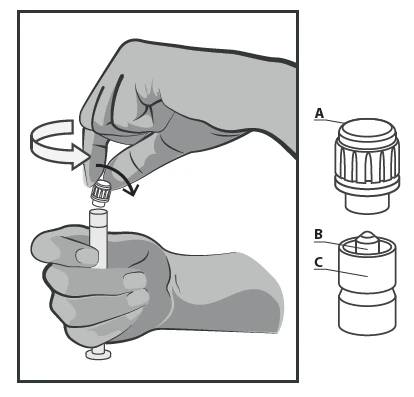
Figure 1
- Remove the rigid plastic cap (A) by pulling it straight upward. To ensure sterility, do not touch the tip of the syringe (B) (see Figure 2).
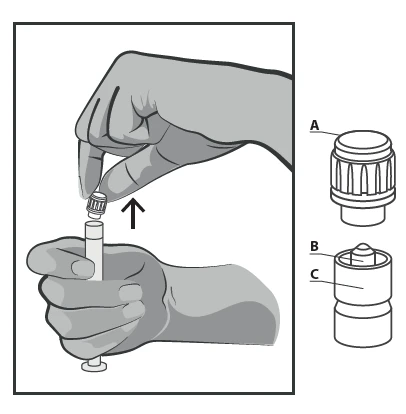
Figure 2
- Attach the safety needle to the Luer-Lock and rotate to securely lock it in place (see Figure 3).
- Ensure the needle is securely fixed to the Luer connector before removing it from the vertical plane.
- Remove the needle protector promptly to avoid damaging the needle tip.
- Carry the filled syringe to the administration site.
- Remove the needle sheath.
- Expel excess air from the syringe.
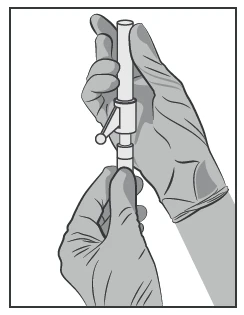
Figure 3
-
- Administer slowly (1 or 2 minutes/injection) by intramuscular injection into the gluteal region (gluteal area). For user convenience, the “blunt” needle tip is aligned with the lever arm (see Figure 4).
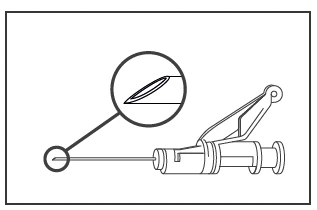
Figure 4
After injection, immediately apply single-finger force to the lever arm with assisted activation to engage the safety mechanism (see Figure 5).
NOTE: Activate away from yourself and others. Listen for the click and visually confirm that the needle tip is completely covered.
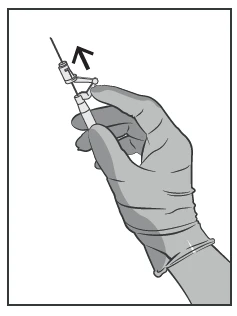
Figure 5
Disposal
Pre-filled syringes are for single use only.
This medicinal product may pose a risk to the aquatic environment. Unused medicine and waste derived from this medicine must be disposed of in accordance with local regulations.