Freamine III
Italy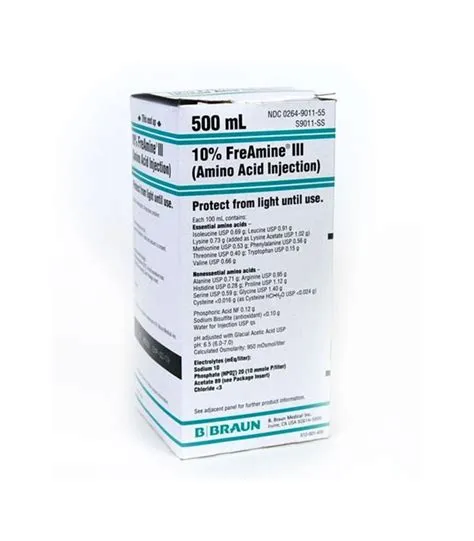
Table of Contents
- Package leaflet: Information for the patient
- FREAMINE III 8.5% solution for infusion
- 1. What FREAMINE III is and what it is used for
- 2. What you need to know before using FREAMINE III
- 3. How to use FREAMINE III
- 4. Possible side effects
- 5. How to store FREAMINE III
- 6. Packaging contents and other information
- The following information is intended exclusively for healthcare professionals:
Package leaflet: Information for the patient
FREAMINE III 8.5% solution for infusion
Read this leaflet carefully before you are given this medicine
because it contains important information for you.
- Keep this leaflet. You may need to read it again.
- If you have any questions, ask your doctor, pharmacist or nurse.
- This medicine has been prescribed for you only. Do not give it to others, even if their symptoms are the same as yours, because it could be harmful.
- If you experience any side effects, including those not listed in this leaflet, tell your doctor, pharmacist or nurse. See section 4.
Contents of this leaflet:
- What FREAMINE III is and what it is used for
- What you need to know before using FREAMINE III
- How to use FREAMINE III
- Possible side effects
- How to store FREAMINE III
- Contents of the pack and other information
1. What FREAMINE III is and what it is used for
FREAMINE III contains amino acids (substances used by the body for protein production).
FREAMINE III is a solution for parenteral nutrition, meaning it is administered through a vein.
FREAMINE III is indicated for patients in whom:
- oral feeding is not possible;
- there is malabsorption of proteins taken orally;
- nutritional requirements are markedly increased, for example due to extensive burns.
2. What you need to know before using FREAMINE III
Do not use FREAMINE III
- if you are allergic to the active substances or to any of the other ingredients of this medicinal product (listed in section 6);
- if you are not producing urine (anuria);
- if you have severe liver or brain disease (hepatic encephalopathy or coma);
- if you have a congenital (present from birth) disorder that impairs proper amino acid metabolism;
- if you have high levels of sodium, potassium, magnesium, or phosphorus in your blood.
Warnings and precautions
Talk to your doctor, pharmacist, or nurse before using FREAMINE III.
When used in neonates and children under 2 years of age, the solution (in bottles and administration sets) must be protected from exposure to light until administration is complete. Exposure of Freamine III to ambient light, especially after addition of trace elements and/or vitamins, generates peroxides and other degradation products, which can be reduced by protecting from light exposure.
Your doctor will perform frequent blood tests/monitoring during treatment, especially during the first few days.
Inform your doctor if:
- you have liver problems (hepatic insufficiency);
- you have serious lung problems (pulmonary embolism) or heart conditions such as myocardial infarction or heart failure;
- you develop fever, chills, or reactions at the infusion site (where the infusion needle is inserted) during treatment.
Other medicines and FREAMINE III
Inform your doctor if you are taking, have recently taken, or might take any other medicines.
Inform your doctor if you are being treated with:
- medicines that increase urine production and reduce potassium loss (amiloride, spironolactone, triamterene);
- medicines used to lower blood pressure (ACE inhibitors and angiotensin II receptor antagonists);
- medicines that suppress the immune system (tacrolimus and cyclosporine).
Pregnancy, breastfeeding, and fertility
If you are pregnant, suspect you may be pregnant, planning a pregnancy, or breastfeeding, consult your doctor before using this medicinal product. Clinical data on the risk during pregnancy and breastfeeding are not available. Your doctor will prescribe FREAMINE III only if clearly necessary.
Driving and using machines
There is no information available on the effects of FREAMINE III on the ability to drive or operate machinery.
FREAMINE III contains sodium bisulfite
Rarely, this may cause severe hypersensitivity reactions and bronchospasm.
This medicinal product contains 115 mg of sodium per 500 ml bottle. This is equivalent to 6% of the maximum recommended daily dietary intake for an adult.
This medicinal product contains 30 mmol of potassium per 500 ml bottle.
This should be taken into consideration in patients with reduced renal function or those on a low-potassium diet.
It may cause pain at the injection site.
3. How to use FREAMINE III
Use this medicine exactly as instructed by your doctor.
If you have any doubts, consult your doctor.
The duration of treatment and the dose will be determined by your doctor based on the following
factors: your age, weight, general health and nutritional status, your daily requirements for substances such as proteins and nitrogen, and your ability to metabolize the components of
FREAMINE III.
Method of administration
When used in neonates and children under 2 years of age, the solution (in bottles and administration sets) must be protected from exposure to light until the end of administration (see section 2).
You will receive this medicine by infusion into a peripheral or central vein.
If you use more FREAMINE III than you should
In case of overdose, hypervolemia (increased fluid volume in the body), electrolyte disturbances (alteration of salt levels in the blood), acidosis (alteration of blood pH), and increased blood urea (azotemia) may occur. In such cases, your doctor will perform specific laboratory tests and initiate appropriate therapy.
If you have any doubts about how to use this medicine, consult your doctor or nurse.
4. Possible side effects
Like all medicines, this medicine can cause side effects, although not everybody will experience them.
The frequency of the following side effects is not known (cannot be estimated from the available data):
hot flushes,
skin redness (erythema).
Reporting of side effects
If you experience any side effect, including those not listed in this leaflet, please contact your doctor or nurse.
You can also report side effects directly via the national reporting system at the following website:
https://www.aifa.gov.it/content/segnalazioni-reazioni-avverse.
By reporting side effects, you can help provide more information on the safety of this medicine.
5. How to store FREAMINE III
Prolonged storage under extreme conditions (temperatures above 40 °C; below 0 °C) may
alter the appearance of the solution – discoloration up to dark brown, turbidity – and may cause
formation of crystalline precipitate.
Keep this medicine out of the sight and reach of children.
When used in neonates and children under 2 years of age, the solution (in bottles and administration sets)
must be protected from exposure to light until completion of administration (see section 2).
Do not use this medicine after the expiry date stated on the bag after EXP. The expiry date refers to the
last day of that month.
Do not dispose of medicines via wastewater or household waste. Ask your pharmacist how to
dispose of medicines no longer required. This will help protect the environment.
6. Packaging contents and other information
What FREAMINE III contains
The active substances contained in 100 ml are:
| ACTIVE INGREDIENTS | |
| Essential amino acids L-Isoleucine mg 590 L-Leucine mg 770 L-Lysine acetate mg 870 L-Methionine mg 450 L-Phenylalanine mg 480 L-Threonine mg 340 L-Tryptophan mg 130 L-Valine mg 560 | Non-essential amino acids L-Alanine mg 600 L-Arginine mg 810 L-Histidine mg 240 L-Proline mg 950 L-Serine mg 500 L-Cysteine HCl mg 18 Aminoacetic acid g 1.19 |
The other components are magnesium chloride hexahydrate, potassium acetate, sodium bisulfite,
water for injections, glacial acetic acid.
Description of the appearance of FREAMINE III and packaging contents
FREAMINE III 8.5% in 250, 500 and 1000 ml bottles is a sterile, clear, pale yellow solution, free from particles.
It is available in:
- pack of 10 bottles of 500 ml
- pack of 1 bottle of 250, 500 or 1000 ml Not all pack sizes may be marketed.
Marketing Authorization Holder and Manufacturer
Baxter S.p.A.
Via Del Serafico 89
00142 Rome
Manufacturer
Bieffe Medital S.p.A.
Via Nuova Provinciale s.n.c.-
Grosotto (So)
The following information is intended exclusively for healthcare professionals:
Dosage
Freamine III is intended for intravenous use.
The initiation and duration of parenteral nutrition, as well as the dosage (dose and frequency of administration), depend on the following patient characteristics:
- age, weight, clinical condition,
- nitrogen requirements,
- ability to metabolize the components of Freamine III,
- daily protein requirement. The daily dietary intake of protein is approximately 0.9 g per kg of body weight in healthy adults and 1.4–2.2 g per kg in growing children and neonates. However, protein and caloric requirements may be significantly higher in traumatized or malnourished patients. Daily amino acid doses of approximately 1.0–1.5 g per kg of body weight in adults and 2–3 g/kg in children, along with adequate caloric intake, are generally sufficient to meet protein needs and promote a positive nitrogen balance in these patients, although higher doses may be required in severe catabolic states. When administering these higher-than-normal doses, especially in children, more frequent laboratory monitoring is necessary. For protein sparing in well-nourished patients who do not receive significant additional calories, amino acid doses of 1–1.7 g/kg/day significantly reduce nitrogen losses and spare body proteins. If the increase in BUN exceeds 20 mg% within 48 hours, the amino acid infusion should be suspended or the infusion rate reduced. For optimal utilization of amino acids, adequate amounts of intracellular electrolytes must also be provided, particularly potassium, magnesium, and phosphate. Approximately 60–180 mEq of potassium, 10–30 mEq of magnesium, and 20–80 mEq of phosphate per day should be administered to achieve optimal metabolic response. Sufficient amounts of major extracellular electrolytes—sodium, calcium, and chloride—must also be administered. In hyperchloremic patients or those affected by other types of metabolic acidosis, sodium and potassium should be added as acetates or lactates to provide bicarbonate precursors. The electrolyte content of Freamine III must be taken into account when calculating the daily electrolyte intake. Serum electrolytes, including magnesium and phosphate, should be monitored frequently.
Central Venous Nutrition
Central venous nutrition should be considered in severely catabolic patients with severe depletion, or when total parenteral nutrition is indicated for prolonged periods. To achieve a positive nitrogen balance in these patients, a non-protein calorie-to-nitrogen ratio of at least 100–150 calories per gram of nitrogen is recommended. These ratios can be conveniently and effectively achieved using concentrated glucose solutions and, if needed, supplemental parenteral fat emulsions.
Total parenteral nutrition should be initiated with mixtures containing lower glucose concentrations; the glucose content should then be gradually increased to meet the targeted caloric needs as patient tolerance increases.
In adults, highly hypertonic mixtures of amino acids and glucose can be safely administered only via continuous infusion through a central venous catheter placed in the vena cava.
For optimal nitrogen utilization, infuse 500 ml of 8.5% Freamine III mixed with concentrated glucose, electrolytes, and vitamins over 8 hours.
If administration falls below scheduled doses, do not attempt to make up for lost time. In addition to meeting protein requirements, particularly during the first days of therapy, administration should also be adjusted according to the patient's glucose tolerance.
The daily intake of amino acids and glucose should be gradually increased to reach the maximum dose; frequent monitoring of urinary and blood glucose levels will indicate the appropriate rate of escalation.
In many patients, administration of adequate calories in the form of hypertonic glucose may require the addition of exogenous insulin to prevent hyperglycemia and glycosuria.
When hypertonic glucose administration is abruptly discontinued, infuse a 5% glucose solution to prevent rebound hypoglycemia.
Peripheral Parenteral Nutrition
In moderately catabolic patients with moderate depletion who require parenteral nutrition and in whom central venous administration is not indicated, Freamine III may be mixed with 5% glucose solution and administered through a peripheral vein.
The osmolarity of a specific infusion solution must be considered when evaluating peripheral administration. Highly hypertonic parenteral nutrition solutions must be administered through a central venous catheter with the tip positioned in a large central vein.
For example, to prepare a solution of 4.25% Freamine III in 2.25% glucose, aseptically transfer 500 ml of 8.5% Freamine III into a 1-liter bottle containing 500 ml of 5% glucose. Each liter of the resulting solution provides 42.5 grams of protein and 100 calories from carbohydrates, with an osmolarity of approximately 569 mOsm/liter.
Parenteral fat emulsions provide about 9 calories per gram and can be administered via a Y-connector to supplement caloric intake along with the amino acid + glucose mixture.
Fat emulsions should not constitute the sole caloric source, as various studies have shown that glucose better spares nitrogen in stressed patients.
Protein Sparing
In well-nourished, mildly catabolic patients—such as postoperative patients requiring parenteral nutrition only for short periods—protein sparing can be achieved by administering amino acid solutions peripherally, with or without carbohydrates.
These mixtures can be prepared by diluting 8.5% Freamine III with “Water for Injections” or 5% glucose solutions to obtain an isotonic or slightly hypertonic solution suitable for peripheral vein administration. For example, a 4.25% Freamine III solution can be prepared by aseptically transferring 500 ml of 8.5% Freamine III into a 1-liter bottle containing 500 ml of “Water for Injections.” The resulting solution will contain 42.5 g of amino acids with an osmolarity of approximately 430 mOsm/liter.
A nearly isotonic 3% Freamine III solution can be prepared by aseptically transferring 350 ml of 8.5% Freamine III into a 1-liter bottle partially filled with 650 ml of “Water for Injections.” The resulting solution will provide 29 grams of total amino acids per liter with an osmolarity of approximately 305 mOsm/l.
Special Populations
Children
Exposure of parenteral nutrition solutions to light, especially after the addition of trace elements and/or vitamins, may have adverse effects on clinical outcomes in neonates due to the generation of peroxides and other degradation products. When used in neonates and children under 2 years of age, Freamine III must be protected from ambient light until administration is complete.
Small children (up to 10 kg body weight) receiving parenteral nutrition generally receive 2 to 3 g of protein, 120 to 150 calories, and 120–150 ml of fluid per kg of body weight per day. This requirement is met by administering a solution containing approximately 2.12% Freamine III and 20% glucose. Less hypertonic mixtures may be administered via peripheral veins.
Concomitant administration of fat emulsions may be performed via a Y-administration set into either a central or peripheral vein to provide essential fatty acids and increase caloric intake.
Due to the rapid physiological changes occurring in young children, the daily dose of nutrient mixture should be increased gradually at the beginning, with frequent monitoring of clinical and metabolic parameters.
Children weighing more than 10 kg require fewer calories and slightly less protein: generally, 50 to 80 calories and 2 grams of protein per kg of body weight per day are sufficient.
Elderly
Dosage should be carefully determined, taking into account possible reductions in cardiac, renal, or hepatic function, as well as concomitant diseases or pharmacological therapies.
Patients with Renal Impairment
Administer with caution, as nitrogen tolerance may be altered and dosage adjustment may be necessary. In these patients, fluid and electrolyte status must be closely monitored.
Patients with Hepatic Impairment
Amino acid solutions should be used with caution in patients with pre-existing liver disease or hepatic insufficiency. Close monitoring is required to detect possible signs of hyperammonemia.
Incompatibilities
- Additives may be incompatible.
- Higher concentrations should be added cautiously with adequate mixing (to avoid layering). Additional calcium and phosphate may be added to alternate bottles.
- Excessive addition of calcium and phosphate increases the risk of calcium phosphate precipitate formation.
Special Precautions for Disposal and Handling
When used in neonates and children under 2 years of age, the solution (in bottles and administration sets) must be protected from light exposure until administration is complete (see section 2).
Confirm the integrity of the container. Use only if the container is undamaged and the solution is clear and colorless or slightly yellow.
Visually inspect the bottle for cracks.
If substances are added to the container, the following steps must be taken:
- Maintain aseptic conditions.
- Ensure stability and compatibility of additives.
- Prepare the injection site on the container.
- Pierce the injection site and inject additives using a syringe needle or reconstitution device.
- Mix the container contents and additives thoroughly.
- Check the final solution for changes in color or presence of particles.
- Check the container for leaks.
- Ensure that storage requirements for additives are met.
- The infusion is intended for single use only.
- Do not reconnect any partially used container.
- Do not connect containers in series. During administration, recheck the bottle at least once every hour.