Fluxum
ItalyTable of Contents
- Package leaflet: Information for the patient
- FLUXUM 3,200 IU AXA injectable solution in pre-filled syringe, 4,250 IU AXA injectable solution in pre-filled syringe, 6,400 IU AXA injectable solution in pre-filled syringe, 8,500 IU AXA injectable solution in pre-filled syringe, 12,800 IU AXA injectable solution in pre-filled syringe
- 1. What Fluxum is and what it is used for
- 2. What you should know before using Fluxum
- 3. How to use Fluxum
- 4. Possible side effects
- 5. How to store Fluxum
- 6. Package contents and other information
Package leaflet: Information for the patient
FLUXUM 3,200 IU AXA injectable solution in pre-filled syringe, 4,250 IU AXA injectable solution in pre-filled syringe, 6,400 IU AXA injectable solution in pre-filled syringe, 8,500 IU AXA injectable solution in pre-filled syringe, 12,800 IU AXA injectable solution in pre-filled syringe
Parnaparin sodium
Please read this leaflet carefully before using this medicine because it contains important information for you.
- Keep this leaflet. You may need to read it again.
- If you have any questions, ask your doctor or pharmacist.
- This medicine has been prescribed for you only. Do not give it to others, even if their symptoms are the same as yours, as it could be harmful.
- If you experience any adverse reaction, including those not listed in this leaflet, contact your doctor or pharmacist. See section 4.
Contents of this leaflet:
- What Fluxum is and what it is used for
- What you need to know before using Fluxum
- How to use Fluxum
- Possible side effects
- How to store Fluxum
- Contents of the pack and other information
1. What Fluxum is and what it is used for
Fluxum contains the active substance sodium parnaparin. Sodium parnaparin is a substance that belongs to the class of anticoagulants, medicines used to treat blood clots in blood vessels and to prevent their formation.
Fluxum is used:
- to prevent the formation of blood clots in blood vessels (deep vein thrombosis) in patients undergoing general and orthopedic surgery and in patients at higher risk of developing deep vein thrombosis;
- to treat patients who have blood clots in blood vessels (deep vein thrombosis).
2. What you should know before using Fluxum
Do NOT use Fluxum
- if you are allergic to sodium parnaparin or to other low molecular weight heparins or to heparin or to substances of porcine origin or to any of the other ingredients of this medicine (listed in section 6);
- if you are scheduled to undergo local or regional anaesthesia for a surgical procedure and heparin is not administered for prophylaxis;
- if you have had thrombocytopenia (low platelet count in the blood) caused by administration of Fluxum (see also "Warnings and precautions");
- if you have blood clotting disorders;
- if you have any condition that leads to excessive bleeding, e.g. peptic ulcer, eye diseases called retinopathies, haemorrhagic syndrome;
- if you have a condition known as acute infective endocarditis (inflammation of the membrane lining the heart and heart valves caused by infection), unless an artificial valve is involved;
- if you have or have had bleeding in the blood vessels of the brain;
- if you have or have had a dilation of a blood vessel in the brain (cerebral aneurysm);
- if you have high blood pressure that is difficult to control (hypertension);
- if you have severe kidney or pancreatic disease, very high blood pressure, or severe brain trauma (cranial trauma) in the post-operative period;
- if you are taking other medicines to prevent blood clots (vitamin K antagonists), medicines that reduce platelet aggregation in the blood (antiplatelet agents) such as ticlopidine, salicylates or NSAIDs, dipyridamole, sulfinpyrazone.
Warnings and precautions
Talk to your doctor or pharmacist before using Fluxum.
Fluxum must not be administered intramuscularly.
Exercise particular caution with Fluxum
- if you suffer from heparin-induced thrombocytopenia, a condition in which the number of clotting cells (platelets) decreases and bruising and bleeding occur easily. Thrombocytopenia is a known complication of heparin therapy and may appear from 4 to 10 days after starting treatment, but may also occur earlier in patients who have previously experienced heparin-induced thrombocytopenia. A mild form of thrombocytopenia may occur, which may remain stable or resolve even if treatment continues. In some cases, however, a more severe form of thrombocytopenia may develop, leading to the formation of new blood clots with serious complications such as skin cell death (skin necrosis), blockage of an artery in the limbs or lungs, heart attack, stroke, and sometimes death. In such cases, your doctor will assess whether to discontinue heparin therapy and administer a different anticoagulant. Your doctor will prescribe frequent blood tests to monitor your platelet count: before treatment and subsequently twice weekly during the first month in case of prolonged administration.
- if you are scheduled to undergo surgery (spinal or epidural anaesthesia, epidural analgesia or lumbar puncture), inform your doctor that you are using Fluxum. In particular:
- if you are elderly
- if you have blood clotting disorders
- if you are taking anti-inflammatory medicines, antiplatelet agents and anticoagulants (see section "Other medicines and Fluxum")
- if you have suffered trauma or repeated spinal punctures.
- if you suffer from conditions that may easily cause bleeding, and especially if you have:
- a low platelet count in the blood (thrombocytopenia) and platelet abnormalities
- severe liver disease (hepatic insufficiency)
- severe kidney disease (renal insufficiency)
- high and difficult-to-control blood pressure
- eye diseases due to high blood pressure or diabetes (hypertensive or diabetic retinopathy)
- recently undergone surgery and are using high doses of Fluxum
- other conditions at high risk of bleeding.
- if laboratory tests have shown high levels of potassium in your blood, because heparin may inhibit the release of a hormone called aldosterone, causing an increase in blood potassium levels.
This is particularly likely in patients with diabetes, kidney disease (chronic renal failure), excessive production of metabolic acids (metabolic acidosis), who already have high potassium levels in the blood or who are taking medicines that reduce potassium excretion in urine (potassium-sparing diuretics).
The risk of increased potassium levels rises with the duration of treatment, but is generally temporary.
If you are a high-risk patient, your doctor will prescribe monitoring of blood potassium levels before starting heparin therapy. If treatment lasts longer than 7 days, your doctor will arrange regular checks.
- if you suffer from liver disease (hepatic insufficiency)
- if you suffer from kidney disease (renal insufficiency)
- if you have high blood pressure
- if you have previously had a stomach ulcer or other lesions that could bleed
- if you suffer from eye problems due to vascular causes (chorioretinal vascular diseases)
- if you have recently undergone brain or spinal surgery.
Interchangeability with other anticoagulants
Do not substitute sodium parnaparin with other medicines of similar action (unfractionated heparins, other low molecular weight heparins or synthetic molecules), as these medicines differ from each other in terms of efficacy and safety. Each of these medicines has its own specific instructions and conditions for use; therefore, it is recommended not to switch from one brand to another during treatment.
Other medicines and Fluxum
Inform your doctor or pharmacist if you are taking, have recently taken or might take any other medicine.
Inform your doctor if you are using:
- medicines that affect blood clotting processes (haemostatic function), as they may increase the risk of bleeding. For example:
- medicines that inhibit platelet function and glycoprotein IIb/IIIa receptor antagonists
- non-steroidal anti-inflammatory drugs (NSAIDs)
- medicines that reduce blood clotting time (anticoagulants: vitamin K antagonists) taken orally
- medicines used to dissolve blood clots in blood vessels (thrombolytics)
- dextran (a medicine used, for example, to increase blood volume or reduce blood clotting)
- non-steroidal anti-inflammatory drugs (NSAIDs) or high doses of acetylsalicylic acid (ASA), especially if you suffer from kidney disease (renal insufficiency), as these medicines reduce urine production;
- medicines for heart problems, for example:
- nitroglycerin
- sulfinpyrazone
- ethacrynic acid
- digitalis and other digitalis glycosides
- antibiotics such as tetracyclines and penicillin (when administered by intravenous injection or taken at high doses);
- medicines to lower uric acid, for example probenecid;
- medicines for cancer (cytostatic agents);
- medicines for allergies (antihistamines);
- medicines for malaria (quinine);
- phenothiazines (psychotropic drugs);
- ascorbic acid (vitamin C);
- tobacco.
You must not take the following medicines concomitantly with Fluxum unless under strict medical supervision,
as simultaneous administration may increase the risk of bleeding:
- acetylsalicylic acid and other salicylates. Use other medicines to relieve pain and reduce fever;
- non-steroidal anti-inflammatory drugs (NSAIDs);
- medicines that reduce platelet aggregation in the blood, for example:
- ticlopidine
- clopidogrel
- dipyridamole
- sulfinpyrazone
- medicines that reduce blood clotting (anticoagulants) taken orally;
- corticosteroids (hormonal medicines, e.g. cortisone), if used at high doses or for longer than ten days;
- dextran (when used by injection, for example, to increase blood volume or reduce blood clotting).
Pregnancy and breastfeeding
If you are pregnant, think you may be pregnant, planning to become pregnant, or breastfeeding, ask your doctor or pharmacist for advice before using this medicine.
Animal studies have shown no negative effects on normal fetal development or embryotoxic effects. However, there are no conclusive data on the passage of Fluxum through the placenta or its excretion in breast milk. Fluxum may be used during pregnancy and/or breastfeeding only under the guidance of a doctor and only if absolutely necessary, as the risk of harmful effects on the fetus or breastfed infant cannot be excluded.
Driving and using machines
Fluxum does not affect the ability to drive vehicles or use machinery.
Clinical use of Fluxum, even for several months, has not shown to have any effect on alertness.
Fluxum contains sodium
This medicine contains less than 1 mmol (23 mg) of sodium per pre-filled syringe, i.e. it is essentially 'sodium-free'.
3. How to use Fluxum
Use this medicine exactly as instructed by your doctor or pharmacist. If you have any doubts, consult your doctor or pharmacist.
Fluxum must be administered subcutaneously (under the skin).
Dose
The recommended dose to prevent blood clots in blood vessels (deep venous thrombosis) is:
- In general surgery: one subcutaneous injection of 0.3 ml (3,200 IU aXa) 2 hours before surgery, followed by one injection every 24 hours for at least 7 days. No routine blood monitoring is required.
- In orthopedic surgery: one subcutaneous injection of 0.4 ml (4,250 IU aXa) 12 hours before and 12 hours after surgery, followed by one injection daily on subsequent days after surgery. The duration of treatment should be at least 10 days.
- In patients at higher risk of developing deep venous thrombosis: one subcutaneous injection of 0.4 ml (4,250 IU aXa) daily. The duration of treatment should be at least 10 days.
The recommended dose to treat blood clots in blood vessels (deep venous thrombosis) is:
- Two subcutaneous injections daily of 0.6 ml (6,400 IU aXa). The duration of treatment should be at least 7–10 days. 3–5 days before starting this therapy, you may be given treatment with Fluxum 12,800 IU aXa administered intravenously by slow infusion.
After the acute phase, treatment may continue for another 10–20 days with either one subcutaneous injection daily of 0.8 ml (8,500 IU aXa), or 0.6 ml (6,400 IU aXa) daily, or 0.4 ml (4,250 IU aXa) daily.
If there are no contraindications, your doctor will prescribe an oral anticoagulant therapy to be started as soon as possible. Treatment with Fluxum should not be stopped before the required INR (International Normalization Ratio, a value measuring blood clotting ability) is reached.
How to inject Fluxum
Your doctor or other qualified healthcare professional will show you how to correctly administer the injection.
The injection must be given into the subcutaneous tissue (under the skin) in one of the following areas, alternating between the right and left side:
- Abdominal wall (on the abdomen at waist level), anterolateral or posterolateral, towards the flank;
- Upper outer quadrant of the buttocks, towards the flank.
The needle must be inserted fully, vertically and not at an angle, into the thickness of a skin fold created by pinching the skin between the thumb and index finger. The skin fold must be maintained throughout the entire injection. The presence of an air bubble in the syringe is normal and must not be removed before use.
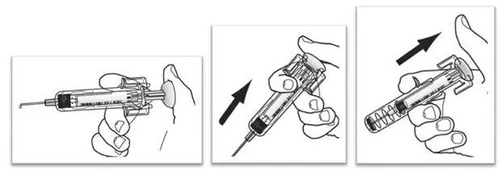
Prefilled syringes with safety system
The prefilled syringes are equipped with a safety system to prevent accidental needlestick injuries after injection. At the end of the plunger stroke, at the end of administration, the safety mechanism activates automatically, covering the needle with a protective cap.
If you use more Fluxum than you should
In case of accidental ingestion or overdose of Fluxum, inform your doctor immediately or go to the nearest hospital.
Overdose is unlikely due to the specific presentation of this medicine. However, if accidental overdose occurs, effects related to the anticoagulant activity (bleeding) may appear, which normally do not occur at therapeutic doses.
If you forget to use Fluxum
Do not use a double dose to make up for the missed dose.
If you stop using Fluxum
If you have any doubts about using this medicine, consult your doctor or pharmacist. Do not stop using Fluxum without first talking to your doctor, as the risk of developing a blood clot may be higher if you stop treatment too early.
4. Possible side effects
Like all medicines, this medicine can cause side effects, although not everybody gets them.
The side effects associated with Fluxum, classified according to their frequency of occurrence, are listed below:
Common (may affect up to 1 in 10 people)
- Localized accumulation of blood under the skin (haematoma) due to rupture of a blood vessel at the injection site
- Bleeding (haemorrhage)
- Irritation, pain, and discomfort at the injection site
Uncommon (may affect up to 1 in 100 people)
- Increase in certain liver enzymes (transaminases)
Rare (may affect up to 1 in 1,000 people)
- Low platelet count in the blood (thrombocytopenia), sometimes severe (see also section “Warnings and precautions”)
- Mild bleeding, mainly due to pre-existing risk factors such as bleeding-prone lesions or medical treatments (see also section “Warnings and precautions”)
- Skin inflammation (dermatitis), skin redness (erythema), itching, red-brown spots on the skin (purpura), skin rash or eruption (rash), and urticaria
- Skin redness (erythema with plaques), red-brown spots on the skin (purpura), skin cell death (skin necrosis) at the injection site
Very rare (may affect up to 1 in 10,000 people)
- Severe allergic reactions (anaphylactic reactions or anaphylactoid reactions)
- Accumulation of blood due to rupture of a blood vessel in the spinal cord or meninges (spinal or epidural haematoma), associated with preventive use of heparin during spinal, epidural anaesthesia, or lumbar puncture (see also section “Warnings and precautions”)
Not known (frequency cannot be estimated from the available data)
- Decreased number of red blood cells in the blood (anaemia)
- Reduced level of consciousness
- Formation of blood clots in blood vessels (deep vein thrombosis)
- Hot flushes
- Difficulty breathing (dyspnoea)
- Nosebleed (epistaxis)
- Swelling of the pharynx (pharyngeal oedema)
- Bleeding from the pleura (membrane lining the lungs) (pleural haemorrhage)
- Abdominal pain
- Diarrhoea
- Swelling of the lips (lip oedema)
- Dark, bloody stools (melena)
- Nausea
- Yellowing of the skin, mucous membranes, and eyes (jaundice)
- Inflammation of the gallbladder and bile ducts associated with jaundice (cholestatic hepatitis)
- Skin rash with small spots and raised areas (maculopapular exanthema)
- Generalized itching
- Joint pain (arthralgia)
- Muscle pain (myalgia)
- Non-menstrual uterine bleeding (metrorrhagia)
- Weakness (asthenia), fatigue
Reporting of side effects
If you experience any side effect, including those not listed in this leaflet, talk to your doctor or pharmacist. You can also report side effects directly via the national reporting system at https://www.aifa.gov.it/content/segnalazioni-reazioni-avverse.
By reporting side effects, you can help provide more information on the safety of this medicine.
5. How to store Fluxum
Keep this medicine out of the sight and reach of children.
Do not store at temperatures above 30°C.
Do not use this medicine after the expiry date stated on the pack.
The expiry date refers to the last day of that month.
Do not use this medicine if the packaging is open or damaged.
Do not dispose of any medicine via wastewater or household waste. Ask your pharmacist how to dispose of
medicines you no longer use. This will help protect the environment.
6. Package contents and other information
What Fluxum contains
- The active substance is sodium parnaparin.
- The other component is water for injections.
Each 0.3 ml pre-filled syringe contains 3,200 IU anti-Xa of sodium parnaparin
Each 0.4 ml pre-filled syringe contains 4,250 IU anti-Xa of sodium parnaparin
Each 0.6 ml pre-filled syringe contains 6,400 IU anti-Xa of sodium parnaparin
Each 0.8 ml pre-filled syringe contains 8,500 IU anti-Xa of sodium parnaparin
Each 1 ml pre-filled syringe contains 12,800 IU anti-Xa of sodium parnaparin
Description of the appearance of Fluxum and contents of the pack
Fluxum is a solution for injection for subcutaneous administration.
Fluxum is supplied in a cardboard box containing pre-filled syringes, with or without a safety system, placed in a polystyrene tray.
Fluxum is available in the following pack sizes:
Pack of 6 pre-filled syringes of 0.3 ml
Pack of 6 pre-filled syringes of 0.4 ml
Pack of 6 pre-filled syringes of 0.6 ml
Pack of 2 pre-filled syringes of 0.8 ml
Pack of 6 pre-filled syringes of 0.8 ml
Pack of 2 pre-filled syringes of 1 ml
Marketing Authorisation Holder and Manufacturer
Marketing Authorisation Holder:
Alfasigma S.p.A. – Via Ragazzi del ‘99, n. 5 - 40133 Bologna (BO)
Manufacturer:
Alfasigma S.p.A. – Via E. Fermi, n. 1 – 65020 Alanno (PE)