Flumazenil Hikma
Italy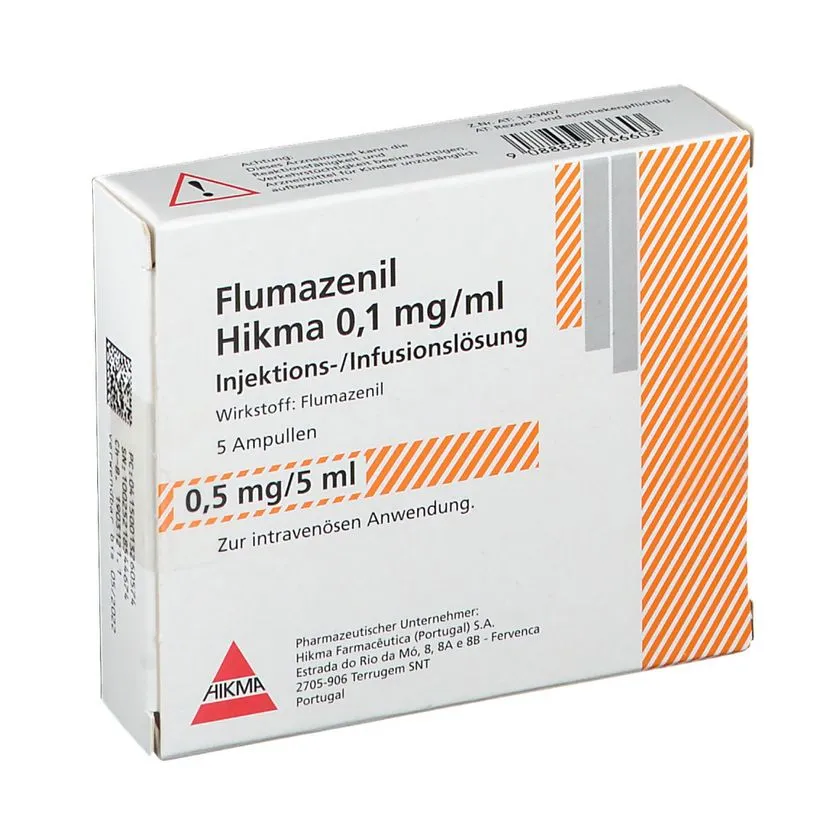
Table of Contents
Patient Information Leaflet: Information for the User
Flumazenil Hikma 0.1 mg/ml injection solution/for infusion
Generic Medicine
Active substance: flumazenil
Please read this leaflet carefully before taking this medicine as it contains
important information for you.
- Keep this leaflet. You may need to read it again.
- If you have any questions, ask your doctor or pharmacist.
- If you experience any side effects, including those not listed in this leaflet, please tell your doctor or pharmacist. See section 4.
Contents of this leaflet:
- What Flumazenil Hikma is and what it is used for
- What you need to know before taking Flumazenil Hikma
- How to take Flumazenil Hikma
- Possible side effects
- How to store Flumazenil Hikma
- Contents of the pack and other information
1. What Flumazenil Hikma is and what it is used for
Flumazenil Hikma is a reversing agent (antidote) used for the complete or partial reversal of the central sedative effects of benzodiazepines (a specific group of drugs with sedative and anxiolytic properties capable of inducing sleep and muscle relaxation).
It may be used in anaesthesia to awaken patients after specific diagnostic procedures or in intensive care for sedated patients. Flumazenil can also be used in the treatment of overdose or poisoning with benzodiazepines, as well as to recover from unexpected effects (paradoxical reactions) caused by them.
Flumazenil Hikma may be used to help determine the cause of unconsciousness in unconscious patients.
- What you need to know before taking Flumazenil Hikma
Do not take Flumazenil Hikma:- if you are allergic to flumazenil or to any of the excipients (for a list of excipients, see section 6);
- if benzodiazepines have been administered to control potentially life-threatening conditions (e.g. increased intracranial pressure or a severe epileptic seizure);
- if you have taken excessive amounts of benzodiazepines together with other medicines such as tricyclic and/or tetracyclic antidepressants (e.g. Imipramine, Clomipramine, Mirtazepine or Mianserine). The harmful effects of these antidepressants may be masked by the simultaneous use of benzodiazepines. Do not take Flumazenil Hikma if you notice signs of overdose with other antidepressants.
Warnings and precautions
Talk to your doctor or pharmacist before using Flumazenil Hikma
- the effects of flumazenil usually wear off more quickly than those of benzodiazepines. This means that the relaxing effects of benzodiazepines may reappear. You will be monitored until the effects of flumazenil have completely disappeared;
- if you have liver problems;
- if you have taken benzodiazepines for a prolonged period, flumazenil may cause withdrawal symptoms (for further details, see section 4);
- if you have epilepsy and have taken benzodiazepines for a prolonged period, the use of Flumazenil Hikma may trigger seizures;
- if you have severe brain damage (e.g. increased intracranial pressure or a severe epileptic seizure), as Flumazenil Hikma may increase intracranial pressure;
- if you are dependent on benzodiazepines or if you experience benzodiazepine withdrawal symptoms. In these cases, do not take Flumazenil Hikma;
- if you have previously experienced panic attacks or anxiety crises, as Flumazenil Hikma may provoke new attacks;
- if you have developed dependence on alcohol or certain other drugs. You may become dependent on or tolerant to benzodiazepines (and thus no longer benefit from them);
- Flumazenil Hikma should be administered to children and neonates only to reverse conscious sedation (during which they remain awake). Children must be closely monitored for at least 2 hours after administration of Flumazenil Hikma.
Other medicines and Flumazenil Hikma
Inform your doctor if you are taking or have recently taken any other medicines, including those without a prescription.
The harmful effects of other medicines (particularly tricyclic antidepressants such as Imipramine) may worsen when the effects of benzodiazepines are reversed with Flumazenil Hikma.
Pregnancy, breastfeeding and fertility
Ask your doctor or pharmacist for advice before taking any medicine.
Due to insufficient data, the use of Flumazenil Hikma is recommended only if the benefit to the patient outweighs the potential risk to the fetus. Administration of Flumazenil during pregnancy is not contraindicated in an emergency situation.
It is not known whether flumazenil is excreted in human milk. For this reason, breastfeeding is not recommended within 24 hours after administration of Flumazenil Hikma.
Driving and using machines
After receiving Flumazenil Hikma, the effects of benzodiazepines may reappear. Do not drive or operate machinery and avoid any strenuous activity for at least 24 hours after treatment with Flumazenil Hikma.
Important information about some of the excipients in Flumazenil Hikma
The medicine contains 3.7 mg of sodium per ml of injectable solution (18.5 mg per 5 ml vial or 37 mg per 10 ml vial). This should be taken into account in patients on a low-sodium diet.
- How to take Flumazenil Hikma
Flumazenil Hikma is administered by intravenous injection (into a vein) or diluted and given by infusion (a slower injection requiring a longer time).
Flumazenil Hikma will be administered by an anaesthetist or a specialist doctor. It may be used together with other treatments to resuscitate the patient.
The dose will be determined by the doctor according to the patient's needs, and must be decided based on the circumstances and tailored to each individual case. Further information for healthcare professionals is provided at the end of this leaflet.
Anaesthesia
The recommended initial dose for adults is 0.2 mg administered intravenously over 15 seconds. If the desired level of consciousness is not achieved within 60 seconds, an additional dose of 0.1 mg may be injected and repeated at 60-second intervals, up to a maximum total dose of 1.0 mg. The usual dose required is between 0.3 and 0.6 mg, but may be adjusted depending on patient characteristics and the benzodiazepine used.
Intensive care unit
The recommended initial dose of Flumazenil for adults is 0.3 mg intravenously. If the desired level of consciousness is not achieved within 60 seconds, an additional dose of 0.1 mg may be injected and repeated at 60-second intervals, up to a maximum total dose of 2 mg or until the patient awakens. If drowsiness recurs, an intravenous infusion of 0.1–0.4 mg/h may be helpful.
The infusion rate should be individually adjusted to achieve the desired level of consciousness.
Children under one year of age
Limited information is available on the use of Flumazenil in children under one year of age. Flumazenil Hikma should be administered to children under one year of age only if the expected benefits outweigh the risks.
Children over one year of age
For reversal of benzodiazepine-induced conscious sedation in children over one year of age, the recommended initial dose is 10 micrograms/kg (up to 200 micrograms), administered intravenously over 15 seconds. If the desired level of consciousness is not achieved after waiting an additional 45 seconds, an additional dose of 10 micrograms/kg (up to 200 micrograms) may be given, and repeated if necessary at 60-second intervals (up to a maximum of 4 times), up to a maximum total dose of 50 micrograms/kg or 1 mg, whichever is lower. The dose should be adjusted according to the patient's response. There are no data on the safety and efficacy of repeated flumazenil administrations in children in case of re-sedation.
If you have further questions about the use of this medicine, consult your doctor.
Patients with hepatic impairment (liver)
In patients with hepatic impairment, the dosage should be carefully determined.
4. Possible side effects
Like all medicines, this medicine can cause side effects, although not everyone experiences them.
Below is a classification of these side effects according to how frequently they occur.
Common (1 to 10 patients out of 100)
feeling sick (nausea) or being sick (vomiting), especially if you have also taken opioid medicines
Rare (1 to 10 patients out of 1,000)
These effects occur more frequently after rapid injection and do not require treatment:
- anxiety
- fear
- awareness of your heartbeat (palpitations)
Not known:
- allergic reactions (hypersensitivity), including severe allergic reaction
- panic attacks (in individuals who have previously experienced panic attacks)
- abnormal crying
- agitation
- feeling aggressive
- seizures (fits). These are more likely to occur in individuals who have previously suffered from epilepsy or severe liver problems, or in individuals who have taken "benzodiazepine" medicines for a long time, or when flumazenil is administered after an overdose of more than one medicine
- transient high blood pressure upon awakening from benzodiazepine effects
- redness of the face and neck (flushing)
- chills (more likely after rapid injection, do not require treatment)
If you have taken benzodiazepines for a prolonged period or are given high doses of Flumazenil Hikma rapidly, withdrawal symptoms may occur, such as:
- agitation
- anxiety
- mood swings (emotional lability)
- confusion
- disturbances in sensory perception (hearing voices or seeing things that are not real, skin sensations)
Similar effects may also be observed in children. When Flumazenil Hikma has been administered to children, excessive crying, agitation, and aggressive reactions have been reported.
Reporting of side effects
If you experience any side effect, including those not listed in this leaflet, talk to your doctor or pharmacist. You can also report side effects directly via the national reporting system at the website: www.aifa.gov.it/content/segnalazioni-reazioni-avverse. By reporting side effects, you can help provide more information on the safety of this medicine.
5. How to store Flumazenil Hikma
Keep this medicine out of the sight and reach of children.
Do not use this medicine after the expiry date stated on the label and carton. The expiry date refers to the last day of that month.
Do not store above 25°C.
The medicine is for single use only and must be used immediately after opening. If diluted, Flumazenil Hikma must not be refrigerated. Chemical and physical stability during use has been demonstrated for 24 hours at 25°C. From a microbiological standpoint, the medicine should be used immediately, unless the method of dilution excludes the risk of microbial contamination. If not used immediately, the duration and conditions of storage are the responsibility of the user.
Flumazenil Hikma should only be used if the solution appears clear and free from particles.
Do not dispose of any medicine via wastewater or household waste. Ask your pharmacist how to dispose of medicines no longer used. This will help protect the environment.
6. Package contents and other information
What Flumazenil Hikma contains
The active substance is flumazenil.
Each ml of injectable solution contains 0.1 mg of flumazenil.
Each 5 ml vial contains 0.5 mg of flumazenil.
Each 10 ml vial contains 1.0 mg of flumazenil.
The excipients are:
- disodium edetate,
- glacial acetic acid,
- sodium chloride (3.7 mg per ml),
- hydrochloric acid 36% for pH adjustment,
- sodium hydroxide for pH adjustment,
- water for injections.
Description of the appearance of Flumazenil Hikma and contents of the pack
Flumazenil Hikma is a clear, colourless solution for injection or for dilution prior to infusion. Flumazenil Hikma is supplied in colourless glass vials.
The medicine is available in the following pack sizes:
Carton boxes containing 5 or 50 (10x5) vials of 5 ml.
Carton boxes containing 5 or 50 (10x5) vials of 10 ml.
Not all pack sizes may be marketed.
Marketing Authorisation Holder and Manufacturer
Hikma Farmacêutica (Portugal), S.A.
Estrada do Rio da Mó, 8, 8A and 8B - Fervença
2705-906 Terrugem SNT
Portugal
Tel.: +351 219 608 410
Fax: +351 219 615 102
e-mail: [email protected]
Manufacturer
Hikma Italia SpA
Viale Certosa 10
27100 Pavia
Italy
Sales Concessionaire for Italy
Hikma Italia SpA
Viale Certosa 10
27100 Pavia
This medicinal product is authorised in the European Economic Area Member States under the following names:
| Austria | Flumazenil Hikma 0.1 mg/ml solution for injection/infusion |
| Germany | Flumazenil Hikma 0.1 mg/ml solution for injection/infusion |
| Italy | Flumazenil Hikma 0.1 mg/ml solution for injection/infusion |
| Portugal | Flumazenil Hikma 0.1 mg/ml solution for injection/infusion |
| United Kingdom | Flumazenil 0.1 mg/ml solution for injection/infusion |
| Spain | Flumazenil Hikma 0.1 mg/ml solution for injection/infusion |
| France | Flumazenil Hikma 0.1 mg/ml solution for injection/infusion |
This leaflet was last approved on
The following information is intended for healthcare professionals only.
Flumazenil Hikma must be administered intravenously by an anaesthetist or a specialist physician.
Flumazenil may be given as an injection or infusion (for instructions on dilution prior to administration, see the following section).
Flumazenil may be used in conjunction with other resuscitation measures.
The medicine is for single use only. Flumazenil Hikma should be visually inspected before use and used only if the solution appears clear and free from particles.
If no clear effect on consciousness and respiration is observed after repeated doses of Flumazenil Hikma, consider the possibility that intoxication may be due to agents other than benzodiazepines.
If Flumazenil Hikma is used in anaesthesia at the end of a surgical procedure, it should only be administered after the effects of muscle relaxants have completely worn off.
Children sedated with Midazolam should be closely monitored for at least 2 hours after administration of Flumazenil Hikma to prevent complications related to re-sedation or respiratory difficulties. When other benzodiazepines are used, the monitoring period should be determined according to the duration of their respective effects.
How to store Flumazenil Hikma
If Flumazenil Hikma is used as an infusion, it must be diluted before use. Flumazenil should only be diluted with sodium chloride 9 mg/ml (0.9% w/v) or glucose 50 mg/ml (5% w/v). Compatibility of flumazenil with other injectable solutions has not yet been established.
For microbiological reasons, diluted Flumazenil Hikma should be used immediately unless the dilution method excludes the risk of microbial contamination. If not used immediately, the storage times and conditions during use are the responsibility of the user. Do not refrigerate. Chemical and physical in-use stability has been demonstrated for 24 hours at 25°C.
Do not mix Flumazenil Hikma with other medicinal products except those mentioned above.
Recommended dosages for Flumazenil Hikma
Adults:
Anaesthesia
The recommended initial dose is 0.2 mg administered intravenously over 15 seconds. If the required level of consciousness is not achieved within 60 seconds, an additional dose of 0.1 mg may be injected, repeated at 60-second intervals, up to a maximum dose of 1.0 mg. The dose most frequently required is between 0.3 and 0.6 mg, but may vary depending on patient characteristics and the benzodiazepine used.
Intensive care
The recommended initial dose of Flumazenil is 0.3 mg administered intravenously. If the required level of consciousness is not achieved within 60 seconds, an additional dose of 0.1 mg may be injected, repeated at 60-second intervals, up to a maximum dose of 2 mg or until the patient wakes up.
In cases of drowsiness, an intravenous infusion of 0.1 – 0.4 mg/hour may be useful.
The infusion rate should be individually adjusted to achieve the desired level of consciousness.
If no clear effect on consciousness and respiration is observed after repeated dosing, consider the possibility that intoxication may not be due to benzodiazepines.
The infusion should be interrupted every 6 hours to assess for possible re-sedation.
To avoid withdrawal symptoms in patients treated for prolonged periods with high doses of benzodiazepines in intensive care, the flumazenil dose should be individually titrated and the injection administered slowly.
Elderly
In the absence of data on the use of flumazenil in elderly patients, it should be noted that this population is generally more sensitive to the effects of medicinal products and should be treated with particular caution.
Paediatric population
Children over one year of age
For reversal of benzodiazepine-induced conscious sedation in children over one year of age, the recommended initial dose is 10 micrograms/kg (up to 200 micrograms), administered intravenously over 15 seconds. If the desired level of consciousness is not achieved after waiting an additional 45 seconds, a further injection of 10 micrograms/kg (up to 200 micrograms) may be given and, if necessary, repeated at 60-second intervals (up to a maximum of 4 times), up to a total maximum dose of 50 micrograms/kg or 1 mg, whichever is lower. The dose should be adjusted according to the patient's response. There are no data available on the safety and efficacy of repeated flumazenil administrations in children in case of re-sedation.
Children under one year of age
Limited information is available on the use of flumazenil in children under one year of age.
Flumazenil should be administered to children under one year of age only if the potential benefits to the patient outweigh the possible risks.
Patients with renal or hepatic impairment
Since flumazenil is primarily metabolised in the liver, careful dose calculation is recommended in patients with impaired liver function.
Dosage adjustment is not required in patients with renal impairment.