Flumazenil Hameln
Italy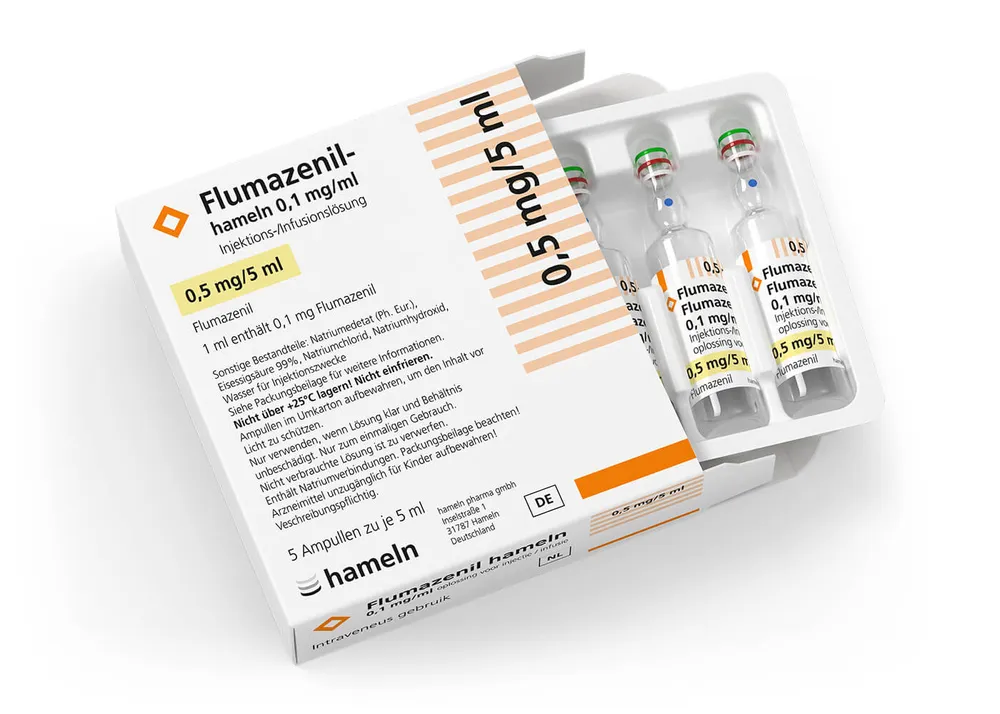
Table of Contents
- Package leaflet: Information for the user
- Flumazenil hameln 0.1 mg/ml solution for injection or infusion
- 1. What Flumazenil hameln is and what it is used for
- 2. What you need to know before taking Flumazenil hameln
- 3. How to take Flumazenil hameln
- 4. Possible side effects
- 5. How to store Flumazenil hameln
- 6. Package contents and other information
- 1. Incompatibilities
- 2. Posology and method of administration
Package leaflet: Information for the user
Flumazenil hameln 0.1 mg/ml solution for injection or infusion
flumazenil
Generic medicine
Please read all of this leaflet carefully before you are given this medicine because it contains important information for you.
- Keep this leaflet. You may need to read it again.
- If you have any questions, ask your doctor or pharmacist.
- This medicine has been prescribed for you only. Do not give it to other people, even if their symptoms are the same as yours, as it may be harmful.
- If you experience any side effects, including those not listed in this leaflet, tell your doctor or pharmacist. See section 4.
The name of your medicine is Flumazenil hameln.
Contents of this leaflet:
- What Flumazenil hameln is and what it is used for
- What you need to know before receiving Flumazenil hameln
- How to receive Flumazenil hameln
- Possible side effects
- How to store Flumazenil hameln
- Contents of the pack and other information
1. What Flumazenil hameln is and what it is used for
Flumazenil hameln is an antidote used to completely or partially reverse the central sedative effects of benzodiazepines (a specific group of medicines with sedative, sleep-inducing, muscle-relaxant, and anxiolytic properties).
Therefore, it can be used during anaesthesia to reverse sedation after certain diagnostic procedures or in intensive care when sedation has been maintained. Flumazenil may also be used for the diagnosis and treatment of benzodiazepine poisoning or overdose.
Flumazenil is also used in children (over 1 year of age) to reverse sedation induced by benzodiazepines.
2. What you need to know before taking Flumazenil hameln
Flumazenil will be administered to you by a specially trained doctor, under close supervision.
Do not take Flumazenil hameln
If you are allergic (hypersensitive) to flumazenil or to any of the other ingredients of this
medicinal product (listed in section 6).
If you have been given benzodiazepines to control a potentially life-threatening condition, such as to manage increased pressure in the brain (increased intracranial pressure) or a severe epileptic seizure (epileptic status).
Warnings and precautions
Talk to your doctor before taking Flumazenil hameln:
- If you suffer from epilepsy and have been taking benzodiazepines for a long time, Flumazenil hameln may cause seizures.
- If you have liver problems.
- If you have or have had a severe brain injury, Flumazenil hameln may increase pressure in the brain.
- If you were anxious before a procedure or have had panic attacks or have suffered from anxiety for a long time.
- If you have previously experienced panic attacks. Flumazenil hameln may trigger new attacks.
- If you have taken benzodiazepines at high doses for a prolonged period. A rapid injection of Flumazenil at a dose greater than 1 mg may cause withdrawal symptoms.
- If you are dependent on alcohol or have abused other substances, there is an increased risk of becoming tolerant and dependent on benzodiazepines, with a higher risk of withdrawal symptoms. The anaesthetist will carefully calculate the appropriate dose for you.
Pay attention to the following
Flumazenil counteracts only the effects of benzodiazepines.
- If reduced level of consciousness or sedation is caused by another medicine, it is unlikely that Flumazenil will be effective.
- Although Flumazenil is used to reverse sedation, you may remain sedated for up to 24 hours after treatment with Flumazenil. This is due to the sedative effects of benzodiazepines, which last longer than the anti-sedative effects of Flumazenil. You will therefore be closely monitored, preferably in intensive care, until all possible effects of benzodiazepines have completely worn off.
- If you are undergoing a particularly invasive procedure causing significant pain, the anaesthetist may keep you sedated.
- Flumazenil is not recommended for the treatment of benzodiazepine dependence or its symptoms.
If Flumazenil is administered to you at the end of surgery to wake you up, it must not be given until after the effects of muscle relaxants have worn off.
Children
In children previously sedated with midazolam: these children must be closely observed in an intensive care unit for at least 2 hours after administration of flumazenil, as repeated sedation or respiratory difficulties may occur. In case of sedation with other benzodiazepines, the monitoring period should be adjusted according to their expected duration of action.
Children should receive Flumazenil only after intentional sedation. Available data are insufficient for any other indication. The same applies to children under 1 year of age.
Other medicines and Flumazenil hameln
Tell your doctor or pharmacist if you are taking, have recently taken, or might take any other medicines, including those obtained without a prescription. This information is necessary so that the anaesthetist can accurately adjust the dose.
In particular, inform your doctor or nurse if you are taking any of the following medicines:
- zopiclone and triazolopyridazine (for the treatment of insomnia)
- benzodiazepines (e.g. diazepam, midazolam)
- tricyclic or tetracyclic antidepressants such as amitriptyline, nortriptyline, clomipramine, mirtazapine, mianserin and imipramine
During the use of Flumazenil in cases of accidental overdose, it must be considered that the toxic effects of these psychotropic medicines (particularly antidepressants such as imipramine) taken simultaneously may increase as the effects of benzodiazepines decrease.
Pregnancy and breastfeeding
If you are pregnant, think you may be pregnant, are planning to become pregnant, or are breastfeeding, consult your doctor before taking this medicine.
The risk to the human fetus has not yet been evaluated; therefore, flumazenil is not recommended during pregnancy, except in cases where the benefits to the patient clearly outweigh the risks to the unborn fetus, such as in life-threatening or emergency situations.
It is not known whether flumazenil is excreted in breast milk. Therefore, breastfeeding is not recommended for 24 hours after taking Flumazenil.
Driving and using machines
The effects of flumazenil are shorter in duration than those of benzodiazepines; therefore, you may still feel sleepy. Do not drive vehicles or operate machinery, nor engage in any other activities requiring mental or physical alertness for at least 24 hours after treatment with flumazenil.
Flumazenil hameln contains sodium
This medicine contains 3.7 mg of sodium (a main component of table salt) per ml.
- Each 5 ml vial contains less than 1 mmol (23 mg) of sodium, i.e. essentially 'sodium-free'.
- Each 10 ml vial contains 37 mg of sodium. This corresponds to 2% of the recommended maximum daily dietary intake for an adult.
3. How to take Flumazenil hameln
Flumazenil is administered intravenously, either diluted or undiluted.
Flumazenil hameln will be administered under the supervision of an experienced anaesthesiologist.
The dose will be determined by the doctor according to your age, body weight, degree of liver and kidney function, and the indication for which it is being administered. Flumazenil may be administered together with other medicinal products used to restore consciousness.
Adults
The dose depends on the clinical situation; initially, 0.2 milligrams are normally administered intravenously over 15 seconds.
If the required level of consciousness is not achieved after 60 seconds, a second dose of 0.1 milligram may be administered. This dose may be repeated every 60 seconds until the desired level of consciousness is reached, up to a maximum total dose of 1 milligram after anaesthesia and 2 milligrams in intensive care therapy.
Treatment should be interrupted every 6 hours to assess whether sedation recurs.
Children over 1 year of age
Initially, 0.01 milligrams per kilogram of body weight (up to a maximum of 0.2 milligrams) is normally administered intravenously over 15 seconds. If consciousness does not improve sufficiently after 45 seconds, an additional dose of 0.01 milligrams per kilogram of body weight (up to a maximum of 0.2 milligrams) may be administered. This dosing may be repeated after 60 seconds, up to four additional times, to a maximum total dose of 0.05 milligrams per kilogram of body weight or 1 milligram, whichever is lower.
There are insufficient data on the use of Flumazenil hameln in children under 1 year of age. The doctor will decide whether administration of flumazenil is necessary for children in this age group.
Elderly patients
Elderly patients are normally more sensitive to the effects of flumazenil and should be treated with appropriate caution.
Patients with hepatic impairment
If you have liver problems, your doctor may administer a lower dose.
If you have any further questions about how to use this medicine, ask your doctor or pharmacist.
4. Possible side effects
Like all medicines, Flumazenil hameln can cause side effects, although not everybody will experience them. If a side effect worsens, or if you notice any side effect not listed in this leaflet, inform your doctor or pharmacist.
Inform your doctor or nurse immediately if you experience any of the following side effects. Flumazenil can cause allergic reactions. Symptoms of allergic reactions include facial swelling, swelling of the lips, throat or tongue, skin rash and difficulty breathing.
The following side effects have been reported:
Very common (may affect more than 1 in 10 people):
- nausea
Common (may affect up to 1 in 10 people):
- allergic reactions
- mood changes (emotional lability)
- difficulty falling asleep and staying asleep (insomnia)
- drowsiness (somnolence)
- dizziness
- headache
- involuntary tremors
- dry mouth
- rapid breathing (hyperventilation)
- speech disorders
- individual skin sensations (e.g. cold, heat, tingling, pressure, etc.) in the absence of stimuli (paresthesia)
- double vision
- strabismus (a condition in which the eyes are not properly aligned with each other)
- increased tear production
- skin redness
- drop in blood pressure upon standing (orthostatic hypotension)
- transient increase in blood pressure
- vomiting
- hiccups
- sweating
- pain at injection site
Common after rapid injection (which does not require treatment):
- anxiety
- agitation
- palpitations
Uncommon (may affect up to 1 in 100 people):
- fear
- seizures
- hearing disturbances
- slow or rapid heartbeat
- premature heartbeat (extrasystoles)
- difficulty breathing
- cough
- nasal congestion (nasal congestion)
- chest pain
- tremors
Rare (may affect up to 1 in 1,000 people):
- severe allergic reactions
If you have been treated with high doses of benzodiazepines or for a prolonged period, Flumazenil hameln may cause withdrawal symptoms such as tension, agitation, anxiety, marked emotional lability, confusion, hallucinations, dizziness, sweating, rapid heartbeat, tremors and seizures, panic attacks, abnormal crying, agitation and aggressive behaviour.
Additional side effects in children
In general, side effects in children do not differ from those in adults. When Flumazenil hameln is used to reverse sedation in children, sedation, abnormal crying, agitation and aggressive reactions have been reported.
Reporting of side effects
If you experience any side effect, including those not listed in this leaflet, please contact your doctor or nurse.
You can also report side effects directly via the national reporting system at www.aifa.gov.it/content/segnalazioni-reazioni-avverse.
By reporting side effects, you can help provide more information on the safety of this medicine.
5. How to store Flumazenil hameln
- Keep this medicine out of the sight and reach of children.
- Do not store above 25°C. Do not freeze. Store the vials in the original packaging to protect the medicine from light.
- After first opening, the medicine must be used immediately.
- Any unused solution from opened vials must be discarded.
- Do not use this medicine if the solution is not clear and colourless.
- Do not use Flumazenil hameln after the expiry date stated on the packaging after “Exp.”. The expiry date refers to the last day of the month indicated.
- Do not dispose of any medicine via wastewater or household waste. Ask your pharmacist how to dispose of medicines you no longer use. This will help protect the environment.
- Shelf life after dilution: Chemical and physical in-use stability has been demonstrated for 24 hours at 25°C.
From a microbiological point of view, the diluted medicine should be used immediately. If not used immediately, storage times and conditions are under the responsibility of the user and generally should not exceed 24 hours between 2 and 8°C, unless the dilution was carried out under controlled and validated aseptic conditions.
6. Package contents and other information
What Flumazenil hameln contains
The active substance is flumazenil.
1 ml of injectable or infusion solution contains 0.1 mg of flumazenil.
One 5 ml vial of solution contains 0.5 mg of flumazenil.
One 10 ml vial of solution contains 1.0 mg of flumazenil.
The other components are disodium edetate, glacial acetic acid, sodium chloride, sodium hydroxide, water for injectable preparations.
Description of the appearance of Flumazenil hameln and contents of the pack
Flumazenil is a clear, colourless solution supplied in glass vials.
Pack sizes: 5 or 10 vials of 5 ml.
Pack sizes: 5 or 10 vials of 10 ml.
Not all pack sizes may be marketed.
Marketing Authorisation Holder
hameln pharma gmbh, Inselstraße 1, 31787 Hameln – Germany
Exclusive distributor for sales in Italy:
Tillomed Italia S.r.l., Viale Richard 1A, 20143, Milan, Italy
Marketing Authorisation Number
0.1 mg/ml injectable or infusion solution, 5 glass vials of 5 ml: A.I.C. No. 037498019
0.1 mg/ml injectable or infusion solution, 10 glass vials of 5 ml: A.I.C. No. 037498021
0.1 mg/ml injectable or infusion solution, 5 glass vials of 10 ml: A.I.C. No. 037498033
0.1 mg/ml injectable or infusion solution, 10 glass vials of 10 ml: A.I.C. No. 037498045
Manufacturer
Siegfried Hameln GmbH
Langes Feld 13
31789 Hameln
Germany
This medicinal product is authorised in the European Economic Area countries under the following names:
DE Flumazenil-hameln 0.1 mg/ml Injection/Infusion Solution
DK Flumazenil hameln
FI Flumazenil hameln 0.1 mg/ml injection/infusion solution, solution
IT Flumazenil hameln 0.1 mg/ml solution for injection or infusion
NL Flumazenil hameln 0.1 mg/ml, solution for injection/infusion
NO Flumazenil hameln 0.1 mg/ml injection/infusion solution, solution
SE Flumazenil hameln
UK Flumazenil 100 micrograms/ml solution for injection/infusion
The following information is intended exclusively for physicians or healthcare professionals:
Preparation guide for:
Flumazenil hameln 0.1 mg/ml solution for injection or infusion
Please refer to the Summary of Product Characteristics for further prescribing information.
1. Incompatibilities
This medicinal product must not be mixed with other medicinal products except the following:
Sodium chloride 9 mg/ml (0.9%) solution, glucose 50 mg/ml (5%) solution, or sodium chloride 4.5 mg/ml (0.45%) + glucose 25 mg/ml (2.5%) solution (10, 20, 50 ml of Flumazenil hameln 0.1 mg/ml in 500 ml of solution). The compatibility of flumazenil with other injectable solutions has not been established.
Chemical and physical in-use stability has been demonstrated for 24 hours at 25°C.
From a microbiological point of view, the medicinal product should be used immediately. If not used immediately, the duration and conditions of in-use storage are the responsibility of the user and generally should not exceed 24 hours between 2°C and 8°C, unless the dilution is carried out under controlled and validated aseptic conditions.
2. Posology and method of administration
This medicinal product is for single use only, and any unused solution must be discarded.
When flumazenil is to be infused, it must be diluted prior to infusion.
Posology
Adults
Anaesthesia
The recommended initial dose is 0.2 mg administered intravenously over 15 seconds. If the desired level of consciousness is not achieved within 60 seconds, an additional dose of 0.1 mg may be injected, which can be repeated every 60 seconds up to a maximum dose of 1.0 mg. The effective dose is generally between 0.3 and 0.6 mg, but may vary depending on patient characteristics and the benzodiazepine used.
Intensive care
The recommended initial dose is 0.3 mg administered intravenously. If the desired level of consciousness is not achieved within 60 seconds, an additional dose of 0.1 mg may be injected, which can be repeated every 60 seconds up to a total dose of 2.0 mg or until the patient awakens.
If drowsiness recurs, a second bolus injection of flumazenil may be useful. An intravenous infusion of 0.1–0.4 mg/h may also be beneficial.
The infusion rate and dose should be individually adjusted until the desired level of awakening is achieved.
If no clear effect on the level of consciousness and respiratory function is observed after repeated doses, consider that the intoxication may not be of benzodiazepine origin.
The infusion should be interrupted every 6 hours to assess whether sedation recurs.
In intensive care units, to avoid withdrawal symptoms in patients treated for prolonged periods with high doses of benzodiazepines, the flumazenil dosage should be individually determined and administered slowly.
Special populations
Elderly
In the absence of data on the use of flumazenil in elderly patients, it should be considered that this population is generally more sensitive to drug effects and should be treated with appropriate caution.
Patients with renal or hepatic impairment
Since flumazenil is primarily metabolized by the liver, careful dose determination is recommended in patients with hepatic impairment. Dose adjustments are not required in patients with renal impairment.
Paediatrics
Children over 1 year of age
For reversal of benzodiazepine-induced conscious sedation in children over 1 year of age, the recommended initial dose is 0.01 mg/kg (up to 0.2 mg) administered intravenously over 15 seconds. If the desired level of consciousness is not achieved after a 45-second waiting period, subsequent injections of 0.01 mg/kg (up to 0.2 mg) may be given, repeated as necessary at 60-second intervals (up to a maximum of 4 times) until a maximum dose of 0.05 mg/kg or 1 mg is reached, whichever is lower. Dosing should be adjusted according to the patient's response.
There are no data on the safety and efficacy of repeated flumazenil administration in children in case of re-sedation.
Children under 1 year of age
Data on the use of flumazenil in children under 1 year of age are insufficient; therefore, flumazenil should be administered to children under 1 year of age only if the potential benefits to the patient outweigh the possible risks.
Method of administration
Flumazenil must be administered intravenously by an anaesthetist or a physician experienced in anaesthesiology.
Flumazenil may be administered by infusion (for instructions on dilution of the medicinal product before administration, see section 1).
Flumazenil may be used concomitantly with other resuscitation procedures.