Fintepla
Italy
Table of Contents
- Package leaflet: Information for the patient
- Fintepla 2.2 mg/mL oral solution
- 1. What Fintepla is and what it is used for
- 2. What you should know before you or your child take Fintepla
- 3. How to take Fintepla
- 4. Possible side effects
- 5. How to store Fintepla
- 6. Package contents and other information
Package leaflet: Information for the patient
Fintepla 2.2 mg/mL oral solution
fenfluramine
This medicinal product is subject to additional monitoring. This will allow rapid identification of new safety information. You can help by reporting any side effects you or your child may experience while taking this medicine. See the end of section 4 for information on how to report side effects.
Please read this leaflet carefully before you or your child takes this medicine,
because it contains important information for you.
- Keep this leaflet. You may need to read it again.
- If you have any questions, ask your doctor, pharmacist, or nurse.
- This medicine has been prescribed only for you or your child. Do not give it to other people, even if their symptoms are the same as yours or your child’s, because it could be harmful.
- If you or your child experience any side effects, including those not listed in this leaflet, consult your doctor, pharmacist, or nurse. See section 4.
Contents of this leaflet
- What Fintepla is and what it is used for
- What you need to know before you or your child takes Fintepla
- How to take Fintepla
- Possible side effects
- How to store Fintepla
- Contents of the pack and other information
1. What Fintepla is and what it is used for
Fintepla contains the active substance fenfluramine.
Fintepla is used as adjunctive therapy for the treatment of epileptic seizures (attacks) in patients aged 2 years and older who have a type of epilepsy called Dravet syndrome or a type called Lennox-Gastaut syndrome. It may help reduce the number and severity of seizures.
The mechanism of action of Fintepla is not fully understood. However, it is believed to work by increasing brain activity of a natural substance called serotonin and of the sigma-1 receptor, which can reduce epileptic seizures.
2. What you should know before you or your child take Fintepla
Do not take Fintepla
- if you or your child are allergic to fenfluramine or any of the other ingredients of this medicine (listed in section 6);
- if you or your child have a heart problem such as "valvulopathy" or "pulmonary arterial hypertension" (high blood pressure in the lung arteries);
- if you or your child have taken within the last 2 weeks medicines used to treat depression called monoamine oxidase inhibitors (MAOIs).
Do not take Fintepla if any of the above conditions apply to you. If in doubt, consult your doctor, pharmacist or nurse before taking Fintepla.
Warnings and precautions
Talk to your doctor, pharmacist or nurse before taking Fintepla if:
- you or your child have glaucoma;
- you or your child have had thoughts about harming yourself or ending your life;
- you or your child are taking a medicine called cyproheptadine, used to treat allergies or to improve appetite;
- you or your child have experienced an increase in the frequency of epileptic seizures;
- you or your child have had increased drowsiness.
If any of the above situations apply to you or your child (or if you are unsure), consult your doctor, pharmacist or nurse before taking Fintepla.
Tests and monitoring
Before you or your child start taking Fintepla, your doctor must check your heart with an echocardiogram (echo). Your doctor will verify that the heart valves are functioning properly and that the pressure in the artery between the heart and lungs is not too high. Once you have started taking Fintepla, you or your child will undergo an echocardiographic check every 6 months for the first 2 years, and then once a year. If treatment with Fintepla is stopped, you or your child will need to have an echocardiogram 3–6 months after the last dose.
Your doctor should also monitor weight before and during treatment, as Fintepla may cause weight loss or reduced appetite.
"Serotonin syndrome"
Inform your doctor or pharmacist before taking Fintepla if you or your child are taking medicines that can increase serotonin levels in the brain, as taking these medicines together with Fintepla may cause serotonin syndrome, a potentially life-threatening condition. Medicines that may increase serotonin levels include:
- "triptans" (such as sumatriptan), used for migraine;
- MAO inhibitors (MAOIs), used for depression;
- SSRIs or SNRIs, used for depression and anxiety.
Be alert for signs of serotonin syndrome, which include:
- agitation, seeing things that are not there (hallucinations), or fainting;
- heart and circulation problems such as rapid heartbeat, fluctuating blood pressure, high body temperature, sweating;
- muscle twitching and lack of coordination;
- feeling unwell or malaise and diarrhea.
Contact your doctor immediately if you notice any of the serious side effects listed above.
Other medicines and Fintepla
Inform your doctor or pharmacist if you or your child are taking, have recently taken, or might take any other medicines. This is because Fintepla may affect how some medicines work. Also, some medicines may affect how Fintepla works.
Fintepla may cause drowsiness. You or your child may feel more drowsy if you take other medicines such as antidepressants or alcohol together with Fintepla.
In particular, inform your doctor or pharmacist if you or your child are taking, have recently taken, or might take:
- stiripentol, a medicine for epilepsy, as it may be necessary to reduce the dose of Fintepla;
- "triptans", MAOIs, SNRIs or SSRIs (see above under "Serotonin syndrome");
- carbamazepine, primidone, rifampicin, phenobarbital and other barbiturates, phenytoin and efavirenz, as it may be necessary to increase the dose of Fintepla;
- clobazam, valproate and cannabidiol, which are medicines used to treat epilepsy.
Pregnancy and breastfeeding
If you are pregnant, think you might be pregnant, planning to become pregnant, or are breastfeeding, consult your doctor before taking this medicine.
Driving and using machines
Talk to your doctor about driving, operating machinery, or if you or your child engage in activities such as cycling or other sports, as you may experience drowsiness or fatigue after taking this medicine.
Fintepla contains sodium ethyl-p-hydroxybenzoate (E 215) and sodium methyl-p-hydroxybenzoate (E 219)
which may cause allergic reactions (sometimes delayed).
Fintepla contains sulphur dioxide (E 220)
which rarely may cause hypersensitivity reactions and bronchospasm.
Fintepla contains glucose
This may be harmful to teeth.
If your doctor has diagnosed you with an intolerance to certain sugars, contact them before taking this medicine.
Fintepla contains sodium
This medicine contains less than 1 mmol (23 mg) of sodium per 12 mL, i.e. essentially "sodium-free".
3. How to take Fintepla
Take this medicine exactly as directed by your doctor, pharmacist, or nurse. If you have any doubts, consult your doctor, pharmacist, or nurse.
Your doctor, pharmacist, or nurse will calculate the dosage volume up to the maximum recommended dose using the following formula:
weight (kg) × dose per unit of weight (mg/kg) ÷ 2.2 mg/mL = mL of dose to be taken twice daily
Always round the calculated dose up or down to the nearest graduation mark, following standard rounding conventions. For example, for a patient requiring a dose of 2.15 mL, the administered volume should be rounded up to 2.2 mL, since the 3 mL syringe can only dispense amounts of 2.1 mL or 2.2 mL. Similarly, a volume of 1.13 mL should be rounded down to an administered volume of 1.1 mL. For a patient requiring a dose of 3.15 mL, the administered volume should be rounded up to 3.2 mL, since the 6 mL syringe can only dispense amounts of 3.0 mL or 3.2 mL. Likewise, a volume of 4.25 mL should be rounded down to an administered volume of 4.2 mL.
The table below should only be used as a check for the calculated dosing volume. Table 1 does not replace the requirement to calculate the individual dosing volume.
Table 1: Range of dosing volumes in mL for calculation verification
| Dosage without concomitant STP* | Dosage with concomitant STP** |
| Weight category | Initial dose | Day 7-13 | From Day 14 onwards | Initial dose | From Day 7 onwards |
| 0.1 mg/kg twice daily | 0.2 mg/kg twice daily | 0.35 mg/kg twice daily | 0.1 mg/kg twice daily | 0.2 mg/kg twice daily | |
| 3–5 kg | 0.1–0.2 mL | 0.3–0.5 mL | 0.5–0.8 mL | 0.1–0.2 mL | 0.3–0.5 mL |
| 5–7 kg | 0.2–0.3 mL | 0.5–0.6 mL | 0.8–1.1 mL | 0.2–0.3 mL | 0.5–0.6 mL |
| 7–10 kg | 0.3–0.5 mL | 0.6–0.9 mL | 1.1–1.6 mL | 0.3–0.5 mL | 0.6–0.9 mL |
| 10–15 kg | 0.5–0.7 mL | 0.9–1.4 mL | 1.6–2.4 mL | 0.5–0.7 mL | 0.9–1.4 mL |
| 15–20 kg | 0.7–0.9 mL | 1.4–1.8 mL | 2.4–3.2 mL | 0.7–0.9 mL | 1.4–1.8 mL |
| 20–30 kg | 0.9–1.4 mL | 1.8–2.7 mL | 3.2–4.8 mL | 0.9–1.4 mL | 1.8–2.7 mL |
| 30–38 kg | 1.4–1.7 mL | 2.7–3.4 mL | 4.8–6 mL (maximum dose) | 1.4–1.7 mL | 2.7–3.4 mL |
| 38–43 kg | 1.7–2 mL | 3.4–4 mL | 6 mL (maximum dose) | 1.7–2 mL | 3.4–4 mL (maximum dose) |
| 43–55 kg | 2–2.5 mL | 4–5 mL | 6 mL (maximum dose) | 2–2.5 mL | 4 mL (maximum dose) |
| 55–65 kg | 2.5–3 mL | 5–6 mL (maximum dose) | 6 mL (maximum dose) | 2.5–3 mL | 4 mL (maximum dose) |
| 65–86 kg | 3–4 mL | 6 mL (maximum dose) | 6 mL (maximum dose) | 3–4 mL (maximum dose) | 4 mL (maximum dose) |
| 86–130 kg | 4–6 mL (maximum dose) | 6 mL (maximum dose) | 6 mL (maximum dose) | 4 mL (maximum dose) | 4 mL (maximum dose) |
Dose to be taken
- You will be told how many mL to take for each dose.
- Take the medicine twice a day.
- Your doctor will start you or your child on a low dose, which may then be gradually increased depending on the medicine's effectiveness and its impact on you or your child.
- The maximum amount you can take is 6 mL twice a day.
- If you are taking stiripentol, the maximum amount you can take is 4 mL twice a day.
- Do not take more than the prescribed dose, as it may cause serious side effects.
Taking the medicine
- Take this medicine by mouth.
- Take the medicine with food or between meals.
- Fintepla oral solution is compatible with a ketogenic diet.
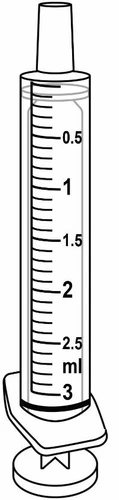
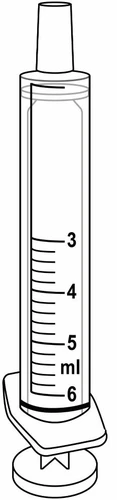
- The medicine is a liquid. Use the oral syringes provided to measure the dose, as illustrated below.
- Use the green 3 mL syringe for doses up to 3 mL.
- Use the purple 6 mL syringe for doses between 3.2 mL and 6 mL.
- Fintepla oral solution is compatible with most enteral feeding tubes.
- To flush the feeding tube, fill the administration syringe with water and flush the tube. Repeat this procedure three times.
3 mL syringe: green
6 mL syringe: purple
Write the date of first
opening on the pack.
When you open the bottle for the first time,
you must attach the special adapter. The
instructions below explain how to apply the
adapter.
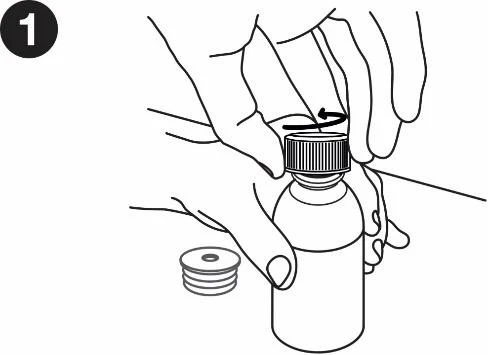
Inserting the bottle adapter:
When you open the bottle for the first time,
the adapter must be inserted.
Wash and dry your hands.
Remove the bottle adapter from its packaging.
Place the bottle on a flat, stable surface.
Open the bottle.
Hold the bottle firmly.
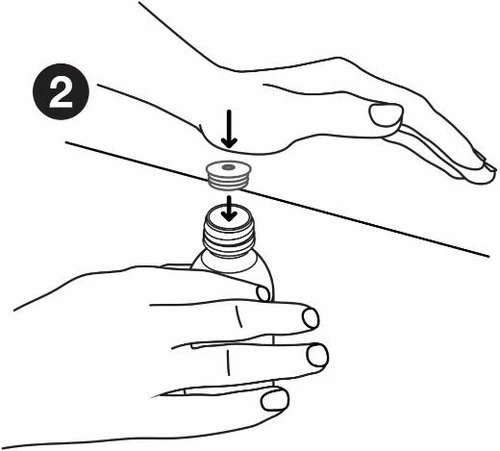
Align the adapter with the open top of the
bottle.
Push the bottle adapter into the bottle with
the palm of your hand until the adapter is
level with the top of the bottle.
Leave the adapter in the bottle after using
the medicine.
Screw the bottle cap onto the bottle with the
adapter left in place.
Taking the medicine:
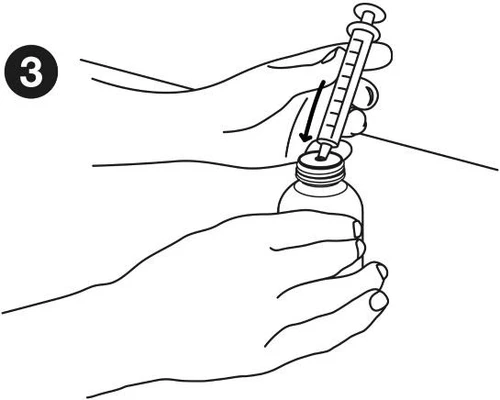
Before measuring the dose, make sure the
plunger is fully pushed into the oral
administration syringe.
Hold the medicine bottle firmly on a hard,
flat surface.
Push the tip of the oral administration syringe
into the bottle adapter until it can go no
further.
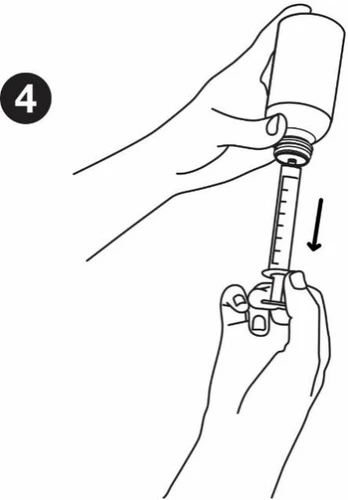
Hold the oral syringe and bottle together and
turn them upside down.
Slowly pull the plunger to draw up the
correct dose.
Hold the oral syringe and bottle together and
then turn them back upright.
Holding the bottle firmly, gently remove the
oral administration syringe from the adapter.
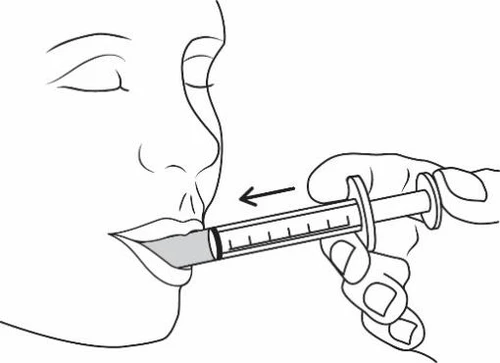
Place the tip of the oral administration
syringe against the inside of the patient’s
cheek.

Gently push the plunger until it is fully
depressed.
A small amount will remain in the tip of the
syringe. This is normal.
Do not inject the medicine into the back of
the throat, as this may cause choking.
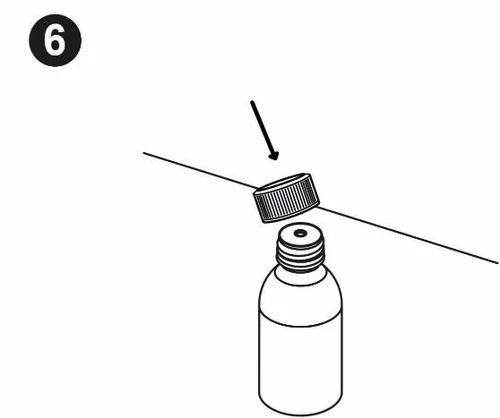
Replace the cap on the bottle and screw it
until it stops.
Always leave the adapter in the bottle.
Cleaning the syringe:
Rinse the oral administration syringe with
cold water and allow it to air dry after each
use.
Rinse the inside of the syringe and the
plunger.
You may draw cold water into the syringe
using the plunger and then push it out several
times to clean the syringe.
You may separate the plunger from the
syringe to rinse each part. Do not use
detergents to clean the syringe and plunger.
Do not wash the syringe and plunger in a
dishwasher.
Before the next use, the syringe and plunger
must be completely dry.
If you or your child takes more Fintepla than you should
Contact a doctor or go to hospital immediately. Take the medicine bottle with you.
The following effects may occur: agitation, drowsiness or confusion, flushing or feeling hot, chills and sweating.
If you or your child forgets to take Fintepla
- Take it as soon as you remember. However, if it is almost time for the next dose, skip the missed dose.
- Do not take a double dose to make up for a forgotten dose.
If you or your child stops taking Fintepla
Treatment with Fintepla must not be stopped without consulting your doctor. If your doctor decides to stop treatment with this medicine, they will ask you or your child to gradually reduce the daily dose. Gradually reducing the dose lowers the risk of having a seizure or status epilepticus.
Three to six months after the last dose of Fintepla, you or your child will need to have an echocardiogram.
If you have any questions about using this medicine, speak to your doctor, pharmacist, or nurse.
4. Possible side effects
Like all medicines, this medicine can cause side effects, although not everyone gets them.
Very common: may affect more than 1 in 10 people
- reduced appetite
- drowsiness
- diarrhoea
- fatigue
Common: may affect up to 1 in 10 people
- bronchitis
- abnormal behaviour
- rapid mood changes
- aggression
- agitation
- tremor of the hands, arms, or legs
- problems with movement coordination, walking, and balance
- reduced muscle tone
- epileptic seizures
- prolonged and repeated seizures (status epilepticus)
- deep and prolonged sleep (lethargy)
- weight loss
- constipation
- increased saliva production
- vomiting
- rash
- low blood sugar level
- increased prolactin in the blood
Not known (frequency cannot be estimated from the available data):
- irritability
- serotonin syndrome
- high blood pressure in the arteries of the lungs (pulmonary arterial hypertension)
- valvular heart disease
Inform your doctor, pharmacist, or nurse if you experience any of the side effects listed above.
Reporting of side effects
If you get any side effects, including those not listed in this leaflet, talk to your doctor, pharmacist, or nurse. You can also report side effects directly through the national reporting system listed in Annex V. By reporting side effects, you can help provide more information on the safety of this medicine.
5. How to store Fintepla
- Keep this medicine out of the sight and reach of children.
- Do not use this medicine after the expiry date stated on the carton and on the label of the bottle after “Exp.”. The expiry date refers to the last day of that month.
- Do not refrigerate or freeze.
- Use within 3 months after first opening of the bottle.
- If a syringe is lost or damaged, or if the dosage markings on a syringe cannot be read, use another one provided in the package, or consult your pharmacist.
- Do not dispose of medicines via wastewater or household waste. Ask your pharmacist how to dispose of medicines no longer required. This will help protect the environment.
6. Package contents and other information
What Fintepla contains
The active substance is fenfluramine. Each mL contains 2.2 mg of fenfluramine (as 2.5 mg of
fenfluramine hydrochloride).
The other components are:
- sodium ethyl-p-hydroxybenzoate (E 215)
- sodium methyl-p-hydroxybenzoate (E 219)
- sucralose (E 955)
- hydroxyethylcellulose (E 1525)
- monosodium phosphate (E 339)
- disodium phosphate (E 339)
- cherry flavour powder: either acacia (E 414) or glucose (maize) or ethyl benzoate or natural flavour preparations or natural flavouring substances or flavouring substances or maltodextrin (maize) or sulfur dioxide (E 220)
- potassium citrate (E 332)
- citric acid monohydrate (E 330)
- water for injections
Description of the appearance of Fintepla and contents of the pack
- Fintepla oral solution is supplied as a clear, colourless, slightly viscous liquid with a cherry flavour.
- The solution is provided in a white bottle with a child-resistant and tamper-evident closure.
- Each carton contains one of the following:
- bottle containing 60 mL of oral solution, one bottle adapter, two 3 mL oral dosing syringes with 0.1 mL graduations, and two 6 mL oral dosing syringes with 0.2 mL graduations
- bottle containing 120 mL of oral solution, one bottle adapter, two 3 mL oral dosing syringes with 0.1 mL graduations, and two 6 mL oral dosing syringes with 0.2 mL graduations
- bottle containing 250 mL of oral solution, one bottle adapter, two 3 mL oral dosing syringes with 0.1 mL graduations, and two 6 mL oral dosing syringes with 0.2 mL graduations
- bottle containing 360 mL of oral solution, one bottle adapter, two 3 mL oral dosing syringes with 0.1 mL graduations, and two 6 mL oral dosing syringes with 0.2 mL graduations.
- Not all pack sizes may be marketed in your country.
Marketing Authorisation Holder
UCB Pharma S.A.,
Allée de la Recherche 60,
B-1070 Bruxelles,
Belgium
Manufacturer
Millmount Healthcare Ltd,
Millmount Site, Block 7,
City North Business Campus,
Stamullen,
Co. Meath,
K32 YD60,
Ireland
Or
UCB Pharma SA
Chemin du Foriest
1420 Braine-l’Alleud
Belgium
For further information about this medicinal product, please contact the local representative of the Marketing Authorisation Holder:
België/Belgique/Belgien Lietuva
UCB Pharma S.A./NV UAB Medfiles
Tél/Tel: + 32 / (0)2 559 92 00 Tel: +370 5 246 16 40
България Luxembourg/Luxemburg
Ю СИ БИ България ЕООД UCB Pharma SA/NV
Teл.: + 359 (0) 2 962 30 49 Tél/Tel: + 32 / (0)2 559 92 00
(Belgique/Belgien)
Česká republika Magyarország
UCB s.r.o. UCB Magyarország Kft.
Tel: + 420 221 773 411 Tel.: + 36-(1) 391 0060
Danmark Malta
UCB Nordic A/S Pharmasud Ltd.
Tlf: + 45 / 32 46 24 00 Tel: + 356 / 21 37 64 36
Deutschland Nederland
UCB Pharma GmbH UCB Pharma B.V.
Tel: + 49 /(0) 2173 48 4848 Tel.: + 31 / (0)76-573 11 40
Eesti Norge
OÜ Medfiles UCB Nordic A/S
Tel: +372 730 5415 Tlf: + 47 / 67 16 5880
Ελλάδα Österreich
UCB Α.Ε. UCB Pharma GmbH
Τηλ: + 30 / 2109974000 Tel: + 43-(0)1 291 80 00
España Polska
UCB Pharma, S.A. UCB Pharma Sp. z o.o. / VEDIM Sp. z o.o.
Tel: + 34 / 91 570 34 44 Tel: + 48 22 696 99 20
France Portugal
UCB Pharma S.A. UCB Pharma (Produtos Farmacêuticos), Lda
Tél: + 33 / (0)1 47 29 44 35 Tel: + 351 21 302 5300
Hrvatska România
Medis Adria d.o.o. UCB Pharma Romania S.R.L.
Tel: +385 (0) 1 230 34 46 Tel: + 40 21 300 29 04
Ireland
UCB (Pharma) Ireland Ltd. Slovenija
Tel: + 353 / (0)1-46 37 395 Medis, d.o.o.
Tel: + 386 1 589 69 00
Ísland Slovenská republika
UCB Nordic A/S UCB s.r.o., organizačná zložka
Sími: + 45 / 32 46 24 00 Tel: + 421 (0) 2 5920 2020
Italia Suomi/Finland
UCB Pharma S.p.A. UCB Pharma Oy Finland
Tel: + 39 / 02 300 791 Puh/Tel: + 358 9 2514 4221
Κύπρος Sverige
Lifepharma (Z.A.M.) Ltd UCB Nordic A/S Tel: + 46 / (0) 40 294 900
Τηλ: + 357 22 056300
Latvija
Medfiles SIA
Tel: +371 67 370 250
Other sources of information
More detailed information on this medicinal product is available on the website of the European Medicines Agency: https://www.ema.europa.eu. In addition, links to other websites on rare diseases and related therapeutic treatments are provided.
ANNEX IV
SCIENTIFIC CONCLUSIONS AND GROUNDS FOR THE VARIATION OF THE TERMS OF THE MARKETING AUTHORISATIONS
Scientific conclusions
Taking into account the assessment by the Pharmacovigilance and Risk Assessment Committee (PRAC) of the Periodic Safety Update Reports (PSURs) for fenfluramine, the PRAC's scientific conclusions are as follows:
New confirmed cases of valvular heart disease (VHD) and pulmonary arterial hypertension (PAH) have been identified in post-marketing experience, possibly related to fenfluramine used in the treatment of Dravet syndrome (DS) and Lennox-Gastaut syndrome (LGS). VHD and PAH represent significant risks associated with fenfluramine for the treatment of DS and LGS. Considering the plausible mechanism of action involving serotonergic stimulation of cardiac valvular tissue, the known association between VHD/PAH and higher doses of fenfluramine previously used as an appetite suppressant, and the identification of a first confirmed case of valvular heart disease in a child treated with lower doses of fenfluramine (6.6 mg/day) for DS reported in the latest PSUR, the PRAC considers that the identification of additional confirmed cases of VHD and PAH possibly related to fenfluramine warrants an update of the product information to provide physicians with the most up-to-date evidence regarding this important risk.
Having reviewed the PRAC's recommendation, the Committee for Medicinal Products for Human Use (CHMP) agrees with its overall conclusions and the rationale behind the recommendation.
Grounds for the variation of the terms of the marketing authorisations
Based on the scientific conclusions on fenfluramine, the CHMP considers that the benefit-risk balance of medicinal products containing fenfluramine remains unchanged, subject to the proposed updates to the product information.
The CHMP recommends a variation to the terms of the marketing authorisations.