Fibriclotte
ItalyTable of Contents
- Package leaflet: Information for the user
- Fibriclotte 1.5 g
- 1. What Fibriclotte is and what it is used for
- 2. What you need to know before using Fibriclotte
- 3. How to use Fibriclotte
- 4. Possible side effects
- 5. How to store Fibriclotte
- 6. Contents of the pack and other information
- The following information is intended for healthcare professionals only:
Package leaflet: Information for the user
Fibriclotte 1.5 g
Powder and solvent for injectable/infusion solution
human fibrinogen
Please read this leaflet carefully before using this medicine because it contains important information for you.
- Keep this leaflet. You may need to read it again.
- If you have any questions, ask your doctor, pharmacist, or nurse.
- This medicine has been prescribed for you only. Do not give it to others, even if their symptoms are the same as yours, as it may be harmful.
- If you experience any side effects, including those not listed in this leaflet, tell your doctor, pharmacist, or nurse. See section 4.
Contents of this leaflet
- What Fibriclotte is and what it is used for
- What you need to know before using Fibriclotte
- How to use Fibriclotte
- Possible side effects
- How to store Fibriclotte
- Contents of the pack and other information
1. What Fibriclotte is and what it is used for
What Fibriclotte is
Fibriclotte is a medicine that belongs to the class of haemostatic agents. The active substance is human fibrinogen, a protein naturally present in the body. This protein ensures normal blood coagulation and helps prevent prolonged bleeding.
What Fibriclotte is used for
It is used in all age groups to compensate for deficiency of human fibrinogen and thus to prevent and treat bleeding (haemorrhages) in patients with congenital fibrinogen deficiency.
Congenital fibrinogen deficiency is an inherited disorder characterised by lower than normal levels or absence of a protein called fibrinogen. This deficiency may cause prolonged bleeding.
2. What you need to know before using Fibriclotte
Do not use Fibriclotte
If you are allergic to the active substance (human fibrinogen) or to any of the other ingredients of
this medicine (listed in section 6. "Contents of the pack and other information").
Inform your doctor if you are allergic to any medicine.
Warnings and precautions
Talk to your doctor, pharmacist, or nurse before using Fibriclotte.
Traceability
It is strongly recommended that each time you receive a dose of this medicine, the name and
batch number be recorded to maintain a record of the batch used.
Risk of blood clot formation
At high doses or with repeated administrations, this medicine may increase the risk of blood clot
formation in blood vessels.
Therefore, your doctor must assess the benefits of the medicine against the risk of blood clot
formation, particularly:
- If you have had a heart attack (history of coronary artery disease or myocardial infarction).
- If you suffer from liver disease.
- If you have recently undergone surgery.
- If you are about to undergo surgery soon.
- In newborn children (neonates).
- If you have a higher than normal risk of developing blood clots. Your doctor may also ask you to undergo additional tests to monitor this risk.
Risk of allergies
Your doctor will inform you about the warning signs of an allergic reaction or serious allergic
reaction (anaphylactic reaction) (see section 4. "Possible side effects"). If any of these symptoms
occur, the medicine must be stopped immediately.
Viral safety
This medicine is produced from human plasma (the liquid part of blood).
When medicines are made from human blood or plasma, certain measures are taken to prevent
transmission of infections to patients, including:
- careful selection of blood and plasma donors to ensure that those at risk of carrying infections are excluded;
- testing of each donation and plasma pool for signs of viral infections;
- inclusion in the manufacturing process of steps that can inactivate or remove viruses. Despite these measures, when administering medicines prepared from human blood or plasma, the possibility of transmitting infections cannot be completely ruled out. This also applies to unknown or emerging viruses or other types of infections.
The measures taken are considered effective against enveloped viruses such as human
immunodeficiency virus (HIV or AIDS virus), hepatitis B virus, and hepatitis C virus, and against the
non-enveloped hepatitis A virus.
The measures taken may have limited effectiveness against non-enveloped viruses such as parvovirus
B19. Infection with parvovirus B19 can be serious for pregnant women (fetal infection) and for
individuals with compromised immune systems or suffering from certain forms of anemia (e.g.
sickle cell disease or hemolytic anemia).
Your doctor may recommend that you consider vaccination against hepatitis A and B if you
regularly/repeatedly use products derived from human plasma.
Risk of antibody formation
Antibody responses have been observed during replacement therapy with coagulation factors in
other congenital disorders, but currently there are no data available regarding fibrinogen.
Children and adolescents
The warnings and precautions listed above also apply to children and adolescents.
Other medicines and Fibriclotte
Inform your doctor or pharmacist if you are taking, have recently taken, or might take any other
medicines, including those without a prescription.
To date, no interactions between this treatment and other medicines have been observed. However,
it must not be mixed with other products and/or medicines.
Pregnancy and breastfeeding
- If you are pregnant, suspect you may be pregnant, are planning a pregnancy, or are breastfeeding with breast milk, consult your doctor before taking this medicine. This product should be used during pregnancy and breastfeeding only after consulting with your doctor.
- If you find out you are pregnant during treatment, contact your doctor, as only they can determine whether you should continue therapy.
Driving and use of machinery
This medicine does not affect the ability to drive vehicles or operate machinery.
Fibriclotte contains sodium
This medicine contains up to 3 mmol (or 69 mg) of sodium (a main component of table salt) per
vial. This corresponds to 3.45% of the maximum recommended daily dietary intake for an adult.
This should be taken into account if you are on a low-salt diet.
3. How to use Fibriclotte
Treatment must be initiated under the supervision of a physician experienced in the management of
congenital fibrinogen deficiency.
Dose
The appropriate dose and frequency of administration will be determined by your doctor and will depend on:
- body weight,
- severity of the disorder,
- site and extent of bleeding or nature of the surgical procedure,
- health status.
Your doctor will recommend regular blood tests during treatment to monitor your fibrinogen levels.
Based on the results of these tests, your doctor may decide to adjust the dose and frequency of injections.
Frequency of administration
The frequency of injections will be determined by your doctor.
Your doctor will adjust the number of injections according to the severity of bleeding and the response to treatment.
At the end of this leaflet, in the section intended for healthcare professionals, information on the frequency and duration of treatment in various situations is provided.
Method of administration:
This medicine must be injected into a vein. A 15 µm filter infusion set, such as the one supplied in the package, must be used. If you have any doubts about the use of this product, consult your doctor, pharmacist, or nurse.
If you use more Fibriclotte than you should
To avoid the risk of overdose, your doctor will perform regular blood tests to monitor your fibrinogen levels.
In case of overdose, the risk of abnormal blood clot formation cannot be ruled out.
4. Possible side effects
Like all medicines, this medicine can cause side effects, although not everyone gets them.
The most serious side effects are:
- Allergic reactions: as with any protein-based product for intravenous use, allergic reactions may occur. In some cases, these reactions have progressed to a serious allergic reaction, sometimes with a sudden drop in blood pressure (anaphylactic shock). Warning signs of allergic reactions include:
- burning and stinging sensation at the injection site,
- tingling,
- redness, itching, and skin rash,
- hives (urticaria),
- skin inflammation,
- paleness,
- swelling of the face or throat,
- cough,
- wheezing (asthma-like symptoms),
- chest tightness,
- rapid heartbeat,
- low blood pressure,
- extreme tiredness (lethargy),
- restlessness,
- chills,
- feeling unwell (nausea), vomiting.
If you experience any of these effects, contact a doctor immediately. Depending on the type and severity of the reaction, the doctor will discontinue treatment with this medicine and/or initiate appropriate treatment.
- Blood clots: blood clots may form in the bloodstream, which can cause:
- heart attack, whose warning signs are sudden chest pain or shortness of breath.
- stroke, whose warning signs are sudden onset of muscle weakness, loss of sensation and/or balance, reduced level of consciousness, or difficulty speaking.
- a serious condition called pulmonary embolism (a blood clot blocking an artery in the lungs), whose warning signs are chest pain, difficulty breathing, or coughing up blood.
- clot in a vein (venous thrombosis), whose warning signs are redness, warmth, pain, tenderness, or swelling in one or both legs.
If you experience any of these effects, contact a doctor immediately. Depending on the type and severity of the reaction, the doctor will discontinue treatment with this medicine and/or initiate appropriate treatment.
The following side effects are common (may affect up to 1 in 10 infusions):
- headache.
The following side effects are uncommon (may affect up to 1 in 100 infusions):
- allergic reaction (including anaphylactic shock, paleness, feeling unwell (vomiting), cough, low blood pressure, chills, hives (urticaria); see also section "Allergic reactions"),
- dizziness,
- vomiting (associated with headache),
- ringing in the ears,
- circulatory disorder (deep vein thrombosis, superficial venous thrombosis),
- breathing difficulties (asthma),
- skin rash, skin redness, skin irritation, night sweats,
- feeling of warmth.
Children and adolescents
The frequency, type, and severity of side effects in pediatric patients (from birth up to 18 years of age) are similar to those in adults, except for allergic/anaphylactic-type reactions, which occur more frequently in the pediatric population.
Reporting of side effects
If you experience any side effect, including those not listed in this leaflet, please inform your doctor, pharmacist, or nurse. You may also report side effects directly via the national reporting system at the following website:
https://www.aifa.gov.it/content/segnalazioni-reazioni-avverse.
By reporting side effects, you can help provide more information on the safety of this medicine.
5. How to store Fibriclotte
Keep this medicine out of the sight and reach of children.
Do not use this medicine after the expiry date stated on the label and the carton.
The expiry date refers to the last day of that month.
Do not store above 25°C. Do not freeze.
Keep the vial in the outer carton to protect the medicine from light and moisture.
The product should be used immediately after reconstitution. Do not store the reconstituted product.
Do not use this medicine if the reconstituted solution is cloudy or contains particles.
Do not dispose of any medicine via wastewater or household waste. Ask your pharmacist how to dispose of medicines you no longer use. This will help protect the environment.
6. Contents of the pack and other information
What Fibriclotte contains
The active substance is human fibrinogen (1.5 g per vial). After reconstitution with 100 ml of
water for injections, Fibriclotte contains 15 mg/ml of human fibrinogen.
The other components are arginine hydrochloride, isoleucine, lysine hydrochloride, glycine, sodium citrate dihydrate and solvent (water for injections).
Description of the appearance of Fibriclotte and contents of the pack
This medicine is supplied as a powder together with a solvent for injectable solution in glass vials, a transfer system and an infusion set equipped with a 15 μm filter.
The reconstituted solution must be almost colourless and slightly opalescent (with a pearly appearance).
Marketing Authorisation Holder:
Laboratoire français du Fractionnement et des Biotechnologies
Tour W – 102 Terrasse Boieldieu 19th Floor 92800 Puteaux, FRANCE
Tel.: +33(0) 1 69 82 70 10
Fax: +33(0) 1 69 82 19 03
Manufacturer:
LFB BIOMEDICAMENTS
59 rue de Trévise, 59000 Lille, FRANCE
Concessionaire for sale:
BIOVIIIx srl
Via A. Manzoni, 1
80123 - Naples
ITALY
This medicine is authorised in the Member States of the European Economic Area under the following names:
Austria, Germany, Greece, Spain and United Kingdom: FibCLOT
Denmark, Finland, Hungary, Luxembourg, Norway, Sweden, Netherlands: Fibclot
Belgium: Fibclot 1.5 g, powder and solvent for injectable/perfusion solution
Italy: Fibriclotte
<--------------------------------------------------------------------------------------------------------------------->
The following information is intended for healthcare professionals only:
Treatment must be initiated under the supervision of a physician experienced in the management of
coagulation disorders.
Dosage
The dose and duration of replacement therapy depend on the severity of the deficiency, the site and
extent of bleeding, and the patient's clinical condition.
To determine the individual dosage, the functional fibrinogen level should be measured; the amount and
frequency of administration must be adjusted for each patient by regularly monitoring plasma fibrinogen
levels and continuously assessing the patient's clinical status and any concomitant replacement therapies.
The normal plasma fibrinogen level ranges between 1.5 and 4.5 g/l. In congenital hypo- or afibrinogenemia,
the critical plasma fibrinogen level below which bleeding may occur is approximately 0.5–1.0 g/l.
In major surgical procedures, careful monitoring of replacement therapy using coagulation assays is essential.
Treatment of bleeding episodes and perioperative prophylaxis in patients with congenital hypo- or afibrinogenemia and a known tendency to bleed.
To treat non-surgical bleeding episodes, it is recommended to increase fibrinogen levels to 1 g/l and maintain
this level until hemostasis is achieved, and above 0.5 g/l until complete healing.
To prevent excessive bleeding during surgical procedures, prophylactic treatment is recommended to increase
fibrinogen levels to 1 g/l and maintain this level until hemostasis is achieved, and above 0.5 g/l until complete wound healing.
For surgical procedures or treatment of non-surgical bleeding, the dose should be calculated as follows:
Dose (g) = [desired level (g/l) – baseline level (g/l)] × 1/recove\ry (g/l)/(g/kg) × body weight (kg)
The “1/recove\ry” ratio is based on the patient’s individual recove\ry* (see section 5.2), or, if recove\ry is unknown:
- 0.053 (g/kg)/(g/l) for children and adolescents with body weight < 40 kg
- 0.043 (g/kg)/(g/l) for adults and adolescents with body weight ≥ 40 kg
* Example of patient recove\ry and dose calculation
For a 60 kg patient with undetectable baseline fibrinogen level and an increase to 1.20 g/l one hour after infusion of 0.060 g/kg of Fibriclotte:
- Patient recove\ry calculation: 1.20 (g/l) / 0.060 (g/kg) = 20.0 (g/l)/(g/kg)
- Dose calculation for an increase to 1.0 g/l: 1.0 g/l × 1 / 20.0 (g/l)/(g/kg) [or 0.050 (g/kg)/(g/l)] × 60 kg = 3 g
In an emergency situation when the baseline fibrinogen level is unknown, the recommended initial dose is 0.05 g per kg body weight administered intravenously in adults and adolescents with body weight ≥40 kg, and 0.06 g per kg body weight in pediatric patients with body weight <40 kg. Subsequent dosing (doses and frequency of injections) should be adjusted based on the patient’s clinical condition and laboratory test results.
The biological half-life of fibrinogen is 3–4 days. Therefore, in the absence of consumption, repeated administration of human fibrinogen is usually not required. However, considering accumulation that may occur with repeated administration for prophylactic use, the dose and frequency should be determined according to the physician’s therapeutic objectives for a given patient.
Paediatric population
Recove\ry and half-life in children and adolescents with body weight <40 kg are lower than in adults and adolescents with body weight ≥40 kg (see section 5.2 of the SmPC). Therefore, adjusted recove\ry values should be used to calculate the dose of Fibriclotte in the respective body weight groups when individual patient recove\ry is unknown. A body weight <40 kg is considered to cover the age range from birth to approximately 12 years. Dosing (doses and frequency of injections) should be adjusted according to the individual’s clinical response.
Reconstitution:
Follow current guidelines for aseptic technique.
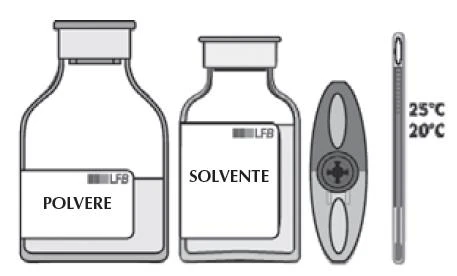
If necessary, warm both vials (powder and solvent) to room temperature.
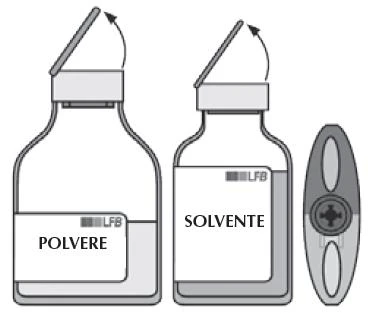
Remove the protective caps from the solvent vial and the powder vial.
Disinfect the surface of each stopper.
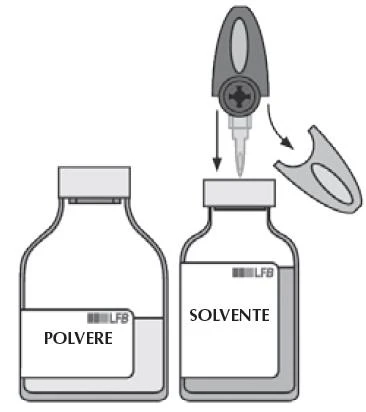
Remove the translucent protective film from the transfer device and insert the exposed piercing tip fully into the center of the solvent vial stopper with a twisting motion.
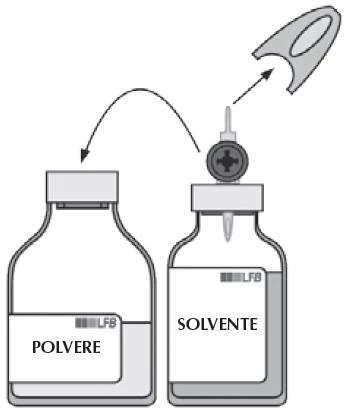
Remove the second grey protective film from the other end of the transfer device.
Invert the solvent vial and quickly press the free end of the piercing tip into the center of the powder vial stopper to transfer the solvent into the powder.
Ensure the piercing tip remains immersed in the solvent throughout to prevent premature vacuum release.
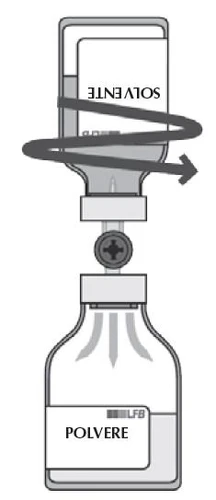
During transfer, direct the solvent stream over the entire powder surface and along the vial wall using a horizontal rotating motion.
Ensure all solvent is transferred.
At the end of the transfer process, the vacuum is automatically released as sterile air through the vent part of the transfer device.
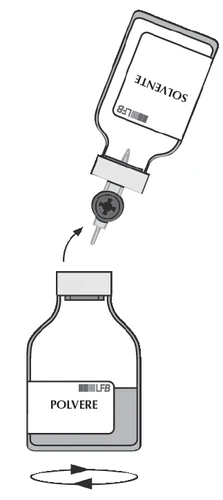
Remove the empty vial (solvent) with the transfer device.
Gently swirl for several minutes with a rotating motion, avoiding foam formation, until the powder is completely dissolved.
The reconstituted product should be inspected visually before administration to ensure it is free from particulate matter. The reconstituted solution should be almost colourless and slightly opalescent. Do not use cloudy solutions or those containing deposits.
Administration:
Fibriclotte must be administered exclusively by intravenous route, as a single dose, immediately after reconstitution, at a rate not exceeding 4 ml/min.
Use of an infusion set equipped with a 15 µm filter, such as the one supplied in the package, is mandatory.
Any unused medicinal product or waste material must be disposed of in accordance with local requirements.
This medicinal product must not be mixed with other medicinal products and must be administered via a separate injection/infusion line.