Fetcroja
Italy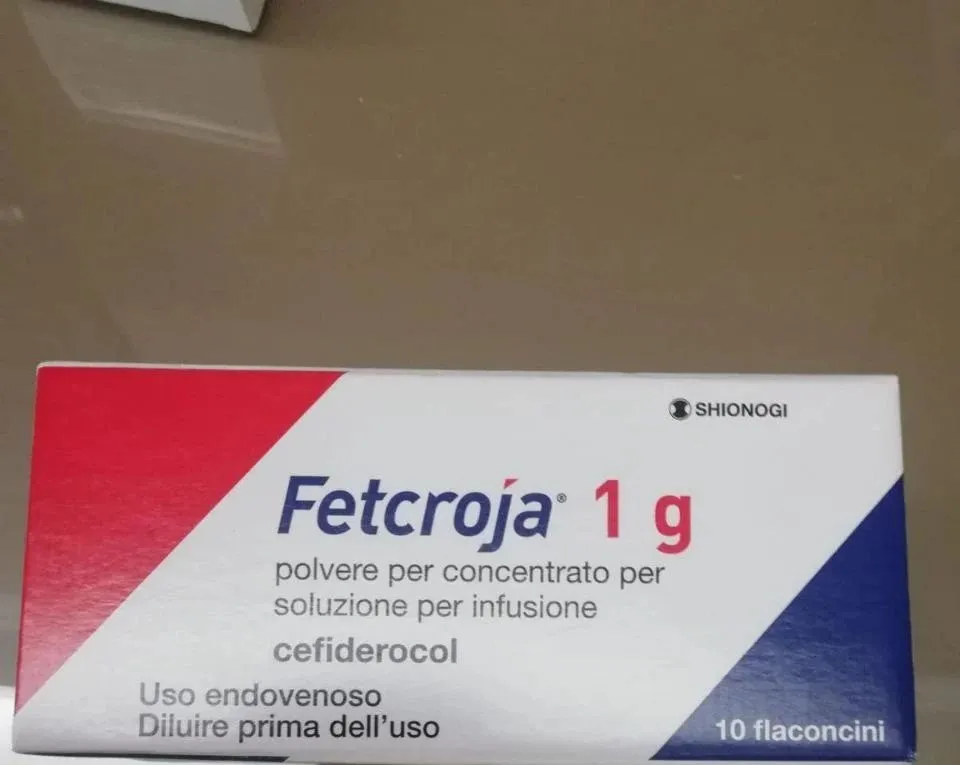
Table of Contents
- Package leaflet: Information for the user
- Fetcroja 1 g powder for concentrate for solution for infusion
- 1. What Fetcroja is and what it is used for
- 2. What you need to know before receiving Fetcroja
- 3. How Fetcroja is used
- 4. Possible side effects
- 5. How to store Fetcroja
- 6. Package contents and other information
- The following information is intended exclusively for healthcare professionals:
Package leaflet: Information for the user
Fetcroja 1 g powder for concentrate for solution for infusion
cefiderocol
Please read this leaflet carefully before receiving this medicine because it contains important information for you.
- Keep this leaflet. You may need to read it again.
- If you have any questions, ask your doctor or nurse.
- If you experience any side effects, including those not listed in this leaflet, tell your doctor or nurse. See section 4.
Contents of this leaflet
- What Fetcroja is and what it is used for
- What you need to know before receiving Fetcroja
- How Fetcroja is used
- Possible side effects
- How to store Fetcroja
- Contents of the pack and other information
1. What Fetcroja is and what it is used for
Fetcroja contains the active substance cefiderocol, an antibiotic medicine belonging to a group of antibiotics called cephalosporins. Antibiotics help fight bacteria that cause infections.
Fetcroja is used in adults to treat infections caused by certain types of bacteria when other antibiotics cannot be used.
2. What you need to know before receiving Fetcroja
Do not use Fetcroja
- if you are allergic to cefiderocol or to any of the other ingredients of this medicine (listed in section 6);
- if you are allergic to other antibiotics known as cephalosporins;
- if you have previously had a severe allergic reaction to certain antibiotics, such as penicillins or carbapenems. This may include severe skin peeling, swelling of the hands, face, feet, lips, tongue or throat, or difficulty swallowing or breathing. ➔ Inform your doctor if any of these apply to you.
Warnings and precautions
Talk to your doctor or nurse before receiving Fetcroja:
- if you have ever had an allergic reaction to other antibiotics. See also the section above "Do not use Fetcroja";
- if you have kidney problems. Your doctor will adjust the dose to ensure you do not receive too much or too little medicine;
- if you develop diarrhea during treatment;
- if you have ever had seizures. ➔ Talk to your doctor or nurse before receiving Fetcroja.
New infection
Although Fetcroja can fight certain bacteria, there is a possibility that a different infection caused by another organism may develop during or after treatment. Your doctor will closely monitor you for any new infections and will give you another treatment if necessary.
Blood/laboratory tests
Inform your doctor that you are being treated with Fetcroja if you are due to have blood or laboratory tests, as abnormal results may occur. A test called the “Coombs test” looks for antibodies that may destroy red blood cells or that may be influenced by the immune system's response to Fetcroja. Fetcroja may also cause false positive results in urine dipstick tests (for proteins in urine or diabetes markers).
Children and adolescents
Fetcroja must not be given to children and adolescents under 18 years of age, as it is not known whether the medicine is safe in these age groups.
Other medicines and Fetcroja
Inform your doctor or nurse if you are taking, have recently taken, or might take any other medicines.
Pregnancy and breastfeeding
If you are pregnant, think you might be pregnant, planning to become pregnant, or breastfeeding, ask your doctor for advice before receiving this medicine.
Driving and using machines
Fetcroja does not affect the ability to drive or operate machinery.
Fetcroja contains sodium
This medicine contains 7.64 mmol (176 mg) of sodium per vial. The total daily dose contains 2.1 g of sodium, slightly exceeding the maximum daily intake recommended by the WHO, which is 2 g of sodium for an adult. Consult your doctor before receiving Fetcroja if you are on a low-sodium diet.
3. How Fetcroja is used
Your doctor or nurse will administer this medicine to you as an infusion (a drip) into a vein over 3 hours, three times a day. The usual recommended dose is 2 g.
The number of days you will receive treatment with Fetcroja depends on the type of infection and how the infection progresses.
If you feel pain at the site where the Fetcroja infusion enters the vein, inform your doctor or nurse.
Patients with kidney problems
If you have kidney problems, consult your doctor before receiving Fetcroja. Your doctor will adjust the dose of Fetcroja.
If you receive more Fetcroja than you should
Fetcroja will be administered to you by a doctor or nurse, so it is unlikely that you will receive an incorrect dose. However, inform your doctor or nurse immediately if you think you have been given too much Fetcroja.
If you miss a dose of Fetcroja
If you think a dose of Fetcroja has not been administered to you, inform your doctor or nurse immediately.
If you have any doubts about the use of this medicine, consult your doctor or nurse.
4. Possible side effects
Like all medicines, this medicine can cause side effects, although not everyone experiences them.
Serious side effects
Contact your doctor immediately if you notice any of the following serious side effects – urgent medical treatment may be required:
- Severe allergic reaction – signs include sudden swelling of the lips, face, throat or tongue; severe rash or other serious skin reactions; difficulty swallowing or breathing. This reaction may be life-threatening;
- Diarrhoea that worsens or does not resolve, or presence of blood or mucus in the stools. This may occur during treatment or after it has been stopped. If this happens, do not take medicines that stop or slow down bowel movements. ➔ Contact your doctor immediately if you notice any of the serious side effects described above.
Other side effects
Inform your doctor or nurse if you notice any of the following side effects.
Common
(may affect up to 1 in 10 people)
- Feeling unwell (nausea) or sickness (vomiting)
- Swelling, redness and/or pain around the site where the needle was inserted for intravenous administration
- Fungal infections, such as oral thrush
- Increased levels of liver enzymes, detected in blood tests
- Cough
- Skin rash with small bumps
- Severe intestinal infection, known as Clostridioides difficile colitis. Symptoms include watery diarrhoea, abdominal pain, fever, etc.
- Increased creatinine levels in the blood
Uncommon
(may affect up to 1 in 100 people)
- Increased blood urea levels
- Allergic reaction to Fetcroja
Not known
(frequency cannot be estimated from the available data)
- Decrease in the number of specific white blood cells (neutrophil granulocytes)
- Abnormal urine colour (chromaturia)
Reporting of side effects
If you experience any side effect, including those not listed in this leaflet, consult your doctor or nurse. You can also report side effects directly via the national reporting system listed in Annex V. Reporting side effects can help provide more information on the safety of this medicine.
5. How to store Fetcroja
Keep this medicine out of the sight and reach of children.
Do not use this medicine after the expiry date stated on the label. The expiry date refers to the last day of that month.
Store the unopened vials in a refrigerator (2°C – 8°C).
Keep in the original packaging to protect the medicine from light.
6. Package contents and other information
What Fetcroja contains
- The active substance is cefiderocol sulfate tosylate, equivalent to 1 g of cefiderocol.
- The other components are sucrose, sodium chloride and sodium hydroxide.
Description of the appearance of Fetcroja and contents of the pack
Fetcroja is a white to off-white powder for concentrate for solution for infusion, contained in a vial.
It is available in packs of 10 vials.
Marketing Authorization Holder and Manufacturer
Shionogi B.V.
Herengracht 464
1017CA Amsterdam
The Netherlands
For further information about this medicinal product, please contact the local representative of the Marketing Authorization Holder:
AT, BE, BG, CY, CZ, DK, EE, EL, FI, HR, Deutschland
HU, IE, IS, LT, LU, LV, MT, NL, NO, PL,
PT, RO, SE, SI, SK
Shionogi GmbH
Tel: + 49 (0)30 2062980 66
Tel/Tel./ Teл./ Tlf./ Tél/ Puh/ [email protected]
Sími/ Τηλ: +31 (0)20 703 8327
[email protected]
España
Shionogi SLU
Tel: + 34 911 239 258
[email protected]
Italia
Shionogi Srl
Tel: + 39 06 94 805 118
[email protected]
France
Shionogi SAS
Tel: +33 (0) 186655806
[email protected]
Other sources of information
More detailed information on this medicinal product is available on the website of the European Medicines Agency: http://www.ema.europa.eu/
The following information is intended exclusively for healthcare professionals:
Each vial is for single use only.
The powder must be reconstituted with 10 mL of sodium chloride 9 mg/mL (0.9%) injection solution or 5% dextrose injection solution drawn from the 100 mL bags that will be used to prepare the final infusion solution, and gently shaken until dissolved. The vial or vials must remain in an upright position until the foam formed on the surface disappears (usually within 2 minutes). The final volume of the reconstituted solution in the vial will be approximately 11.2 mL (note: the reconstituted solution is not intended for direct injection).
To prepare the required doses, the appropriate volume of reconstituted solution should be withdrawn from the vial as described in the following table. Add the withdrawn volume to the infusion bag containing the remaining 100 mL of sodium chloride 9 mg/mL (0.9%) injection solution or 5% dextrose injection solution. Visually inspect the diluted medicinal solution in the infusion bag to check for the presence of particulate matter and any discoloration before use. Do not use solutions that are discolored or contain visible particles.
Preparation of cefiderocol doses
| Dose of cefiderocol | Number of 1 g cefiderocol vials to reconstitute | Volume to withdraw from the reconstituted vial(s) | Total volume of cefiderocol solution required for further dilution in at least 100 mL of 0.9% sodium chloride injection or 5% dextrose injection |
|---|---|---|---|
| 2 g | 2 vials | 11.2 mL (entire contents) from both vials | 22.4 mL |
| 1.5 g | 2 vials | 11.2 mL (entire contents) from the first vial AND 5.6 mL from the second vial | 16.8 mL |
| 1 g | 1 vial | 11.2 mL (entire contents) | 11.2 mL |
| 0.75 g | 1 vial | 8.4 mL | 8.4 mL |
Standard aseptic techniques must be used for the preparation and administration of the solution.
This medicinal product must not be mixed with other medicinal products except those previously mentioned in this section. If treatment with a combination of another medicinal product and Fetcroja is unavoidable, administration must not take place in the same syringe or in the same infusion solution. It is recommended to adequately flush intravenous lines between administrations of different medicinal products.
Any unused medicinal product and waste material derived from such medicinal product must be disposed of in accordance with local regulations.