Fertifol
Italy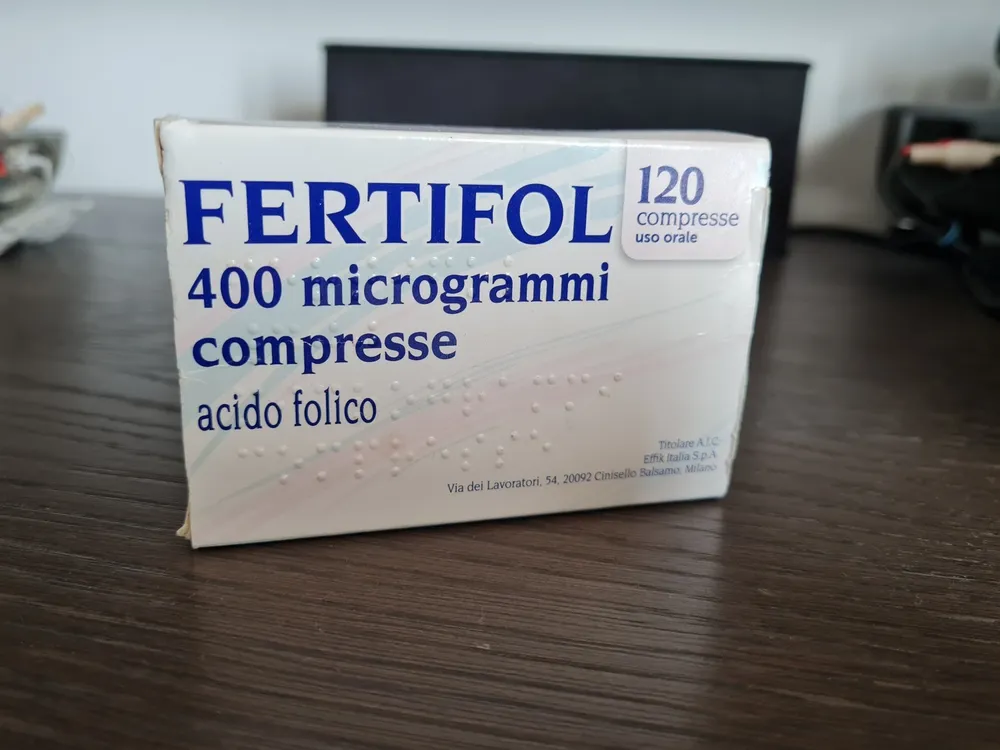
Table of Contents
PACKAGE LEAFLET: INFORMATION FOR THE USER
FERTIFOL 400 micrograms tablets
Folic Acid
Please read this leaflet carefully before taking this medicine because it contains
important information for you.
- Keep this leaflet. You may need to read it again.
- If you have any questions, ask your doctor, pharmacist, or nurse.
- This medicine has been prescribed for you only. Do not give it to others, even if their symptoms are the same as yours, as it may be harmful.
- If you experience any side effects, including those not listed in this leaflet, contact your doctor, pharmacist, or nurse. (See section 4)
Contents of this leaflet:
- What Fertifol is and what it is used for
- What you need to know before taking Fertifol
- How to take Fertifol
- Possible side effects
- How to store Fertifol
- Contents of the pack and other information
1. What Fertifol is and what it is used for
Folic acid is a vitamin necessary for the renewal of the body's cells. You need a regular supply of folic acid to maintain your health.
In particular, women who are planning a pregnancy and pregnant women require an adequate intake of folic acid for the baby's development.
Fertifol is useful in the prevention of neural tube defects such as Spina Bifida (a rare malformation of the caudal portion of the spinal column that may lead to spinal cord herniation, fecal and urinary incontinence, and impaired movement and sensation in the lower limbs).
2. What you need to know before taking Fertifol
Do not take Fertifol
- if you are allergic to folic acid or to any of the other ingredients of this medicine (listed in section 6);
- if you have a tumor.
Warnings and precautions
Talk to your doctor or pharmacist before taking Fertifol:
- if you are a woman who has previously had pregnancies (completed or not) in which neural tube defects have already occurred;
- if you are being treated with antiepileptic medicines: phenytoin, phenobarbital, primidone, carbamazepine, or valproic acid;
- if you are a woman with a family history of neural tube defects;
- if you are being treated with folic acid antagonists (methotrexate, sulfasalazine);
- if you suffer from pernicious anemia. Indeed, folic acid may make the diagnosis of pernicious anemia more difficult by reducing the hematological manifestations of this disease, but it cannot counteract the progression of its neurological complications.
In all these cases, you may need to take a dose of folic acid higher than the amount contained in one tablet of Fertifol.
Other medicines and Fertifol
Tell your doctor or pharmacist if you are taking, have recently taken, or might take any of the following medicines: antiepileptics, folic acid antagonists (methotrexate, sulfasalazine), oral contraceptives, antituberculosis drugs, or any other medicine.
Pregnancy and breastfeeding
If you are pregnant, think you might be pregnant, are planning a pregnancy, or are breastfeeding, consult your doctor or pharmacist before taking this medicine.
Folic acid is excreted in breast milk.
Driving and using machines
There are no data available on the effects of this product on the ability to drive.
Fertifol contains lactose
If your doctor has informed you that you have an intolerance to certain sugars, contact him before taking Fertifol.
Fertifol contains sodium
This medicine contains less than 1 mmol (23 mg) of sodium per tablet, i.e. essentially 'sodium-free'.
3. How to take Fertifol
Take this medicine exactly as directed by your doctor or pharmacist. If you
have any doubts, consult your doctor or pharmacist.
The recommended dose is 1 tablet daily, starting from when pregnancy is planned up to the 12th
week of gestation.
The tablet should be taken regularly before meals.
This dose is not sufficient if you have previously had pregnancies in which neural tube development defects were observed.
The daily dose may be doubled in cases of inadequate folate intake.
FERTIFOL is not effective in preventing the occurrence of neural tube development defects if
treatment is started after the fourth week of pregnancy.
If you take more Fertifol than you should
Even much higher doses than those contained in Fertifol are not expected to cause harm to health.
Doses of folic acid up to 4–5 mg are well tolerated. At higher doses, the following have been observed:
mental disturbances, sleep disorders, and gastrointestinal disturbances.
In case of accidental ingestion/overdose of FERTIFOL, inform your doctor immediately or go to the nearest hospital.
If you have any doubts about how to use this medicine, consult your doctor or pharmacist.
4. Possible side effects
Like all medicines, this medicine can cause side effects, although not everybody gets them.
The most common side effects, which nevertheless occur rarely (occurring in more than 1
patient out of 10,000 but less than 1 out of 1,000), are allergic reactions: erythema, pruritus, and urticaria.
Frequency not known: (frequency cannot be estimated from the available data): severe allergic
reaction (anaphylactic reaction).
At doses higher than those contained in Fertifol, gastrointestinal disturbances (nausea, abdominal discomfort, flatulence), irritability, and insomnia may occur.
Reporting of side effects
If you experience any side effect, including those not listed in this leaflet, talk to your doctor or pharmacist. You can also report side effects directly via the national reporting system at the following address: http://www.agenziafarmaco.gov.it/content/come-segnalare-una-sospetta-reazione-avversa.
By reporting side effects, you can help provide more information on the safety of this medicine.
5. How to store Fertifol
Do not store above 30°C.
Keep in the original container to protect the product from moisture.
Keep this medicine out of the sight and reach of children.
Do not use this medicine after the expiry date stated on the packaging after the abbreviation
"Exp.". The expiry date refers to the last day of the month. The expiry date applies to the product
in its original packaging, correctly stored.
Do not dispose of any medicine via wastewater or household waste. Ask your pharmacist how to
dispose of medicines no longer in use. This will help protect the environment.
6. Package contents and other information
What Fertifol contains
- The active substance is folic acid.
- The other components are: monohydrate lactose, microcrystalline cellulose, sodium carboxymethylstarch (type A), magnesium stearate. Description of the appearance of Fertifol and contents of the pack One pack contains 28 tablets in blister or 120 tablets in four blisters of 30 tablets each.
Marketing Authorization Holder and Manufacturer
EFFIK ITALIA SpA
Via Lincoln 7/A, 20092 Cinisello Balsamo (MI)
ITALFARMACO S.p.A. – Viale F. Testi, 330 – 20126 Milano.